This is Aurelio Spagnoletto, an Italian Jew who perished at Auschwitz in December 1944 at the age of 39.
The stumbling stone in Rome commemorating him was recently vandalized. The memorial stone dedicated to Ezio Spizzichino was also covered with paint.
This is not simply an act of vandalism. It is a sad, hate-driven attack on the memory of specific, innocent victims of Auschwitz.
Paint can be erased easily. We must all make sure their memory cannot.
(Photo: ANSA)
Μπήκα εδώ μέσα για να μου φύγει η τσαντίλα, γιατί εδώ και μία ώρα προσπαθώ να γράψω σε μία παράγραφο την περίληψη αυτού του αριστουργήματος, για μια mini-ανθολογία που ετοιμάζω για το FACT με κάποια από τα αριστουργηματικά άρθρα που γράφτηκαν με αφορμή την «Οδύσσεια» του Νόλαν και συλλέγω όλο το καλοκαίρι. Απαξιώ να χρησιμοποιήσω τον Τάλω. Με συγχαίρω πάντως που είχα την επίγνωση να αφήσω την Αρχαιολογία για την Επικοινωνία. Δεν είναι για όλους αυτές, οι πραγματικά υψηλές πίστες. https://t.co/XaoTZRz2gj
There are so many people on death row in Iran. So many names on the waiting list to be executed.
I don’t even know whose story to write about anymore. And the most painful question is: if I write about them, will anyone listen? Will anyone help me save their lives?
To those who say "it's her choice" I used to say the same thing about my own Hijab.
I was covered head to toe. Even on the beach. Even with my male relatives. And when people challenged me, I said: this is my choice. You know why? Because the other option was burning in hell, hung by my hair for eternity. That's what they taught me since childhood.
Yes, let me repeat it for you to just understand about our version of “freedom of choice.” I grew up in an Islamist culture that gave me two options. Cover yourself and go to heaven. Or don't cover, and be hanged by your hair and burned in hell.
Like when someone puts a gun to your head and says "you can go left or right", technically, yes, that's a choice.
I picked heaven. I called it freedom. And I believed it, because that's what happens when fear is all you've ever known.
And if you think I shouldn't be telling you my story, I don't care. I really, genuinely, from the bottom of my heart, don't care. The women still living under that "choice"? I care about them.
#LetUsTalk
Η χειρότερη στιγμή της τραγικής διακυβέρνησης Τσίπρα ήταν αναμφίβολα το θέατρο που παίχτηκε για συγκάλυψη ευθυνών το βράδυ της τραγωδίας στο Μάτι.
Ακούει για εγκλωβισμένο κόσμο ακούει για βαριά τραυματισμένους δεν ρωτάει τίποτα και αλλάζει την συζήτηση περί ανέμων & υδάτων.
#Μάτι
I don’t know how to stop these executions anymore.
I woke up again to the news that another young protester had been hanged.
Yes, every morning I wake up wondering whose name I’ll have to write next, and whether anyone will care enough to read it.
Today, right after the call to prayer, the regime hanged Mehdi Khaneki. 26 years old. A law graduate. Arrested during the January uprising in Karaj.
The regime released a video of men raiding his “hideout,” his head shaved, staged for the cameras. A production shot after his arrest to build the case against him. This is what passes for evidence in the Islamic Republic.
His family was put under pressure and warned to stay silent and cut off all contact with the media.
This is their answer to international pressure. Not stopping the killings. Hiding them.
Mehdi Khaneki’s name has been added to the long list of people murdered by the Islamic Republic inside its prisons.
How can I ask the international community, especially those leaders who claim to stand for human rights and democracy, to put pressure on the Islamic Republic and demand that it #StopExecutionsInIran?
Every morning I write about someone Iran just executed, within minutes, a message arrives a mother, a sister, a friend, begging me to write about their loved one who is on the death row. Before it's too late.
This is why I want to write before the execution of this young woman, not after. Arghavan Fallahi. 24 years old. Evin Prison. Sentenced to death.
Judge Salavati one of Iran's most notorious hanging judges, sentenced her under "Baghi," armed rebellion.
During months in solitary confinement, she was subjected to severe psychological torture and pressure to make forced confessions. But she refused. So they sentenced her to death anyway.
Fellow female prisoners who were with Arghavan inside Evin say her situation is urgent. The torture has left her with severe psychological trauma and physical illness. She is not just facing the death sentence, she is suffering right now, inside that cell. But is still alive and is still time to save her life.
Please join me and help us Iranians to say her name now and demand international community and the leader leaders of the world to put pressure on these that republic to stop them from executing her and other political prisoners.
#StopExecutionsInIran
Divide and conquer. There's always one or two EU nations corrupt enough to block action against Russia, which is big reason Putin can keep the war on Ukraine going, and gives him hope to outlast the pressure.
Greece has thrown a spanner into the works of fresh EU sanctions by demanding a tailor-made exemption to a full ban on Russian LNG.
Member states are aghast at the request, with one diplomat calling it "shameless".
In other words, for the sake of a few hundred milions for a Greek businessman, Greece used its veto power and blocked the sanctions package. The fact that their decision will prolong the war and cost many lives is less important to Greece.
today marks 12 years since russia downed flight MH17, murdering 298 passengers and crew, including 80 children and 196 fellow countrymen. the same russia that keeps killing Ukrainian civilians today. never forgive, never forget. russia delenda est. #MH17
🇬🇷☦️ Never forget the #Greek Genocide.
Tears still fall when we see this rare archival footage of the forced exile of the #Christian#Greeks from their own ancestral lands.
This is a historical/educational tweet about the Greek Genocide.
The Ottoman Empire, under the Young Turk government (Committee of Union and Progress) and later Kemalist forces, carried out a systematic campaign of persecution, mass murder, and expulsion against the native Greek population of Asia Minor, Pontus, and Eastern Thrace.
This formed part of a broader effort to eliminate Christian minorities and create an ethnically and religiously homogeneous Turkish state.
Over 350,000 Pontian Greeks are estimated to have been killed, with total Greek deaths across regions ranging from several hundred thousand to as many as 1 million, according to various scholarly estimates.
Persecutions began intensifying in 1914 with boycotts, arbitrary arrests, property seizures, and forced conscription of men into lethal labor battalions (Amele Taburları), where most perished from exhaustion, starvation, disease, and execution.
The physical destruction was accompanied by a systematic economic campaign. Under the pretext of laws dealing with "abandoned goods" (Emval-i Metruke), the state seized the homes, lands, businesses, and bank accounts of the deported and murdered Greeks. This mass expropriation stripped the Christian communities of centuries of wealth to build a new national economy.
Beyond physical and economic destruction, this campaign constituted a profound cultural genocide. The perpetrators aimed to erase all historical traces of the Greek presence. Ancient towns were systematically renamed, schools were shut down, and thousands of centuries-old monuments, churches, and monasteries were either destroyed, desecrated, or converted.
Women, children, and the elderly endured death marches designed to kill without pulling a trigger. Deportees were forced to walk for weeks across brutal terrain without food, water, or shelter. Anyone who collapsed from hunger or exposure was either shot on the spot or left to die by the roadsides. Thousands died from disease and attacks by irregular forces. Entire villages were burned.
These atrocities occurred alongside the Armenian Genocide and massacres of Assyrians, as part of the same late Ottoman campaign against Christian populations.
Contemporary evidence is extensive: reports from American consuls and ambassadors, Western missionaries, European diplomats, and relief organizations documented the events in real time.
The violence deliberately targeted Christian clergy. A prominent example is Metropolitan Chrysostomos of Smyrna, who refused to abandon his flock in 1922. He was arrested, tortured, and lynched by a mob - an act of martyrdom that symbolizes the tragedy.
In 2007, the International Association of Genocide Scholars (IAGS) officially recognized the Greek Genocide, affirming that the Ottoman campaign against Pontian and Anatolian Greeks constituted genocide, alongside those against Armenians and Assyrians.
This was the violent erasure of a civilization with roots stretching back three millennia.
Eternal memory to the blessed martyrs.
May the blessed Christian martyrs rest in peace.
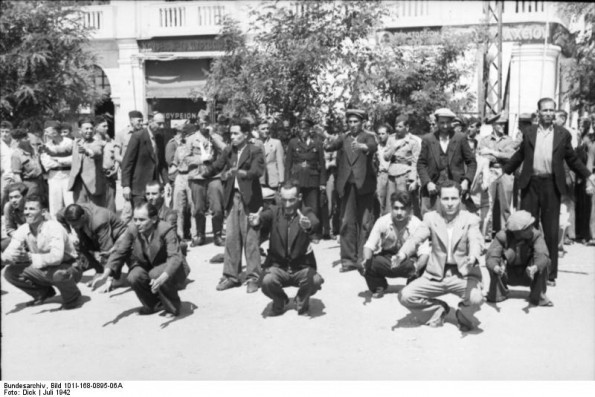
On 11 July 1942, 9,000 Jewish men between the ages of 10-45 were ordered to assemble at Liberty Square in Thessaloniki, where they were humiliated all day in the blazing heat. The event became known as "Black Saturday".
After negotiating with the German Army administration in Macedonia, the Jewish community managed to have the young men released, in exchange for a ransom. Some of the money was collected in Thessaloniki and Athens, and the rest was raised by the sale of the 500-year-old Jewish cemetery to the Municipality.
The cemetery was destroyed, and the tombstones were used as building materials. Some 2,000 Jewish men who were arrested on Black Saturday were sent to forced labor for the German Army. By October 1942, 250 of them had perished due to the harsh conditions.
In February 1943, the Jews of Thessaloniki were given less than a month to move into a ghetto established in the Baron Hirsch quarter, and almost all their property was confiscated. Deportations began in March, and by August, almost all had been deported and murdered at Auschwitz and Treblinka.
Some 54,000 of the approximately 56,000 Jews living in Thessaloniki were murdered in the Holocaust.
In my book 'The Walls Have Ears', I reveal one of the most remarkable secrets of the Second World War.
British intelligence secretly bugged high ranking German generals and officers at luxurious country houses, where hidden microphones captured their unguarded conversations.
The German-Jewish refugees who listened in, known as the 'secret listeners', played a vital part in shortening the war.
Their story remained hidden for over sixty years: https://t.co/Ninlx22p09