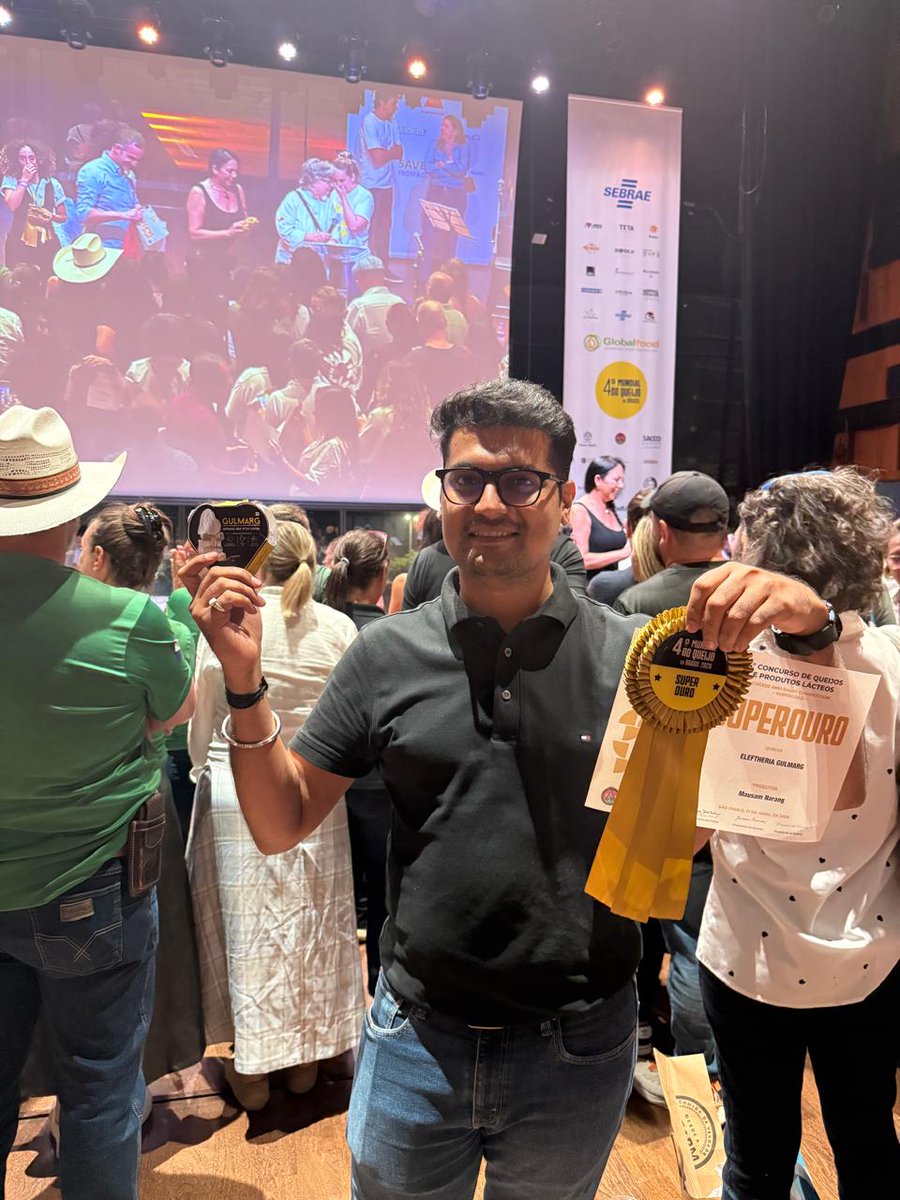
At the 4th Cheese World Cup in Brazil. 30 countries, 2,700 cheeses, 350 judges. India came home with 4 medals.
- Super Gold - Gulmarg (Eleftheria Cheese)
- Gold - Brunost (Eleftheria Cheese)
- Gold - Yak Churpi (soft)
- Silver - Kaali Miri (Eleftheria Cheese)
So happy & proud.
Don't bookmark this. Actually read it.
Your skin isn't a skin problem.
Every Indian woman walking into a dermatologist right now has:
→ Jawline acne at 30
→ Pigmentation on her upper lip
→ Dark circles that don't go away
→ Dull, tired skin
→ Hair fall for 18 months straight
She's spent ₹50,000+ on creams, serums, facials, and treatments.
None of it works because none of it is a skin problem.
Here's what your skin is actually telling you:
A Soviet psychologist walked into a café in 1927 and watched a waiter do something impossible.
He remembered every open order at every table. Perfectly. Without notes. Without effort.
Then a table paid their bill. She asked him to repeat the order.
He couldn't remember a single item.
She spent the next two years figuring out why. What she found is now the operating system underneath every platform fighting for your attention.
Her name was Bluma Zeigarnik, and she was a graduate student at the time, sitting with her professor Kurt Lewin, watching the waiters work the room. What caught her attention was something so ordinary that it had been happening in restaurants for centuries without anyone asking why.
The waiters could remember every open order with perfect accuracy. Table four wanted the schnitzel with no sauce. Table seven had changed their wine twice. Table twelve owed for three coffees and a dessert. Every detail, held without effort, without notes, without any visible system at all.
But the moment a table paid their bill, the information vanished. Completely. Lewin tested it on the spot. He called a waiter back minutes after a table had settled up and asked him to recite the order. The waiter could not do it. Not partially. Not approximately. The information was simply gone.
Zeigarnik went back to her lab and spent the next two years turning that observation into one of the most replicated findings in the history of psychology.
Here is what she proved, and why it changes how you think about attention, memory, and almost every piece of media you have ever consumed.
She gave participants a series of tasks. Some tasks they were allowed to finish. Others were interrupted before completion. Then she tested recall across both groups.
The unfinished tasks were remembered at nearly twice the rate of the completed ones.
Not slightly better. Nearly twice. The brain was holding the incomplete work in a state of active tension, returning to it, keeping it warm, refusing to file it away. The finished tasks were closed, archived, released. The unfinished ones were still running.
She called it the resumption goal. When the brain commits to a task and cannot complete it, it opens a file that stays open until resolution arrives. That open file consumes a portion of your cognitive bandwidth whether you are thinking about it consciously or not. It surfaces in idle moments. It pulls at the edge of your attention during other work. It is the thing you find yourself thinking about in the shower when you were not trying to think about anything at all.
This is not a flaw in human cognition. It is a feature. The brain evolved to finish things. An open loop is a signal that something important is unresolved. Keeping that signal active increases the probability that you will return to it and complete it. In an environment where most tasks had real survival stakes, this was an extraordinarily useful mechanism.
In the modern world, it is the most exploited vulnerability in human attention.
Netflix did not invent the cliffhanger. But it industrialized it in a way no medium before it ever had. When a show ends on an unresolved question, it does not just create curiosity. It opens a file in your brain that stays active until the next episode closes it. The autoplay countdown that begins at 15 seconds is not a convenience feature. It is a precise calculation about how long the average person can tolerate an open loop before the discomfort of not knowing overrides every other intention they had for the evening. One more episode is not a choice. It is your brain doing exactly what it was designed to do: return to what is unfinished.
The writers who built Lost, Breaking Bad, and Succession understood this intuitively without ever reading a psychology paper. Every episode ended on an open question. Every season finale answered three things and opened five more. The entire architecture of prestige television is a Zeigarnik machine running at industrial scale.
But television is not where this gets dangerous.
Every notification on your phone is an open loop. Every unread email is an open loop. Every task you wrote on a list and have not yet crossed off is an open loop. Each one is consuming a small but real portion of your available attention, pulling fractionally at your focus, degrading your capacity to be fully present in whatever you are actually doing right now. TikTok's algorithm does not just serve you content you like. It serves you content that ends one loop and immediately opens another, keeping the resumption system permanently activated so the cost of stopping always feels higher than the cost of continuing.
The research on this accumulation effect is striking. Psychologists studying cognitive load have found that unfinished tasks do not sit passively in memory. They actively interrupt. They surface at the wrong moments. They are the reason you are reading something and suddenly remember an email you forgot to send. The brain is not malfunctioning. It is running its resumption system exactly as designed. It is just running it across forty open loops simultaneously, in an environment that generates new ones faster than any human nervous system was built to process.
The most important practical implication Zeigarnik's research produced is one that most people use backwards.
David Allen built his entire Getting Things Done system on the insight that the only way to close a cognitive open loop is to either complete the task or make a trusted commitment to complete it later. Writing something down in a system you actually trust has the same effect on the brain as finishing it. The file closes. The bandwidth is released. This is why writing a task down feels like relief even before you have done anything about it. You have not solved the problem. You have simply told your brain that the loop is registered and will be returned to, which is enough for the resumption system to stand down.
The inverse is equally true and far more destructive. Every task that lives only in your head, unwritten and unscheduled, is an open loop burning cognitive resources around the clock. The mental cost is not proportional to the size of the task. A tiny nagging obligation consumes the same active tension as a major project. Your brain does not discriminate by importance. It discriminates by completion.
Zeigarnik published her findings in 1927. The paper sat in academic literature for decades before anyone outside psychology paid attention to it.
Then television got good. Then the smartphone arrived. Then the entire attention economy was engineered, largely by people who understood intuitively what she had proven scientifically: an open loop is the most powerful hook available to anyone who wants to hold human attention.
Netflix knew it. Instagram knew it. Every designer who ever made a notification badge red instead of grey knew it.
The café in Vienna is long gone.
The mechanism she discovered there is now the operating system underneath every platform fighting for your time.
Every "to be continued."
Every unread notification.
Every thread that ends with "part 2 tomorrow."
All of it is the same waiter, the same unpaid bill, the same brain refusing to let go of what it has not yet finished.
Zeigarnik noticed it over coffee in 1927.
A century later, it is the most valuable insight in the history of media.
And nobody taught it to you in school.
Pakistan’s contribution to Global Peace:
1. Mumbai 26/11 Attacks 2008
2. Pahalgam Terror Attack 2025
3. Pulwama Terror Attack 2019
4. Uri Terror Attack 2016
5. Nagrota Attack 2016
6. Pathankot Terror Attack 2016
7. Indian Parliament Attack 2001
Never Forget.
Never Forgive.
I've always considered Ranveer Singh an extremely overrated and subpar actor. The only movie of his that I genuinely liked was Lootera , and that, I suspected, had more to do with Vikramaditya Motwane than the man himself. I was perpetually baffled at how the world fell over itself praising his performances in forgettable spectacles like Bajirao Mastani, Ram Leela, and the oh-so-terrible Padmavat.
Somehow, and I'm no expert, I have never been a fan of verbose acting. I firmly believe verbose acting is the acting of the most basic kind. It's the dialogue that's doing the heavy lifting; the actor is merely a vessel. And Ranveer Singh was the undisputed king of this school. Loud dialogues delivered even louder, "Yahi naa Nizam ji…"; "Allah Ke Banai Har Nayab Cheez Par…" The sheer decibels were exhausting.
Acting, again in my humble opinion, should live in the margins, in mannerisms, in internality, in expressions, in eyes, in the sudden tilt of a head, in the quiet storm behind a face. Dialogues don't carry great actors; great actors carry dialogues. So, I was firmly convinced that Ranveer Singh was a non-actor universally coronated as a great one, because these, unfortunately, are the times of mediocrity.
And then there was his clownish behaviour offscreen, the bizarre dressing, the wild expressions, and that perennial trying-to-please-everyone laugh cemented onto his face like a mask he couldn't remove. Worse, he seemed incapable of leaving that circus at the door. It bled into his performances, raw and unfiltered , as is painfully visible in Ram Leela, Simmba, and Rocky Aur Rani Kii Prem Kahaani.
So here I was, a man with a settled verdict: Ranveer Singh is a horrible actor. Case closed.
This was until #Dhurandhar.
I am now eating every last one of my words, and they do not taste good. Because it turns out my eyes had never truly seen the actor. #RanveerSingh isn't just good, he is a powerhouse, a revelation, perhaps the greatest mainstream actor of his generation. Yes, miles ahead of Ranbir Kapoor. One can easily refute my sudden conversion by pointing out that it's the director who truly makes actors act. I will humbly concede. But then, look at #SanjayDutt in the same film. He was playing himself across both instalments , Chaudhary Aslam, nothing more than a loud caricature of his own off-screen personality. The director cannot conjure what isn't there. So, the credit must go to Ranveer Singh.
Ranveer as Hamza Ali Mazari in Dharanidhar, Part 1 is cold, calculating, cunning, and lethal. He operates in the shadows. He barely speaks; his eyes carry the full weight of the character. And when he does speak, it is never high-decibel, never performative. His dialogues, barring the quietly devastating "Ghayal, Ghatak", are almost forgettable, and yet the character is impossible to shake. It reminded me of Al Pacino's Michael Corleone, a man of few clapworthy lines, but whose presence alone is arguably the single greatest achievement in cinematic history.
In #Dhurandhar2, Ranveer Singh is a force of nature. Hamza Ali Mazari is still clever, but now he is unhinged, the leash is off. And as Jaskirat Singh Rangi, Ranveer peels back every layer: broken, vulnerable, achingly gullible. You feel the wound. And when Jaskirat finds his outlet through Hamza, you don't just understand his rage, you share it.
#AdityaDhar has done something extraordinary with this film. He has not merely directed Ranveer Singh; he has liberated him. The old Ranveer was a man straining to fit into a shape that was never his. This, this cold fire, this controlled devastation, is what he truly is. And perhaps Ranveer knows it too. That's why he wiped his Instagram clean, leaving nothing behind except Dhurandhar. No clown. No costume. Just the work.
He knows he has arrived.
And now, his reign begins.
Millions of you have watched #DhurandharTheRevenge and yet nobody seems to be talking about this gentleman Altaf Hussain! Baccha Hai Tu Mera, Pehchaan toh Le Mere Bachhe! Aa tujhe Fanta Pilaun! 🤣