I am honestly disappointed with a lot of investors and popular accounts.
They clearly didn't do their homework on $CBRS and were talking absolute rubbish.
Let me clear this out.
1. Insider selling:
The claim that the CEO sold 99.8% of his shares is flat wrong.
Class A is what you and I trade. Class B is what founders hold, and it only converts to Class A when they sell.
So the CEO shows just 17,659 Class A shares but still holds ~13.9M Class B. Did people actually read the second table?
Since the IPO, insiders sold ~$400M, under 1% of the company. About 80% was pre-planned sales of old options bought at $1-8, and the rest came from VC board members and forced tax sales.
Stake each still holds
- CEO Feldman ~98%
- CFO Komin ~97%
- CTO Lie ~87%
- COO Mallick ~50%, the only outlier
The real short-term scare is the lockup, with ~39M shares (~16%) unlocking on Oct 14 and Oct 28.
These are old shares that can now trade, not new ones. That's pressure on the stock, not dilution.
2. $NVDA competition:
People are saying Nvidia just launched OpenAI's "Ultrafast" mode on Blackwell, so Cerebras is done. That's not the whole picture. Every AI chip trades speed against volume.
Nvidia wins on volume. One GPU holds 288GB of memory, so it serves lots of users at once, the cheapest way to run big models for the masses.
The catch with $NVDA is speed. Its memory sits next to the chip, not on it, so every token has to travel back and forth. To go fast anyway, Nvidia runs each GPU with only a few users, which wastes most of the chip. That's why Ultrafast costs 6x the normal price and still tops out around ~300 tokens/sec.
Cerebras wins on speed per user. The whole model sits on the chip, and data moves thousands of times faster (21 PB/s vs ~8 TB/s on a GPU). Cerebras ran OpenAI's Ultrafast at 750 tokens/sec in August, on a smaller model, and the new CS-4 does 4,400+.
The catch with $CBRS is memory and bandwidth. Each wafer holds 44GB, so big models get split across many wafers that talk to each other slowly, about a sixth of one Nvidia GPU.
That's likely part of why the new tier went to Nvidia. But CS-4 links wafers 6x faster per rack, and more memory is coming. And speed is where a lot of the demand is heading, not just scale. AI agents work for one user or one task at a time, and every second they wait is lost work. Companies will happily pay for that.
That's why $AMZN and $AMD pair Cerebras with their own chips instead of replacing it. Theirs reads the question, and Cerebras writes the answer.
3. OpenAI and concentration:
Yes, OpenAI is the biggest customer, with a $20B+ deal through 2028 and about a third of last quarter's revenue.
One launch on Nvidia doesn't cancel a multi-year contract though. And the list is growing with Amazon, AMD, $META, Mistral, Perplexity, Cognition, $CRWD and more.
Wall Street already expects ~$3B of revenue and the first real profit in 2027, then ~$7.5B of revenue and ~$3B of free cash in 2028, with ~60% gross margins long term.
4. The $450M loss:
$377M was stock comp, and $274M of that was a one-time IPO catch-up. It's non-cash, and without it the business lost only ~$7M.
Stock comp keeps engineers from leaving for Nvidia, OpenAI or Google, and should run ~$100M+ per quarter until ~2028. The cost is dilution from new grants, roughly 1-2% a year, not cash.
Where I land:
Long term, Cerebras owns a specific job in the AI stack that gets more valuable as demand for fast AI grows.
I'd love to see more chip sales, since ~61% of revenue is cloud today, plus the memory and bandwidth upgrades.
The risks are real, but none of those break the story.
- OpenAI is most of the backlog today, but it won't stay the only big customer.
- Nvidia could get "fast enough" with the Groq technology it licensed, but the market is too big for just one winner.
- Dilution is real, and the lockup plus Q3 earnings could bring short-term volatility.
Do your homework before you panic.
Not financial advice.
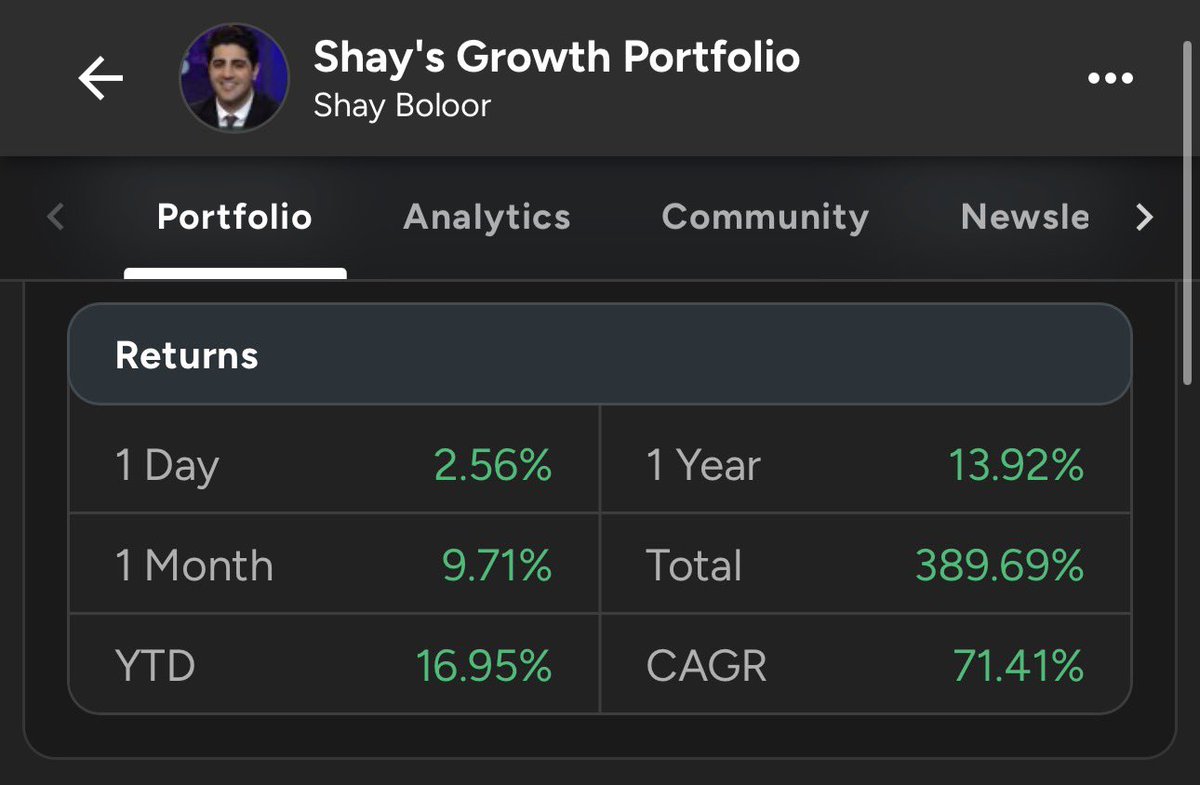
TOP 5 POSITIONS IN MY GROWTH PORTFOLIO
1. $SITM supplying precision timing chips that keep faster AI networks synchronized
2. $AEHR testing powerful AI chips before they reach deployment
3. $CRDO moving data faster between chips & servers inside AI data centers
4. $RKLB creating a vertically integrated space platform across rockets, satellites, components & defense
5. $FPS delivering customized power equipment faster to get AI data centers online sooner
$BLLN: I think I found my next >20 bagger
Many of you know that I’m a very concentrated investor.
I went very heavy into $HIMS at $6-12 and then shortly thereafter into $IREN sub $5, with an average price of about $7.50.
Today, I’m still pretty much all-in $IREN since I think the stock has yet to reach its full potential, with plenty of gains still to be had.
That said, I’m always on the lookout for my next big “bet,” which prompted me to launch our Radar Report series on Substack and X.
The goal of the series is to explore stocks that are still flying under the radar and figure out whether any of them have a realistic chance of becoming major multibaggers.
The stocks I’ve deep dived on so far as part of the series:
$GROY / $REAX / $PGY / $SLDE / $BLLN
I might end up investing in each one of those in the future given their potential, but the one I’m most excited about is $BLLN, the most recent company we covered in a new Radar Report released yesterday.
There are certain companies that eventually become almost synonymous with the industry they dominate. Electric cars make people think of $TSLA, smartphones of $AAPL, while $NVDA has become the defining name in AI hardware.
I think early cancer detection could eventually have a name attached to it as well, and from everything I have seen so far, BillionToOne has a serious chance of becoming that company.
Before I explain why, this is not one of those biotech moonshots that spends hundreds of millions of dollars every year hoping that one experimental drug eventually makes it through clinical trials.
$BLLN is already a profitable diagnostics company with an established prenatal business, 22 consecutive quarters of revenue growth and another major business in oncology that is still in the early stages of scaling.
The technology behind all of this came from founders Oguzhan Atay and David Tsao, both of whom distinguished themselves at Princeton before pursuing doctoral work at Stanford and Rice. What they eventually built is surprisingly elegant for something that solves such a difficult problem.
Genetic testing requires DNA to be copied before it can be properly analyzed, yet that copying process distorts the original quantities because some fragments get duplicated more than others.
$BLLN figured out a way to measure that distortion and mathematically subtract it afterward, allowing the company to count incredibly small quantities of DNA with a level of precision that conventional methods struggle to achieve.
That sounds more complicated than it actually is in practice, and we break the mechanism down much more clearly in the full report.
In any case, the same basic idea is now being applied across several completely different markets.
$BLLN started in prenatal testing because it offered the quickest route to an established business.
Its UNITY platform can use an ordinary blood draw from the mother to screen the baby for genetic conditions that competing prenatal tests either cannot detect directly or struggle to detect with the same approach, which helped the company build its way to roughly 20% of pregnancies that actually undergo prenatal screening in the US.
The company then took essentially the same technology into oncology, because tumor DNA floating through a cancer patient’s bloodstream presents a very similar problem. The signal is tiny, surrounded by an enormous amount of normal DNA, yet finding and accurately measuring that signal can tell an oncologist which mutations are driving the cancer and whether a treatment is actually working.
The next step is MRD, or minimal residual disease, where $BLLN wants to detect microscopic traces of cancer left behind after surgery before they grow large enough to become visible on a scan. That product is expected to launch around the end of this year and moves the company one step closer to the market I find most interesting of all.
Early cancer detection.
Cancer would be a very different problem if a routine blood test could find a tumor while it was still at stage 1, when it is small, localized and in many cases still removable through surgery. The problem today is that these tumors shed almost no DNA into the bloodstream, while a screening test used on millions of healthy people also needs to avoid false alarms with extraordinary accuracy.
Nobody has properly solved both sides of that equation yet...
There is obviously a lot more to the story than what I’ve laid out here. In the full Radar Report, I go much deeper into the technology, business model, competitive landscape, regulatory environment, risks, valuation and the different markets $BLLN is ultimately trying to attack.
After spending the last few weeks researching the company from pretty much every angle I could think of, I genuinely believe this could become a >$100B company over time. At a market cap of ~$5B today, the potential upside for shareholders is enormous if that thesis proves right.
I’m not personally invested yet, since most of my capital remains concentrated in $IREN and I still think there is a major re-rating ahead there. But once that happens, $BLLN is currently the company I’m most seriously considering for my next major position.
If I eventually make that move, I’ll start covering the company on an ongoing basis, both publicly here on X and in considerably more depth for subscribers.
The full Radar Report, BLLN: Genomic’s Disruptive Dark Horse, is available to all X subscribers and Advanced+ subscribers on Substack.
Links to the full report in the comments below.
Wishing you all a great weekend! ✌️