Elon Musk just put a price tag on obedience. It costs $200,000.
Musk: “You don’t need college to learn stuff. Everything is available basically for free. You can learn anything you want for free.”
Every lecture. Every textbook. Every framework ever written. Free on any screen in any country right now. The entire knowledge monopoly collapsed in a decade. Nobody updated the price tag.
Musk: “Colleges are basically for fun and to prove you can do your chores. But they’re not for learning.”
Strip the ivy and the branding. What’s underneath is a four-year obedience trial. Can this person follow instructions on a schedule without asking why.
Musk: “There is a value that colleges have, which is seeing whether somebody can work hard at something, including a bunch of annoying homework assignments, and still do their homework assignments.”
That is the entire six-figure value proposition. Not what you know. Not what you can build. Whether you can be managed. The establishment doesn’t need you educated. It needs you domesticated.
Musk: “If you’re trying to do something exceptional, you must have evidence of exceptional ability. I don’t consider going to college evidence of exceptional ability.”
The system doesn’t produce exceptional. It produces manageable. It takes the most creative years of your life and teaches you to wait for instructions. That is not education. That is containment.
Musk: “Gates is a pretty smart guy, he dropped out. Jobs is pretty smart, he dropped out. Larry Ellison, smart guy, he dropped out.”
They didn’t leave because they couldn’t keep up. They left because the ceiling was underground.
8 billion people now carry the same library in their pocket. The one these institutions charged a lifetime of debt to access.
The only product the university still sells is the belief that you need one.
Today, Valar Atomics became the first nuclear startup to make electricity, and we did it by powering an NVIDIA Spark.
This is the first meeting of advanced nuclear and AI; two technologies which will transform the next century.
But that’s only the start of our collaboration.
.@valaratomics just made history by becoming the first startup to power an NVIDIA Blackwell with a nuclear reactor.
Watch the full conversation as @saranormous joins founder and CEO @isaiah_p_taylor at the Utah San Rafael Energy Lab, home to the Ward 250 microreactor.
Valar Atomics Inc., a California-based nuclear startup, generated power from an advanced reactor to run an Nvidia Corp. AI chip. While just a trickle of electricity was produced, it’s the first time a next-gen reactor has done so in the US. https://t.co/o0GVid1rgz
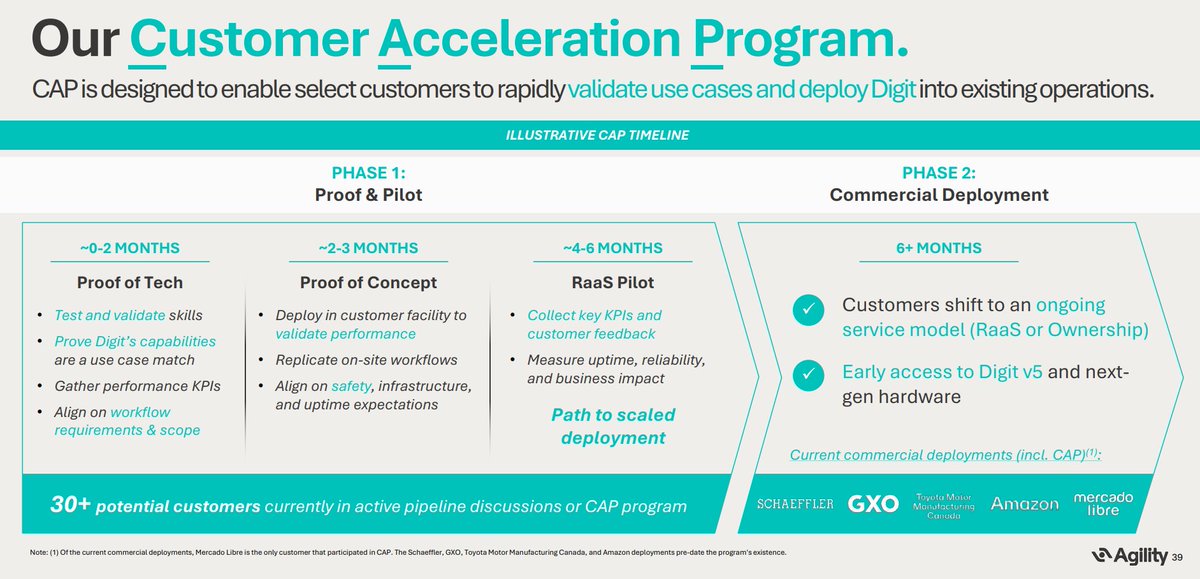
The hype train just hit reality. For the first time ever, you can buy shares in a walking, working humanoid robot company.
On June 24, 2026, Agility Robotics announced a definitive merger agreement with special purpose acquisition company $CCXI (Churchill Capital Corp XI).
The deal will take the company public on the Nasdaq under the ticker $AGLT.
The transaction is expected to close in the second half of 2026, subject to SEC and shareholder approvals.
This marks the historic first debut of a pure-play humanoid robotics company on the U.S. stock market.
Stripped of the usual AI marketing noise, here is a cold, financial and technological breakdown of the industry's first true public market test:
1. Deal Structure & Redemption Risks
> Pre-money Equity Value: $2.5 billion.
> Capital Infusion:
Total gross proceeds of over $620 million ($420 million from $CCXI’s trust account + $200 million via a private placement (PIPE) priced at $10.00 per share).
> Key Players:
The PIPE round is anchored by manufacturing titan #Foxconn.
Existing strategic backers, including #Amazon, #SoftBank (Vision Fund 2), and #GXO Logistics, are rolling 100% of their equity into the combined company and are bound by a 180-day lock-up agreement.
> Financial Safeguard:
The deal includes a minimum cash condition of $200 million.
This structural floor protects the company against high redemption rates from SPAC shareholders = a historical pain point for late-stage tech mergers.
At the current burn rate, this capital injection secures a stable operational runway of 24 to 30 months.
2. Unit Economics & Technical Guardrails
While competitors rely heavily on edited video demonstrations, Agility is anchoring its valuation on verified operational metrics from its signature bipedal robot, Digit:
> Commercial Traction:
Over 65,000 hours of real-world commercial work logged across customer deployments (including facilities owned by $AMZN Amazon, $GXO GXO Logistics, $TM Toyota, and $SHA0.DE Schaeffler).
> Narrow Specialization:
It is crucial to temper expectations - the upcoming Digit v5 is not a general-purpose artificial agent.
It is a highly specialized logistics asset built for repetitive tote-flipping and tote-handling.
It operates within predefined industrial workflows alongside human workers without safety cages.
> RaaS (Robotics-as-a-Service) Model:
Current commercial leasing rates for these bipedal units hover around $30 per hour.
> The Cost-to-Scale Target:
The current total operating cost (including maintenance, high-wear harmonic drive components, and battery cell depreciation) sits at roughly $10–$12 per hour.
Proceeds from the IPO will fund the mass scaling of their "Robofab" facility in Oregon, aiming to drive this operational cost down to a target of $2–$3 per hour.
> Sales Pipeline:
The company claims a backlog of multi-year commercial contracts and commitments valued at over $300 million, primarily tied to the deployment of the Digit v5 platform.
3. The Wall Street Outlook
CEO Peggy Johnson is leveraging the accelerated timeline of a SPAC merger to secure a capital and manufacturing lead over well-funded, private, or conglomerate-backed competition like #Tesla (Optimus) and #FigureAI.
However, public markets are notoriously unforgiving.
The company is in its pre-earnings infancy and operates with a steep net loss. Institutional investors will disregard traditional P/E ratios; instead, the stock will be priced on a forward-looking P/S (Price-to-Sales) multiple tied to hardware delivery milestones and net burn rate.
Given the inherent volatility of the SPAC structure, significant stock fluctuations are expected post-merger.
Wall Street has officially established its first direct barometer for the commercial viability of Physical AI.
What’s your take on the $AGLT debut? Is entering the public markets through a SPAC the right fuel to outrun the competition, or is it too early for retail investors to handle this level of hardware volatility?
🎁Bonus for those who made it to the end: $AGLT 3D LiDAR sensors supplied by $OUST.
Drop your thoughts below and let's discuss.
A TON OF THINGS HAPPENED IN THE STOCK MARKET TODAY.
Here's a full recap:
1. Palantir $PLTR and Nvidia $NVDA expanded their partnership to deliver sovereign AI for the U.S. government and critical infrastructure. The partnership combines Nvidia AI infrastructure and Nemotron models with Palantir’s platforms, allowing agencies to deploy models on proprietary data. Palantir CEO Alex Karp said: “Combining Palantir infrastructure with NVIDIA’s AI and Nemotron models will allow the U.S. government to unleash the full power of LLMs while removing the underlying security risks and rational concerns around proprietary insights migrating into the weights of closed models."
2. Rocket Lab $RKLB announced a definitive agreement to acquire Iridium $IRDM for $54/share in a cash-and-stock deal, implying an enterprise value of roughly $8B. This is a major move because it pushes Rocket Lab beyond space infrastructure and deeper into vertically integrated space communications with recurring, high-margin subscription revenue. Iridium adds a global satellite network, accelerates direct-to-device and space connectivity, and gives Rocket Lab the ability to design, build, launch, operate, and now monetize satellites through long-term communications services.
3. Robinhood $HOOD continues to show strong product momentum. Vlad Tenev, CEO, shared that Robinhood Banking has surpassed $3B in deposits and 200K customers, up from $1.6B and 110K at the end of March. Agentic trading has also seen 50K+ customers open accounts in its first few weeks, with millions of dollars traded daily across equities and options. Robinhood now has 50K+ funded custodial accounts just three months after launch, while 855K+ customers received allocation in the SpaceX IPO through IPO Access.
4. Hedge funds sold the most U.S. information technology equities in the week ending June 25 since Goldman’s data began in 2016, even more than during the August 2024 Nasdaq correction. Overall, hedge funds sold the most U.S. equities since the April 2025 “Liberation Day” selloff. Magnificent 7 exposure has also fallen to 14.5% of total U.S. hedge fund exposure, near a 3-year low, after dropping 7 percentage points since the start of 2026, the biggest six-month decline since the 2022 bear market.
5. Agility Robotics is going public via Churchill Capital Corp XI $CCXI in a deal valuing the humanoid robotics company at $2.5B pre-money. The transaction is expected to raise $620M+, including a $200M PIPE led by Foxconn, with the combined company set to trade as $AGLT. Agility says it has $300M+ in multi-year orders for its Digit v5 robot, with backers including Nvidia, Amazon, SoftBank, and Foxconn.
6. Google $GOOGL has reportedly capped Meta’s $META use of Gemini AI models due to computing capacity constraints, per Financial Times. The limits have affected some of Meta’s internal projects, with staff told to use AI tokens more efficiently. Meta had been using Gemini to automate safety workflows, but is now leaning more on its own Muse Spark model to reduce reliance on external AI models.
7. Micron $MU is now a top 10 holding in the S&P 500 with a 1.9% weighting, reflecting just how important memory has become in the AI trade. Meanwhile, Nvidia $NVDA has fallen from closer to 8.5% of the index to 6.99%, while Apple $AAPL has dropped from around 7.5% to 6.18%.
8. Anthropic reportedly renegotiated part of its Amazon deal, shifting Claude pricing from compute hours to token-based usage starting next year, per The Information. The change could raise $AMZN’s costs for using Claude across products like Alexa for Shopping, Kiro, and Quick. Amazon is now reportedly evaluating OpenAI and its own Nova models to reduce reliance on Anthropic.
9. The top 10 most active options today by contracts traded were $TSLA with 3.8M contracts, $NVDA with 2.9M contracts, $AMZN with 1.4M contracts, $AAPL with 1.1M contracts, $MSFT with 931K contracts, $MU with 767K contracts, $SPCX with 617K contracts, $INTC with 598K contracts, $MSTR with 533K contracts, and $GOOGL with 489K contracts.
10. ByteDance is targeting early next year to finalize the design of its next-gen in-house CPU for AI infrastructure, per SCMP. Mass production and broader deployment are expected in H2 2027, as ByteDance looks to support AI workloads across Doubao, Seedance, and other internal platforms. Qualcomm $QCOM is reportedly helping with development and foundry capacity.
11. South Korea unveiled a massive $576B+ AI and chip investment push, with Samsung and SK Hynix expected to invest around $518B. Suppliers will build two new chip fab sites each in southwest Korea, while the broader plan includes a $52.7B chip packaging cluster and a goal to double DRAM output within five years.
12. U.S. online spending across all retailers hit $26.4B during Amazon $AMZN Prime Day, topping Adobe’s $26.3B estimate. Spending rose 9.3% YoY, while BNPL accounted for 6.6% of orders. However, Numerator said average household spending on Amazon fell 8.3% to $143.
WALL STREET IS THE GREATEST SHOW ON EARTH.
$RKLB: Rocket Lab not competing against Starlink with Iridium deal, says Craig-Hallum
After Rocket Lab (RKLB) agreed to acquire Iridium (IRDM) in an $8B deal, Craig-Hallum said he believes that the notion that the move positions Rocket Lab to compete with SpaceX's (SPCX) Starlink is the "wrong take." Iridium's lower frequency L-band Spectrum by its physical nature has inherently lower throughput capacity, but also has an inherently more stable signal, propagating better through dense foliage and walls, the analyst tells investors in a research note. This means that instead of providing consumer broadband like Starlink, the services Iridium provides are ideally suited to the pros of their spectrum, including services like assured PNT, assured tactical comms, and low bandwidth internet-of-things use cases, the analyst adds. The firm noted that the fact that these markets are not ones Starlink is servicing is why Iridium has continued to grow despite the precipitous rise of Starlink.
Rocket Lab is acquiring Iridium Communications Inc – one of the most transformative deals in the space industry.
By combining our launch capability and satellite manufacturing with @IridiumComm’s global satellite communications network and rare spectrum, Rocket Lab becomes a fully integrated, self-launching, tier-1 space power, delivering critical communications capability to millions of users worldwide.
Full details and important information: https://t.co/hj5aWrDPjz
"The hotel, officially set to open its doors in 2027, will see robots occupy every hospitality role, including reception, room service, cleaning, food preparation and guest support."
Elon Musk has received regulatory approval to acquire startup Mesh Optical Technologies, a company founded by former SpaceX engineers working on optical data center communication technology.
Mesh is developing optical transceivers that rely on light to send and receive information between data centers, which the company says are more power efficient and lower latency than existing options. https://t.co/D7diyxpuHX
BREAKING: US May PCE inflation, the Fed's preferred inflation metric, rises to 4.1%, the highest reading since April 2023.
Core PCE inflation rose to 3.4%, its highest since October 2023.
US inflation is now officially running at more than double the Fed's 2.0% target.
Very interesting statement today: $MU CEO predicts a multi-decade memory demand cycle driven by humanoid robots.
"Humanoid robots, he says, will require roughly ten times more memory than today’s Level 2+ autonomous vehicles."
"And that demand wave is set to begin before the decade is out."
Something as well as was "Over time, we expect the value of on-device AI combined with pent-up unit replacement demand to drive memory demand growth"
Which is also another trend (Apple Intelligence is currently dog, but I'm sure we'll see innovations with localized/edge AI).
Feels like all the industry leaders from $TSM Chairman, $TSLA Elon Musk, to $MU CEO see humanoids as the next major trend so physical AI is probably next.
I wonder if the world is going to have enough memory. Or if we'll see enough breakthroughs to shrink memory usage.
Always amazing looking at $MU earnings:
Revenue: $41.46B vs. $35.8B est.
EPS: $25.11 vs. $20.78 est.
Forecasts:
Revenue: $49B to $51B, vs $43.24B est
EPS: $30.00 to $32.00, vs. $25.31.
“Micron said on Wednesday that it has signed 16 long-term agreements”
"When completed, we expect approximately half or more of our company revenue to be under these"
Looks like memory demand has become structural…
But great earnings to show up the AI trade is continuing to ramp up.