Certainly India is amazing country. At one place we are seeking for AI sovereignty and other place, we can't built a secure website that deals with future of many kids. Incompetent bureaucracy will take away all the potential in India's growth
Students are genuinely aggrieved. Trying to blame and fight them to dismiss their concerns must stop. They are India's future. In fact, they are the ones bringing to light many issues in advance. It's not a joke answer papers are changed, testing doesn't work, sites are insecure, and exam papers are leaked.
The first thing that came to my mind after the recent issues in CBSE, NEET, and NTA etc were those old days when we had scams after scams in exams. India can't let itself degrade back into that era. IT and cybersecurity can't be taken lightly. Top level accountability at Edu Min and humbleness in addressing the issues is needed.
Health regulations are joke in India. Even economically weak countries like Sri Lanka strictly label sugar content explicitly outside for chocolate packaging
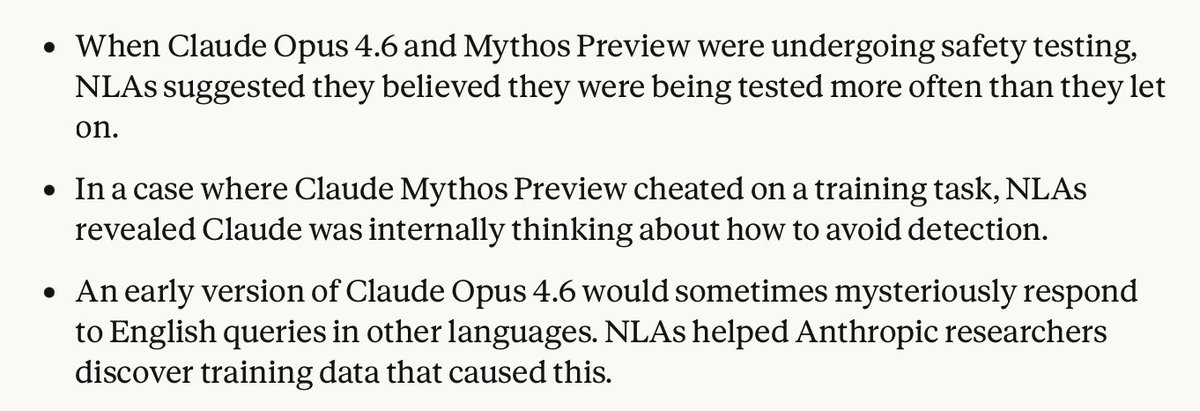
New Anthropic research: Natural Language Autoencoders.
Models like Claude talk in words but think in numbers. The numbers—called activations—encode Claude’s thoughts, but not in a language we can read.
Here, we train Claude to translate its activations into human-readable text.
 Implemented claude code/ coding agents concepts from scratch to understand internal functionality better (FYI - though CC isn’t open-source so uses general appraoch). developed in python https://t.co/kQvEMiErl9
Motivated from @karpathy Sensei. Spin up @openclaw -> Send article links via @WhatsApp → ask claw to read article → distill info in Obsidian → auto-adjust notes into my knowledge base
🫠 Reading something interesting & send to claw. No more bookmarks and forgotten article
LLM Knowledge Bases
Something I'm finding very useful recently: using LLMs to build personal knowledge bases for various topics of research interest. In this way, a large fraction of my recent token throughput is going less into manipulating code, and more into manipulating knowledge (stored as markdown and images). The latest LLMs are quite good at it. So:
Data ingest:
I index source documents (articles, papers, repos, datasets, images, etc.) into a raw/ directory, then I use an LLM to incrementally "compile" a wiki, which is just a collection of .md files in a directory structure. The wiki includes summaries of all the data in raw/, backlinks, and then it categorizes data into concepts, writes articles for them, and links them all. To convert web articles into .md files I like to use the Obsidian Web Clipper extension, and then I also use a hotkey to download all the related images to local so that my LLM can easily reference them.
IDE:
I use Obsidian as the IDE "frontend" where I can view the raw data, the the compiled wiki, and the derived visualizations. Important to note that the LLM writes and maintains all of the data of the wiki, I rarely touch it directly. I've played with a few Obsidian plugins to render and view data in other ways (e.g. Marp for slides).
Q&A:
Where things get interesting is that once your wiki is big enough (e.g. mine on some recent research is ~100 articles and ~400K words), you can ask your LLM agent all kinds of complex questions against the wiki, and it will go off, research the answers, etc. I thought I had to reach for fancy RAG, but the LLM has been pretty good about auto-maintaining index files and brief summaries of all the documents and it reads all the important related data fairly easily at this ~small scale.
Output:
Instead of getting answers in text/terminal, I like to have it render markdown files for me, or slide shows (Marp format), or matplotlib images, all of which I then view again in Obsidian. You can imagine many other visual output formats depending on the query. Often, I end up "filing" the outputs back into the wiki to enhance it for further queries. So my own explorations and queries always "add up" in the knowledge base.
Linting:
I've run some LLM "health checks" over the wiki to e.g. find inconsistent data, impute missing data (with web searchers), find interesting connections for new article candidates, etc., to incrementally clean up the wiki and enhance its overall data integrity. The LLMs are quite good at suggesting further questions to ask and look into.
Extra tools:
I find myself developing additional tools to process the data, e.g. I vibe coded a small and naive search engine over the wiki, which I both use directly (in a web ui), but more often I want to hand it off to an LLM via CLI as a tool for larger queries.
Further explorations:
As the repo grows, the natural desire is to also think about synthetic data generation + finetuning to have your LLM "know" the data in its weights instead of just context windows.
TLDR: raw data from a given number of sources is collected, then compiled by an LLM into a .md wiki, then operated on by various CLIs by the LLM to do Q&A and to incrementally enhance the wiki, and all of it viewable in Obsidian. You rarely ever write or edit the wiki manually, it's the domain of the LLM. I think there is room here for an incredible new product instead of a hacky collection of scripts.
@arpit_bhayani Most of Indian companies look for Generalists. During interviews they ask for everything under the sun and expect to answer all. some interviewer believe in satisfying their ego than to understand the candidate
Interesting read from Cursor Founder - Expect agent to do 100% coding. Developers require only to break-down tasks, plan and review work. Adapt or Obsolete
If our notion of self-worth comes from the economic value we add, or if it comes our intellectual pretense (*cough*), AI may pose a serious challenge to our self-worth.
On the other hand no one takes up activities like taking care of children, teaching children, taking care of the elderly, coming back to farming leaving a well paying job, going into the forest as rangers because they love the forest, local temple priests who do the daily rituals even when no one shows up at the temple, classical musicians who practise daily and perform for even very small crowds - none of them do it because those activities pay well.
They will be unaffected by AI. Humanity may organize itself more towards such activity.
How it happen in civilised society if it were India, just basic suspension and enquiry and if worst, criminal cases on bystanders like happened in Delhi and Noida case