Las inteligencias artificiales no viven una experiencia, no poseen un cuerpo, no pasan por la alegría y el dolor, no maduran en las relaciones ni conocen desde dentro lo que significan el amor, el trabajo, la amistad y la responsabilidad. Tampoco tienen una conciencia moral: no juzgan el bien y el mal, no captan el sentido último de las situaciones ni asumen el peso de las consecuencias. Pueden imitar, pueden simular pero no conocen lo que producen, porque no residen en el horizonte afectivo, relacional y espiritual en el que el ser humano se hace sabio. #MagnificaHumanitas
>>> Qwen3-Coder is here! ✅
We’re releasing Qwen3-Coder-480B-A35B-Instruct, our most powerful open agentic code model to date. This 480B-parameter Mixture-of-Experts model (35B active) natively supports 256K context and scales to 1M context with extrapolation. It achieves top-tier performance across multiple agentic coding benchmarks among open models, including SWE-bench-Verified!!! 🚀
Alongside the model, we're also open-sourcing a command-line tool for agentic coding: Qwen Code. Forked from Gemini Code, it includes custom prompts and function call protocols to fully unlock Qwen3-Coder’s capabilities. Qwen3-Coder works seamlessly with the community’s best developer tools. As a foundation model, we hope it can be used anywhere across the digital world — Agentic Coding in the World!
💬 Chat: https://t.co/V7RmqMaVNZ
📚 Blog: https://t.co/syL1hsSGKq
🤗 Model: https://t.co/1LWwUKMrBN
🤖 Qwen Code: https://t.co/qqwj5nAO3Z
Una banda de rock está en plena actuación y ven a un chaval con una pancarta pidiendo tocar con ellos. El cantante le pregunta:
- ¿Sabes tocar la guitarra, de verdad?
- Sí.
- ¿Cuál es tu banda favorita?
- Guns N' Roses
Le invitan a subir. Lo que ocurre después es maravilloso
🚨🚨🚨🚨
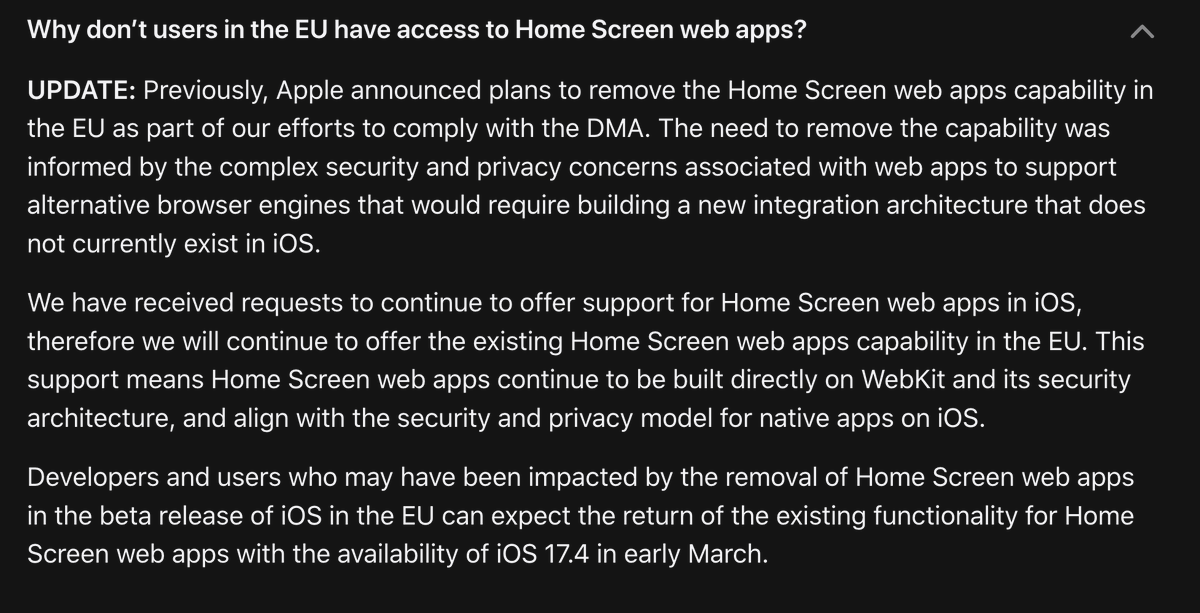
Apple will NOT remove PWA support on iOS
🥳🥳🥳🥳
👉This is an official statement form Apple that replaced today the previous excuses published around the removal.
We did it, folks!
i love you all.
today was a weird experience in many ways. but one unexpected one is that it has been sorta like reading your own eulogy while you’re still alive. the outpouring of love is awesome.
one takeaway: go tell your friends how great you think they are.
This is one major reason I hate the backend/frontend split on teams.
The argument was that I was adding "tech debt" to the backend when we already had "APIs for this data".
The absolute disaster of fetches and joining all the REST fetches together into a data set I could use was not even on his radar as "tech debt" but it was far worse than a couple backend queries. He also had no concept of the effect on UX.
What makes it even worse is they just look at the frontend disaster and think "pfft, JS sucks" when it was their fault the frontend had to be that way!
The backend/frontend split keeps people from making better tradeoffs, and the backend team usually wins arguments just because.
Story Points don't work.
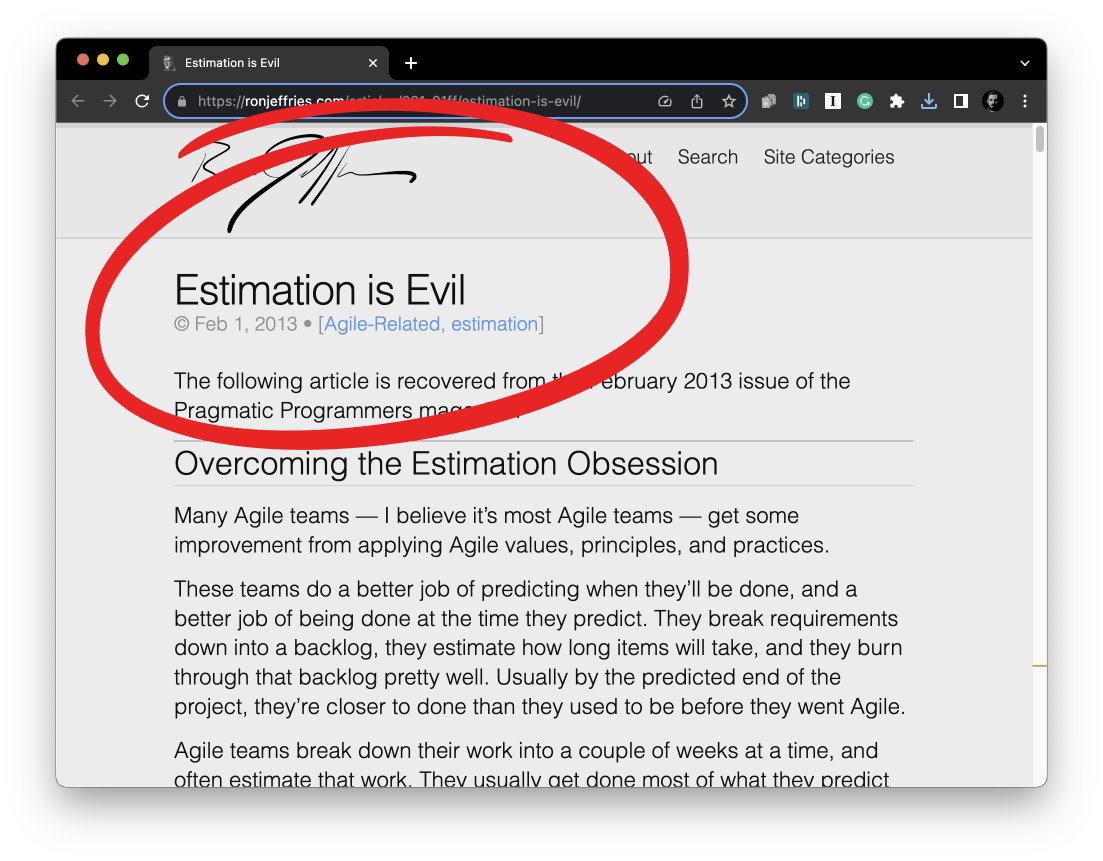
Even Ron Jeffries, who invented them, said he was sorry years ago.
And not only did he apologize, but he called the whole estimation idea "Evil."
Unfortunately, too many teams still use these points to estimate their work.
Story Points is a made-up metric to estimate work effort, not time. The goal was to prevent management from misusing estimates.
But it didn't work.
Every team I've ever met keeps a conversion table to translate back and forth between points and time. Some will never admit it, but go and talk to the folks doing the work.
Look at me and tell me I'm wrong.
But it gets worse:
Teams use points to decide how much work they can finish. But how can they do that without talking about time?
The effort to do something is not the same as the time it will take to finish it. This is especially true when planning an iteration with many people and tasks.
It's clear now: Story Points don't work.
What's the alternative?
I'll let the people who manage projects for a living offer their alternatives, but I can tell you what I've done.
As I got older and wiser, I stopped with the estimation charade altogether. I had my teams focus on short iterations with constant feedback from stakeholders.
From the "scope, budget, and time" triangle, I always tried to keep two of them variable and fix the third one.
If the customer was looking for a specific scope, we had a variable timeline and budget to finish it. We kept the scope and time flexible if the budget was non-negotiable. And if we had to deliver by a specific date, the scope and budget were on the table.
Every company is different, and this doesn't work for everyone. But if it does, I hope you stop the charade.
I'd love to hear about your experience estimating software. What crazy things does your company make you do?
I wrote, "Scrum is a cancer," and the Internet had thoughts about it.
After 3,400 replies, I learned a few things:
First, the most common jobs among the people who told me I was wrong were "Agile Coach" and "Scrum Master." They feel very strongly in favor of Scrum, but I'm not sure why.
Second, Scrum can't fail because Scrum is whatever you want Scrum to be. There's no right way to do Scrum, so if it doesn't work for you, you aren't as bright as you thought you were.
Third, Scrum isn't agile, except when it is. But it's much better than Waterfall, except when it isn't. And it's better than nothing and everything at the same time.
Fourth, many people got triggered by my comparison of Scrum and communism. They say communism is great but recognize they have never lived in a communist society. They keep mentioning this book they read and how every person who shed blood under communism was "doing communism wrong."
Finally, by far, most people hate Scrum with passion.
No matter how you look at it, Scrum is a failure.
Scrum is a cancer.
I've been writing software for 25 years, and nothing renders a software team useless like Scrum does.
Some anecdotes:
1. They tried to convince me that Poker is a planning tool, not a game.
2. If you want to be more efficient, you must add process, not remove it. They had us attending the "ceremonies," a fancy name for a buttload of meetings: stand-ups, groomings, planning, retrospectives, and Scrum of Scrums. We spent more time talking than doing.
3. We prohibited laptops in meetings. We had to stand. We passed a ball around to keep everyone paying attention.
4. We spent more time estimating story points than writing software. Story points measure complexity, not time, but we had to decide how many story points fit in a sprint.
5. I had to use t-shirt sizes to estimate software.
6. We measured how much it cost to deliver one story point and then wrote contracts where clients paid for a package of "500 story points."
7. Management lost it when they found that 500 story points in one project weren't the same as 500 story points on another project. We had many meetings to fix this.
8. Imagine having a manager, a scrum master, a product owner, and a tech lead. You had to answer to all of them and none simultaneously.
9. We paid people who told us whether we were "burning down points" fast enough. Weren't story points about complexity instead of time? Never mind.
I believe in Agile, but this ain't agile.
We brought professional Scrum trainers. We paid people from our team to get certified. We tried Scrum this way and that other way. We spent years doing it.
The result was always the same: It didn't work.
Scrum is a cancer that will eat your development team. Scrum is not for developers; it's another tool for managers to feel they are in control.
But the best about Scrum are those who look you in the eye and tell you: "If it doesn't work for you, you are doing it wrong. Scrum is anything that works for your team."
Sure it is.