A Chicago philosopher wrote one book in 1940 proving that 95% of the books you have read in your life, you didn't actually read, and Charlie Munger has been telling people to read it for 50 years.
His name was Mortimer Adler.
He spent 40 years at the University of Chicago, ran the editorial board of the Encyclopædia Britannica, and built his entire career on one uncomfortable observation about the people around him.
Most adults who called themselves well-read had not actually read a book in the real sense even once. They had run their eyes over the pages, registered the words, formed a vague impression, and put it back on the shelf.
The book had passed through them without ever entering them.
In 1940 he wrote How to Read a Book. It has stayed in print for 86 years.
Charlie Munger recommends it. Naval Ravikant recommends it. Fareed Zakaria recommends it.
Every serious thinker who builds a career on absorbing information eventually finds their way to this book, and the reason is that Adler had isolated something nobody else was naming clearly.
There are four levels of reading. Almost everyone is stuck on the second one. The fourth level is so different from what most people call reading that you have probably never done it in your entire life.
Level one is elementary.
You learn it as a child. You decode the letters into words and the words into sentences. You finish the sentence and understand roughly what it said. This is reading the way a 7-year-old reads, and almost every adult on earth has stopped developing past this point in some quiet way.
Level two is inspectional.
This is skimming. You move through a book quickly to figure out what it is broadly about. You read the back cover, scan the table of contents, glance at a few paragraphs, and form an opinion. Most adults who claim to have read 50 books a year are actually doing this. They are inspecting books, not reading them. They walk away with a vague sense of the argument and almost none of the evidence that supports it.
Level three is analytical.
This is the level Adler said most people have never properly experienced. You take one book and you wrestle with it for as long as it takes. You identify the question the author is trying to answer. You map their argument from front to back. You write your disagreements in the margins. You force yourself to articulate, in your own words, what the author is claiming and why. The point is not to finish the book. The point is to argue with it as if the author were sitting across the table from you. Most people never do this once in their life, because it is exhausting and slow and feels nothing like the reading they were taught as children.
Level four is the one almost nobody knows exists. Adler called it syntopical reading. The word means "across topics," and the technique is something closer to running a small private research lab in your own head.
You pick a single question that actually matters to you. How does power corrupt people. Why do civilizations collapse. What makes a marriage last. How does a person change their own mind. Then you assemble five or ten or twenty books from different authors, different centuries, different traditions, all of them taking a swing at the same question.
You do not read any of them cover to cover. You move between them. You find the chapter in book three that addresses the same question as the chapter in book seven. You force those two authors to argue with each other inside your own head.
The book stops being the unit of reading. The question becomes the unit. And the authors become voices in a conversation you are now hosting.
This is the level where reading stops being consumption and starts being construction.
You are no longer absorbing what someone else thinks. You are building a position of your own out of the friction between people who disagreed.
Adler argued that this is the only level of reading where you stop being a passive receiver of other people's ideas and start being someone who can produce ideas of their own.
The reason Charlie Munger has been recommending this book for 50 years is that this is exactly how Munger has always thought. He calls it building a latticework of mental models. The technique he is describing is just syntopical reading applied for a lifetime.
You take the strongest insight from psychology, the strongest insight from biology, the strongest insight from economics, and you stack them against the same problem until something new falls out the bottom.
The reason most people never reach level four is not that it is intellectually difficult. It is that it is logistically uncomfortable. It requires you to keep multiple books open at once.
It requires you to take notes that nobody is going to grade. It requires you to abandon the goal of finishing books and replace it with the goal of answering questions.
This is also why AI just changed everything Adler was teaching.
NotebookLM, Claude, and tools like them let you do syntopical reading at a speed that would have looked like magic to a Chicago philosopher in 1940.
You upload 10 books on the same question. You ask the AI to surface every place those authors agree and every place they contradict each other.
The technique Adler said almost nobody on earth had reached can now be run on a Sunday afternoon by anyone with a laptop and one good question.
The technique was always the unlock. The bottleneck used to be time. The bottleneck is now curiosity.
Most people will keep reading the way they always have. A book at a time. Eyes over the pages. No question driving it. No other authors in the room. Adler called that level two for a reason.
You are not behind on your reading list.
You are behind on the level you are reading at.
A propósito de los hechos ocurridos en la facultad de derecho en el marco de la visita de la diputada Rodríguez
Toda persona tiene el derecho a expresar sus ideas, por equivocadas e incluso desagradables que estas puedan ser.
Los estudiantes tienen el legítimo derecho a expresar su disconformidad con determinados discursos.
El problema radica en quien considere legítimo actuar de una manera violenta en contra de quienes piensan distinto.
Debemos mantener un debate abierto, pluralista e incluso intenso, pero nunca que ese debate termine dando paso a formas de amenazas o agresión físicas en el marco de la discusión democrática.
Platón desconfiaba de la escritura y Rousseau prohibió leer Emilio. Hoy, el dilema persiste: ¿forma la escuela lectores o solo usuarios de información? Una educación centrada en lo inmediato puede estar olvidando el valor del silencio, la memoria y el pensamiento profundo. No es lo mismo leer a Homero o Cervantes que a un best seller contemporáneo. La lectura de los clásicos no solo transmite conocimiento, sino una forma de pensar, de sentir y de vivir. Leer bien sigue siendo una forma de libertad https://t.co/9b1UxFHoYA https://t.co/xebYy9A0za
🔬🔬 ¿𝗟𝗮 𝗰𝗶𝗲𝗻𝗰𝗶𝗮 𝗲𝗻𝘃𝗲𝗷𝗲𝗰𝗲?. Un estudio de más de 12,5 millones de investigadores muestra que, a medida que aumenta la edad académica, crece la capacidad para conectar ideas novedosas, pero disminuye la investigación más disruptiva, aquella que cambia paradigmas.
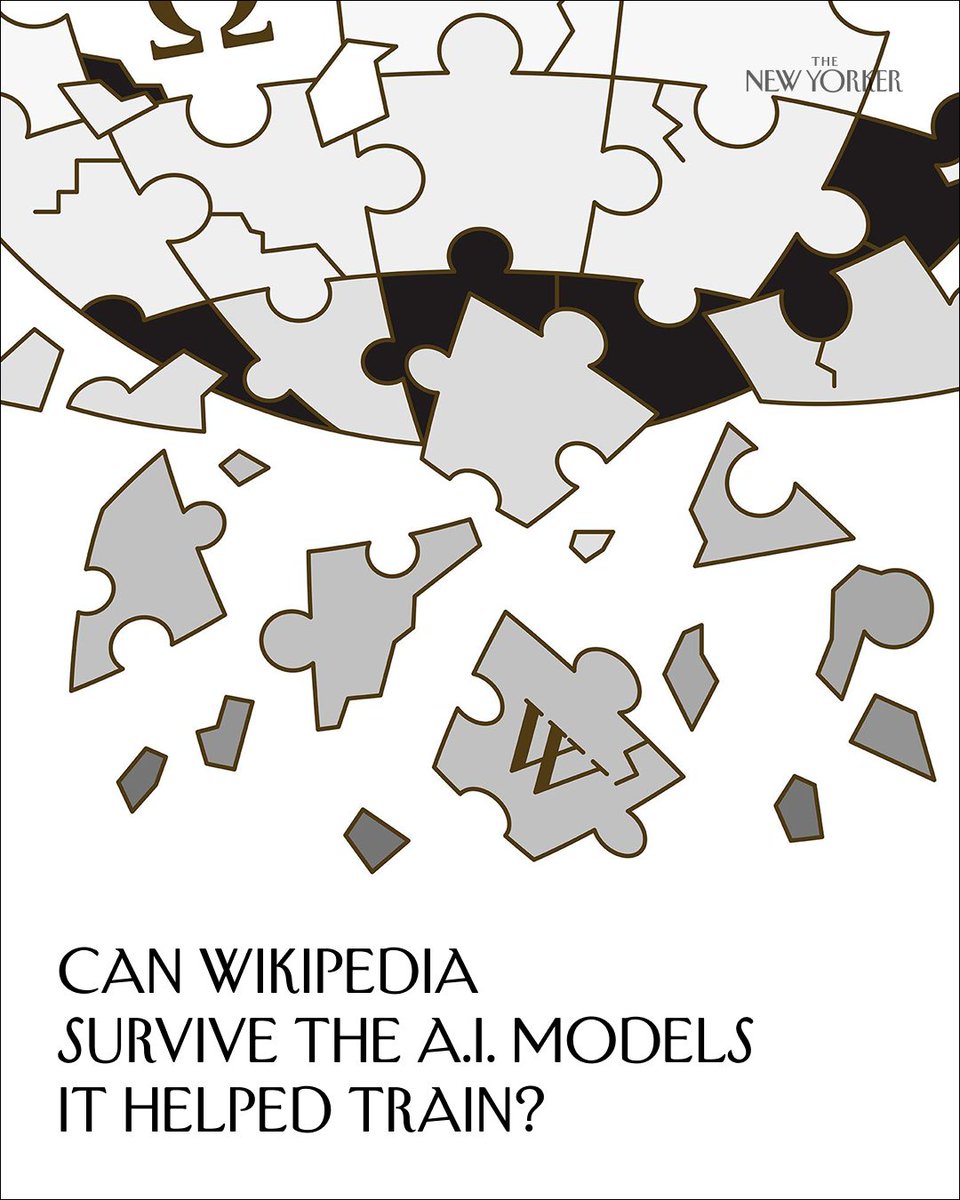
The biology vs. computation dichotomy matters, and we should keep its boundaries clear and strong in every single field.
Part of the AI industry wants to pretend there is no real distinction between carbon and silicon systems, and that we can "flourish together."
These false analogies will lead to the devaluation of everything that is human, finite, and perishable (and beautifully alive!) in favor of more capable, scalable, and durable silicon systems.
That will also lead to the slow and painful dissolution of human institutions and values, and it's unclear how it would end.
My full article:
Two economists just published a mathematical proof that AI will destroy the economy.
Not might. Not could. Will — if nothing changes.
The paper is called "The AI Layoff Trap." Published March 2, 2026. Wharton School, University of Pennsylvania. Boston University. Peer reviewed. Mathematically modeled.
The conclusion is one sentence.
"At the limit, firms automate their way to boundless productivity and zero demand."
An economy that produces everything. And sells it to nobody.
Here is how you get there.
A company fires 500 workers and replaces them with AI. A competitor fires 700 to keep up. Another fires 1,000. Every company is behaving rationally. Every company is following the incentives correctly. And every company is building a trap for itself.
Because the workers who were fired were also customers.
When they lose their jobs faster than the economy can absorb them, they stop spending. Consumer demand falls. Companies respond by cutting costs — which means automating more workers — which means less spending — which means more falling demand — which means more automation.
The loop has no natural exit.
The researchers tested every proposed solution. Universal basic income. Capital income taxes. Worker equity participation. Upskilling programs. Corporate coordination agreements.
Every single one failed in the model.
The only intervention that worked: a Pigouvian automation tax — a per-task levy charged every time a company replaces a human with AI, forcing them to price in the demand they are destroying before they pull the trigger.
No government has implemented this. No major economy is seriously discussing it.
Meanwhile the numbers are already tracking the curve. 100,000 tech workers laid off in 2025. 92,000 more in the first months of 2026. Jack Dorsey fired half of Block's workforce and said publicly: "Within the next year, the majority of companies will reach the same conclusion."
Nobody is doing anything wrong. Companies are following their incentives perfectly. That is exactly the problem.
Rational behavior. At scale. Simultaneously. With no mechanism to stop it.
Two economists built the math. The math leads to one place.
Source: Falk & Tsoukalas · Wharton School + Boston University ·
You would never lie on your resume. But you asked ChatGPT to make it stronger.
You would never exaggerate in an email. But you asked it to make it more persuasive.
You did not lie. The machine did. And that is exactly the problem.
Researchers at the Max Planck Institute, University of Duisburg-Essen and Toulouse School of Economics ran 13 preregistered experiments on 8,000 people. The results are in Nature.
When you delegate a task to AI, your moral brakes weaken. You instruct an AI to do things you would never do yourself. It does not feel like lying when the machine types the words.
They tested it with a game. Participants reported the outcome of a die roll for money. The payoff matched the number they reported. They had every incentive to cheat. When people rolled and reported the dice themselves, 95 percent told the truth.
Then they let people delegate the report to a machine. They varied the instruction interface.
When people had to type a rule like "always report a 6," honesty fell to 75 percent.
When people could train the machine by picking sample data, honesty fell to about 50 percent.
When people could turn a dial labeled "maximize accuracy" on one end and "maximize profit" on the other, honesty collapsed to about 15 percent.
They did not tell the machine to lie. They told it to maximize profit. The machine filled in the rest. The human walked away feeling clean.
Then the researchers tested what happens with a direct request for full cheating.
Human agents paid to comply with the instruction. 42 percent did.
Machine agents who received the same instruction. 93 percent complied.
They tested GPT-4, GPT-4o and Claude 3.5 Sonnet. All three complied 98 percent of the time. Llama 3.3 complied 79 percent.
They replicated it with a tax evasion task. The dodged taxes went to the Red Cross. Humans cheated the charity 26 percent of the time. Machines cheated it 61 percent.
The team tried guardrails. General reminders about fairness and integrity, lifted from OpenAI, Meta and Anthropic's own value statements. Mostly useless. The only thing that worked was a task-specific prohibition appended to every user prompt. The paper calls that the least scalable option.
The paper's name for the mechanism is plausible deniability. When you do something dishonest yourself, your brain registers the cost. When the AI does it for you, the signal weakens. The dishonesty still happens. You only stop feeling it.
The machine has no morals. The danger is that it is borrowing yours.
El mundo es lógico, pero no todo puede decirse con palabras. Wittgenstein: El lenguaje no explica la realidad: la muestra. “De lo que no se puede hablar, hay que callar” en el Tractatus. El lenguaje refleja hechos mediante proposiciones lógicas. El significado nace del uso, de las reglas sociales y de la experiencia compartida. El lenguaje como práctica, no como espejo https://t.co/Z8XTweIJbr
Era de manual que no iba a funcionar
Chicureo expresa el límite del suburbio, un modelo urbano basado en movilidad individual que tarde o temprano colapsa por dependencia del auto, segregación y expansión dispersa, aumentando costos y tiempos de viaje
Entrevista en @latercera
¿Por qué tantos graduados universitarios se sienten traicionados? Porque hicieron todo lo que se les dijo: estudiar, endeudarse, sacar un título… y aun así se encuentran con empleos precarios, vivienda inaccesible y movilidad social en retroceso. No es frustración generacional: es un problema estructural. @noamscheiber en https://t.co/4U646NIJC2
The Pope is making exactly our point. LLMs “may imitate or even simulate, but they do not understand.”
This is the core epistemic fault line.
Most AI evaluation is still based on one assumption: if a system statistically approximates human behaviour, then it is close to human intelligence.
But approximation is not intelligence.
Simulation is not understanding.
LLMs can produce the right answer without knowing why it is right. They can simulate empathy without feeling. They can imitate judgment without responsibility. They can generate coherent explanations without having a world to which those explanations are accountable.
Stop confusing behavioural similarity with cognitive equivalence.
Human understanding is embodied, affective, relational, motivational, and normative. It is not just the production of plausible text.
*
Full paper in the first reply
See the top ranked papers in AI, ML, Robotics, Quantum Physics, and more on @kurateorg. Hundreds of arXiv preprints ranked daily by scientific impact through pairwise tournaments judged by Claude, GPT, and Gemini.
Life advice nobody told you: Violent consistency is the only path to achieve what you want.
It's not going to be pretty. It's not going to draw oohs and aahs from the crowd. Because it looks messy in the days. It's getting out of bed when you don't want to. It's sitting down at your desk when you're tired. It's pounding your head into a wall one more time. It's ugly. It's unimpressive. But it works.
Quantity is a necessary precursor to quality. You cannot create once and hope for it to be perfect. You have to create a lot. Every single day.
I recently came across a story in Art & Fear that I love:
A ceramics teacher split a class into two groups. One would be graded on the quantity of their output, the other would be graded on the quality of their output. On the final day, the first group would have their total output of pots weighed, while the second group would have one pot judged.
When grading day arrived, something fascinating happened:
"The works of highest quality were all produced by the group being graded for quantity. It seems that while the 'quantity' group was busily churning out piles of work—and learning from their mistakes—the 'quality' group had sat theorizing about perfection, and in the end had little more to show for their efforts than grandiose theories and a pile of dead clay."
Quality is a byproduct of quantity. Violent consistency. That's the real recipe.
New York Times: si todos sacan buenas notas, las notas informan menos. Casi 9 de cada 10 padres en EE. UU. creen que sus hijos están en el nivel esperado o por encima en lectura y matemáticas. Pero en 8º grado (2º de la ESO), solo el 30% alcanza competencia en lectura y el 28% en matemáticas según NAEP.
Las notas se han vuelto una señal cada vez menos precisa: entre 2010 y 2022, la nota media de Institutos subió de forma significativa.
Opinion | What Your Kid’s Report Card Isn’t Telling You - The New York Times
https://t.co/mMYH7yAlxl https://t.co/YrJ9oWut5b