This is terrifying, all the more when you know Anne Applebaum is married to Radosław Sikorski, Poland's deputy prime minister and minister of foreign affairs.
In other words, she's not some rando hawkish think tanker, she's at the heart of power in Europe - intimately so.
She says that "unfortunately, [war with Russia] is one of these situations where there would have to be an event that convinces people that it was really necessary... The politics don't work for it yet."
It's terrifying not only because she desperately wishes for war with Russia (it's all in the "unfortunately") but also because it illustrates how little the will of the people actually counts for them: if Europeans don't want war with Russia, then the people are the problem, to be fixed by an "event" that brings them around.
Your daily reminder that 9.9 times out of 10 those who regularly accuse others of being Russian shills/assets/etc. are LITERALLY on the US gov’s payroll.
The goal, which is shared by most of NATO and a lot of American neoconservatives, is to push Russia into an overreaction that would justify a wider war. It’s a desperation move, but they’re desperate.
Russia has settled into a slow-grind strategy that it can keep up indefinitely, but the West can’t. The Ukrainian military is a hollow shell at this point, propped up by sheep-dipped military personnel from NATO countries and allies; the economic costs of the war are landing hard on Europe in particular; and the grand hope of breaking Russia apart, annexing the weak successor states to the EU, and looting them to the bare walls is further away than ever.
They know that if things go on as they’re going, the end will be a defeat for Ukraine and NATO, and very likely the replacement of current European governments by populist regimes that will dismantle the EU. So they’re making a high-stakes gamble, buoyed by the grand old neoconservative delusion that when push comes to shove, the West cannot lose.
Fortunately for the survival of us all, Russian government leaders seem well aware of this, and — in stark contrast to NATO politicians — are acting like adults.
A top commander for the first time reveals that the UK is conducting offensive cyber operations against Russia, China, Iran and North Korea.
General Sir Rob Magowan says the cyber risk to the nation is "significant" but that Britain’s cyber force will meet "threat with threat".
@haynesdeborah
🔗 Download and subscribe to Defence Insider: https://t.co/WG3MuH4Z0y
Anyone who tells you that your interests or your country’s interests are the same as those of the elites running your country — and therefore that anyone who opposes those elites is an enemy of yours or of the country — is either a paid propagandist or an idiot. In this case it’s probably the latter.
@PhilipProudfoot As I recall though MPs had a chance some years ago to go for a 5 year renovation that would mean they'd have to move out, or a 20 year one that would also be vastly more expensive.
Unsurprisingly they went for the vibes option.
@PhilipProudfoot Turn HoP into a world class interactive museum. Doing so with private funding would cost little and make huge returns as likely to become a world class attraction.
Again, can also be used for education and develop awareness amongst next generations of their history.
@RogerLMartin Also worth noting the work of Gary Klein here who has a similar definition for intuition (application of oast patterns), but also contrasts it with insight (sudden and unexpected emergence of new patterns).
The latter can come from anywhere and can be useful for innovation.
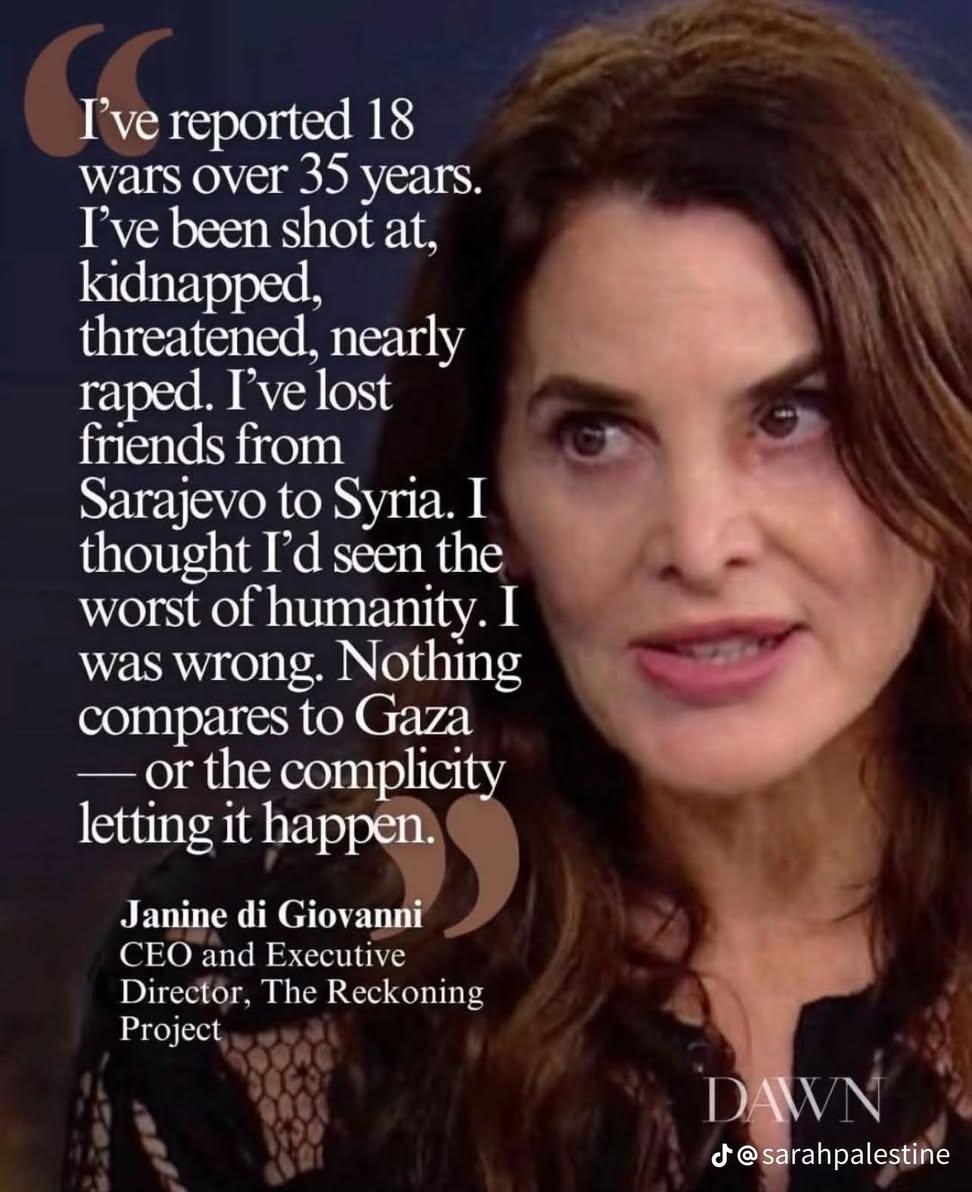
“I've reported 18 wars over 35 years. I've been shot at, kidnapped, threatened, nearly raped. I've lost friends from Sarajevo to Syria. I thought I'd seen the worst of humanity. I was wrong. Nothing compares to #Gaza, or the complicity letting it happen.”
– Janine di Giovanni
@FuriousKoen@imetatronink@npinnau That's what they were working on as the tensions rose in Eastern Ukraine. Not on finding a solution, but on preparing for hybrid warfare on multiple fronts.
Europe didn't want peace and doesn't want peace now. Wonder what it will take for them to want peace again?
The US organized and supported a coup d'etat in Kiev in 2014. They installed a government dominated by Ukrainian nationalists who modeled themselves ideologically after the Ukrainian Nazi forces from WW2, who killed tens of thousands of Poles, Jews, and Russians over the course of the war.
Crimea and the predominantly Russia-leaning populace of Lugansk and Donetsk resisted them. Crimea joined the Russian Federation by an overwhelming referendum. Lugansk and Donetsk declared their independence. Civil war ensued in the Donbass from that point forward.
Directed by their US/NATO overlords, the Ukrainians turned many of the cities in the western Donbass into fortresses between 2014-2022.
In late 2021 and early 2022, the AFU concentrated their best-equipped forces to the Donbass, and commenced artillery preparation in early February 2022, which increased in intensity with each passing day. They planned to invade the Donbass and destroy the "rebels" once and for all.
Lugansk and Donetsk formally petitioned Russia for protection on February 21st. The Russian Armed Forces entered the Donbass on February 24, 2022.
These are the objective facts of the matter.
As I wrote in a recent piece debunking the “Russian hybrid warfare” narrative, a “hybrid war” is indeed being waged against Europe — but it is being waged by the EU-NATO establishment itself, against its own population. Europeans are being subjected to a sustained campaign of cognitive or psychological warfare aimed at conditioning them to believe that Europe is under attack from Russia, and that these hybrid attacks are a prelude to conventional hostilities — a claim for which, by and large, there is little or no proof.
This leads to a disquieting question: given how much European governments and NATO have invested in — and come to depend on — the “hybrid war” narrative, and the broader idea of Russia as an existential threat to Europe, will they continue to limit themselves to inflating a threat that has little basis in reality? Or might they at some point feel compelled to go further? There is, after all, a historical precedent involving NATO. In October 1990, Prime Minister Giulio Andreotti confirmed to the Italian parliament the existence of “Gladio”: a secret paramilitary network, established in the early post-war years in various NATO countries under NATO auspices with CIA involvement, equipped with hidden arms caches and maintained for four decades outside any parliamentary oversight. The European Parliament’s resolution of November 1990 described an organisation that had “eluded all democratic control” and had been implicated in certain member states, “as evidenced by various judicial inquiries”, in serious cases of terrorism.
Parliamentary inquiries followed in Italy, Belgium, Switzerland, and Germany. In Italy, those inquiries reached the sharpest conclusions. A decade later, a report by members of the parliamentary commission on massacres concluded that a “strategy of tension” — bombings of civilians in public places, blamed on the left to frighten the electorate towards the anti-communist right — had been “organised or promoted or supported by men inside Italian state institutions and, as has been discovered more recently, by men linked to the structures of United States intelligence”. This is what is commonly known today as a false flag: a covert operation designed to conceal who is really responsible and pin the blame on someone else. It is curious, then, that European and NATO officials have themselves accused Russia of planning false flag attacks. Could this be preparing the public for a scenario in which an attack bears no trace of Russia — and is nonetheless blamed on Moscow precisely for that reason, as a “Russian false flag”?
Read my in-depth investigation here: https://t.co/e9660QqTAQ