Very happy to announce that the call for papers of the new collection "Wikidata across the humanities: datasets, methodologies, reuse" is out! As a Guest Editor, I can't wait to read all of your amazing propositions in the next months
https://t.co/KkjyP2irQq...
Exciting news!
🎉 The RPC project is editing and translating over 100,000 coin inscriptions into English using AI and EpiDoc standards.
🔊Plus, you can now listen to Latin and Greek inscriptions!
👉 https://t.co/eAfzxdCIWL
#numismatics#epigraphy
We wanted to share that the Calls for Papers, Posters, and Workshops have been extended to 24 November 2024.
All the info can be found here: https://t.co/mAGb6gZ7kR
😄
SHORT COURSE
Sign up now for a 3 day online only, flipped workshop in #EpiDoc, the de facto standard for encoding ancient epigraphic and papyrological editions in #TEI#XML for online publication and interchange
🗓️9-13 Sep
💷£80 (£40 unwaged/unfunded)
https://t.co/ZDLShXq2jw
OK, our final -and biggest- Loeb give-away for the summer: 31 of them by the looks of it! Sophocles, Euripides, Cicero, Sallust, Suetonius, and the dirtiest poet of all, Martial in 3 vols. Draw 10pm Thurs BST: just RT and follow us before then! And vote below for 1 or 2 winners!
We are pleased to share the special issue of Pasts Imperfect, about new developments and research focused on Dura-Europos
featuring IDEA’s team and advisors @JA_Baird @ahcnyc84 @Adnan77227624 @LR_Brody ✨ https://t.co/QYIp7UKVcW
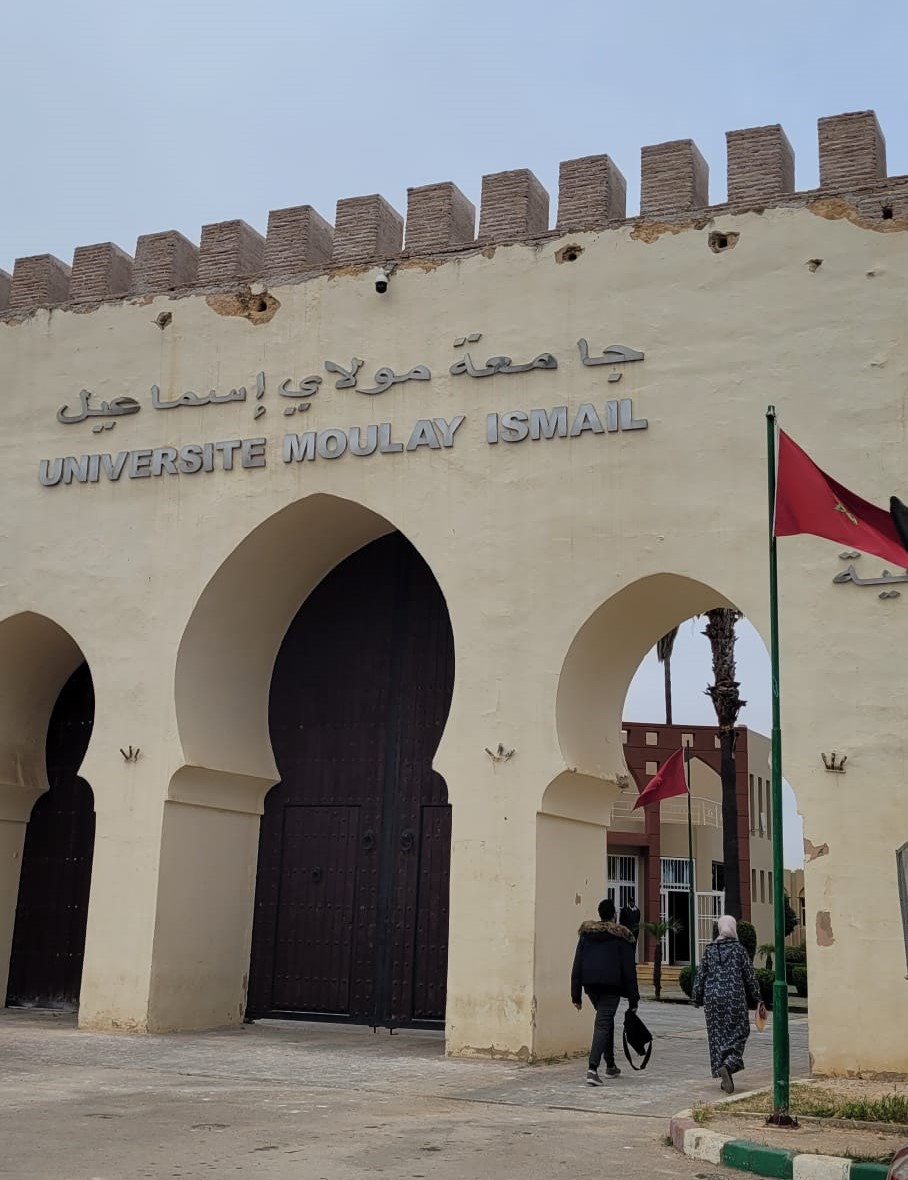
Heureux de voir que trois étudiants de @FASNouvelles et notre centre ont obtenu une bourse de mobilité @HumanisticaDH pour assister au colloque 2024 à Meknès. Félicitations ! @ENumeriques
Et c’est parti pour un nouveau colloque cette fois-ci à Meknès avec les collègues et amies Giulia Ferretti et @VrstMathilde pour présenter nos recherches.
Merci à @ENumeriques et @DigitalDura pour le soutien!
Je donnerai dans quelques heures une présentation sur les résultats de reconnaissance d'écriture manuscrite de l'Anthologie Palatine. Venez en grand nombre!!! @ENumeriques
À l'occasion du colloque Horizons de la philologie numérique, un nouveau dossier (Miscellanea anthologica) de la revue Sens public vient de paraître en lien avec le projet de l'Édition numérique et collaborative de l'Anthologie grecque. https://t.co/6le0e5Yog9
Les mots de bienvenue des organisateurs du colloque “Horizons de la philologie numérique: L’Anthologie grecque pour repenser [formats], [paradigmes] et [collaboration]” — 3 jours à Naples avec le soutien du @SSHRC_CRSH@FRQSC (avec mon équipe) @crihunum et @FASNouvelles
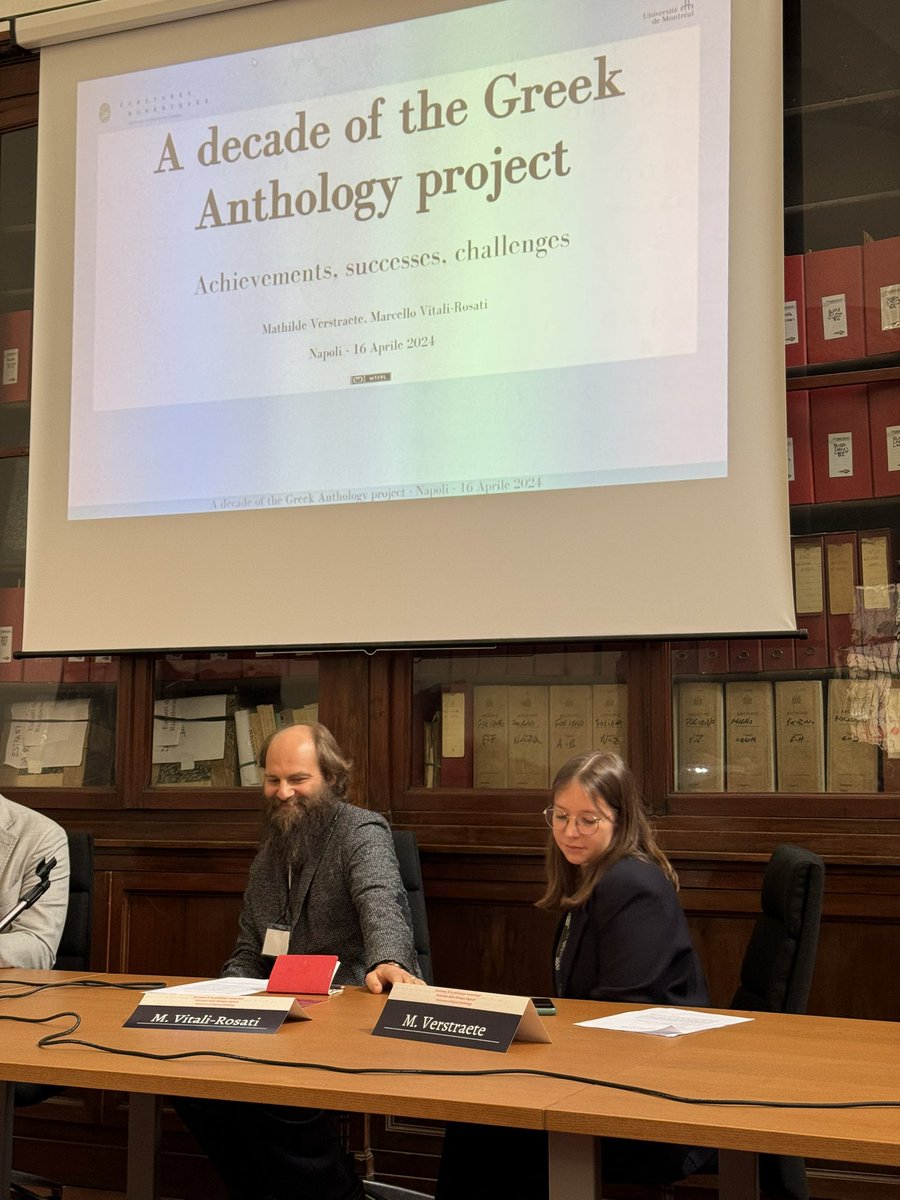
Le colloque “Horizons de la philologie numérique” commence avec la première présentation sur “Une décennie du projet Anthologie grecque – bilan, succès, défis” (subventionné par @SSHRC_CRSH) présentée par M. Vitali-Rosati et M. Verstraete @ENumeriques@dllf_udm@FASNouvelles
Alix Chagué, doctorante en co-tutelle dans notre option humanités numériques @FASNouvelles et @Inria, présente “Des transcriptions plus FAIR: HTR-United et la possibilité d’un commun pour les données d’entraînement” dans le cadre du colloque “Horizons de la philologie numérique”
J'ai la chance de pouvoir participer à ce magnifique colloque pour parler de nos expérimentations sur la reconnaissance d'écriture manuscrite et du grec ancien! Pour accéder au live stream: https://t.co/sXtErQfQcd
Avec le @UmanistiUnina, nous vous invitons aux journées d’étude « Horizons de la philologie numérique. L’Anthologie grecque pour repenser [formats], [paradigmes] et [collaboration] ». Cet événement se tiendra du 16 au 18 avril 2024.
https://t.co/mXgMfTiYe4
@crihunum@UMontreal
Do you have good quality archaeological data that you would like more people to find and reuse? Do you want to increase its value and usefulness by combining it with other data? Then the ARIADNE Portal may offer a solution:
Ten months ago, we launched the Vesuvius Challenge to solve the ancient problem of the Herculaneum Papyri, a library of scrolls that were flash-fried by the eruption of Mount Vesuvius in 79 AD.
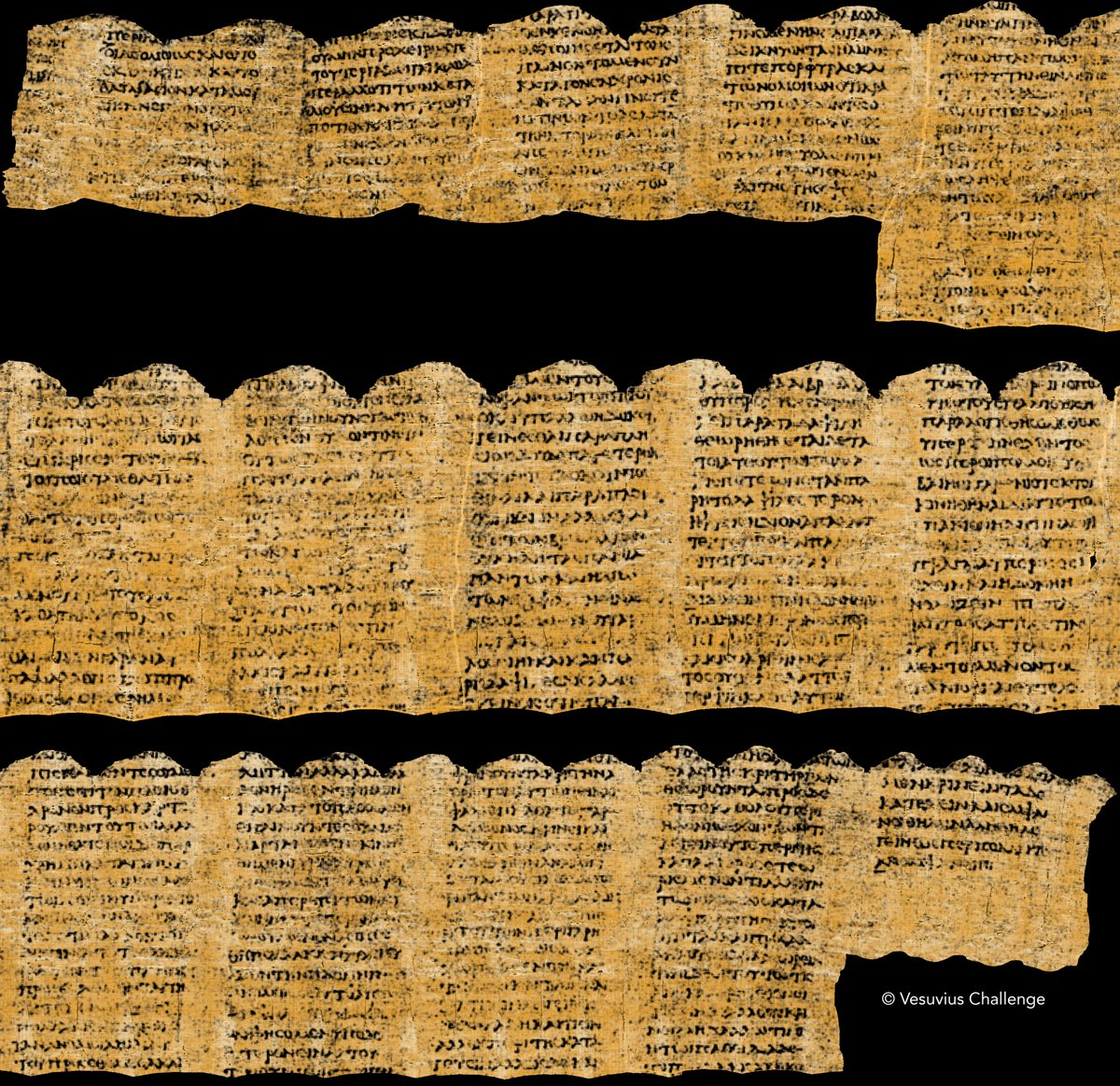
Today we are overjoyed to announce that our crazy project has succeeded. After 2000 years, we can finally read the scrolls:
This image was produced by @Youssef_M_Nader, @LukeFarritor, and @JuliSchillij, who have now won the Vesuvius Challenge Grand Prize of $700,000. Congratulations!!
These fifteen columns come from the very end of the first scroll we have been able to read and contain new text from the ancient world that has never been seen before. The author – probably Epicurean philosopher Philodemus – writes here about music, food, and how to enjoy life's pleasures. In the closing section, he throws shade at unnamed ideological adversaries – perhaps the stoics? – who "have nothing to say about pleasure, either in general or in particular."
This year, the Vesuvius Challenge continues. The text that we revealed so far represents just 5% of one scroll.
In 2024, our goal is to from reading a few passages of text to entire scrolls, and we're announcing a new $100,000 grand prize for the first team that is able to read at least 90% of all four scrolls that we have scanned.
The scrolls stored in Naples that remain to be read represent more than 16 megabytes of ancient text. But the villa where the scrolls were found was only partially excavated, and scholars tell us that there may be thousands more scrolls underground. Our hope is that the success of the Vesuvius Challenge catalyzes the excavation of the villa, that the main library is discovered, and that whatever we find there rewrites history and inspires all of us.
It's been a great joy to work on this strange and amazing project. Thanks to Brent Seales for laying the foundation for this work over so many years, thanks to the friends and Twitter users whose donations powered our effort, and thanks to the many contestants whose contributions have made the Vesuvius Challenge successful!
Read more in our announcement: https://t.co/rUlrdGXBMs




![ENumeriques's tweet photo. Avec le @UmanistiUnina, nous vous invitons aux journées d’étude « Horizons de la philologie numérique. L’Anthologie grecque pour repenser [formats], [paradigmes] et [collaboration] ». Cet événement se tiendra du 16 au 18 avril 2024.
https://t.co/mXgMfTiYe4
@crihunum @UMontreal https://t.co/6STM0XxkCX](https://pbs.twimg.com/media/GK5FKj4XEAAC8tG.jpg)


![mesinatra's tweet photo. Les mots de bienvenue des organisateurs du colloque “Horizons de la philologie numérique: L’Anthologie grecque pour repenser [formats], [paradigmes] et [collaboration]” — 3 jours à Naples avec le soutien du @SSHRC_CRSH @FRQSC (avec mon équipe) @crihunum et @FASNouvelles https://t.co/TndUP4rrg0](https://pbs.twimg.com/media/GLRXd5YXUAAe7LK.jpg)

![ENumeriques's tweet photo. Avec le @UmanistiUnina, nous vous invitons aux journées d’étude « Horizons de la philologie numérique. L’Anthologie grecque pour repenser [formats], [paradigmes] et [collaboration] ». Cet événement se tiendra du 16 au 18 avril 2024.
https://t.co/mXgMfTiYe4
@crihunum @UMontreal https://t.co/6STM0XxkCX](https://pbs.twimg.com/media/GK5FKj5WcAEV7QI.jpg)