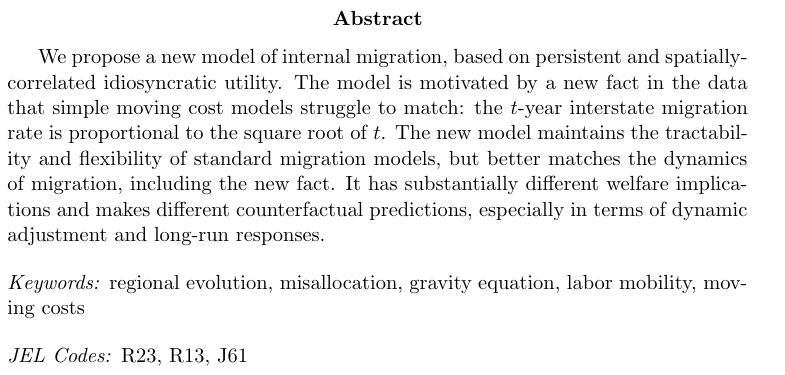
Thrilled to have this paper with Hansen Shao, "The Dynamics of Internal Migration: A New Fact and its Implications" accepted. We hope it changes the way you think about internal migration and that it provides a useful tool for economists to model location choices.
AI is everywhere. AI-related products account for 23% of U.S. imports in 2025. This study from @tradewartracker is very interesting. https://t.co/7z5ca0rdiP
1/ At long last, we are ready to share a revision of my 2023 paper on Austrian capital theory and global value chains. I say “we”, because the current draft is joint work with the great @AdrianPKulesza (G4 at Harvard).
Link: https://t.co/V4O5w8DamU
A thread on the paper 🧵👇🏻
🚨 Forthcoming in Econometrica!
How does trade liberalization affect developing countries with large informal sectors?
Informality fundamentally changes how we think about the gains from trade. (1/5)
These are 10 of my favourite #UrbanEconomics & #SpatialEconomics articles published in academic journals in 2025, continuing with a tradition started in 2018 (order is alphabetical by first author, no ranking implied):
Check out Francesco Ruggieri's JMP! He studies fiscal spillovers across overlapping jurisdictions (school districts, cities, special districts sharing a tax base). Much less explored than spillovers between neighbors. Fantastic data work and super carefully implemented!
Thrilled to see our decade-long research agenda with Teresa Fort (@Tfpiasecki) and Felix Tintelnot (@FelixTintelnot) on firm-level approaches to global value chains featured in the latest NBER Reporter. What a ride!
Link: https://t.co/8fOmdX0UcL
What is the value of new and improved goods? The question is central for our theories of trade and economic growth, in which the value of new and better goods provides the motive for trade, and is the source of long-run growth. 1/6
Who are the entrepreneurs that drive economic progress, and what does this mean for research and policy? w/ @UfukAkcigit Harun Alp @MartaPrato and I use microdata to uncover the critical symbiosis between entrepreneurs and inventors that power innovation and growth 🧵
Great to see our practical guide to shift-share instruments wiht @borusyak and @instrumenthull out in the Journal of Economic Perspectives today 👇👇👇
https://t.co/depWiGJxRt
Let's put a 25% tariff into context. Here's a (brief) US tariff history back to 1900.
In 1972 the US average tariff rate was ~6%. We cut tariffs to facilitate development (GSP), control drug production (ATPA), and facilitate integration (GATT/WTO). Then in 1985...