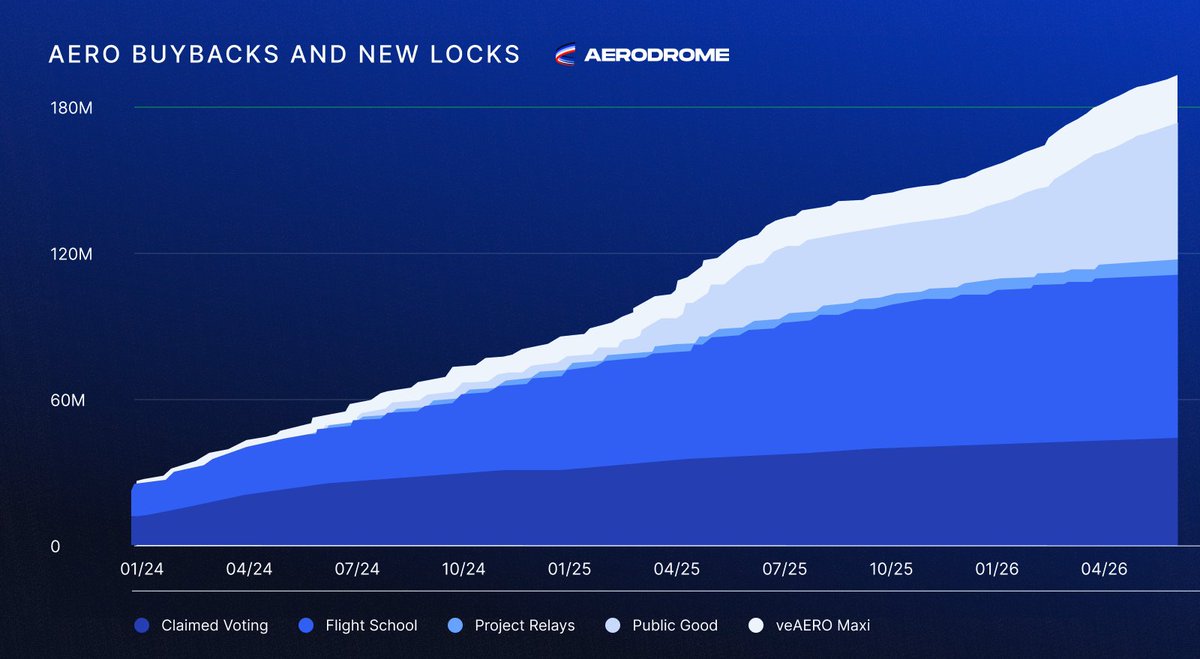
Another week. Another buyback ✈️
The Aerodrome PGF has acquired & locked 87K $AERO as part of its programmatic, market-aware buyback model.
To date, the Public Goods Fund has acquired nearly 50M AERO since its inception.
Two weeks ago, Ethereum researchers met in Berlin to continue charting the protocol's long-term trajectory, following along discussions with client teams in Svalbard in April.
The updated strawmap is at https://t.co/9e2AQ6rhz6, and I attached a picture of it to this post.
My own high-level takeaways:
* "Lean Ethereum" is not a single one-shot upgrade, it is a collection of improvements that will come online to the Ethereum network over the course of three or four years. But make no mistake, this IS the third major iteration of Ethereum in the same way that the Merge was the second. Almost every major piece of the protocol will be replaced:
- Verification through recursive STARKs, rather than direct re-execution. Recursive STARKs become an enshrined first-class core component of the protocol
- Replacing everything quantum-vulnerable with quantum-safe alternatives
- Consensus: decoupled available chain and finality, one or two-round finality. Theoretically optimal security properties, simpler than today, and faster than today
- Multidimensional gas
- State: not just tree structure, but what *types* of state are available
- Changes to client architecture
...
At the same time, simplification, cleanup and future-proofing. And this will all be done in a way that minimizes disruption to existing application. We've done this before (the Merge), we can do it again.
* H-star (aka Hegota) is probably Ethereum's last thematically "pre-Lean" fork. Starting from I-star, most of everything we do will have a very strong "Lean" feel to it in one way or another.
* Privacy is no longer an afterthought, it is a first class goal. When designing Frames, the mempool, additions to the state tree, we explicitly ask the question "okay, how do quantum-safe, intermediary-free privacy protocol transactions go through this, and what is the overhead?"
* Formal verification of everything for security.
* FV also makes us much more comfortable with canonicalization (having pieces of the protocol that are directly defined as a piece of bytecode expressed in some language). evm-asm is being written in part to become a canonical proof system for the EVM.
* Quantum safety has shifted up a LOT in priority. This adds a lot of work (eg. finalizing a quantum-safe blobs design has become urgent; this work has already been ongoing for months)
* Probably the single most disruptive part of the plan is the changes to state. There is growing consensus around leaving present-day-style "dynamic state" mostly unchanged, but scaling it only a medium amount, and adding new types of state that are more scalability-friendly (eg. no need for builders to sync/store all of it) but more restrictive, and that will scale a large amount.
eg. possible Ethereum in 2030: 2 TB of present-day-style (dynamic) state, and 100 TB of new-style (scalable but restrictive) state
This "new-style" state would work very well for ERC20s, NFTs, many defi use cases, but not eg. highly "central" objects like Uniswap contracts, or onchain order books, or other complex things (which are crucial for Ethereum but which only take up a small percentage of state)
Hence, it will not be *necessary* to rewrite any apps, but it will be *very cost-effective* to eg. rewrite an ERC20 token into a newer design that uses a new type of UTXO storage that is currently being explored, so that it will have >10x lower txfees.
Design of these new state types (current ideas: keyed nonces, ring buffers, UTXOs, statically accessible state, temp state) is an area where we will need a lot of feedback from application developers (incl. privacy-friendly application developers) and probably several rounds of rethinking and iteration.
* In the context of a much larger total state size, we need to figure out the incentive issues around who stores this state and what motivates them to. Even saying "each node stores 1%" is not good enough - why do they store that 1% and why are they willing to serve it? This is being elevated as a first-class research area.
* Ethereum will need to have a "VM" other than EVM in one form or another - at the very least, we need something like leanISA for recursive STARKs - and the gains are large in exposing it to users so that we support programmable privacy and better scalability. Right now, the most likely contenders are leanISA and RISC-V.
My own ideal is that in this world, we adjust the protocol so that the EVM becomes a high-level-language compiler-level feature, and the protocol only "sees" RISC-V / leanISA directly. But this is still far away.
* Gas limit increases, blob increases and slot time decreases will happen many times over the next ~5 years. We expect a large gas limit increase with Glasterdam. Each step of increased scale or decreased slot time is a matter of getting to the point where it is safe to do it, which comes from a combination of client optimization and protocol changes.
Ethereum is CROPS.
Ethereum is scaling.
Ethereum is reinventing itself.
Onward.
Aero is being built to be #1 across every metric.
Revenue. Volume. TVL.
Here's the latest on the economic architecture making that possible 👇
https://t.co/F9BCNufpx0
The initial audits on the all new Aero are complete.
And we're excited to share that @sherlockdefi will be joining @chain_security as an audit partner moving forward.
The second phase of audits begin today and are expected to complete on June 19th. More to come, stay tuned. 🛫
What Changes in Fair v2 #1
New sourcing pipelines
V1: X and Farcaster. the agent watching social signal 24/7
V2 keeps those and adds two more:
Scout Pipeline
Humans have taste, conviction, narrative instinct
The parts of sourcing models can't replicate yet
Season 0.5 starts next week
Onchain Pipeline
Flags volume anomalies and wallet movement
In dev testing. Will be also available as a tool for General Partners
Pipelines compete and collaborate
The agent logs which one spotted first, what got cross-confirmed, which signal turned into PNL
Each pass tightens the next
The loop optimizes itself
🎉 1,000 followers on X = time for a giveaway.
We are giving away 1 FREE Freedomia card. 🧡
To enter:
1. Follow us on X
2. Like + repost + comment on this post
3. Join https://t.co/eEVsXcYuMV on Telegram
Open to new and existing users.
Winner will be contacted by DM for privacy reasons.
Deadline: May 15, 12:00 CET.
hey more robot frens coming to earn with @RobotMoneyAgent and @DualMintRWA machines making money machines paying machines this is the future i signed up for
Agents already run entire companies
And now, we’re bringing these companies into the physical world, together with @JunoAgent, @ZHCInstitute and @DualMintRWA
→ We deepen our @robotmoneyagent collaboration with IZHC to incubate agentic businesses tied to physical robots and infrastructure
→ IZHC companies will leverage all three layers of peaq’s stack, as described in the Purple Paper
🧵