Excited to share our new human memory paper in @Nature! 🧠
Bausch et al. (2026): https://t.co/fRdU4ukP9C
Rodent neurons often mix content & context. But humans? We found neurons encode content & context largely separately, then dynamically combine them. 🧵👇
@Nature This suggests the brain supports flexible memory by reusing content representations while reconstructing context as needed.
Huge thanks to co-authors @j_niediek Thomas Reber, Sina Mackay, Jan Boström, C. Elger & F. Mormann at @UniBonn & @UniklinikBonn!
#Memory#Hippocampus
Excited to share our new human memory paper in @Nature! 🧠
Bausch et al. (2026): https://t.co/fRdU4ukP9C
Rodent neurons often mix content & context. But humans? We found neurons encode content & context largely separately, then dynamically combine them. 🧵👇
@Nature Rather than storing combinations, context is dynamically reinstated.
We saw co-activation of distinct content & context neurons. Signal strength predicts memory performance. 📈 With learning, coordinated firing emerges consistent with synaptic plasticity & pattern completion.
@Nature#memory: Human MTL keeps content and context separate, then links them when needed. After pairing, entorhinal content spikes predict hippocampal context spikes ~40 ms later, pointing to plasticity and pattern completion. [https://t.co/fRdU4ukhk4](https://t.co/fRdU4ukhk4)
Great work from Dan Bush @FOlafsdottir & @caswellcaswell - phase coding vs ripples during replay, just like phase coding vs theta during running (with slightly different forward sweeps). Out now! https://t.co/nmuCz5SPgZ
@TheBrainTLDR@j_niediek @tpreber @humansingleunit Concept neurons increased firing whenever attention was directed towards the preferred concept that could be maintained in memory without sustained activation. Sequential firing of concept neurons suggested activity-silent storage mechanisms of concepts and their relations.
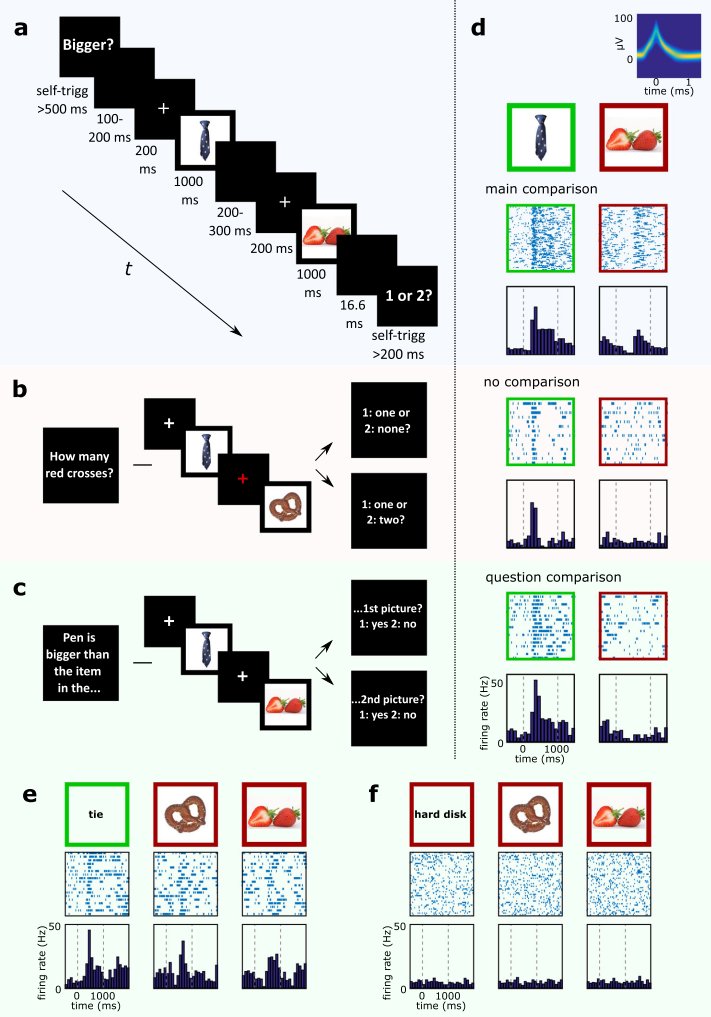
@TheBrainTLDR@j_niediek @tpreber @humansingleunit A subset of concept neurons with invariant responses to a preferred concept (e.g. tie) expressed relations between concepts as late reactivated firing to non-preferred stimuli (e.g. strawberry or pretzel) whenever the task required a comparison to the preferred concept.
Very interesting study that investigates how the relevance of spatial versus temporal relations affects hippocampal representations and choice with the help of the OFC. Great work!
Our new preprint led by @mona_garvert is live: Hippocampal spatio-temporal cognitive maps adaptively guide reward generalization. Work with @cpilab & @nico_schuck https://t.co/agLyozwyow
@doellerlab@mona_garvert@cpilab@nico_schuck Very interesting study that investigates how the relevance of spatial versus temporal relations affects hippocampal representations and choice with the help of the OFC. Great work!
@tpreber @NatureComms @humansingleunit Thank you Thomas. It was a great collaboration and it's a pleasure to work with you. Also many thanks to @j_niediek Sina Mackay and Florian Mormann.
@leafs_s@j_niediek @tpreber @humansingleunit Concept neurons increased firing whenever attention was directed towards the preferred concept that could be maintained in memory without sustained activation. Sequential firing of concept neurons suggested activity-silent storage mechanisms of concepts and their relations.
@leafs_s@j_niediek @tpreber @humansingleunit A subset of concept neurons with invariant responses to a preferred concept (e.g. tie) expressed relations between concepts as late reactivated firing to non-preferred stimuli (e.g. strawberry or pretzel) whenever the task required a comparison to the preferred concept.
@CogSciSoc Our paper (@humansingleunit) shows that concept neurons encode relations between concepts in humans, suggests activity-silent storage mechanisms and supports Cowan's model of working memory as adapted by @kaminski_janek and @UeliRutishauser
@CogSciSoc Thanks! A subset of concept neurons with invariant responses to a preferred concept (e.g. tie) expressed relations between concepts as late reactivated firing to non-preferred stimuli (e.g. strawberry or pretzel) whenever the task required a comparison to the preferred concept.
@humansingleunit @kaminski_janek @UeliRutishauser Concept neurons increased firing whenever attention was directed towards the preferred concept that could be maintained in memory without sustained activation. Sequential firing of concept neurons suggested activity-silent storage mechanisms of concepts and their relations.
@humansingleunit @kaminski_janek @UeliRutishauser A subset of concept neurons with invariant responses to a preferred concept (e.g. tie) expressed relations between concepts as late reactivated firing to non-preferred stimuli (e.g. strawberry or pretzel) whenever the task required a comparison to the preferred concept.