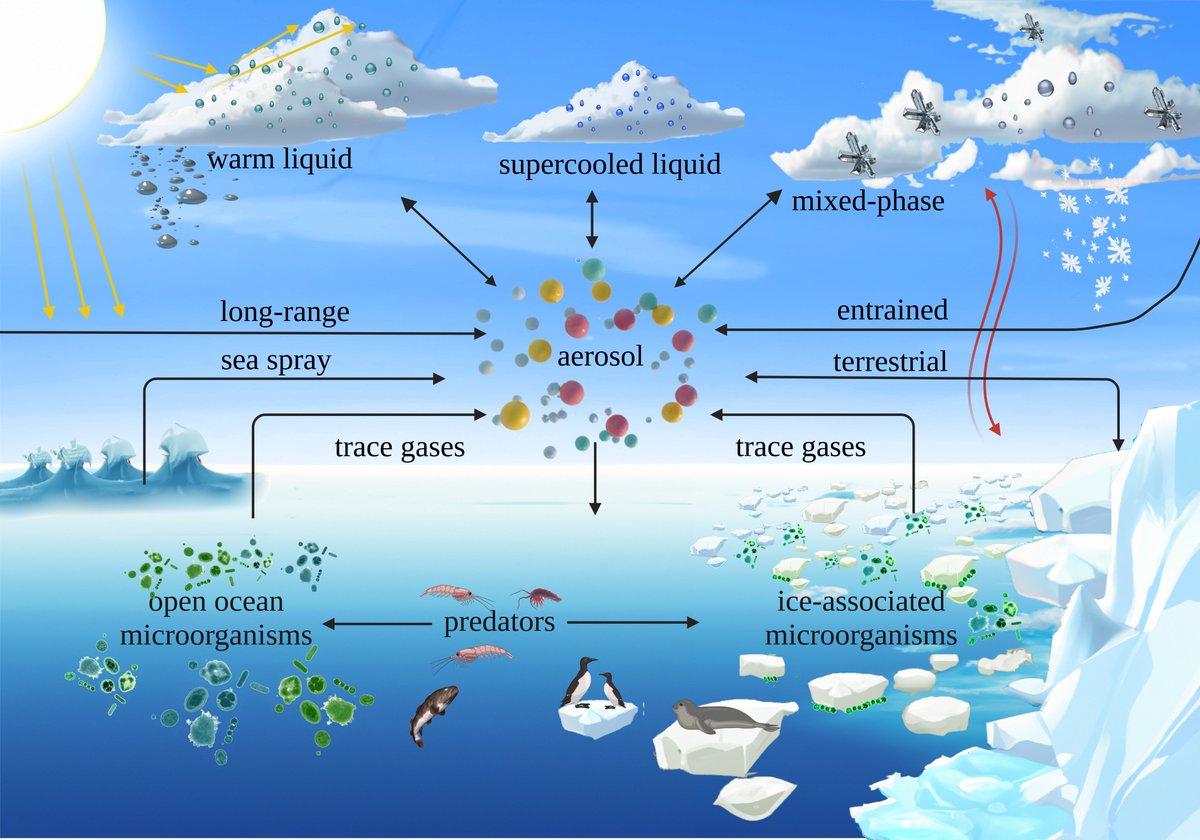
🌨️ Clouds over the cold Southern Ocean are different from elsewhere in the world. Here they are seeded not by aerosols from land, but by the ocean — and even life itself.
Chelsea Bekemeier, from @ColoradoStateU on the Denman Marine Voyage #DMV, explains.
https://t.co/T7PYhuvYtO
Join myself @MarcMallet and the @Ant_Partnership for a PhD project on modelling cloud-aerosol interactions over the Southern Ocean in a high resolution atmosphere model! Send your students my way!! https://t.co/5aqSutir0K
Join our atmospheric chemistry modeling team in Grenoble to work with @HeleneAngot on modeling atmospheric microplastics. Apply at https://t.co/8QooHO8rF1
A commentary paper I worked on with a bunch of great collaborators was published recently. We discuss how Southern Ocean clouds are influenced by biology and summarise some of the huge efforts to learn more.🔗: https://t.co/3VEpLr1f4q and a nice writeup by @Ant_Partnership below
☁️ What makes clouds in the Southern Ocean around Antarctica different from elsewhere in the world?
In this relatively pristine region without dust or pollution, clouds are seeded by tiny airborne particles (aerosols) that come from the ocean itself.
🧵1/6
Images: @NASA WorldView
🚨 Excited to share new work! 💻🌞🌏🌊 We used machine learning with #ERA5 to more accurately simulate sunlight over the Southern Ocean. I learned a lot during this project and can't wait to see what's next.🔗: https://t.co/qJ8B7kJQUX #ClimateScience#machinelearning @AMS_AIES
😎 Our AAPP researchers from partners @AusAntarctic, @BOM_au & @IMASUTAS use #MachineLearning to simulate solar radiation in the Southern Ocean - crucial to improve weather and #climate modelling.
👏 just published in #AIforEarthSystems @AMS_AIES @ametsoc
https://t.co/rlmy66pVmF
📣 Come work for us! We are looking for a Research Associate to undertake research on quantifying the marine biogeochemical cycling of carbon and the progress of acidification in the Southern Ocean using a suite of existing observations 🌊
https://t.co/89b4VIzBWI
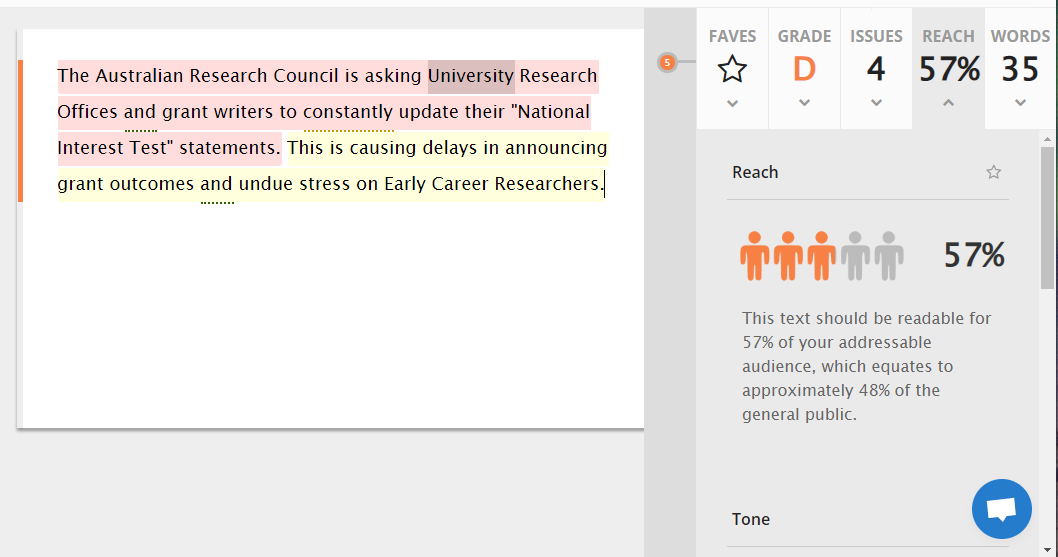
@ARC_Tracker I think there are still easy to use and quantitative tools for estimating how much the general public can understand text. Here's an example to demonstrate.
Remember when the 2019-20 AUS bushfires fertilised the South Pacific? There's more to the story! See our new study in #AGUPubs Geophysical Research Letters: https://t.co/WeLKFHS6Wx
Southern Ocean #Phytoplankton Stimulated by #wildfire Emissions and Sustained by Iron Recycling
Next week the @CATCH_science Open Science Workshop is on! @MarcMallet, @ruhihumphries and myself have organised a session designed to start early discussions on upcoming Southern Ocean voyages targeting biogeochemistry links to aerosol and clouds! https://t.co/iBrAkVY0yA /1