I like computers, Korean, and computers-and-Korean.
Language+keyboard stuff @Google
Georgia Tech → 연세대학교 → 東京工業大学
Interested in high school CS education.
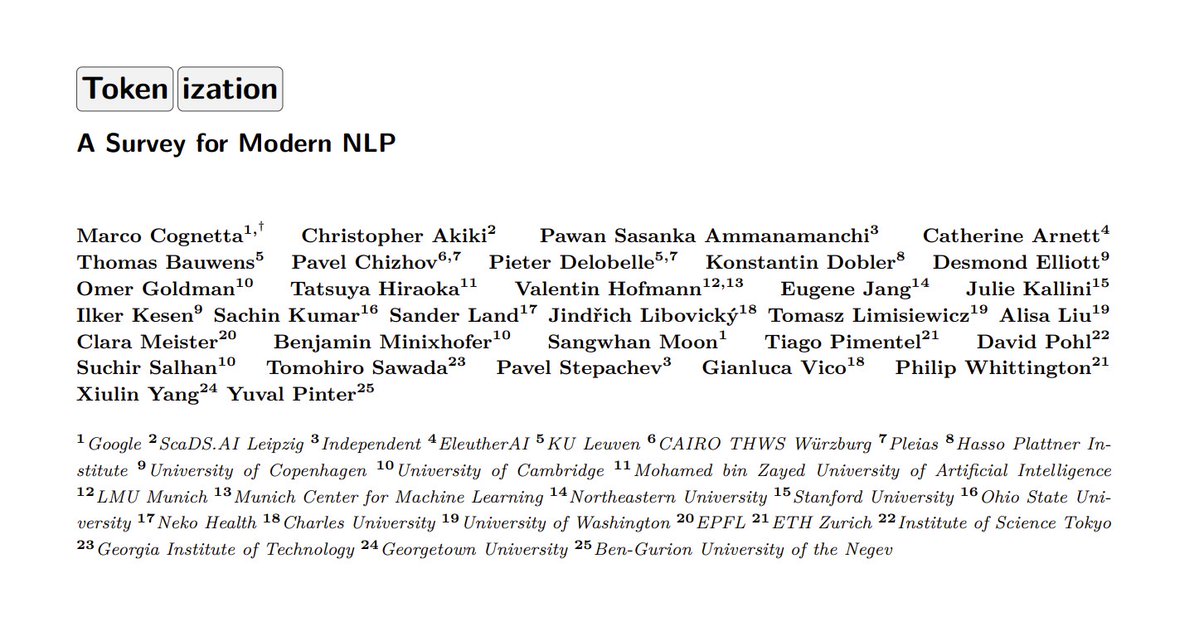
🚨 [Token][ization] Paper Alert 🚨
Tokenization is a wildly understudied area of language modeling despite it having effects across all of NLP. Over the past ~8 months, 32 (!) tokenizer researchers put together the most comprehensive survey of the field. Check it out!
@sliminality apparently Donald Knuth had a baseball section of TAOCP that was cut, but you can still see it in the handwritten drafts in the Stanford archives.
Shot in the dark, but I guess this would be right up your alley.
masked decoding on gemma 3 12b to control text rivers
if a token isn't the length i want it to be, i mask it out
added a lora for width tags so the model is aware of text length + coherence RL afterwards
@Ben_Reinhardt You might enjoy this substack about the Japanese rail system and it's public / private transformation:
https://t.co/qVSIyHFb2H
https://t.co/uUTNlSJRV7
Overall, I agree with your message. But I think if you ask people (especially foreigners) who are living in Japan, they are all going to have horror stories about absolutely ridiculous things that simply "just are they way they are". These are things that would be resolved in a ~2 minute phone call in the US.
My go-to example is that ATMs and many large internet services shutdown at midnight/random times. Actually most banking stuff is very frustrating. There is no way that they are optimal for the user, the employees, the business, or the government but they are done because that's how they have always been done or some random higher up wants it done that way for whatever reason they came up with.
The bureaucracy around random university/city ward stuff was also pretty wild. If you had _exactly_ what you needed coming in, Japan was quite good (i.e., the happy path was often better than the US), but if you missed anything at all, there was absolutely nothing that could be done to fix it other than starting over.
To be clear, I am not saying the US or whatever is much better in all of these areas, but there are aspects of Japan that are just so adversarial to the user it defies all logic.
@Ben_Reinhardt This part is funny, because Japan also has the feel to me of someone sat down and decided to do something some way and then no one ever questioned it again.
Some things they do hyper optimize but others are painfully bad.
@rdesh26@_albertgu There are a couple of interesting ways around this. As @shocheen mentioned, variable compression rates are one way.
You could also abandon UTF8 for a more equitable encoding:
https://t.co/2VM9VmF2VY
https://t.co/otpNHGbl4e
And Baidu's ERNIE 5+ uses UTF16 for better CJK.
3/
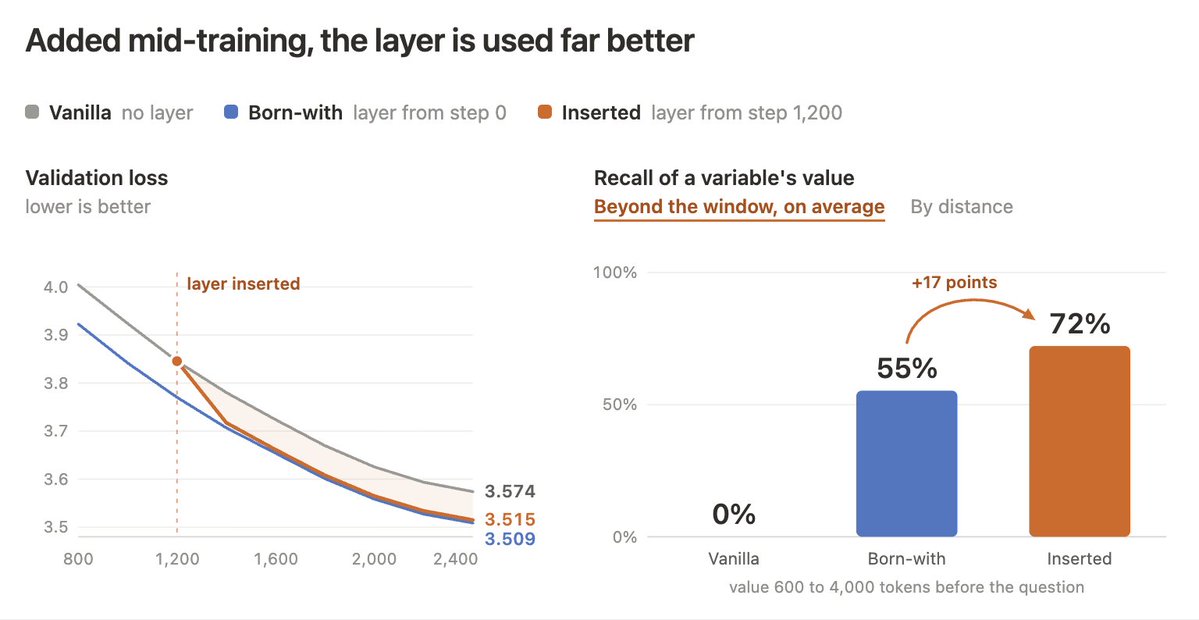
The timing of architecture changes mattered.
The agent planted new code layers at the start of training instead, and recall dropped from 72% to 55%. This points towards a different way of training: just as a network's weights evolve over training, so should its code and architecture. Agents must decide to introduce code exactly when the network is ready for it.