havent seen one person from OAI or Ant address Jon's argument here.
the point is simple: the USG does not owe either of the large labs a business model. if the economics of selling tokens don't work due to distillation/cheap clones/Chinese AI magick, the American enterprise and consumer will be A-OK. they will benefit from hyperdeflation in the cost of digital cognition just like everyone else. the hyperscalers will be fine. it's just OAI and Ant that won't be – in their current forms at least. if they are willing to adapt, they can develop new business models.
so what if the token merchants don't do well? the neoclouds will be fine. the internet companies will be fine. the consumer gets cheaper queries. the enterprise will still incorporate AI.
the only world in which this isn't fine, is if you hold a quasi-religious belief that we're on the cusp of a kind of AI rapture in which one of the labs Logs On And Wins Forever, namely hits RSI and we enter some kind of sublime post economic society run by GEOTUS Dario. so to accept that Ant's business model might be suboptimal or impaired by China's commoditization is to accept the unacceptable; namely that someone other than the anointed might kick off the runaway feedback loop and that they, instead might log on and win forever.
this appears to explain the discrepancy in reaction to Deepseek Moment v254 Kimi edition. everyone has bag bias, of course. but leaving that aside, most people think it's pretty much ok if Ant and OAI suffer margin compression due to Chinese distillation / industrial sabotage via open weight models. the American economy is not reliant on those two firms. they could blink out of existence and we would pretty much be ok. the AI capex supercycle will still produce tokens, closed weight or not. American firms will consume those tokens. OAI and Ant would probably still scratch a living, due to the latent preference of some token consumers to buy domestic and face off against a known entity.
this is only unacceptable if you think AI is strongly path dependent; that is, if it really matters who the market leader is when AI reaches a breakout level of capability. this is true both in the good case (superintelligence, singularity, etc) and the bad case (this is the essence of safetyism). but if this sounds more like wishcasting than forecasting, you probably don't mind the labs being pressured economically.
now you can clearly tell which side I'm on. I think AI is a fantastic technology which is hyperdeflating the cost of cognition and will fundamentally reshape society but there are real reasons why it wont diffuse as fast as the AGI people think it well. I would prefer an American firm achieve RSI relative to a Chinese one but I think either outcome would be suboptimal; better that we don't end up with a closed oligopoly composed of Ant/OAI. China by crushing the margins of the labs is doing everyone a favor by eliminating their pricing power and empowering the buyers of AI, namely, everyone.
objections:
-but you can't celebrate America losing to China!
- in my opinion this is a minor victory for China but not necessarily an enduring one. USA still has the chip, datacenter, and neocloud advantage, not to mention, it still has the best frontier models. Chinese labs releasing open weight models have no business model of their own. so even if they hurt the US labs, they have nothing to show for it. it's profoundly unlike their successful dumping campaigns with solar panels, batteries, drones, etc where they eventually built big domestic industries. (if China kills American AI with open weight models, we can even the score the moment they try and release a proprietary model). even if open weights win, the USA can still leverage AI extremely well and potentally retain the aggregate compute advantage. yes, the US would be more assured of victory if OAI or Ant won forever, but I don't know if I want to live in that world.
- no one will ever train a model again
- this is where I think the concern is unwarranted. let's say distillation really is a golden bullet and kills big training runs. that doesn't advantage either China or the US. that's a stalemate. not to mention, the trend seems to be less focusing less on massive pretraining budgets and more on finetuning for specific genres of tasks, thinking machines style. and lastly I find it hard to believe that training runs will stop altogether. the labs can probably develop anti-distillation techniques. you could adopt a whitelist style permission for everyone using your model. different consortia could be put together to share in the cost of training a model, if it is seen as too expensive for an individual firm.
- the AI buildout is path dependent and OAI/Ant are now load bearing GDP infrastructure
- it would be a significant setback for investors if they had to cancel their IPOs and suffered big markdowns, and some neoclouds with lab based RPOs would suffer for a while, but everyone would be fine, really. does Microsoft need OAI or Ant? does Meta? does Google? ordinary Americans have ~no exposure to either OAI or Ant. would the world want any less compute if it turns out to be another order of magnitude cheaper? certainly not. as we all know at this point, consumption would go up. I don't think the economy is so dependent on the labs that it couldn't handle their margins compressing.
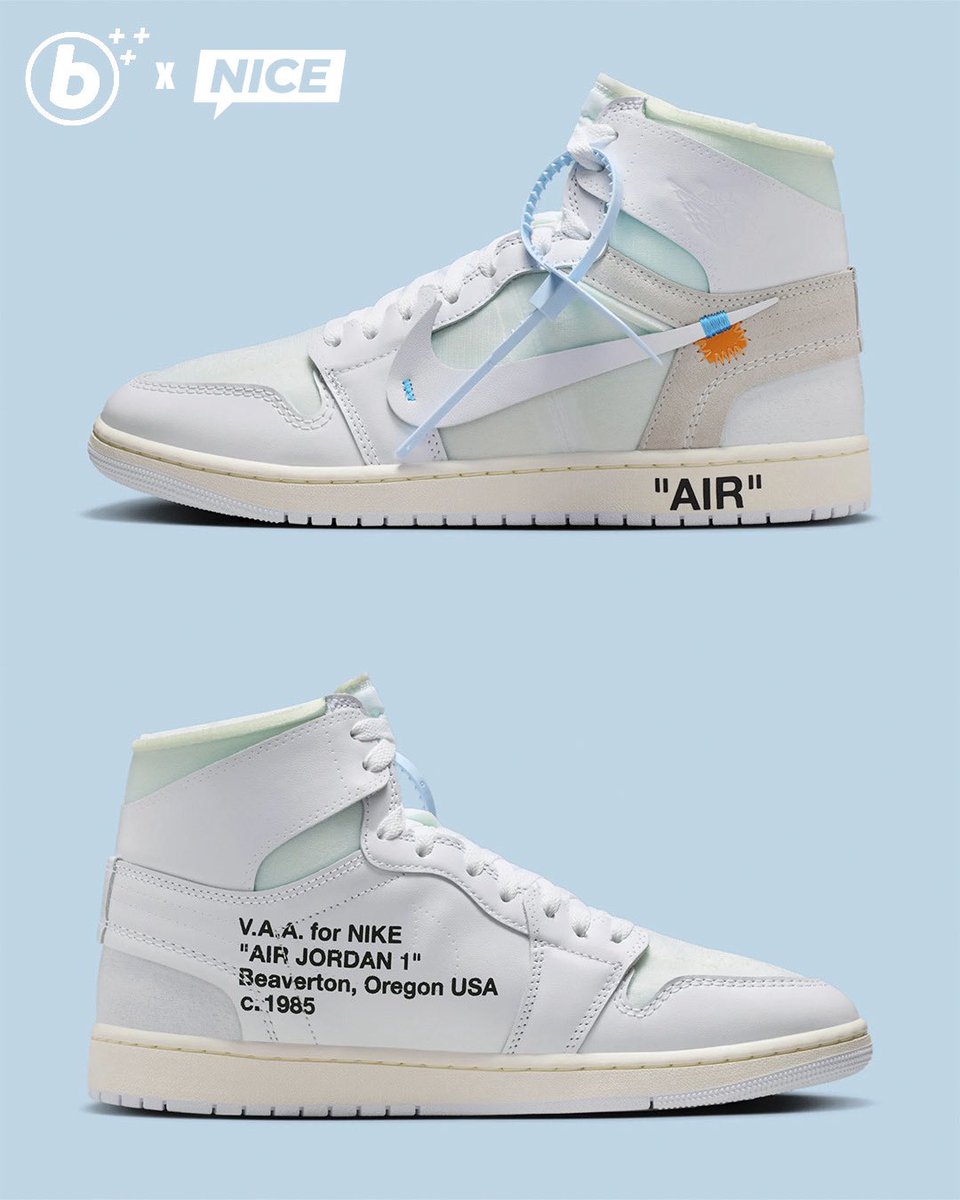
Did you take an L on the Virgil Abloh Archive x Air Jordan 1? 🤔
We’ve linked with The Better Generation to give a few of you the chance to win a pair at retail price! 👀🔥
TWO STEPS TO ENTER:
- Follow @TBGeneration
- Quote tweet with your US size
Winners announced 5/4 🗓️
If you’d told me a few years ago this is where we’d be on Iran, I’d have said you were high:
1. Nuke program set back years. Enrichment and reprocessing gutted, weaponization sites destroyed, Fordow inoperable, Natanz in ruins, a generation of senior nuclear scientists eliminated.
2. Ballistic missile program crippled. Monthly production down from 100 to near zero. Roughly half the regime’s missiles and launchers destroyed. The IRGC Aerospace Force commander who ran the missile enterprise dead.
3. Air defenses devastated. American and Israeli airpower dominating Iranian skies, with strike aircraft operating over the country with near impunity.
4. Full economic warfare. Not just OFAC sanctions anymore, but military pressure layered on top: naval blockade, near-zero oil exports, choked imports, wrecked steel and petrochemical sectors, triple-digit inflation, and a currency that is effectively worthless.
5. Regime decapitation. Khamenei dead. Larijani dead. Hundreds of senior IRGC, intelligence, military, and Basij commanders dead including the IRGC commander-in-chief, the armed forces chief of staff, and the Aerospace Force commander. Mojtaba Khamenei inheriting a hollowed-out regime with no supreme authority and a gutted command structure.
6. The region turning on Tehran. Gulf states shutting down the sanctions-busting, money-laundering, and financial escape routes the regime has relied on for years. No Arab capital willing to throw Iran a lifeline. China and Russia providing limited support.
7. Proxy network shattered. Hezbollah and Hamas heavily degraded. Houthi political leadership taking direct Israeli strikes. The “Axis of Resistance” and “ring of fire” are now more slogans than real threats.
8. Syrian corridor severed. Assad is gone. The new government in Damascus is actively blocking Iranian arms transfers to Hezbollah: arresting smugglers and publicly declaring Syria will no longer serve as a transit corridor for Tehran’s terrorists. The land bridge to the Mediterranean that took decades to build is effectively closed.
9. Lebanon pivoting west. With Hezbollah battered and resupply choked, Israel and Lebanon have opened direct peace talks for the first time since 1983, aimed at a permanent agreement and Hezbollah’s disarmament. Beirut now asserting that the Lebanese armed forces alone are responsible for national defense. This is a direct repudiation of Hezbollah’s “resistance” claim. TBD.
10. Deterrence exposed as a bluff. Four direct attacks on Israel — April 2024, October 2024, June 2025, March 2026 — failed to impose strategic cost and instead triggered heavy retaliation. Iran couldn’t even use Syria as a launchpad.
11.Economy hollowed out from within. Power shortages, water crises, factory shutdowns, pension unrest, and mass protests. Nationwide demonstrations erupted in December 2025 after a year of economic freefall, with bazaaris, oil workers, and truckers, the regime’s traditional support base, joining strikes across all 31 provinces. Running out of oil storage space. Fuel shortages. The worst crisis since 1979.
12. Scientific and technical brain drain. Beyond the nuclear experts, Iran has lost a generation of irreplaceable expertise in missile design, centrifuge engineering, and weapons development. The survivors are harder to recruit and easier to deter.
13. Naval power decimated. The regular navy shattered, IRGC navy taking growing losses as CENTCOM moves to reopen Hormuz.
And against all of this: the regime forced to play its Hormuz card at its weakest possible moment when the U.S. has options instead of when we didn’t: namely, Tehran with nuclear-armed ICBMs, 10,000 ballistic missiles, a Chinese- and Russian-built military, hundreds of thousands of attack drones, a fully operational terror network, and hundreds of billions of dollars to harden its economy.
That’s the strategic picture. It’s extraordinary. Much more to do but I can’t comprehend how much has been achieved.
GIVEAWAY: We're giving away a FREE pair of the Virgil Abloh Archives x Air Jordan 1 High Alaska ❄️❄️❄️
To Enter:
1️⃣ Retweet & Like
2️⃣ Comment your size
3️⃣ Must be following @SoleRetriever