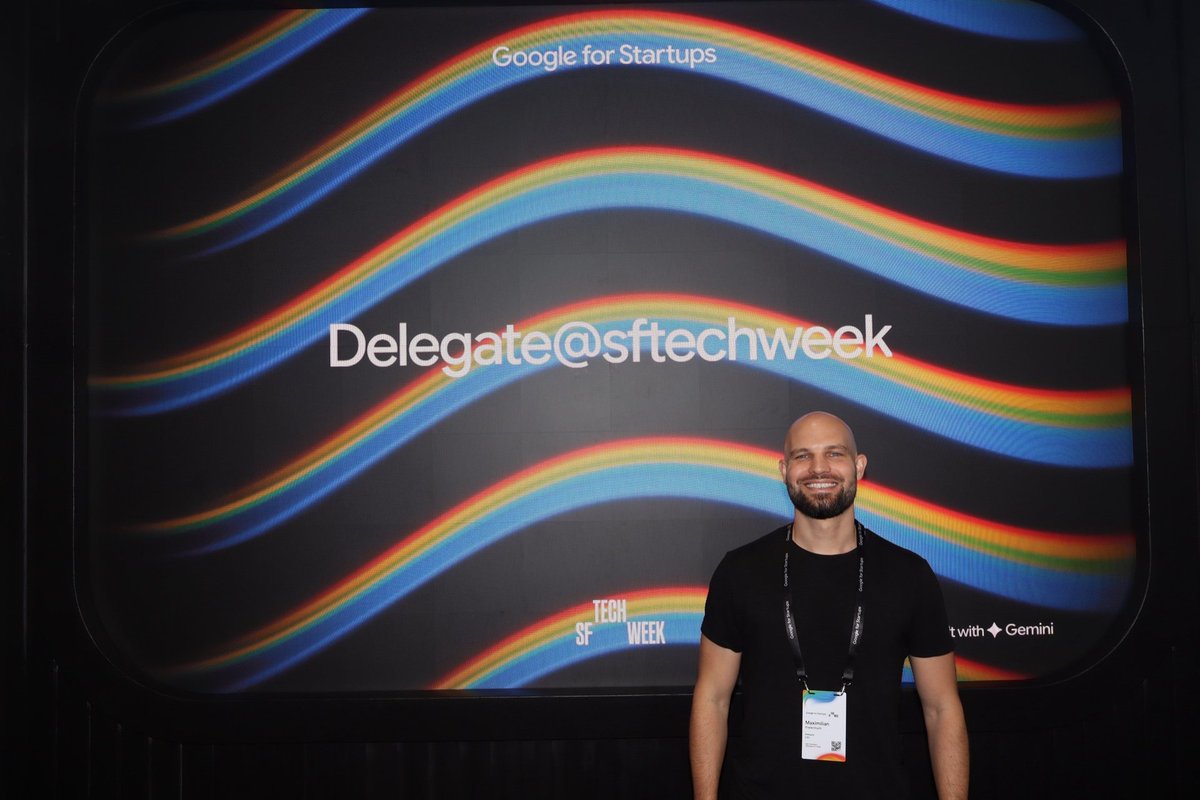
Today, we're launching Delegate: @dlgtio
With Delegate, your Claude / Codex / ChatGPT can do things that were previously impossible.
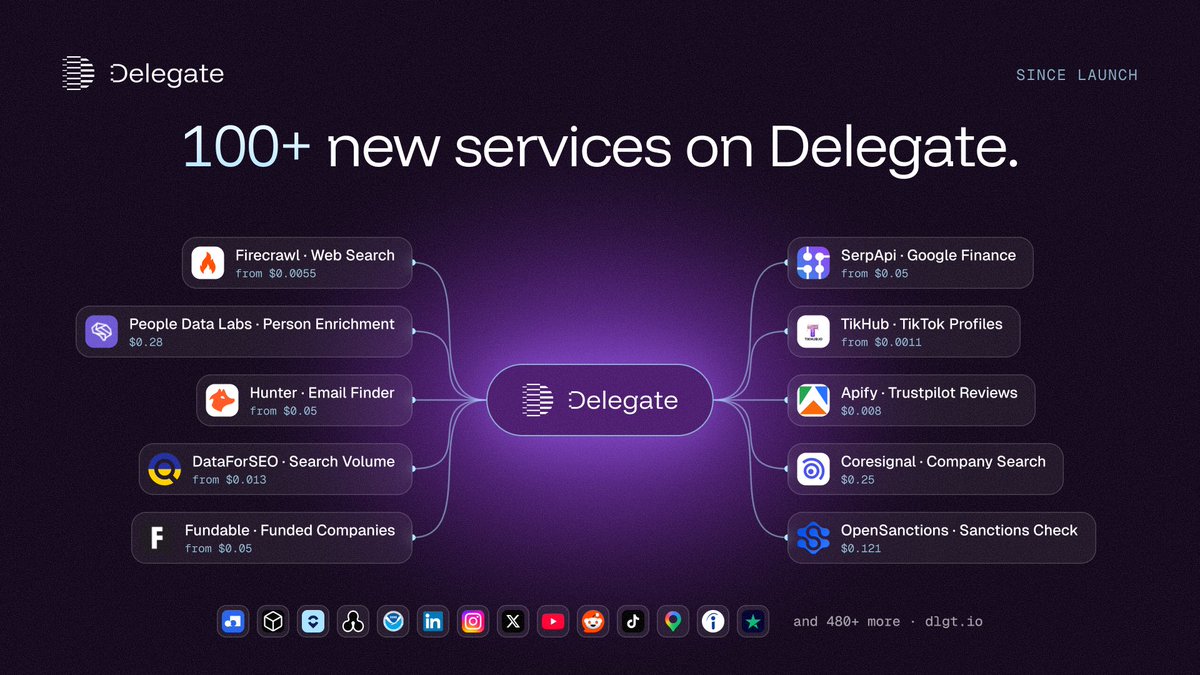
It gives your agent access to data it can't reach on its own: TikTok, Instagram, Reddit, YouTube, LinkedIn, B2B contact databases, financial and maps data, email tools, specialized models like ElevenLabs and 476 other verified services. No paid placement. Adding new ones daily.
Why: those services easily cost you 20+ subscriptions at $200+ a month. On Delegate you pay per request (~few cents) and your agent decides what it needs for the job.
Sign up today and get $20 for free.
Wow, so much major stuff was said in today's SpaceX earnings report; I don't even know where to start explaining it all.
1. Tesla & SpaceX have formed special committees to negotiate a merger, and Elon says it’s a good idea.
2. $500B–$1T ARR targeted by the end of 2027. Won't sound so absurd once Agentic AGI is achieved next year and if they deploy 10GW+.
3. 2.5–3 GW by year-end, at 220K GB300s/ 400MW deployed every MONTH. Elon is highly confident of 10 GW more compute in 2027 (≈13 GW total), with a plan for 20+ GW if everything goes right. Agentic AGI will make it look small.
4. Terafab first test chip May–June 2027 (Austin), volume production Q3–Q4 2028.
5. Starship Flight 15 will try to catch both stages next month; weekly flights in H1 2027. Next month will be epic is all I will say here!
6. Modular inference compute: factory-built clusters with power and cooling built in, deployed all over the country & globally, which implies Tesla Supercharger network, which has capacity for up to 15-20 GW peak globally.
7. 440K Vera Rubin training cluster by end of Q2 2027, to make Grok “potentially the best model"; no other lab will have this many Rubins.
8. Grok Bot enterprise going wide “within a few weeks” as a “virtual human”, major implications as the first mass automation of jobs, with consumers already at 800K paid weekly users doubling monthly.
9. SpaceX casts its own turbine blades, so it brings power online 12–18 months faster than anyone. Will make an entire analysis on this, but super major deal if it comes through in time.
11. Q1 2027 revenue guided at $33–37B; just one year ago, total year revenue was barely half that, crazy.
12. Louisiana spaceport will have 20+ towers, with launches at scale in 2029. This will easily produce thousands of flights a year, which is just.... .
@emollick I’d add the right tools to that:
smart model + harness + tools.
Sometimes an agent knows how to do the job and just can’t get the data it needs. LinkedIn and Instagram are good examples. Services like Delegate can help fill those gaps. https://t.co/BVxIeHqXXD
Introducing Delegate Agents.
705+ services in one chat: social, search, SEO, finance, crypto, research, companies, coding, and more.
No subscriptions, no extensions. Pay per request, just a few cents each.
https://t.co/Kq9lQ95H47
We're launching Delegate Agents.
Delegate your questions & tasks to 695+ services, proprietary data sources, specialized models and more.
Try it for top of funnel lead generation, SEO, B2C/B2B marketing, product & e-commerce research, stocks, video/image/voice gen or agent email.
No need to install or integrate anything, runs directly in your browser, pay only for what you use.
https://t.co/seFvwaMepk
@getcontextdev allows next level web scraping. An amazing ressource built by @mynameisyahia
No idea when to use it?
No worries, with Delegate you can let your agent chose.
Now, we use Jev inside Delegate.
Before your agent gets matched to a service, every provider is graded on the jobs it actually delivered. An LLM used to do that grading. Jev does it now, and the scores are far steadier.
What you get: a better answer, from the service that has proven it's best at your task.
I agree. Choosing the right model is important. Getting the job done takes all three: the model, the harness, and the toolkit.
A browser and a few basic tools only get you so far. You need more than a hammer when the job calls for data from places like LinkedIn or Instagram.
That’s what we’re working on with Delegate: letting agents find and use the extra tools they need
https://t.co/7JNB3WcAEr
@TreeRunner5000@tariqkhanfmd SpaceXAI hosted Anthropic und Google. Evtl. haben die da einen speziellen Deal ausgehandelt. Und OpenAI wird er vermutlich eher nicht anbieten ;)
Sehe ich ähnlich. Neben dem Modell ist aber auch der Harness entscheidend und welche Werkzeuge er dem Agenten gibt. Bei WebGPT war das 2021 ein Browser, später kamen bei ChatGPT Code-Ausführung und Plugins dazu.
Diese Tools reichen aber nicht für alle Aufgaben aus. Wenn der Agent beispielsweise auf LinkedIn oder Instagram nach Informationen suchen soll, stößt er damit schnell an Grenzen.
Mit Delegate arbeiten wir daran, dem Harness weitere spezialisierte Werkzeuge und Dienste zur Verfügung zu stellen, die der Agent bei Bedarf nutzen kann.
https://t.co/7JNB3WcAEr
@elonmusk@bot@SpaceX Even a genius needs more than a hammer 🔨
Give your AI the best brain AND the right tools.
That’s why we’re building Delegate @dlgtio: your agent finds and uses the services it needs for each job.
I think the important point is that not every transaction needs global consensus.
Your coffee payment shouldn’t have to compete for blockspace with every game, exchange or other application. Keep activity local where possible, and connect chains when you actually need to.
Others are working on similar ideas, but I think Avalanche has the best architecture for this.
@snowpeerio has a great visualization.
It’s not going to be one chain to rule them all.
@hosseeb of @dragonfly talks about how Avalanche’s unique L1 infrastructure powers interoperability onchain.
@Bazzaruto@nbaschez One example: your agent hires a specialist through @dlgtio for a job that takes a while. Delegate can notify the calling agent when it’s done, so it can pick up the result and continue the workflow.
@santtiagom_ Really good breakdown. Funny reading this because it sounds so similar to what we're building at Delegate, but for public services. One MCP connection where agents discover and use the tools they need across different providers.
This is very close to what we're building at Delegate, but for public services. One MCP connection, then agents discover the services and tools they need and use them. Same idea, beyond one company's internal systems.
Uber publicó cómo armó su infraestructura de MCP y hay varias ideas muy buenas acá.
imaginate una empresa con miles de servicios internos y muchos equipos conectando agentes a esos sistemas por su cuenta.
cuando eso empieza a crecer, terminás con tooling fragmentado, infra duplicada, distintas formas de exponer tools y poca consistencia en seguridad, discovery y operación.
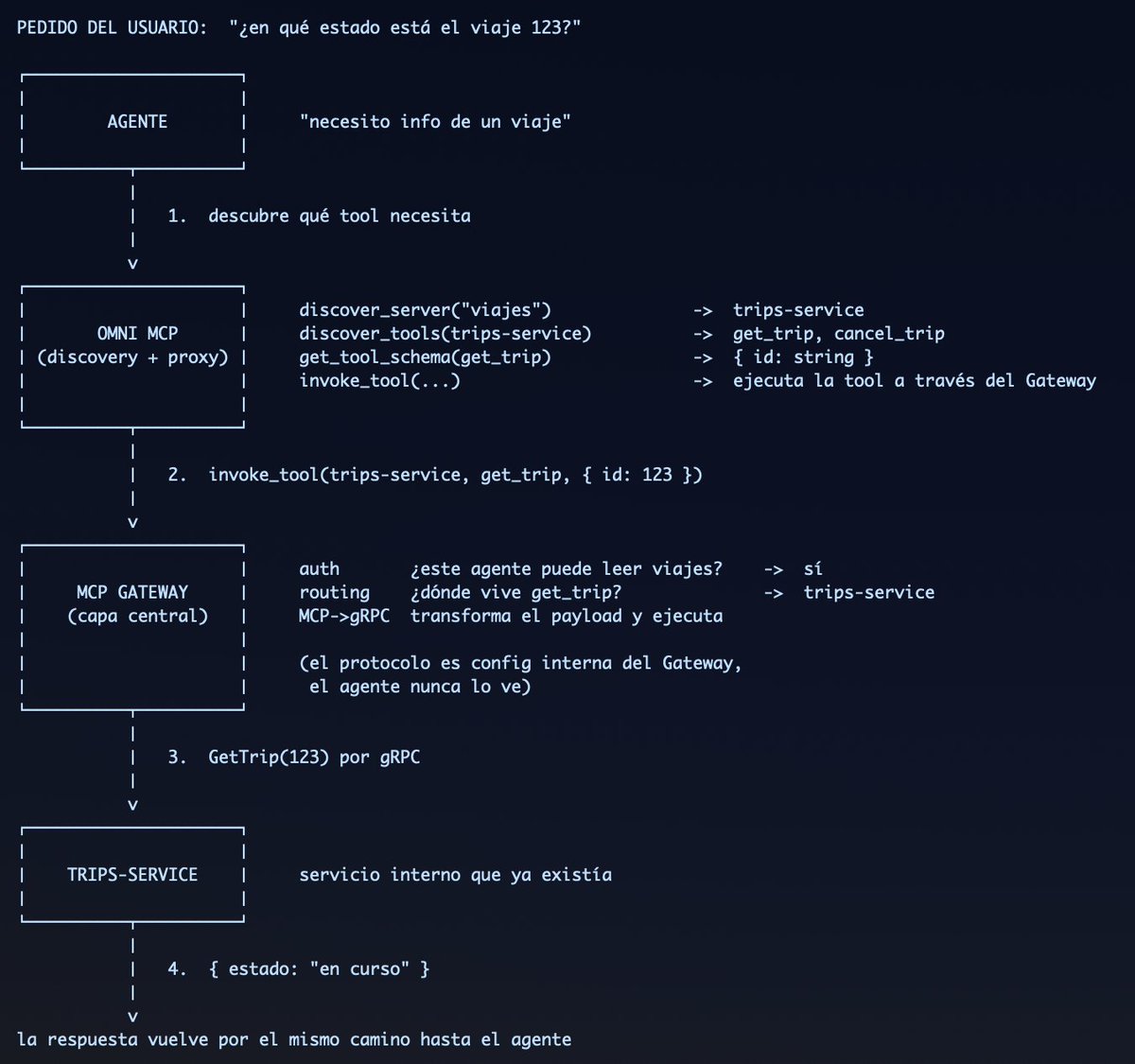
por eso Uber hizo un MCP Gateway: una capa central entre los agentes y sus servicios internos.
el agente habla MCP y el gateway se encarga de routing, permisos, ejecución y de traducir las llamadas a HTTP, gRPC o TChannel según corresponda.
como Uber ya tenía miles de APIs internas, también hicieron AutoCrawler: recorre sus definiciones, detecta métodos y schemas y genera MCP tools automáticamente. incluso usan un LLM para mejorar las descripciones.
hoy tienen +800 MCP servers y +5000 tools. y ahí aparece otro problema: no podés cargar todas esas definiciones en el contexto del modelo.
para eso crearon Omni MCP. en vez de pasarle miles de tools al agente, este va descubriendo qué server necesita, qué tools tiene disponibles, carga el schema de la correcta y recién ahí ejecuta.
me parece un muy buen ejemplo de cómo cambia la arquitectura cuando los agentes pasan de usar unas pocas tools a trabajar con miles.
terminás necesitando algo muy parecido a un API Gateway para agentes.