Lançado pela @editjuspodivm meu livro " Justiça na Blockchain: Smart Contracts e Cortes Descentralizadas)", com a honra do prefácio ser do grande inspirador Federico Ast @federicoast . https://t.co/z5XWNbAFoj
Miren qué tremenda obra colectiva sobre Autonomía Privada y consentimiento. De ahora mismo. Open access, pueden descargar libremente.
Reconozcamos que, hoy, el que no estudia es porque no quiere.
Aquí la obra:https://t.co/mMpOqLa5Hk
Which AI decides your dispute is starting to matter as much as which arbitrator does. ⚖️🤖
With @williamhwgeorge and Rob Dean, we ran 99 real fintech consumer disputes through different AI models acting as jurors: the same instructions, the same facts and the same rules the human jurors had received.
Claude Opus 4.7 was nearly FIVE times more likely than ChatGPT 5.5 to rule in the consumer's favor. And Opus 4.8, the newer version of the same model, systematically reversed some of its own predecessor's rulings by silently applying a different burden-of-proof standard.
The full results, published today on the @Wolters_Kluwer International Arbitration & Mediation Blog, are the empirical starting point for a problem the "AI in dispute resolution" narrative tends to skip.
Over the decades, commercial arbitration built an entire toolkit (arbitrator lists, disclosure obligations, challenge procedures) around the fact that WHO decides shapes WHAT gets decided.
How this toolkit applies to AI might be one of the most critical questions of the next decade of arbitration.
Read the full piece on the Kluwer Arbitration Blog:
https://t.co/2qIxDPxW3j
I think a common problem in the blockchain industry is people trying to “disrupt” industries they haven’t really worked in and know nothing about. Sometimes thinking out of the box is cool. But sometimes there are still valid reasons why legacy systems are the way they are.
This is why Marcos’s contribution is so relevant, in my view. It comes from someone with years of experience who knows very well what he’s talking about and where the real opportunities for adoption lie.
Meet @marcosjps, a participant in the 7th batch of the Kleros Fellowship of Justice and one of the pioneers in the decentralized justice movement. 🇧🇷🧑⚖️
Marcos is a public prosecutor at the Public Prosecutor's Office of the State of Paraná (Brazil) and is the author of "Justiça na Blockchain: Smart Contracts e Cortes Descentralizadas", the first book in Portuguese on decentralized justice.
His graduation research for the Fellowship was: "Integrating Kleros Into The Brazilian Justice System".
His contribution comes from the perspective of someone who litigates daily inside the Brazilian judicial system and as a result is very institutionally grounded. His work starts from a familiar diagnosis (the structural overload of Brazilian courts) and proposes different levels of Kleros integration to help solve the problem.
First as a mechanism to defuse unnecessary claims before they reach the courts.
Second, as an "assistant" to the state judge, providing inputs to improve the quality of decisions.
And finally (the boldest point of the thesis) as an issuer of binding and enforceable decisions, directly taking on part of the service the judiciary provides today.
You can read more about Marcos and his research here: 👇
https://t.co/OlKV6aWlQH
1/ Today, the Global Policy Strategy (GPS) team is publishing Ethereum Basics for Governments and Institutions, a non-technical primer to equip the leaders making policy and deployment decisions with an understanding of how Ethereum works, how it's governed, and how it compares with perceived alternatives.
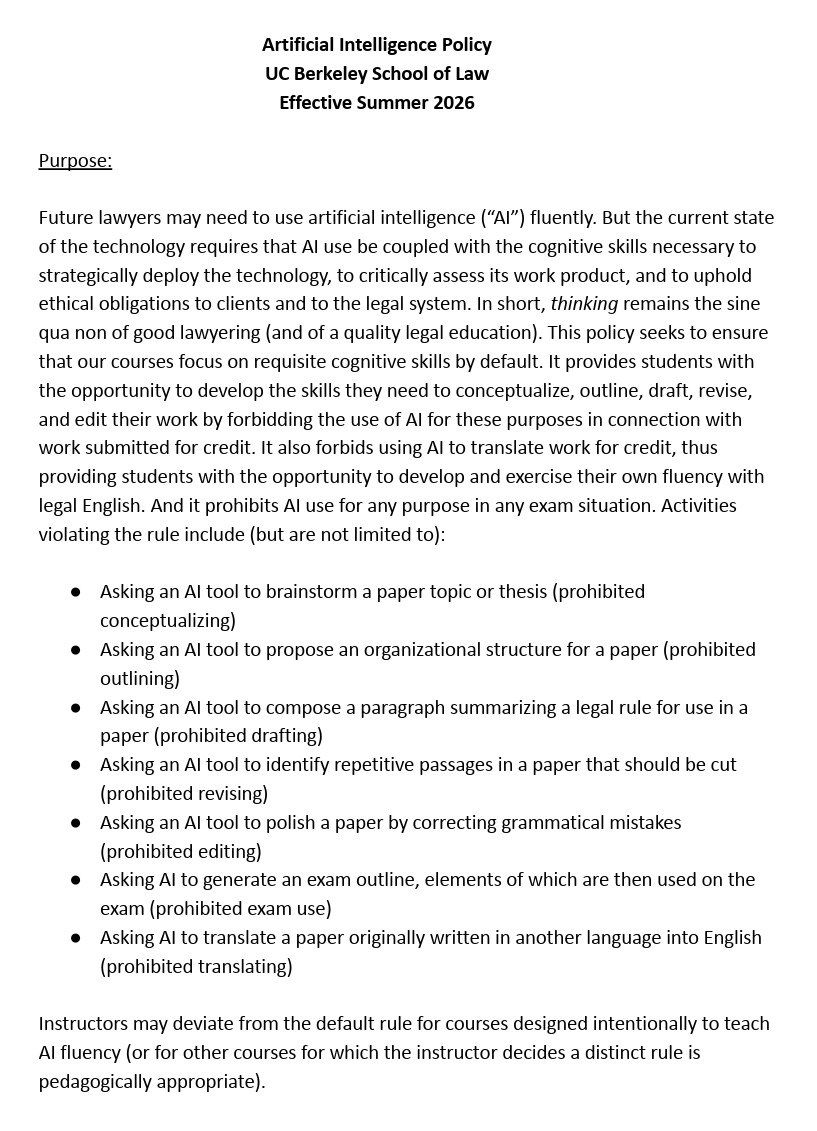
🖥️ The new Artificial Intelligence policy at UC Berkeley School of Law, effective Summer 2026.
📝 Here is the main rule:
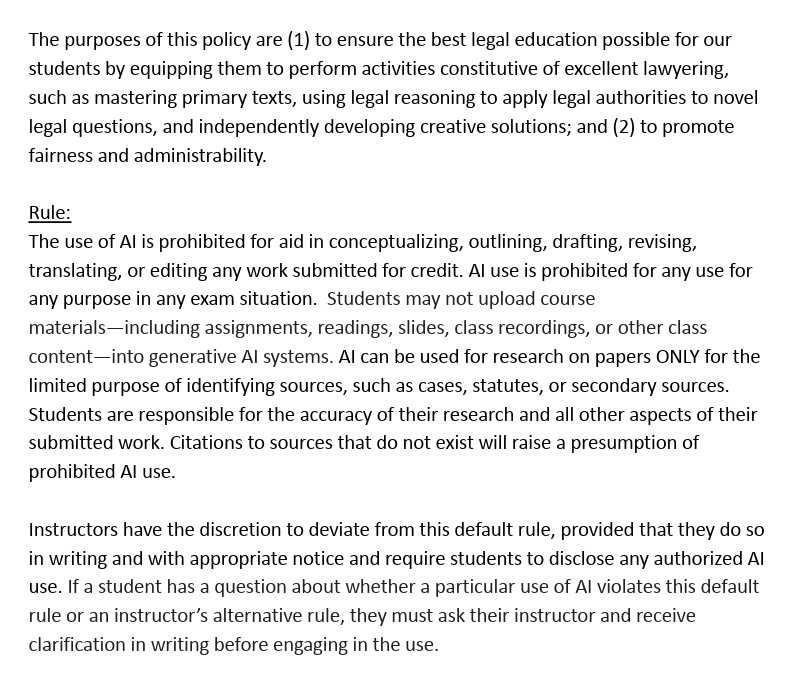
"The use of AI is prohibited for aid in conceptualizing, outlining, drafting, revising, translating, or editing any work submitted for credit. AI use is prohibited for any use for any purpose in any exam situation. Students may not upload course materials—including assignments, readings, slides, class recordings, or other class content—into generative AI systems. AI can be used for research on papers ONLY for the limited purpose of identifying sources, such as cases, statutes, or secondary sources."
"Somos lo suficientemente listos como para inventar la #InteligenciaArtificial, tan tontos como para necesitarla, y tan estúpidos que no podemos averiguar si hicimos lo correcto" #JerrySeinfeld#FallonTonight
🔢 Can you read hex strings? Neither can we.
The @ethereum Foundation just shipped "Clear Signing": a standard that turns 0x... into readable swaps.
Kleros Scout is ready to be the data layer underneath: 2.6M+ address tags, tokens, contract/domain pairs.
Signing transactions shouldn't be a leap of faith ↓
Compiled law is coming.
Current AI systems are the first systems we have ever built that can read a paragraph of statutory text, an evolving fact pattern, and a precedent, and produce a structured output that is good enough most of the time to act on.
They'll turn natural language into a programmable interface.
Instead of watching an hour of Netflix watch this 30 minutes lecture and learn more about bitcoin mining than most people working at top Bitcoin companies learn in their entire careers.
En Argentina se acaban de resolver tres casos reales de protección al consumidor en una corte de Kleros, con jurados que necesitan determinadas credenciales para participar.
Disputas reales, resueltas sin un juez, sin esperar turno en un sistema que acumula décadas de promesas incumplidas.
La reforma judicial,que tanto se necesita para este tipo de disputas, está llegando.
Un cliente compró comida para gatos por internet y recibió comida para perros. El vendedor se negó a hacer un reembolso.
El caso fue llevado a la corte digital de Kleros.
Resultados en el primer comentario.
Jony Ive designed the iPhone. The iMac. The MacBook.
He asked Steve Jobs to soften his criticism.
Jobs: "No. You're just vain. You want people to like you."
Jony was furious.
Because he knew it was true.
He spent 3 minutes explaining what Jobs actually taught him:
The first lesson: Focus.
"This sounds really simplistic. But it still shocks me how few people actually practice it."
"Steve was the most remarkably focused person I've ever met in my life."
"Focus is not something you aspire to. It's not something you decide on Monday. 'You know what, I'm going to be focused.'"
"It is every minute asking: why are we talking about this? This is what we're working on."
"You can achieve so much when you truly focus."
The second lesson: What focus actually means.
"One of the things Steve would say, because I think he was concerned that I wasn't focused, he would say: how many things have you said no to?"
"And I would have these sacrificial things. Because I wanted to be very honest about it."
"So I'd say: I said no to this, and no to that."
"But he knew I wasn't vaguely interested in doing those things anyway. So there was no real sacrifice."
Here's what real focus means.
"Saying no to something that with every bone in your body you think is a phenomenal idea."
"That you wake up thinking about."
"But you say no to it because you're focusing on something else."
The third lesson: The difference between caring about people and caring about being liked.
Jony asked Jobs why he was so harsh.
"Couldn't we moderate the things we said a little bit?"
"Why?"
"Because I care about the team."
Jobs said something brutally insightful.
"No Johnny. You're just really vain."
"You just want people to like you."
"I thought you really held the work up as the most important. Not how you believed you were perceived by other people."
"I was terribly cross."
"Because I knew he was right."
How will agents trust each other to do business?
How will they build reputation — the way gig workers do?
Which trust bridges need to exist before this can start?
@sophiadew breaks down the @a16zcrypto piece on the missing infrastructure for the agent economy.
🇦🇷Argentina’s Resolution 893/2025 modernizes the "Customer Defender" figure: it allows independent, panel-based bodies, selection by random draw from an approved roster, fully online ODR, and decisions that become binding if the consumer accepts.
This opens the door for Kleros (with 2.0's juror certification) to serve as an impartial Customer Defender, cutting legal/ops costs for companies and giving consumers fast (≤5 days), efficient, online decisions by an impartial panel.
Argentine consumer-law professionals: interested in participating? Check @federicoast's thread for details. 🧑⚖️
El fracaso es el mejor maestro. Walt Disney fue rechazado por 'falta de imaginación', a Stephen King le devolvieron su novela 30 veces, y a los Beatles los rechazaron por 'no tener futuro en la música'. Aprender de los errores nos ayuda a corregir, priorizar y perseverar
Robert Sapolsky is a Stanford neuroscientist who proved chronic stress is the silent killer doctors ignore.
On Chris Williamson's podcast, he revealed 10 "normal" habits you do every day that wreck your sleep, mood, and nervous system:
1) Replay conversations in your head