58% of revenue generated by DeFi lending protocols belongs to @Aave.
This metric will keep growing, as Aave is currently scaling:
1. Curated markets on V4, with @SentoraHQ being the first
2. Tokenized asset hubs, with Aave already having 28% of all tokenized equity loans
3. Swaps, with over $550K in swap fees generated in October
4. Liquidation efficiency and value recapture, with SVR generating $10M+ in revenue for Aave throughout 2026.
Don't sleep on Aave.
Data by @Blockworks and TokenLogic
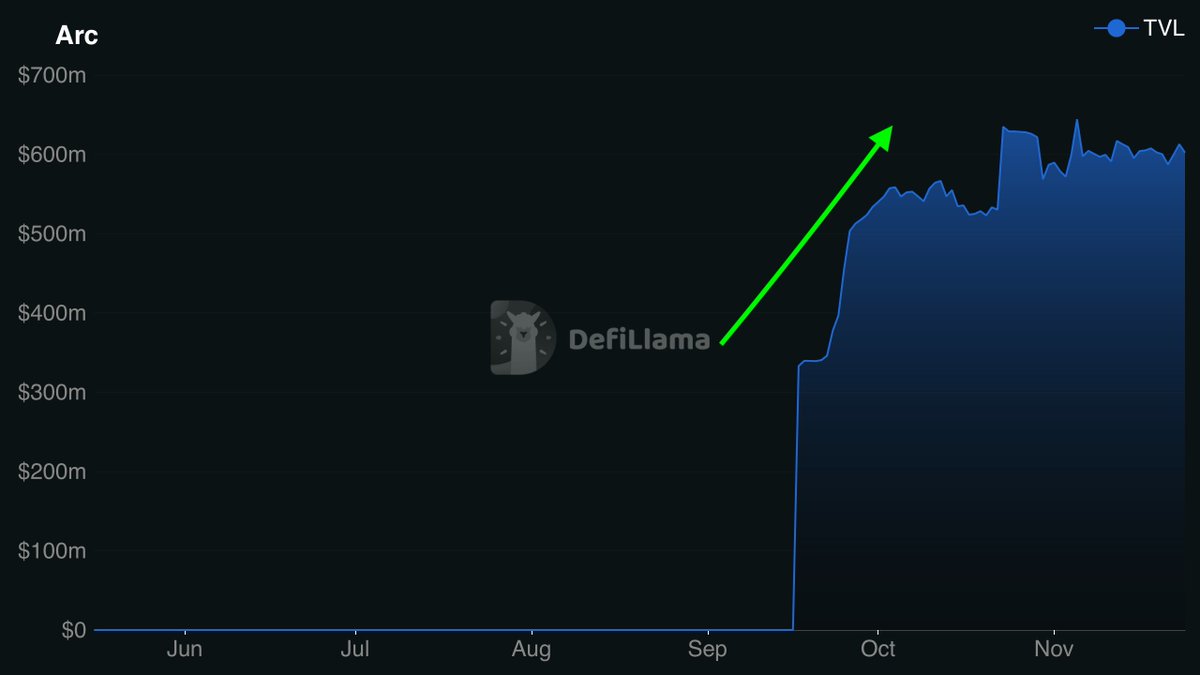
Arc is one of the chains I've been watching closely during the recent DeFi downturn
Still holding up relatively well ↓
• $613M TVL
• $1.55B stablecoin supply
• Nearly 78% of TVL comes from @aave and @Morpho
Most of Arc's liquidity is concentrated in credit markets
I think this is an important direction for a stablecoin-focused chain
Beyond payments and transfers, users can earn yield on their idle stablecoin balances through lending markets
⤷ I'll be watching whether @arc can turn stablecoin payment activity into real demand for credit
@safetyth1rd Trump has just over 2 years left in office
Is Takaichi betting too heavily on his support when there's no guarantee his successor will take the same stance?
You want yields? Points? Giga-brain farming strats?
A place where both yield and points farmooors can enjoy the treat!
It's time for Yield Collective No. 65
Bring your wallet, let’s eat 👇
you'll almost never time the exact bottom or top
buy early and you get underwater fast. sell early and you watch it go higher without you. hodl too long without a target and a single pullback wipes out months of profit
most people forget that a 50% drop takes a 100% gain just to break even - and big drawdowns wreck your mindset just as much as your wallet
always have a risk management plan before you click the button, stick to it when emotions kick in, and always protect what you've earned
Found a nice tool from @valueverse_ai you gotta check
It ranks tokens by 30d P/FCFt - basically how much you're paying for every $1 of cashflow that actually reaches holders (buybacks, fee share, etc).
Lower = cheaper relative to holder value accrual. Top 10 cheapest right now:
aerodrome-finance:native - 4.6x
$GOMINING - 5.2x
$CRV - 7.8x
$PUMP - 8.8x
$PENDLE - 10.8x
$SKY - 14.9x
$GEOD - 19.8x
$UNI - 41.8x
$LIT - 43.8x
$HYPE - 58.3x
Looking at this table, the recent dump has pulled many projects with real revenue into a much more comfortable discount zone.
In derivatives group, because token prices corrected more than the decline in revenue, many large protocols have become significantly cheaper compared to 3 months ago.
→ Clear examples are $HYPE and $LIT.
In contrast to the broader valuation compression, a few names recorded a sharp rise in P/FCFt over the past 90D because their token prices held up better than the short-term pace of fee generation.
→ The standouts are $ETHFI and $CAKE.
NFA, DYOR.
⊢ let's have an update from the privacy era:
- @ambire shipped @0xprivacypools transfers in its main release, with 0xBow and Kohaku support, visibility into anonymity protection, and tx history generated entirely on-device.
- @fhenix activated coFHE on ethereum and arbitrum. dual-mode tokens for switching between public and confidential states are in development
and USDG-backed $FUSD and yield-bearing $FUSDY are planned for december.
- @FlutonIO is live on arbitrum.
you can deposit $ETH/ $USDC and make private payments using zk and fhenix's cofhe for encrypted balances.
deposits and withdrawals remain public.
- @tacitfi made tacit. wei fully onchain and immutable. eth is split into standard tornado denominations for a larger anonymity set, with swaps supported for any token.
- @cakewallet added offline shielded $ZEC signing to cupcake.
an old phone can now sign txs without bringing private keys online.
- @aztecnetwork reached stage 2 decentralization with tierra V6.
normal network operations no longer rely on centralized team control.
- @P_Inference built a 26-model ai chat on aztec with private cUSDC payments through nulo.
sender, recipient, and amount stay hidden onchain.
the public beta and api are live.
- @unicity_labs is working on proof CLI for proving document ownership and history, and audit capsule for logging agent events.
migration from PoA to PoS is underway.
unicity qatar has been established, cooperation efforts with ooredoo have started, and major government discussions in oman and egypt are ongoing.
- @Himess__ built an encrypted account prototype using @zama's fhe.
the PIN stays encrypted in the contract and some transfers still require it even if the seed leaks.
PIN guesses are limited.
it's on sepolia and unaudited for now.
- @citrea_xyz plans to migrate its rollup proofs and clementine bridge to @SuccinctLabs's sp1 in the nov 23 pomelo upgrade.
nodes must update by nov 25.
and what about @NEARProtocol:
- @near_ai offers tee inference with verifiable attestation. gteway now includes red team sandbox for code security testing with models that have no refusal restrictions.
- near business offers confidential multisig treasury management across 35+ networks, with batch payments, swaps, and yield.
permanent deposit addresses are now available alongside one-time addresses.
- @near_intents powers features in unstoppable wallet, leoDEX, and circuit, including $BTC invoice payments with zec, private swaps, and automated agent trading.
something interesting happens when the market crashes: lending fees across DeFi protocols start surging.
i just checked the latest data from @Morpho and @aave, and the numbers caught my attention.
according to DefiLlama, on november 20:
- Morpho Blue: $3.11M fees, roughly 4x normal levels
- Aave V3: $2.22M fees, up 55%
- Aave V3 protocol revenue: only ~$370K
→ that's $5.33M in combined fees in just one day.
so what's driving this sudden spike? i think there are a few reasons.
[1] liquidations: as collateral prices fall, leveraged positions become unhealthy, triggering liquidations and additional fees across lending markets.
[2] higher borrowing costs: when liquidity gets tighter and borrowing demand remains high, utilization can rise, pushing interest rates and fees higher.
[3] deleveraging activity: traders rush to repay debt, unwind positions and rebalance collateral, creating more activity across lending protocols.
but remember fees aren't the same as protocol revenue. much of that money goes to lenders and other participants.
i'm still bullish on the long-term role of DeFi, especially protocols that can turn this activity into sustainable revenue.
that's one reason i continue to have conviction in $ETH and its DeFi ecosystem.
This is probably one of the safest places to farm USDC right now:
> Only major tokenized stocks as collateral
> ~6% APY on USDC
> No lockup, withdraw when liquidity is available
Still comes with @aave smart contract, oracle, and collateral risks
Anywhere better than this?