The most expensive word in AI infrastructure is still “bottleneck.”
First it was GPUs, then HBM, then optics. This piece looks at the point where memory and optics meet:
MicroLED optical interconnects. The striking part is that Samsung Electronics, SK hynix, and Micron have all invested in the same startup, Avicena.
Avicena’s LightBundle uses MicroLED arrays instead of lasers, built around a “wide and slow” optical architecture.
The idea is not to push one channel faster, but to move data through hundreds of low-speed parallel optical lanes with lower power and latency.
The reason memory makers care is that this could become one of the structural candidates for future memory fabric, especially as HBM bandwidth keeps scaling.
If you still think of MicroLED only as a display technology, this article is a good reason to look again.
Going deep for you.
$QS alpha signals:
Board additions often signal the next phase.
When companies are pure R&D stories, they recruit scientists.
When they approach commercialization, they recruit operators, manufacturing leaders, defense executives, and financial veterans.
This is actually one of the strongest parts of the QS bull case that most investors aren't paying attention to.
If you zoom out, the people joining QS are not battery scientists. They're experts in scaling difficult technologies into mass production.
1. Dr. Siva Sivaram
This may be the most important hire of all.
Before QS, Siva spent decades in semiconductors and storage, including leadership roles at Western Digital.
That matters because QS's biggest challenge is no longer proving the battery works.
The challenge is manufacturing.
When I saw QS bring in a semiconductor manufacturing veteran instead of another battery researcher, it signaled that management believes the science hurdle is largely behind them and the execution hurdle is now dominant.
2. Geoff Ribar
Former CFO of NVIDIA, AMD, Cadence, Matrix Semiconductor.
Notice the pattern:
$NVDA → platform IP
$CDNS → design software monopoly
$AMD → semiconductor scaling
Matrix Semiconductor → advanced manufacturing
3. Ross Niebergall
L3Harris $LHX (CTO and later President of Aerojet Rocketdyne)
Aerojet Rocketdyne
Raytheon $RTX
Why is that interesting?
That is a strange board addition if QS is merely trying to become another EV battery company.
It makes more sense if QS sees future opportunities in aerospace, defense, drones, aviation, energy storage, and strategic battery applications.
4. Dennis Segers
Former CEO of Matrix Semiconductor and former chairman of Xilinx!!
Xilinx (invented the FPGA) went on to be one of the most important companies in the AI race and was bought out by $AMD
5. JB Straubel
Probably the most obvious one.
Few people understand battery supply chains, manufacturing, and EV economics better than Straubel.
He was pretty much the co founder and energy guy at $TSLA
What stands out?
The board increasingly resembles a semiconductor company more than a battery startup.
You have:
Semiconductor CEOs
Semiconductor CFOs
Manufacturing experts
Defense executives
Tesla veterans
Volkswagen battery leadership
This is an excellent interview btw
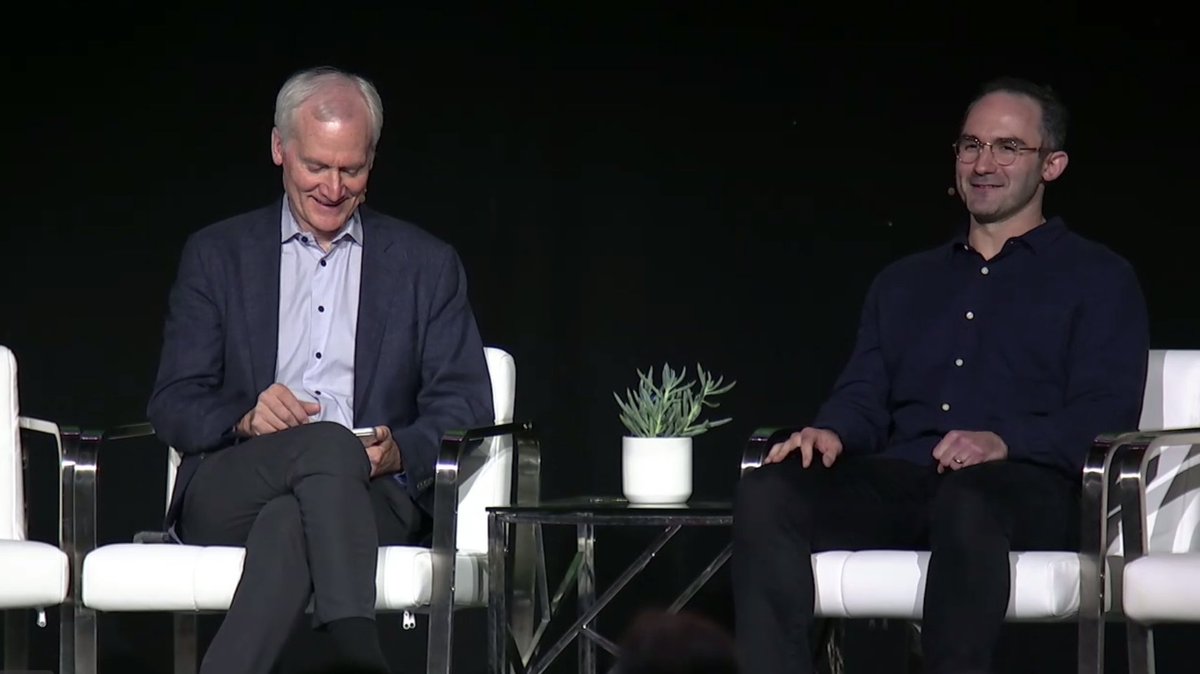
Nicolai (Norwegian Sovereign Wealth Fund CEO) asks the IBM CEO if AI a bubble
Listen very very carefully to his answer
NEW: Inside @PsiQuantum's Silicon Photonic Chipset
*Never-Before-Seen*
With Er-Xuan Ping, SVP, Barium Titanate (BTO) Development
Backdrop: the U.S. government just announced a $2B push into domestic quantum computing manufacturing - but what does that actually fund?
The @CommerceGov Department recently awarded PsiQuantum $100M to accelerate development of BTO, giving a rare look into the underlying manufacturing stack required to scale fault-tolerant quantum computing.
We profiled PsiQuantum last September following its $1B Series E, including how the company produces the world’s highest-performing optical switch - a core component of its silicon photonics platform.
PsiQuantum is currently the only company or institution in the world manufacturing this BTO material for optical switches at 300mm scale.
While the company built this silicon photonics platform for fault-tolerant quantum computing (FTQC)*, the implications may extend far beyond quantum itself.
As AI data centers increasingly shift from copper to optical networking, PsiQuantum’s photonics stack could also become foundational infrastructure for next-generation AI systems.
*Fault-tolerant quantum computing (FTQC) refers to quantum computers that can continue operating accurately even when individual quantum bits (“qubits”) are noisy or error-prone.
Shoutout to @PeteShadbolt
One of the biggest historical scams people successfully pulled off was convincing the world that Arabs only started massacring Jews in the Land of Israel because of “occupation” and modern Israel.
The 1929 Hebron Massacre alone completely destroys that narrative.
On August 24, 1929, Arab mobs in Hebron slaughtered one of the oldest Jewish communities in the world. There was no Israel. No IDF. No checkpoints. No “occupation.” No settlements.
Just Jews.
Hebron’s Jewish community had existed for centuries. Many were deeply religious families with roots going back generations, long before political Zionism even existed. But after weeks of incitement and false rumors surrounding Jewish access to holy sites in Jerusalem, Arab mobs stormed Jewish homes and began butchering civilians.
Jews were stabbed, beaten, mutilated, and hacked to death with axes. Families were murdered inside their homes. Synagogues were ransacked. Children and elderly Jews were not spared.
67 Jews were murdered.
Some survivors were only saved because a handful of neighbors hid Jewish families in their homes while the mobs searched the streets outside.
The massacre was so horrific that the surviving Jews were evacuated by the British, effectively ending a Jewish community in Hebron that had existed for hundreds of years.
And this is the part people desperately try to avoid:
This happened in 1929.
Before “occupation.”
Before “settlements.”
Before “the Nakba.”
Before modern Israel existed.
People can argue and complain all day about modern politics, borders, settlements, or governments. But the claim that anti-Jewish violence in the Land of Israel only began because of modern Israel falls apart the moment you look at what happened in Hebron in 1929.
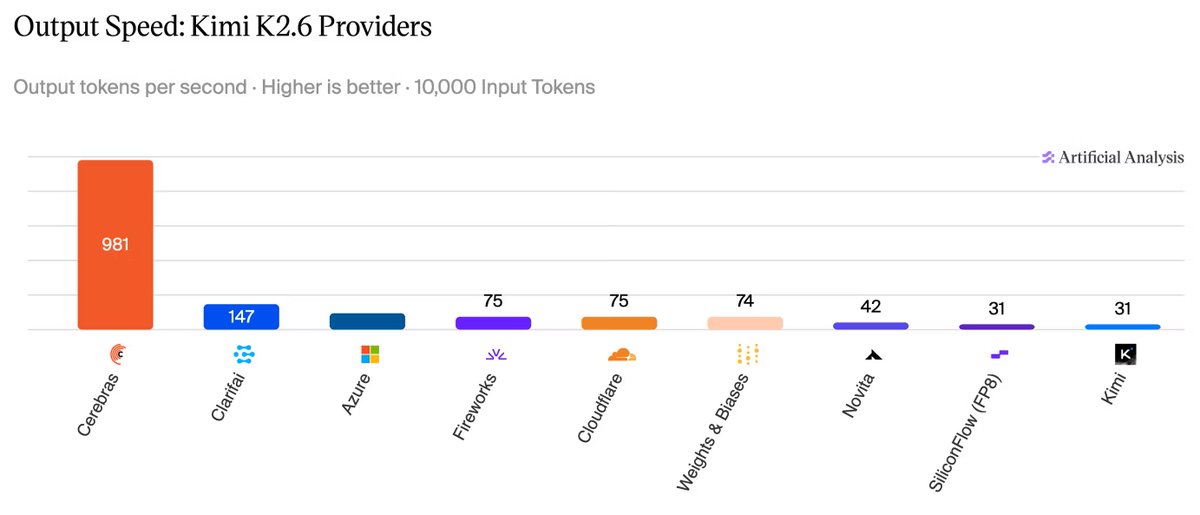
Cerebras is now running Kimi K2.6 – a trillion parameter model – in enterprise trials.
At ~1,000 tokens/s, this is the fastest frontier model performance ever measured by Artificial Analysis @ArtificialAnlys.
Everything Morgan Stanley says, I have been saying for a long time about Nvidia, the cost of datacenters, and the shift toward custom chips. The only “problem” is that Morgan Stanley still argues Nvidia is the preferred path, while Anthropic and Google are showing that it is not.
Only xAI, OpenAI, and Microsoft had little choice but to pay Nvidia’s premium pricing. The same goes for Meta.
But not for long.
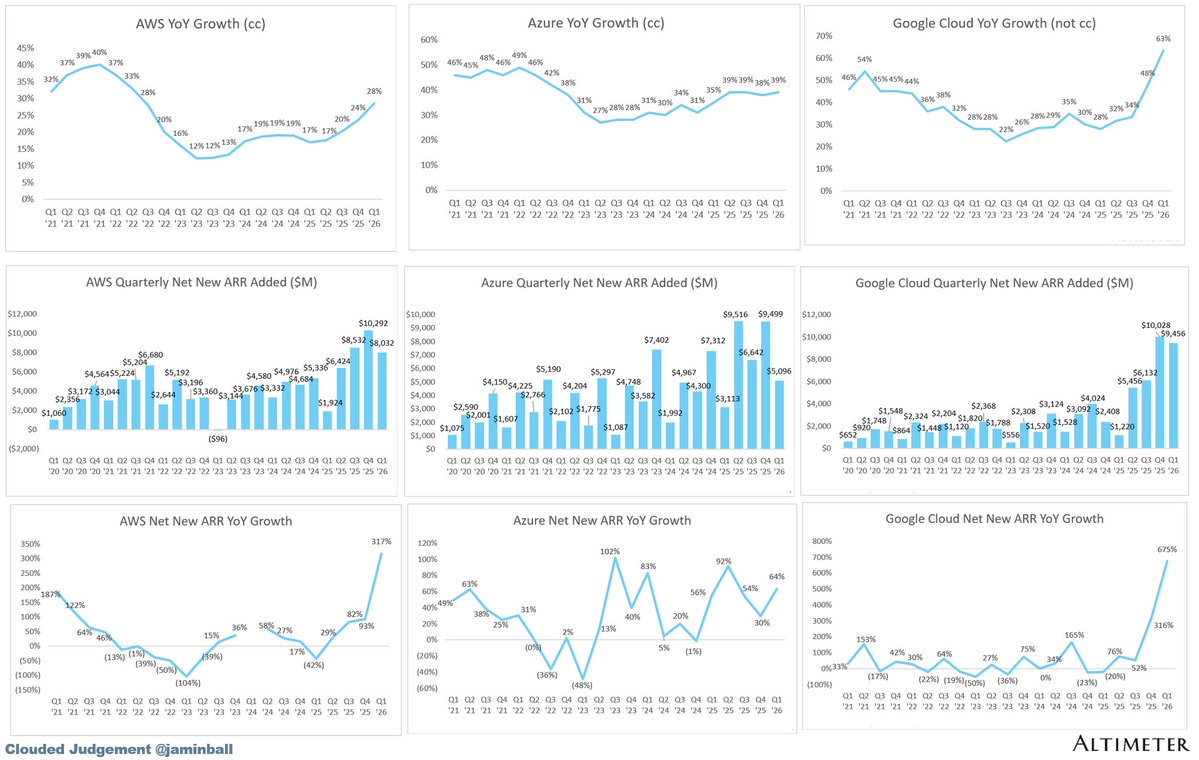
Just not true. $AMZN is aiming to undercut $NVDA backed neo-clouds with Amazon Bedrock. "At scale, we expect Trainium will save us tens of billions of capex dollars per year, and provide several hundred basis points of operating margin advantage versus relying on others’ chips for inference." https://t.co/oL5Q63EDmV Bedrock will use Cerebras for decode. https://t.co/XJDBlPGzM2 And Anthropic is seeking 5 gigawatts of capacity from $AMZN https://t.co/8TWtVAKMaZ So $CBRS narrative that it depends solely on OpenAI is just not true.
Anthropic Says Life Sciences Is Its Biggest Bet After Code.
Eric Kauderer-Abrams started @AnthropicAI 's life sciences division ten months ago. He took on the stage at @SynBioBeta with Marc Tessier-Lavigne from @Xaira_Thera , and what caught my attention was how plainly Eric stated the following:
"The greatest opportunity to have a beneficial, scaled impact with everything that's happening in frontier AI is in the life sciences."
After coding, it's their biggest investment area. They've been training Claude on bioinformatics, chemistry, molecule design, structural biology, clinical regulatory. Their models went from mediocre in life sciences to roughly PhD level across most domains in under a year. That's a steep curve.
But what I found more telling than the benchmarks was the infrastructure they're building around it. Wet labs for basic research so their own scientists hit the walls firsthand. An acquisition of Coefficient Bio (acquired by Anthropic) to teach @claudeai how to think like a biotech program manager, not just a bench scientist. The gap between "Claude can answer a biology question" and "Claude can help you run a drug program" is enormous, and they're clearly aware of it.
Marc mentioned that 90% of drugs fail in the clinic. Two-thirds of those failures aren't bad science, but patient matching. You have a good target, a good drug, and you can't find who will respond. That's the problem both of them kept circling back to, and it's where causal AI models trained on real perturbation data might actually move the needle.
Marc said nobody's pushing a button for a development candidate anytime soon. But Anthropic went from $1B to $30B in revenue in sixteen months. That kind of resource behind this kind of focus is new. It's fun to think of what R&D can look like in the next few months!
#SynBioBeta2026 #SyntheticBiology #Biotech #AIxBio
$TEM 👀TD Cowen gets it, Tempus AI upgraded to a buy. They get the picture here, and how could you not with data growth 44% YoY? Watch everyone crowd in once it's $100. Typical. So many people "panican-ed" $TEM and cried, but they clearly never understood what they owned. This is a beast in the making🔥
"The increasing size and scope of Tempus' multi-year deals with large pharma represents is encouraging, with ~6 customers now signing deals >$100M (incl. new wins with Merck & Gilead). The noted shift in project focus from a primarily data exploration strategy toward model training reflects checks signaling pharma are increasingly bolstering their own internal discovery capabilities by building out data-first internal AI/ML platforms."
Every wind turbine and solar panel on earth today is expected to be decommissioned and replaced long before Net Zero in 2050.
We aren't just building a new energy grid, we're initiating the world’s largest, most resource-intensive replacement cycle. The staggering cost of these recurring cycles is expected to add trillions to an already massive price tag.
McKinsey Global estimates the transition requires $9.2 trillion per year, totaling $275 trillion by 2050. However, these figures are only the baseline - they don't account for the new price ceiling driven by the physical failure and required replacement of first-generation infrastructure.
Most of today’s 225,000 wind turbines (over 1.2 TW capacity) will exceed their 20–30 year lifespans by 2050. This necessitates waves of decommissioning or 'repowering' on a scale never seen before.
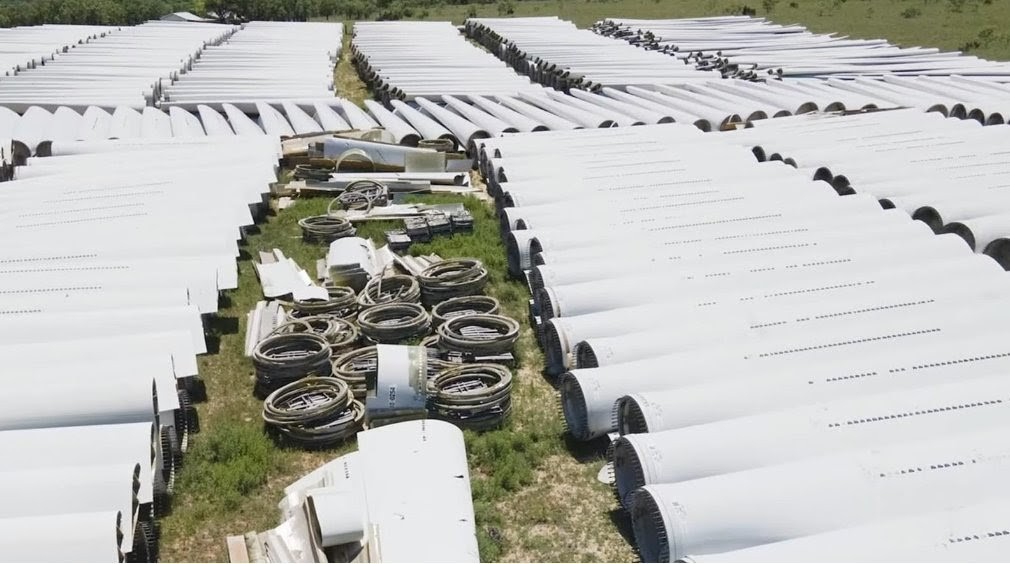
With wingspans rivaling an Airbus A380 or Boeing 747, these massive composite structures are fueling blade graveyards that present a disposal challenge unmatched in human history. Projections suggest 43 million tonnes of blade waste and 60–80 million tonnes of solar PV waste by 2050.
A global rebuild of this scale must compete for finite resources. China currently refines 90% of the global rare earth supply, creating a precarious geopolitical dependency for the permanent magnet technology required for modern turbines.
* Rare earths: Neodymium and praseodymium for magnets; dysprosium and terbium for heat resistance.
* Essential metals: Massive quantities of copper for wiring, tungsten for components, and tin for soldering.
* Physical scale: Larger direct-drive turbines require 0.5–2 tonnes of rare-earth magnets per MW, supported by vast quantities of steel and concrete.
A 'second transition' is destined to become a third, and a fourth—replacing the entire global inventory every few decades. This demands a WWII-scale 'D-Day' mobilisation of capital and labor, occurring just as subsidies fade and private investment thins due to uneven returns.
Furthermore, the 'diesel paradox' remains: heavy mining equipment is still powered by the very same fossil fuels the transition seeks to eliminate.
The math suggests a looming collision between physical reality and political agendas.
Image: The Casper Regional Landfill in Wyoming has become a global focal point for 'clean energy waste'.
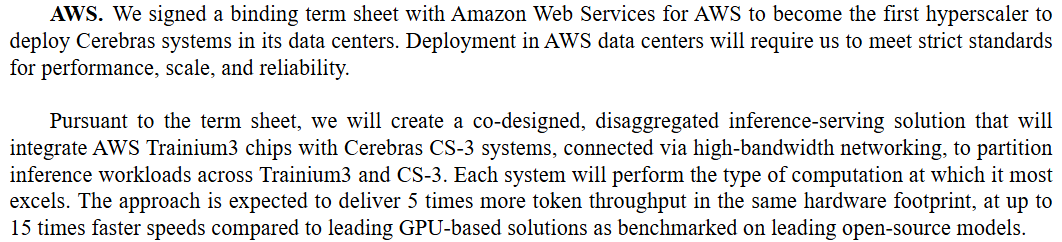
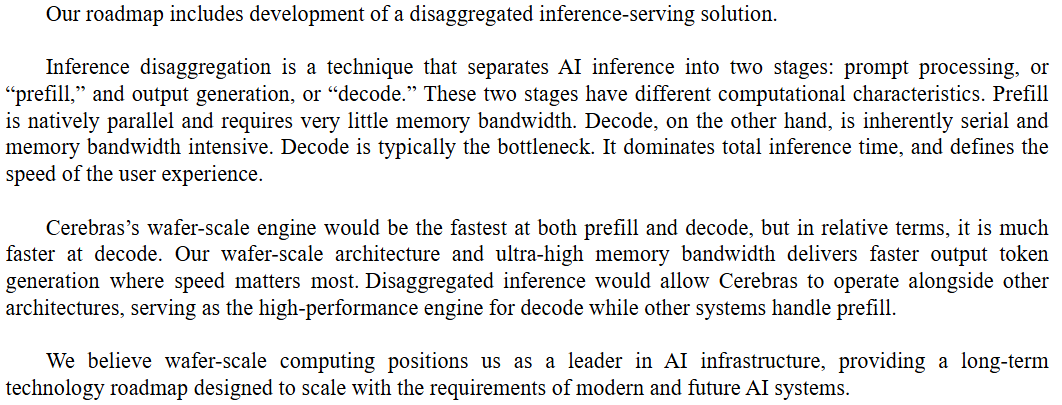
$AMZN + Cerebras are working on a similar disaggregated inference solution as $NVDA + Groq
Prefill => runs on Trainium 3
Decode => runs on Cerebras
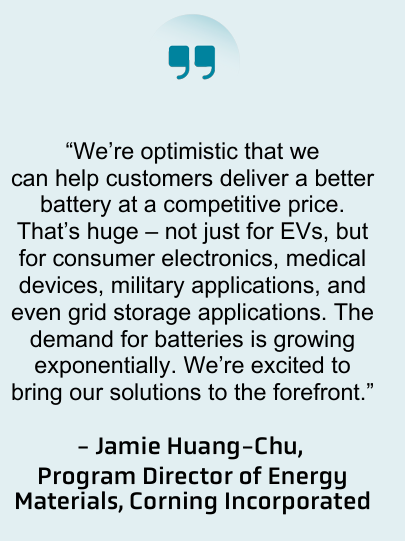
$GLW 👀 NICE shoutout from Corning to partner $QS about working to produce the most advanced next gen SSB batteries around... you think Corning is going to BS about this, think again, they are the big dog partner everyone wants for this sort of manufacturing!
@GirthCharlie@ShabbosK Absolute nonsense. Russia has taken 45k square miles of Ukraine. Israel maybe 200 square miles of Lebanon. Did Ukraine start firing missiles into Russia before Russian
invaded Ukraine ?
Tokens are how we convert compute into intelligence.
At @cerebras we make very very fast tokens.
2 years ago nobody cared.
2 years ago, inference was simple.
You asked a question. You got an answer.
That's single-shot inference.
Call it 1x compute.
Then came reasoning.
The model stopped just answering.
Instead it makes a plan.
Breaks the problem into parts.
Solves each one.
Reassembles the answer.
That's 10-100x more tokens per query.
Slow tokens frustrate users.
In 2025 Paul Graham wrote: "I'd use Google half as much if ChatGPT weren't so slow."
Sam Altman jumped on within minutes. Then Elon.
Three tweets described the entire cost of being slow.
Your customers leave you.
Your competitors use it against you.
Now we're in the agentic era.
Multiple models talking to each other.
Running reasoning chains over and over.
Vastly more tokens consumed before you see a single word of output.
Each stage compounded.
Each stage gave better answers.
But at the cost of more compute used, more tokens generated.
And each stage speed more important.
This is why we built @Cerebras the way we did.
Wafer scale.
Fast memory on-chip.
No bottleneck between memory and compute.
That's how we provide the fastest AI inference in production.
Just spoke with dozens of European VCs
They all agreed: AI is over
No one is putting money into AI startups anymore
OpenAI is likely going bankrupt
I asked what the next big thing is
They all answered in unison:
Regulation.
And the hot spot for the best regulations?
Europe.
Meanwhile, America is getting left behind
The U.S. has 750 bases in 80 countries. That's 150,000+ troops at around $100 billion/year. Germany, Japan, Korea, the UK, Turkey, Qatar, etc.
If you want to end that, then say so. But it's a bit obvious when you focus solely on Israel -- which doesn't have a U.S. base.