When reading English off the cuff
It isn’t hard to think ‘Enough! -
The problem’s not with me and you
That -ough confuses through and through."
If you’ve been trained to read, you ought
To have no issues, you’d have thought.
But then you hesitate, for how
Can ‘slough it off’ not rhyme with “Slough”?
And then there’s cough, and bough, and through,
And dough, and lots of others too.
Perhaps in time of mental drought
I’ll write a poem to spell it out.
While putin is desperately fighting with bridges in Kyiv,
we find solutions.
I’m in an absolutely beautiful Telegram group, where people can ask for a lift from one bank of the city to another or offer one.
I love reading messages there.
After more than two years of research in archives across Europe:
The malicious plots and international intrigues surrounding the most strategically important invention you’ve never heard of
https://t.co/ZpiLxhUIvL
Kyiv.
Air defence is shooting down drones.
I finished writing today’s letter.
russian drones found a new target - data centres and internet providers.
Perhaps I’ll go out for a while.
Yes, it’s not safe to wander now. But we have to live somehow.
On Friday Sep 25th at 10am, it seems all the church bells in France will ring for 7 minutes to welcome the Pope. I expect there’ll be some annoyed people, as the french always love to complain ! #PopeFrance
How Kyiv adapts to war challenges.
Some of the changes:
From today (Sept 10), businesses may stay open during yellow drone alerts; red alerts (missiles or mass drone attacks) mean everyone must go to a shelter.
The same applies to cultural events. A shelter must be nearby. Safety first.
The Black Death did not arrive in England to find a well fed population. It arrived to find a generation that had been raised without milk, because the cattle had died thirty years earlier.
It began with rain. In 1315, 1316 and 1317 it rained across northern Europe on a scale nobody had a word for. Three harvests failed in succession. The Great Famine took perhaps a tenth of the population of northern Europe and it is the worst subsistence crisis on the record north of the Alps. In August 1315 Edward II stopped at St Albans and there was no bread to be had for the king of England and his household, which is the kind of detail that survives because everyone present was appalled.
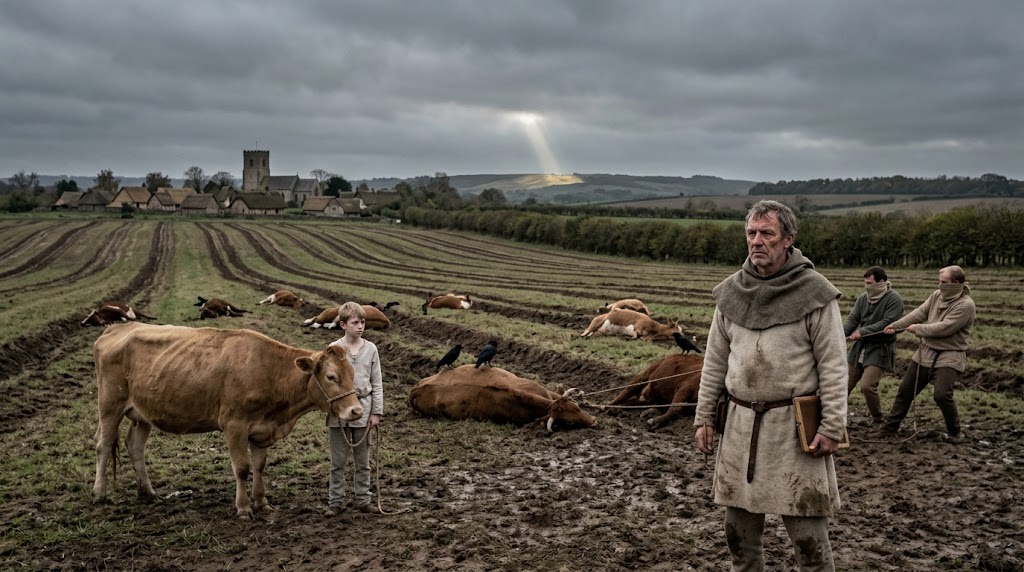
Between 1319 and 1320 a cattle plague, almost certainly rinderpest, moved into Britain from the continent and went through the herds like fire in stubble. Philip Slavin went through the manorial accounts, the workaday parchment where a reeve had to record every animal on the demesne and answer for it, and the figure that comes out is sixty two per cent. Nearly two beasts in three dead across England and Wales in twenty four months. On some manors the loss was total.
In September 1319 Simon Eye, the abbot of Ramsey, wrote to Edward II to say that a sudden pestilence had struck his animals, that they were dead in such numbers that the air was infected with the stench of the carcasses, and that he feared a pestilence among people would follow. St James's Hospital at Westminster wrote in the same year complaining of the mortality of animals.
Rinderpest kills between eight and nine animals in ten once it is into a herd, and it moves on shared water and shared pasture, and in 1319 there was nothing on earth a reeve could do about it but watch and count. The chroniclers describe carcasses lying in the fields because there were not enough living animals left to drag them off.
The ox was the tractor. Fifty five per cent of them went, and you cannot plough with an intention. Horses were bought in as a stopgap, which cost money and gave nothing back, because a horse yields no milk, no cheese and no calf.
And the cow was the dairy. Butter, cheese, buttermilk, whey, curds: the fat and the protein and the calcium that carried an ordinary family through a winter and put growth on a child. Dairy output halved after the pestilence and did not climb back to eighty per cent of its old level until the middle of the 1330s. Cattle numbers reached four fifths of the old figure by the end of the 1320s. Oxen were at eighty five per cent by 1331.
So there is a stretch of about fifteen years in which the children of England grew up in villages where the milk had gone.
Sharon DeWitte and Philip Slavin went to the bones. The skeletal evidence from the decades before 1348 shows chronic shortage of protein, calcium and vitamin B12 running for at least a generation, far longer than the three wet summers usually blamed for it. The famine had already killed the frailest. What the bovine pestilence did was take a population that had survived the famine and raise its children without animal food.
Those children were in their late twenties and thirties when the plague ships tied up in 1348.
What the body had been built out of decided who walked away from 1348, and that is now sitting in the burial record rather than in anybody's theory, and it points at dairy.
The story we tell about the fourteenth century is rain, then rats. Two acts of God, thirty three years apart, with nothing worth mentioning in between.
The thing in between was the loss of two thirds of the cattle in the country, and a generation that grew up without butter.
Among the trees of Richmond Park lies a view so treasured that it has been protected for centuries.
From King Henry’s Mound in Richmond Park, a narrow opening through the trees frames the dome of St Paul’s Cathedral nearly 10 miles away.
The sightline is remarkably old. Maps from 1754 show a visual corridor towards St Paul’s, and generations of park keepers have carefully managed the trees to preserve it ever since.
Today, it is one of London’s few officially protected views.
Planning rules restrict development along the sightline so that the cathedral remains visible.
The mound itself is older still. Despite its Tudor name, it is believed to be a Bronze Age burial mound, later used as a viewpoint for hunting and falconry.
From prehistoric burial place to Georgian landscape design to modern planning law, one narrow window through the trees has survived centuries of change.
And at its centre, St Paul’s remains as magnificent as ever.
Follow @OaksAndLions for more of England’s history, heritage and culture.
First day of school in Greenland 🇬🇱
Here are children on their first day of school in Nuuk today.
For many families, the first day of school is a very special occasion. Children often wear the beautiful Greenlandic national costume, as seen in the photo, celebrating not only a new beginning, but also Greenlandic culture and identity.
After school, many families gather for a traditional kaffemik with coffee, cakes, food, family and friends.
A beautiful tradition — and a proud celebration of education, culture and Greenlandic identity. 🇬🇱
I just heard that there are cars requiring a monthly subscription for things like “remote start” and “heated seats”. Please, what are these companies/brands so I can make sure I never even consider buying one?
Few things match the quiet intensity of the flight deck during a long-haul night crossing. The world below is fast asleep, the cockpit instruments provide the only glow, and you are hurtling through the dark at Mach 0.85.
It is a view that never, ever gets old. Where is the most memorable place you’ve watched the sun rise or set from an aircraft?
The massed pipers and drummers march down the Royal Mile playing ‘Scotland the Brave” after the Royal Edinburgh Military Tattoo at Edinburgh Castle. 🏴🥁
Absolutely glorious.
This saga has been going on for four and a half years now. Tonight — around 20 missiles. The exact number has not been officially confirmed yet, but judging by the timeline of air raid alerts and the warnings from monitoring channels, it was roughly that many. I don’t know how many Shaheds there were. I think around 80 were definitely heading toward the region, and perhaps about forty were over the city itself. I also don’t know how many were intercepted over the sea. This morning I’m reading different channels. Some people say we didn’t shoot down a single missile. But we did — you could see it even from the chronology of the reports. Others are angry that too few were intercepted. And I have only one question: with what? But that is not really what I want to talk about.
At around two in the morning, my child woke me up saying, “Mom, the packages are flying. We need to get up.” Half asleep, I said, “No, they’re probably heading for the region.” — “We need to get up, Mom.” And then there were our two dogs, my child, and me. Teddy has a wonderful little safe spot, and somehow all four of us managed to squeeze in there. We sat and counted: how many were flying, where they were heading, how many had been intercepted. There’s a strike. Another one. The city center is burning. And for some reason I kept thinking about Yalom — about that almost instinctive belief we have that terrible things may happen, but somehow they will not happen to us. It is very difficult to hold on to that illusion when missiles and Shaheds are flying directly over your home.
I understand that the world’s media are gradually getting tired of Ukraine. I understand that ordinary people in other countries are largely powerless. And those who actually have power already have too many interests of their own. Who cares today about who built my city? Who built my Odesa? How much human work, talent, and history went into these streets and buildings? That this is cultural heritage that cannot simply be rebuilt from scratch? Apparently, no one. Sometimes it feels as though Ukraine has become one enormous testing ground — for weapons, geopolitical ambitions, political experiments, and the games of people who will never have to sit at night with their children and dogs, counting missiles above their own homes. And for some reason I remembered that old movie about two millionaire brothers who made a one-dollar bet, without giving a thought to what would happen to the people who became part of their game. I don’t know what else to say. I know for certain that my country was attacked. I remember the Budapest Memorandum. And at 47, I know exactly what is right and what is wrong. And more and more, I think this world is going to hell.
I’m planning a short art trip near Kyiv this weekend.
One sentence from the organiser stopped me:
If there’s an attack, we’ll leave later so everyone can get some sleep.
There is so much life in that simple sentence.