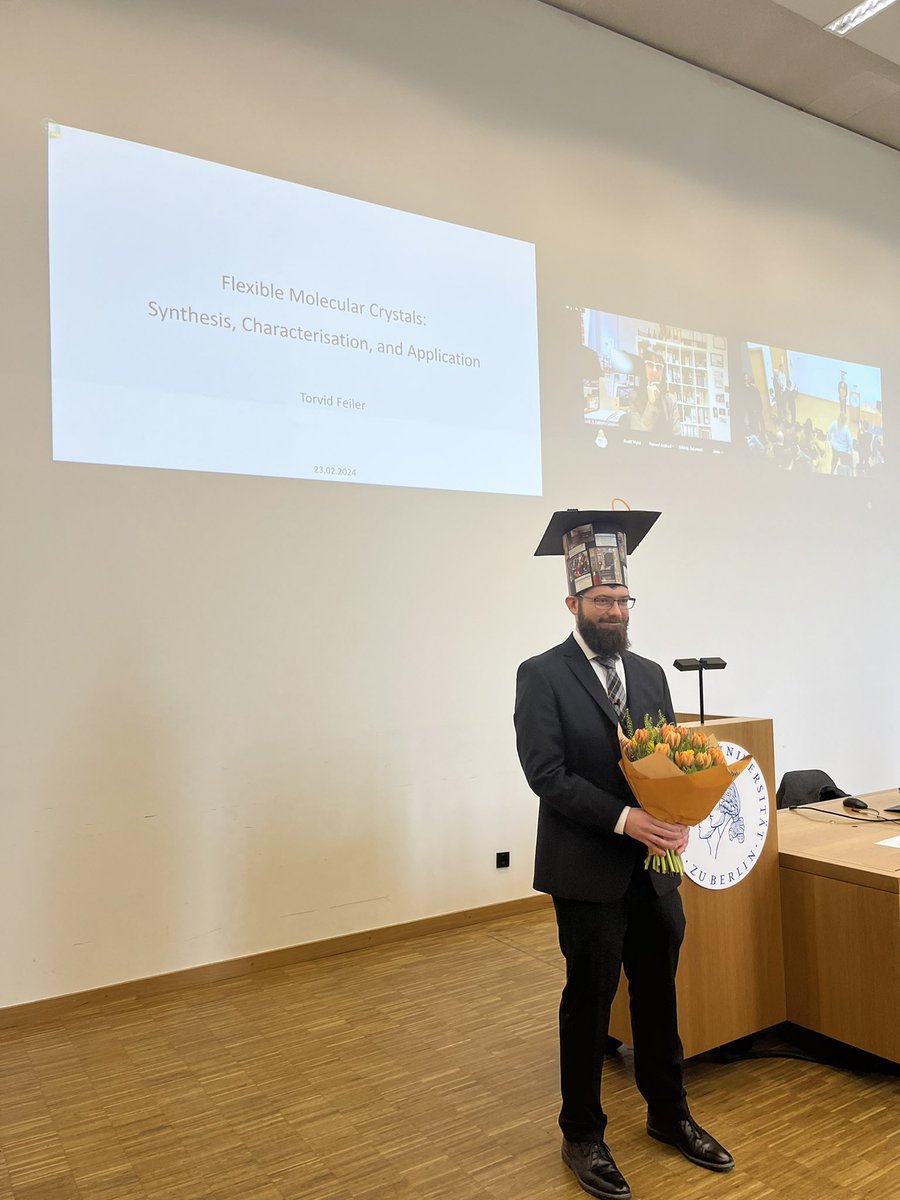
Very proud of this new doctor! Congratulations, Stephanos @SKarafiludis @BAMResearch@HumboldtChem Amazing defence, and amazing publications!
And finally, a decent hat! 😄
https://t.co/vggX92BgNP
https://t.co/vXpv3BMZrW
Congratulations, Torvid @FTorvid! We have a new doctor. Brilliant defense and a great time at @BAMResearch are behind you. All the best for the future! Read more here ➡️https://t.co/g9vJLlZykz congratulation also to Biswajit @BisuChem!!
Please retweet: 4-year fully funded PhD position available in my group exploring micro heterogeneity and it's influence on crystallisation. This project is co-supervised by AstraZeneca and combines fundamental and applied crystallisation research. https://t.co/wrmF1BouRa
Very excited to be guest editing this special issue in @PCCP from @UoBChemistry with Francesco Delogu @univca, on Fundamental @Mechanochem ! We very much look forward to receiving your papers on this exciting and interdisciplinary field!
@Rewadii@BAMResearch thanks!
Yes, we did comparisons and the catalytic activity (not TOF itself) is lower at lower temperatures, while the selectivity is higher. Although the differing reaction conditions like loading, gas flow and stream composition are problematic for comparison.
@atikur_chem@BAMResearch Thanks!
We have yet no insights into the recyclability of the catalysts. But this and the long term stability will be investigated.
@deuxbeck@BAMResearch Thanks!
The shell thicknesses vary within the different particles. And XPS can see Cu in decreasing amounts from the smaller to the larger NPs.
@VPolshettiwar@BAMResearch thanks!
TEM measurements after catalysis showed unsintered and still well separated NPs on the silica. First tests showed a good catalyst stability over a period of 7 h.
@Dr_Oli_Jones@BAMResearch thanks!
The RWGS reaction can be an important step in the power to syngas precess. Energy from renewable sources is converted via water electrolysis and RWGS reaction to syngas, which can be further utilized (e.g. Fischer-Tropsch or Haber-Bosch)
@Street_Research@BAMResearch thanks!
Yes, I added the NPs to the silica via dry impregnation after NP synthesis. And no, I haven´t tried yet using just the NPs for catalysis.
@MooresResearch@BAMResearch Hi Audrey,
thanks!
Surprisingly for the investigated set of NPs there was no impact of reaction conditions on selectivity, but activity. So the next step would be to lay the focus on optimizing the activity.
@FelipeMBolner@BAMResearch Hi Felipe,
thanks!
I used silica with a pore volume of 1 mL/g and a pore size of 160 nm. The pore volume distribution could have an impact when it comes to the surface, which the gas flow interacts with. We chose a silica with pores much bigger than the used NPs.
Have you ever heard of MOF synthesis by simply mixing solid reagents? We did it with ZIF-8 and adapted to the large-scale green production by reactive extrusion🌍#RSCMat#RSCEnv Check out my work for more info! Zoomable poster in reply👇Happy to answer any questions! #RSCPoster