Suicide clusters - where deaths are linked - may be more common than we used to realise. They need to be handled with vigilance & urgency.
New Govt guidance out today from @OHID.
https://t.co/kByAdWnSnx
Hospices support patients and families in their hardest moments with vital palliative and end of life care.
Earlier this year, we released £100 million capital funding for hospices to upgrade facilities.
@WesStreeting visited @StChrisHospice to see how this makes a difference.
Another view we should avoid is of suicide being inevitable.
We may use the word to bereaved families to assure them they could have done nothing more. They need to know that.
But when working with someone at high risk, it is mistaken, fatalistic. Preventable, never inevitable.
It’s why we should be sceptical about “choice”.
Most people who survive a suicide attempt do not go on to take their own lives.
Choice is not made in a vacuum. Circumstances change - or change just enough.
We’re excited to announce the launch of a new government campaign, calling on anyone expecting a baby to protect themselves and their little one with vaccines against RSV, whooping cough and flu. 👶
🔗 https://t.co/5cyiW1K5fT #StayStrongGetVaccinated
In the #AssistedDying Bill, we have reached a crucial point in medical ethics.
I will always believe that preserving life is paramount, that helping people through their worst crisis is essential.
I will never accept that helping patients take their lives is part of our role.
Today is World Suicide Prevention Day.
If you're feeling like you want to end your life, it's important to tell someone.
If you're worried about someone else, try to get them to talk to you.
Suicide is not inevitable.
Help and support: https://t.co/PfnQ1v8oit
The goal is not to be happy all the time. It’s okay to feel anxious. It’s okay to feel sad. It’s okay to be scared. It’s okay to be vulnerable. The goal is to have the emotional flexibility to navigate whatever it is you are feeling and to stay the course on what matters to you.
TikTok science can leave you overconfident in your knowledge.
Evidence: Simplifying complex ideas makes them more compelling, but also fosters an illusion of deep understanding.
Beware of mistaking familiarity for fluency. Soundbites aren't substitutes for systematic study.
If you have a secret or secondary phone hidden from an abuser, this alert could reveal it.
Silence can protect you.
Check your settings before the alert test.
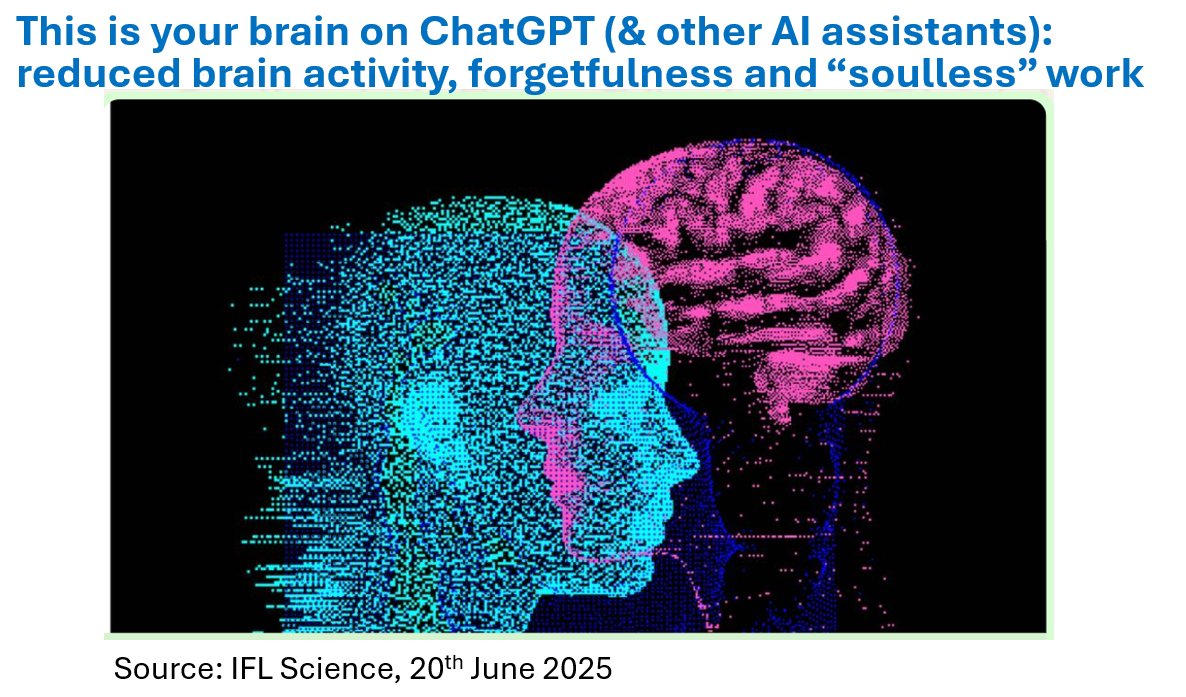
A new study looked at how using AI assistants like ChatGPT for writing tasks impacts the brain & thinking skills. It focussed on students writing essays but the findings have implications for workplace leaders.
The researchers found that people who used AI used their brains less, created work that was “shallow” & “soulless”, remembered less & had less ownership of their work.
Starting a piece of work with AI created a “cognitive debt” – people get short term benefits like more efficient writing but pay a price in reduced creativity & a mental laziness that sticks around & makes it harder to think critically later on.
Even when peopled stopped using AI, their brain engagement stayed lower. People who started the work unaided by AI produced more original content with wider vocabulary & critical analysis. They retained stronger cognitive engagement even when later using AI.
Implications: actions for workforce development
1. Prioritise critical thinking & problem-solving training: ensure people regularly engage in tasks that require independent thought & reasoning without AI assistance.
2. Encourage hybrid workflows: human first, AI second.
3. Implement continuous upskilling & reskilling: as AI rapidly changes job requirements, ensure people stay adaptable, resilient & capable of meeting evolving demands.
4. Use AI judiciously & monitor cognitive impact: regularly assess how using AI affects people’s engagement, learning & critical thinking & adjust policies to avoid undermining core human skills.
Original article: https://t.co/9WwtW4O2Se via @PietroMicheli13
Summary & graphic from @IFLScience https://t.co/Z1TruvhXqf
New NHS guidance on suicide risk assessment published today. More personal & collaborative, no checklists.
Driven by evidence & the experience of families, esp @philippirie & @NCISH_UK
https://t.co/uZ3G6DhQCH
If you knew someone was struggling with suicidal thoughts, would you know what to say?
Learn how to start conversations about suicide. This @Zer0Suicide training takes 20 minutes and could help save a life.
➡️ https://t.co/tn7xQnEm75
Walking is your body’s way of resetting your nervous system, your cortisol levels, and in the process slows down racing thoughts. Don’t make a decision before you walk on it.
A little reminder for anyone struggling with these darker evenings…
By the end of this month, the sun will set around 5:39 PM.
By the end of next month? About 7:30 PM.
And the month after that it will be roughly 8:22 PM.
Those longer lighter days are on the way. 💚
There is too much noise on how to exercise for health and longevity. There is way too much performative nonsense too. Here is a simple and straightforward guide to what actually works. You can start today. It's a must-read if you care about your health: https://t.co/KzXBszspHc