Pashov Audit Group security researcher internship coming soon. Learn by doing, 100% practice. Real audits, real projects.
Like/RT this post if you'd be interested in this. There will be lots of slots, I've thought of a scalable model to do this right, full announcement soon🫡
1/10 @SkyEcosystem's Core Allocator System looks complex until you break it into 4 pieces: Vault, Buffer, Oracle, and Dss Blow.
This is the contract layer that generates USDS and routes capital into Prime Agents (“Stars”). Dewiz unpacks it through the Obex case study. 👇
another first-of-its-kind upgrade to ethereum took place today. not in the code, but in the foundation’s treasury.
the protocol and the economy will finally start speaking the same language.
there’s a old joke that the ethereum foundation just hodls to the top, then market-sells on everyone but today’s treasury policy flips that meme completely.
instead of selling eth, the ef is now using it.
let’s be clear. the ethereum foundation is not ethereum. it’s one steward among many, now choosing to participate in the economy it helped unlock.
but when a core steward leads with transparency, alignment, and skin in the game, it does more than set a precedent: it encourages the rest to follow.
this should be the start of something bigger where more treasuries. more teams and more allocators start using the tools they claim to believe in.
so..what is the ef doing?
they are committing to deploying their eth treasury into the very defi rails the broader ethereum community has spent the last decade building.
think of it like a university endowment finally investing in its own alumni.
the ef will still protect a rainy-day buffer to support operations, but its surplus is now fueling the ecosystem directly.
productive assets > passive bags.
and the domino effect will be great:
every time the ef moves onchain, a few things will happen:
> liquidity deepens for the protocol it touches
> that liquidity signals safety to more conservative allocators (..other billion dollar endowments)
> the ef earns yield, reducing the need for fiat sales
> the entire defi stack gets stronger by being battle-tested with size
people who misclaimed and held on to the double standard “foundation dump” narrative will now get to watch the same wallets generate sustainable yield.
and because it all happens on ethereum, you can follow every transaction.
every safe, every staking position, every swap is open for anyone to see.
no other industry lets the public audit a billion-dollar nonprofit’s balance sheet in real time. not in web2. not tradfi. and definitely not in other crypto foundations (they don’t have public wallets like the ef does, it’s mostly all hidden! hopefully this pushes them to be more accountable too).
imo transparency isn’t a buzzword here, it’s literally enforced by the architecture and the ef’s willingness to live the values it proclaims.
re values, this is very important to note in terms of where the ef stands:
> surveillance-by-default is called out as an existential risk.
> privacy is treated as a core mandate, not an optional add-on.
> capital will go to teams building permissionless, privacy-preserving infrastructure.
if you don’t take user protection seriously, you don’t qualify. as they note; privacy is a social contract & the ef is making that contract enforceable through capital alignment.
now the real test is what happens next. will others follow? will more treasuries align their actions with the values they preach?
ethereum’s strength has never come from any single actor it comes from coordination and today’s upgrade is a reminder: coordination starts with action, and the ef has just made the first move.
A hacker stole $223M from Sui yesterday.
Then something unprecedented happened.
Sui validators literally banned him from the network and froze his funds mid-escape.
This changes everything we thought we knew about "decentralized" blockchains.
Here's the wild story 🧵
@sherlockdefi It can overwrite storage.
That’s why you usually add a gap variable at the end of the contract, to reserve that storage for future extensions.
It’s not the only solution though. In the latest versions of openzeppelin contracts, they prefer to use namespaced storage.
La impotencia que siento no se puede explicar. He pagado dos envíos urgentes y los dos han llegado tarde.
Seguramente, lo máximo que pueda hacer es poner una reclamación y que (con suerte) me devuelvan el dinero, pero el daño está hecho.
@Cex_responde Una amiga me envió el 5 de noviembre a las 12:27 desde Cornellà una maleta que debería llegar en 24h a Bilbao. Resulta que lo último (y lo único) que aparece en el seguimiento del envío es que fue admitido.
Debería haber llegado ayer y aún no sé nada.
Lo indignante es que esa misma maleta se me envió desde Sevilla a Barcelona con el mismo formato de envío (24h) el pasado 28 de octubre, por lo que debería haber llegado a Barcelona el 29, pero no.
Finalmente llegó el 31 (dos días más tarde de lo previsto).
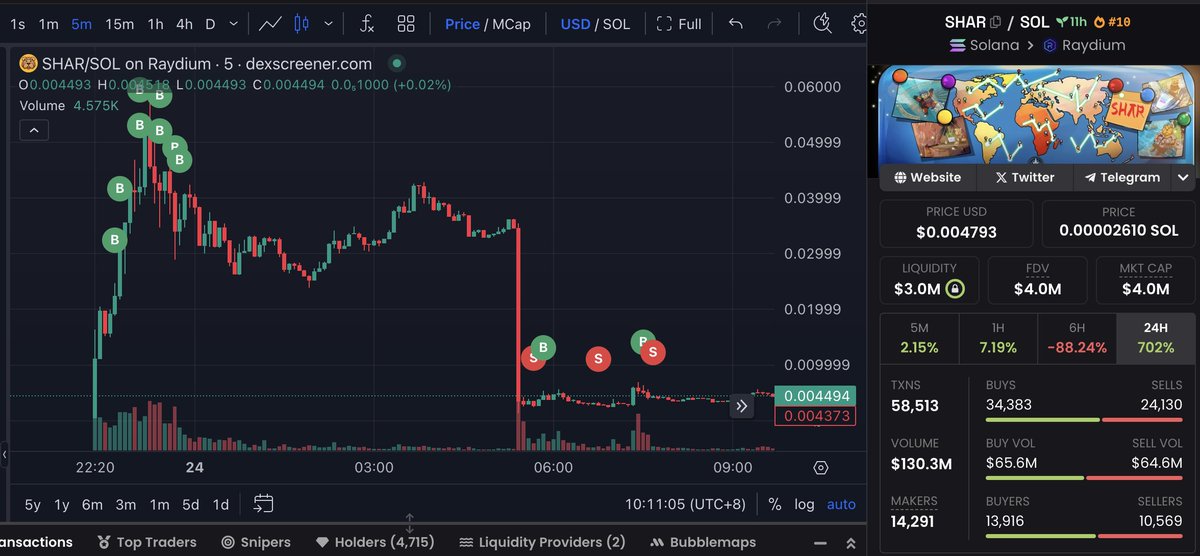
Even the trader who profited 18,539 $SOL($3.7M) on $BOME got rugged on $SHAR.
This trader spent 2,952 $SOL to buy 27M $SHAR and sold for 471 $SOL, losing 2,481 $SOL($429K).
He previously spent 2,620 $SOL to buy 345.35M $BOME and sold for 21,159 $SOL, making 18,539 $SOL($3.7M).
https://t.co/QfzlBSy042
Unified Liquidity Lending
Say goodbye to Fragmented Liquidity.
🕊️Enjoy a frictionless, global lending experience no matter which chain you’re on.
https://t.co/4rVlcrDFpr