Karpathy found a way to reduce token consumption by 90%
The problem is that the LLM re-reads the same files over and over again, loses context between documents, and provides less accurate answers as a result
The solution is called Wiki Layer the LLM cleans, structures, and links all your data once, after which it never works with raw files again
Three folders `raw/` for originals, `wiki/` for a clean knowledge base in Markdown, and files with rules for the agent
Result up to 90% token savings on repeat queries, automatic links between documents, and a visual knowledge graph in Obsidian
Everything stays on your local machine nothing goes to the cloud
Claude Sonnet 4.8 Leaks
- Anthropic accidentally shipped a massive 512,000-line internal debugging source map through a Claude Code npm update on March 31, 2026
- The leaked source code references Sonnet 4.8 inside unreleased keyword filters, strongly suggesting Anthropic is skipping Sonnet 4.7 entirely
- Sonnet 4.8 is expected to inherit vision upgrades from Opus 4.7, reportedly pushing visual accuracy above 98% for UI mockups and messy architecture diagrams
- A major coding boost with cleaner one pass completions and much more literal instruction following
- A new "X high" reasoning effort tier may also be coming for stronger logic without extremely long generation times
Updated tokenizer may use 30% more tokens on the same prompts compared to older Sonnet versions
- Currently expected around mid to late June
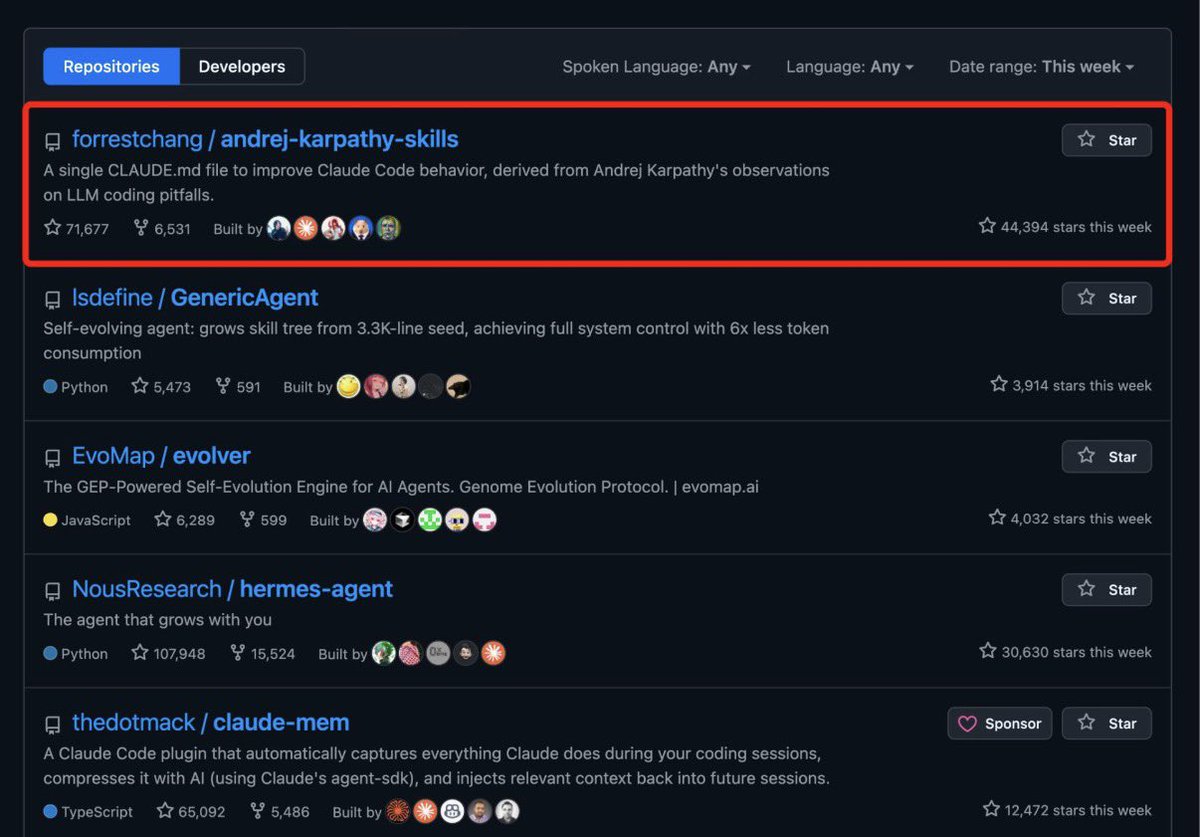
karpathy's CLAUDE.md hit #1 on github trending.
220,000 stars. most devs still haven't read it.
it's 65 lines.
it took AI coding accuracy from 65% to 94%.
the 4 rules inside:
→ think before coding
state your assumptions. ask when unsure. never guess.
→ simplicity first
write the minimum code that solves the problem.
no abstractions nobody asked for.
→ surgical changes
don't touch code unrelated to the request.
every changed line must trace back to what was asked.
→ goal-driven execution
turn vague instructions into verifiable success criteria
before writing a single line.
that's it.
65 lines. 4 rules. 94% accuracy.
save this before everyone else does.
Andrej Karpathy just explained the future of software engineering without directly saying it.
The best AI engineers are no longer “prompting.”
They’re building systems around the agents.
Karpathy’s biggest insight wasn’t:
“Claude can code.”
It was:
LLMs become dramatically better when you force them into disciplined workflows.
That’s why "CLAUDE.md" files are suddenly everywhere.
Not because they’re prompts.
Because they behave like an operating system for the agent.
Karpathy called out the exact problems with AI coding:
- models assume instead of asking
- they overengineer simple tasks
- they hide confusion
- they rewrite unrelated code
- they optimize for completion, not correctness
So developers started encoding rules directly into the workflow:
→ Think before coding
→ Simplicity first
→ Surgical edits only
→ Goal-driven execution
And the results are wild.
People are now running multiple Claude Code agents in parallel like engineering teams:
• one agent researching
• one debugging
• one writing tests
• one optimizing code
• one validating outputs
Not “AI assistance.”
Actual orchestration.
And this part from Karpathy changes everything:
“Don’t tell the model what to do. Give it success criteria and let it loop.”
That is the shift.
From:
“write this function”
To:
“here’s the goal, constraints, tests, and verification system — now iterate until correct.”
The craziest part?
This already feels like a phase shift in engineering.
A lot of developers quietly went from:
80% manual coding → to 80% agent-driven coding in just months.
Not because AI became perfect.
Because the leverage became impossible to ignore.
We’re entering an era where the highest leverage engineers won’t necessarily be the best coders.
They’ll be the people who build the best systems around AI agents.
@ContiUK quick question while I somehow managed to make SportContact 7 pop up for the size I am looking for I know it’s not really available. I wanted to ask if 325/35/r22 will ever be an option?
Creator of Claude Code just dropped a 6-min workshop on new Claude feature during live session in London.
Boris Cherny: “A lot of my code these days is written by "routines". I’m not doing the prompting - I create the routines that do the prompting.”
6 minutes. Free. From a live session.
Watch this now. This will change the way you vibe-code forever.
the engineer who built Claude Code just dropped a 28-minute video on how to write prompts that actually work
I've seen $300 courses that don't cover what he shows in the first 10 minutes
CLAUDE.md files, memory shortcuts, parallel sessions, prompting patterns
all in one video and completely free
works whether you're a developer, a beginner, or someone who's been using Claude for months
based on this, I put together 18 things you can copy and use in Claude today
full guide in the article below
How to set up Claude Code so it runs like a full dev team:
5 folders. That's the entire system.
1. CLAUDE.md → Memory.
Your repo's constitution. Naming rules, structure, expectations. One global file for all projects, one local file per repo.
2. skills/ → Knowledge.
Reusable workflows Claude auto-invokes by matching the task description. No slash commands. It just knows.
3. hooks/ → Guardrails.
Shell scripts that run before and after every tool call. Block dangerous commands. Auto-lint on save. Ping Slack on deploy. Deterministic. Not AI.
4. subagents/ → Delegation.
Isolated agents with their own context window. A code reviewer that only sees the diff. A test runner with custom permissions. Keeps your main session clean.
5.plugins/ → Distribution.
Bundle the whole system into one install. Every teammate gets the same skills, same hooks, same agents. Aligned from day one.
This is the Agent Development Kit. Five layers, one stack.
To learn how and get the full Claude guide:
1. Go to https://t.co/xViEAXTX7v
2. Subscribe free by just writing your email.
3. Open my welcome email and get the free resources.
Repost ♻️ to help someone in your network.
A single 𝗖𝗟𝗔𝗨𝗗𝗘.𝗺𝗱 file just hit #1 on GitHub trending 🤯
It fixes LLMs' worst coding habits using 4 principles from Karpathy:
Karpathy called LLMs out for making wrong assumptions silently. They overcomplicate everything. They edit code they were never asked to change. No pushback. No clarifying questions. They just run.
So those observations were encoded into 4 behavioral constraints:
→ Think before coding. If something’s ambiguous, ask. Don’t pick one interpretation and run. Surface tradeoffs, stop when confused.
→ Simplicity first. Write the minimum code that solves the problem. No speculative abstractions, no flexibility nobody asked for.
→ Surgical changes. Only touch what the task requires. Don’t improve neighboring code, don’t refactor what isn’t broken.
→ Goal-driven execution. Turn vague instructions into verifiable targets before writing a line. “Add validation” becomes “write tests for invalid inputs, then make them pass.”
It works immediately.
Drop the file in your project root and Claude Code follows it from the first task.
One file. Zero dependencies. No setup.
And best part, 100% open source.
SYSTEM DESIGN PLAYBOOK:
Giveaway Alert (Valid for 24 hours only)!
• System design foundations.
• Condensed notes to read for system design interviews.
• Must know concepts from real-world software engineering case studies.
To get it:
1 Follow @systemdesignone [MUST]
2 Like & Retweet to get DM
3 Reply "Playbook"
The 3 phases of refactoring a SwiftUI View to improve readability and reusability.
1️⃣ Extract Dedicated SwiftUI Views
2️⃣ Create Reusable View Modifiers
3️⃣ Build Generic View Extensions
Applying these together makes your views easier to scan, read, and reuse.
Your code becomes cleaner, faster, and future-proof.
Scalability starts today.
The fundamentals were built yesterday.
(Short video below 🎥)
#swiftdevelopment #iosdevelopment #swiftui #swiftlanguage
"A calculator app? Anyone could make that."
Not true.
A calculator should show you the result of the mathematical expression you entered. That's much, much harder than it sounds.
What I'm about to tell you is the greatest calculator app development story ever told.
SwiftUI doesn't have a dedicated view for UISegmentedControl. It is just another form of a picker view.
Learn how to use them and a little bit of why.
https://t.co/DZBv6D8RHJ





![systemdesignone's tweet photo. SYSTEM DESIGN PLAYBOOK:
Giveaway Alert (Valid for 24 hours only)!
• System design foundations.
• Condensed notes to read for system design interviews.
• Must know concepts from real-world software engineering case studies.
To get it:
1 Follow @systemdesignone [MUST]
2 Like & Retweet to get DM
3 Reply "Playbook"](https://pbs.twimg.com/media/G6mjKu2XgAAPH6Z.jpg)