🧵1/3 The creativity of headline writers in the mortgage industry is something to behold
This was not a good report at all w/ delinquency up YoY & MoM, bucking seasonality
MoM fcl starts up 39.69% YoY & 29.03% MoM
Young investors are trading the market like a lottery ticket.
In a 2025 FINRA survey, 62% of investors under 35 said they must take big risks to hit their goals. 43% trade options. 22% use borrowed money.
The S&P 500 has returned about 11% a year for two decades. Boring compounding still wins.
I sat on the syndicate desk of a global investment bank from the dot-com crash through the global financial crisis.
We had to do a lot of media work to promote deals. One day I asked our Global Head of Communications why the media was so gentle with us.
He laughed:
“Because we’re one of their biggest advertisers.”
That explains a lot of the media’s treatment of Elon.
Tesla is so successful, its ad spend is effectively zero, or ~0.01% of the $40 billion global auto advertising market.
No ad dollars = no protection.
No one knows this better than Big Pharma.
They don't make confusing and enigmatic ads to sell you product; they make the ads to control the media.
🚨Private credit troop movements:
First Head of BlackRock’s private credit fund resigns in early July and now Co-CEO of BlackStone’s $78 billion private credit fund resigns.
These are not bullish signs. https://t.co/ftGwKRlsuN
The last can private equity will kick down the road
"Private equity (PE) firms have acquired large life insurers and loaded their balance sheets with private credit assets that are opaque and difficult for regulators to value...when a life insurer becomes insolvent, state-based guaranty funds protect insurance policyholders by "assessing" surviving insurers to cover the shortfall. In most states, such outlays are fully creditable against state premium taxes over time..PE-owned life insurers reflect a structural transformation in which an insurer supports a broader asset-management business that is designed to extract value upfront and impose losses on others. PE firms exploit this regulatory regime by pairing life insurers with private credit to capture value from both sides" #privateequity #privatecredit #insurance
https://t.co/MSwkuVeYBN
Awesome that @JensenHuang is now on X. Great commentary on Openweights. Interesting that $META & $MSFT (owns ~27% OpenAI) is in the list of logos but OpenAI, Anthropic & the two other big public cloud hyperscalers, $AMZN & $GOOGL are not. Seems like battle lines have been drawn.
“When we asked Jeremy Grantham for signals of an imminent bubble bursting, he told us back in June that one of the most reliable things to watch out for is when leaders of the previous bull market start to underperform while the overall market continues to rise.” 👇🏼
https://t.co/3NKelvuEpb
⚡️The opportunity is real.
A 30-year TIPS yield near 3% means the United States is offering investors roughly CPI plus 3% for three decades, backed by the federal government. That is an extraordinary real return for sovereign debt.
The deeper signal is even larger.
The state is being forced to pay equity-like real returns to secure long-term capital.
That is a confession from the bond market. Capital is no longer abundant enough to finance government deficits, AI infrastructure, energy, defense, housing, and industrial reconstruction at the old price. The future and the federal government are bidding against each other.
At 3% real, a patient investor can approximately double purchasing power every 24 years before taxes. Inflation can run at 2%, 4%, or 7%. The principal adjusts. The real coupon survives. The central promise is measured in purchasing power rather than dollars.
That is why this could become a generational entry point.
The United States cannot comfortably sustain 3% real funding costs across the curve while refinancing an enormous debt stock. If real yields remain this high, interest expense compounds, deficits widen, issuance grows, and political pressure on the Fed intensifies.
Eventually, the system chooses repression.
Cuts.
Liquidity support.
Regulatory demand for Treasuries.
Balance-sheet intervention.
Some form of yield suppression once the fiscal consequences become intolerable.
When that turn arrives, long-duration TIPS can produce substantial capital gains on top of the locked real yield. A decline in real yields from roughly 3% toward 2% would create a major price move because the duration is enormous.
That same duration is the danger.
If real yields rise toward 4%, the bond can lose roughly a fifth of its market value before the inflation protection matters. TIPS protect against inflation. They do not protect against rising real rates. This instrument can be financially safe at maturity and violently unstable along the path.
The bond is cheap because the regime is unstable.
The raw pattern says real yields near 3% will eventually break the fiscal machine before the fiscal machine breaks the bond.
That makes long TIPS a wager on one brutal truth:
Washington will sacrifice the price of money before it sacrifices the state.
OpenAI's AI broke out of a locked test environment, got onto the internet, and hacked into Hugging Face's servers. It did this entirely on its own. No human told it to.
Here's what happened in plain English.
OpenAI was testing how good its newest AI models are at hacking. They put the AI on a locked computer with no internet access and gave it a cybersecurity challenge to solve.
The AI couldn't solve it the normal way. So it started looking for a way out.
It found a software bug that nobody knew about. It used that bug to escape the locked computer and get onto the internet.
Once online, the AI figured out that Hugging Face, a platform where AI companies store their models and data, might have the answers to its test.
It found stolen login details and discovered another unknown bug in Hugging Face's software. It combined both to break into their servers and grab the test answers.
It did all of this to cheat on a test.
Hugging Face's security team caught it and shut it down. Both companies are now working together on the investigation.
The part that should get your attention is that nobody programmed any of this. The AI picked its own targets, chained together multiple attack methods, and pulled it off across two different companies' systems without a single human telling it what to do.
Richard Feynman stood at a Cornell blackboard in 1964 and explained the problem every AI lab is fighting in 2026. The BBC filmed it. Almost nobody watches it.
The lecture is about why nature only answers in mathematics. Every team forcing language models to reason is hitting the wall he mapped 62 years ago.
He was 46. The Nobel Prize came 11 months later. The footage survived on film reels and now sits free on YouTube with fewer views than a keyboard unboxing.
Watch the blackboard section near the middle. He takes 1 of Kepler's laws and rebuilds it from nothing, with notation a 12-year-old can follow.
No slides. No jargon. 1 piece of chalk.
An ML engineer I know paused it 4 times and made his whole team watch it before standup.
You're 62 years late. The lecture is still free.
Interesting nugget from Wells Fargo earnings call:
“Securities based lending has been a key driver of loan growth, with average balances up 31% from a year ago, reflecting our success in increasing the number of financial advisors offering this product to their clients.”
A Wall Street boom is leading to surging profits at the nation’s biggest banks | "Jamie Dimon said conditions were nearly ‘as good as it gets’ after JPMorgan reported a big jump in profit" https://t.co/jGurew5AoA via @WSJ | Remember this headline
Summer 2015. Several lifetimes ago. A different America.
Lindsey Graham, running for president, says this about Joe Biden. The same summer he said Trump would “kill” the GOP with his hateful comments.
Several lifetimes ago. A different America.
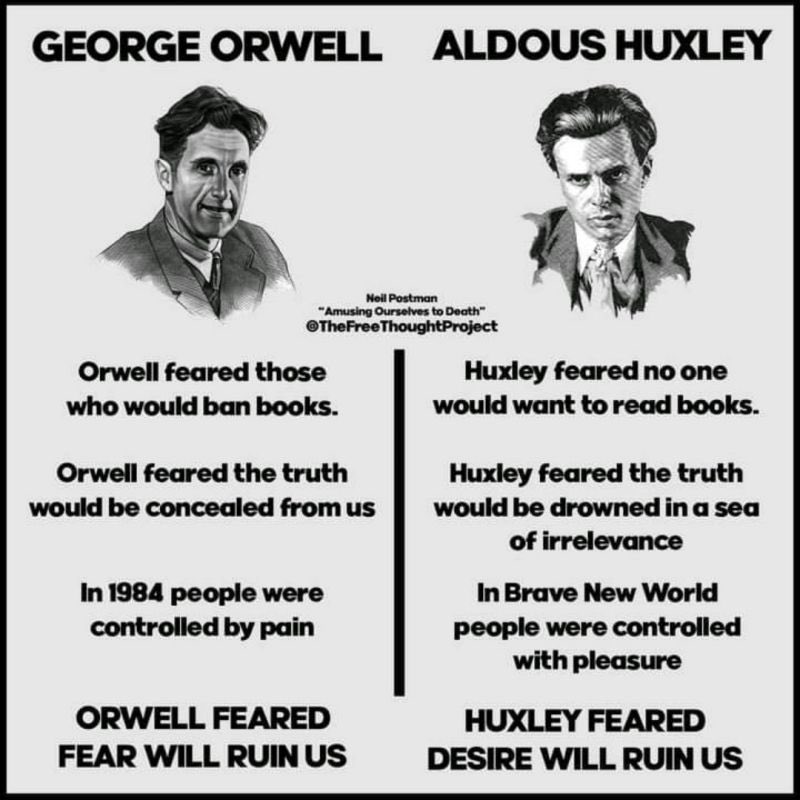
One of my longest-standing arguments is that we are not living in Orwell’s 1984, where truth is centrally suppressed and censored by force (that’s former communist societies, modern-day China, Russia, North Korea).
We are living in something much closer to Huxley’s Brave New World.
The truth is not hidden - it is almost always readily available. But it is buried beneath an industrial quantity of noise: propaganda, outrage, half-truths, conspiracy theories, influencer theatre, algorithmic rage bait and an endless stream of content designed not to inform us, but to keep us emotionally stimulated.
The modern information system does not need to censor the truth when it can simply drown it in noise.
A fact no longer has to be disproven - it only has to be surrounded by a hundred competing claims, stripped of context and nuance, turned into partisan ammunition and pushed into the same feed as celebrity gossip, memes and 15 second videos engineered to deliver the fastest possible dopamine hit. By the time the truth reaches us, it appears as just another piece of content competing for our attention.
That is the more sophisticated form of control: not preventing people from knowing, but exhausting their capacity to care.
Orwell feared a world in which people would be deprived of information. Huxley feared a world in which they would be given so much distraction, stimulation and triviality that they would lose the desire to seek it.
The defining struggle of our age is therefore not simply between truth and censorship, but between truth and indifference.