The surge in East Asia's current account surplus has become so big that it is impossible to miss (or almost impossible to miss, there are still some, umm, small exceptions).
Big as the actual surplus is tho, the underlying true surplus is actually bigger
1/
@Nev_or_never@FOXFOOTY Scott. Whoosha. Rutten. Knights. Who’s mate were they? Dodoro and that group clearly. And that’s the problem. They need a solid process to choose the next coach but if they land with an Essendon affiliate guy it’ll be only the second in 6.
‼️Market sentiment is deteriorating but FAR from capitulation:
The BofA's Bull & Bear Indicator FELL from 8.4 to 7.4, falling out of the "Extreme Bull" zone for the first time since February 2026.
The market is nervous, but nowhere near peak fear. 👇
https://t.co/bGlWBGgnkI
"Some believe market valuations are highly predictive of forward returns. We’re skeptical ... In our own work, we found the underlying data to be heavily influenced by a single extreme outlier: the dot-com era from 1998-2002."
@coatuemgmt
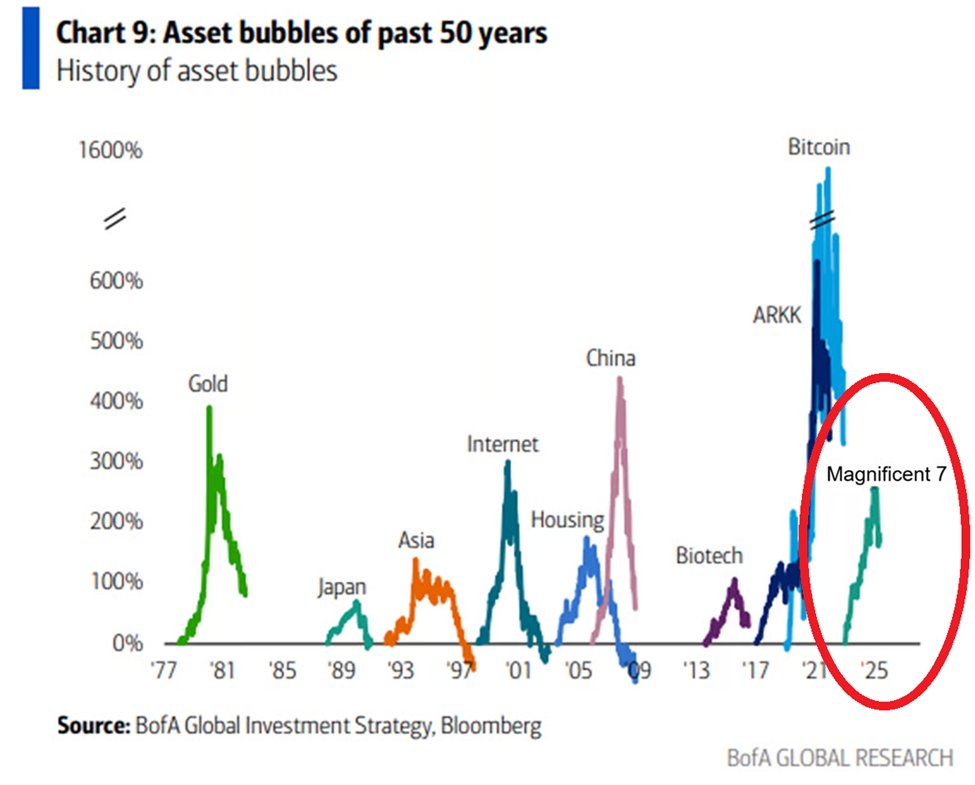
🚨Is the US market in a bubble?
Everyone has an opinion on whether US stocks are in a bubble.
Some argue the AI mania is nearing its end, while others say it is only beginning.
To cut through the noise, we can examine 5 key areas.
Let's start with LEVERAGE. (a thread)👇
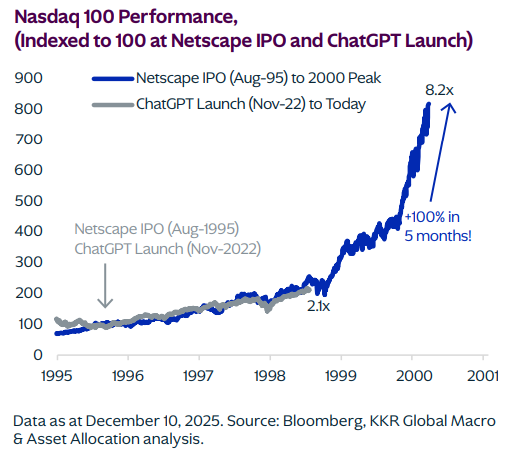
KKR just released an 88 page report on their 2026 outlook for public and private markets
A few charts that caught my eye
1/ Nasdaq 100 performance following Netscape IPO and ChatGPT launch are following similar trajectories
📌 Debt
Global debt keeps climbing, set to breach $350 trillion this year. A reminder that fiscal discipline and global coordination remain crucial to preventing financial shocks
👉 https://t.co/blMxcoFA78
h/t @IIF#debt#corporatedebt#governmentdebt
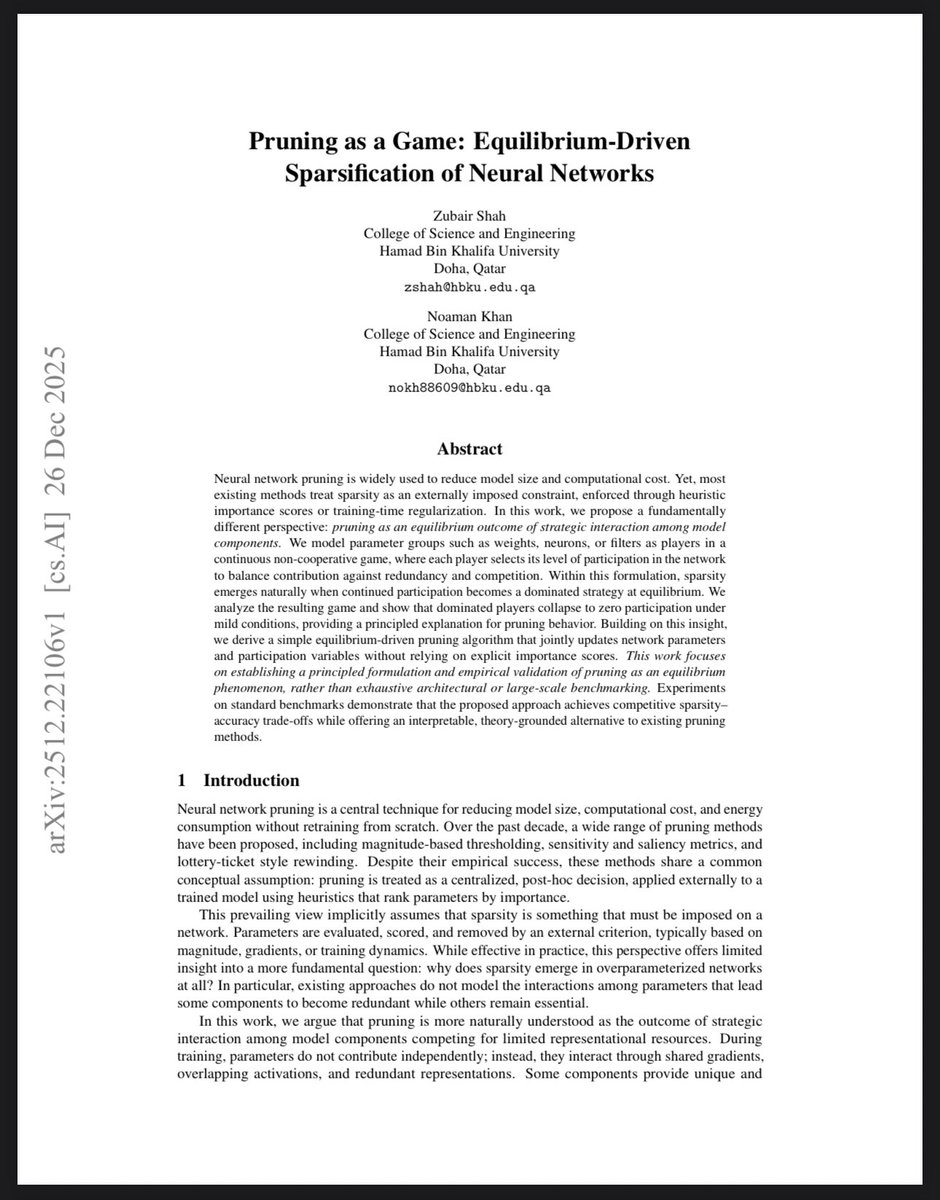
Breakthrough: Game-Theoretic Pruning Slashes Neural Network Size by Up to 90% with Near-Zero Accuracy Loss: Unlocking Edge AI Revolution!
I am testing this now on local AI and it is astonishing!
introduced Pruning as a Game.
Equilibrium-Driven Sparsification of Neural Networks, a novel approach that treats parameter pruning as a strategic competition among weights. This method dynamically identifies and removes redundant connections through game-theoretic equilibrium, achieving massive compression while preserving – and sometimes even improving – model performance.
Published on arXiv just days ago (December 2025), the paper demonstrates staggering results: sparsity levels exceeding 90% in large-scale models with accuracy drops of less than 1% on benchmarks like ImageNet and CIFAR-10. For billion-parameter behemoths, this translates to drastic reductions in memory footprint (up to 10x smaller), inference speed (2-5x faster on standard hardware), and energy consumption – all without the retraining headaches of traditional methods.
Why This Changes Everything
Traditional pruning techniques – like magnitude-based or gradient-based removal – often struggle with “pruning regret,” where aggressive compression tanks performance, forcing costly fine-tuning cycles. But this new equilibrium-driven framework flips the script: parameters “compete” in a cooperative or non-cooperative game, where the Nash-like equilibrium reveals truly unimportant weights.
The result?
Cleaner, more stable sparsification that outperforms state-of-the-art baselines across vision transformers, convolutional nets, and even emerging multimodal architectures.
Key highlights from the experiments:
•90-95% sparsity on ResNet-50 with top-1 accuracy loss <0.5% (vs. 2-5% in prior SOTA).
•Up to 4x faster inference on mobile GPUs, making billion-parameter models viable for smartphones and IoT devices.
•Superior robustness: Sparse models maintain performance under distribution shifts and adversarial attacks better than dense counterparts.
This isn’t just incremental – it’s a paradigm shift. Imagine running GPT-scale reasoning on your phone, real-time video analysis on drones, or edge-based healthcare diagnostics without cloud dependency.
By reducing the environmental footprint of massive training and inference, it also tackles AI’s growing energy crisis head-on.
The implications ripple across industries:
•Mobile & Edge AI: Affordable on-device intelligence explodes.
•Green Computing: Lower power draw for data centers and devices.
•Democratized AI: Smaller models mean broader access for startups and developing regions.
As AI scales toward trillion-parameter frontiers, techniques like this are essential to keep progress practical and inclusive.
Pruning as a Game: Equilibrium-Driven Sparsification of Neural Networks (PDF: https://t.co/OxRgcEqOue)
I will continue my testing but thus far results are robust!
Holy shit... this might be the next big paradigm shift in AI. 🤯
Tencent + Tsinghua just dropped a paper called Continuous Autoregressive Language Models (CALM) and it basically kills the “next-token” paradigm every LLM is built on.
Instead of predicting one token at a time, CALM predicts continuous vectors that represent multiple tokens at once.
Meaning: the model doesn’t think “word by word”… it thinks in ideas per step.
Here’s why that’s insane 👇
→ 4× fewer prediction steps (each vector = ~4 tokens)
→ 44% less training compute
→ No discrete vocabulary pure continuous reasoning
→ New metric (BrierLM) replaces perplexity entirely
They even built a new energy-based transformer that learns without softmax no token sampling, no vocab ceiling.
It’s like going from speaking Morse code… to streaming full thoughts.
If this scales, every LLM today is obsolete.
NVIDIA ($ 4.2 trillion) is now 10% of the total US market cap nearing the size of India’s market cap of $4.8 T |MICROSOFT is bigger than the UK’s market cap | APPLE ahead of Canada, France & Germany |GOOGLE & AMAZON bigger than Switzerland, S Korea.
Serious market concentration.
"In 2023, US data center demand only accounted for 3.7% of America’s total power usage. By 2030, McKinsey projects that electricity consumption from data centers could reach 11.7% of all US power consumption" https://t.co/7lFEkLYc8k