So let me get this straight:
When immigrants take jobs, it’s a national crisis.
When AI takes jobs, it’s innovation.
Can someone explain why we’re supposed to fear people willing to work, but celebrate technology designed to replace workers?
Non ho mai scritto a riguardo della raffineria di alluminio ad Aughinish in Irlanda; pensavo erroneamente: quanto alluminio può mai produrre l’Irlanda per la Russia?
Mi sbagliavo. La raffineria di Aughinsh, posseduta dal colosso russo “Rusal” (posseduto dall’oligarca Deripaska) produce un terzo di tutto il (poco) alluminio ancora prodotto in Europa. Tutto questo alluminio è trasportato in Russia dove viene usato per nutrire lo stesso complesso militare industriale che rade al suolo le città ucraine facendo stragi di civili.
Ma lo scandalo è ancora maggiore di quello che potrebbe sembrare: che le sanzioni europee non siano affatto complete e permettano ancora tali follie non era una novità. Quello che personalmente mi ha scandalizzato è il modo in cui i politici irlandesi, incalzati dal bravissimo reporter Caolan, neghino che la raffineria abbia una qualche connessione con il complesso militare russo, nonostante tutto, a partire dalle insegne fuori dalla struttura, porti a tale conclusione.
Questa roba deve finire all’istante. La raffineria va sanzionata, chiusa e basta.
The New York Times accidentally revealed the moral bankruptcy of capitalism.
China is making breakthroughs in cancer drugs, clinical trials, biotech research, and life-saving medicines.
The first American reaction is not:
“How many patients can this save?”
It is:
“Will this threaten U.S. dominance?”
“Will American biotech lose its edge?”
“Will Big Pharma struggle to keep up?”
That tells you everything.
In a sane world, better cancer drugs would be a human victory.
In Washington’s world, even medicine becomes a battlefield the moment China helps people live.
China’s biotech rise is not just about winning.
It is about responsibility to a massive patient population that cannot wait for American monopolies, American prices, or American permission.
Cancer patients do not care about U.S. dominance.
They care about staying alive.
And that is exactly why China cannot leave this field to America.
On this #WorldEnvironmentDay, we join 72 other NGOs in calling on Prime Minister Hun Manet to immediately free the Mother Nature Cambodia 5 #MNC5, 5 young Cambodian environmental defenders sentenced to 6–8 years in prison for peacefully advocating to protect their environment.
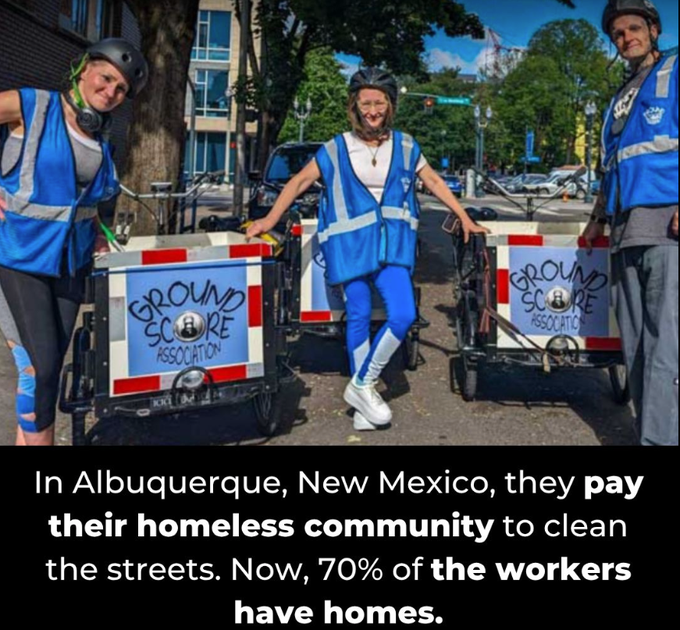
In a groundbreaking social initiative, Albuquerque, New Mexico launched a program that pays homeless individuals to clean streets, parks, and public areas.
The idea was simple — offers work, dignity, and purpose instead of punishment or pity.
The results were remarkable: over 70% of participants have now secured permanent housing or full-time employment, transforming their lives and communities alike. The city’s “There’s a Better Way” program proves that compassion-driven policies can be more effective than traditional welfare systems.
One man in California has spent 57 years recording the sounds of natural places. Much of what he's recorded no longer exists.
His name is Bernie Krause. He started as a folk musician and an early pioneer of the Moog synthesizer. In 1968, he began carrying recording equipment into rainforests, deserts, coral reefs, African savannas, and research sites associated with scientists like Jane Goodall and Dian Fossey.
The Wild Sanctuary archive now contains more than 5,000 hours of recordings and over 15,000 identified species. Krause coined the term "biophony" to describe the collective sound of living organisms in a habitat and helped establish the field of soundscape ecology.
Through thousands of recordings, he observed that healthy ecosystems often partition acoustic space, with different species occupying different frequencies and times of day. On a spectrogram, an intact habitat can resemble a densely layered musical score.
When Krause revisited many of the places he had recorded decades earlier, he found that over half had become silent, severely degraded, or so altered by human activity that their original biophonies could no longer be heard. His archive preserves sounds from ecosystems that have been transformed or lost.