Ornithological researcher specialising in climate change impacts on passerine migrants with a wider interest in natural history. Aviation safety consultant.
Lack of rigour in the Pied Flycatcher piece on #Springwatch today. No mention of the recent earlier arrival and breeding trend that offsets earlier oak leaf bud burst. Pied Flys arrived early and nested early this warm spring. 10 days earlier at my study site, like my Redstarts
6 #BOUsci23#BREAK2 Looking at the wider literature, I see estimates for advancement of Mediterranean passage prior to European passage comparable with the UK arrival trend which demolishes my simple hypothesis and suggests a wider, potentially synchronous overall adjustment.
1 #BOUsci23#BREAK2#ornithology Looking at migrant arrival interannual variation, I was struck by the between species correlations and the possible insights provided about migration weather dependence. https://t.co/yBtT6wAt9d
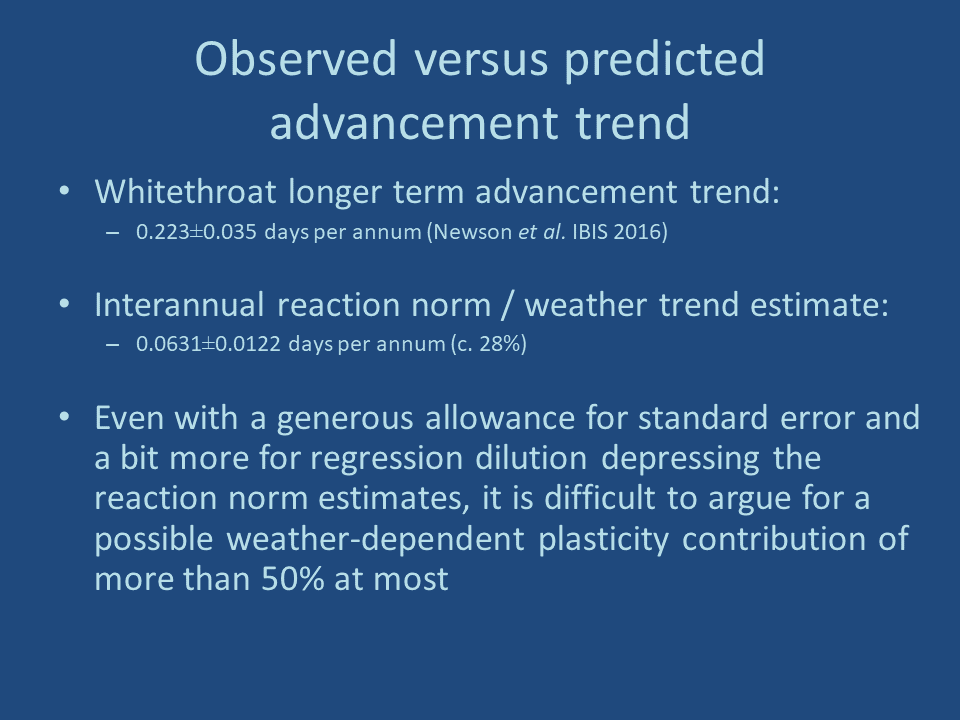
5 #BOUsci23#BREAK2 Even allowing for standard error and under-estimation of reaction norms by invoking regression dilution, I couldn’t really say that these weather-related phenomena might possibly account for more than about half of the observed recent advancement trend.l
I am pleased to announce my recent publication on abundance-related bias in #phenology estimates using site presence survey methods - https://t.co/oxHOC9QJQi really good @IBIS_journal review experience with both reviewers engaging positively in the process.
Just when I thought that the Pied Flycatcher nesting period was over, there’s another female on a new nest, on top of an old one where the chicks recently fledged. This must be a good nest box as the one a few metres away is still empty. @piedflynet @_BTO@somersetbirds
Three male #redstart back at my Horse Dale study site this morning. The earliest since I started this study in 2016 but by one day only. The fun for 2023 is just starting.
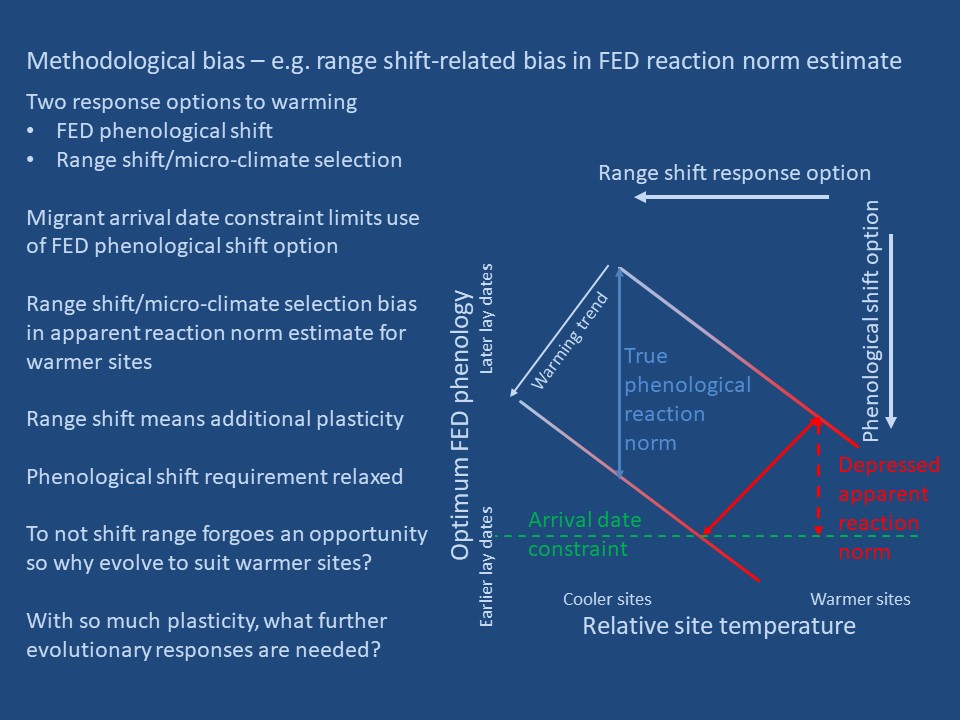
6 #BOU2023#BREAK4 Range shift may skew our reaction norm estimates and add plasticity to the system. With all this previously evolved plasticity, what further evolutionary responses do mobile passerine migrants need to meet the climate change challenge?
1 #BOU23#BREAK4#ornithology For empiricists studying migrant arrival and first egg dates the dominant impression is of plastic responses to inter-annual weather variability. With all that plasticity how will we distinguish evolutionary responses to climate change?
5 #BOU2023#BREAK4 Confounding factors, known and unknown, add plasticity and data uncertainty to our reaction norm estimates, complicating matters further.
Just a few days left for #BOU2023 early-bird registration - https://t.co/Pmu0vGdQTM
Great opportunity to catch up on how birds are responding to the challenges of environmental change