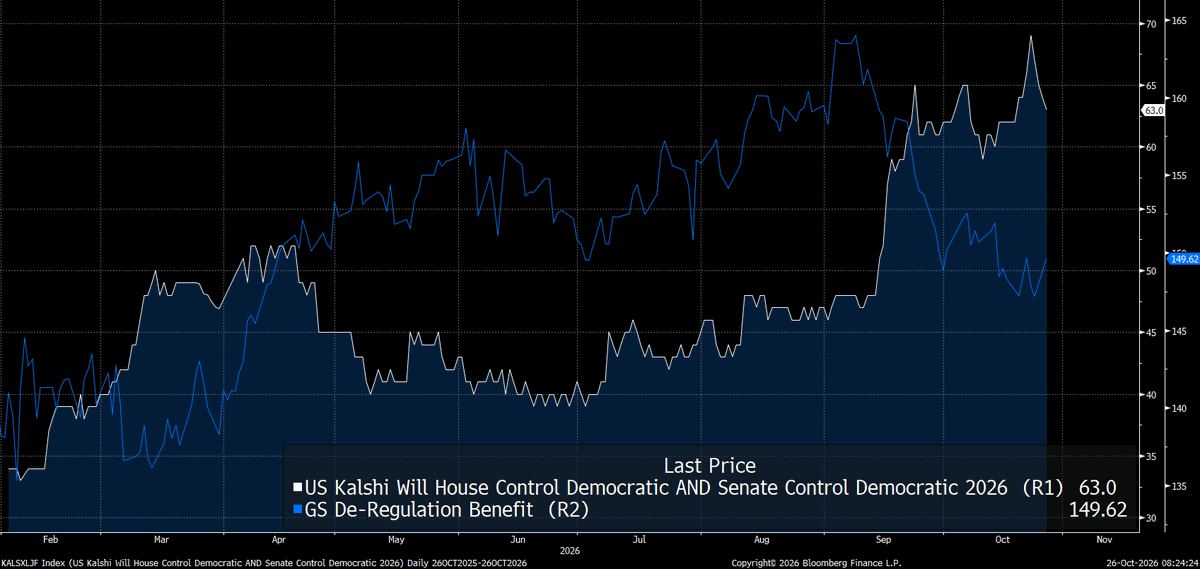
@FundaAI is closing in on @citrini on the MarketStack Index after James Bulltard pulled ahead of them earlier this week.
At this rate, the top 3 MarketStack Index authors, all with 17k subscribers each, will have a combined distribution 19x smaller than the top 3 Bestsellers (Citrini/Burry/Doomberg) who together have almost 1 million subscribers.
As someone who has personally spent $500k / mo+ on Google Ads for years, I can tell you with certainty:
This revenue growth in Search is artificial & extremely unhealthy for Google’s business long term
Search volumes are declining as legacy search is being increasingly cannibalized by non-monetized LLM queries
Google’s response?
Manufacture revenue growth via short-sighted, highly extractive, customer-hostile tactics. I.e. charge advertisers more for lower quality clicks, including clicks they do not want and explicitly did not approve Google to charge them for
A few examples to illustrate:
For all of its history until recently, Google operated on a 2nd price auction model
I.e. if you bid $5 CPC and the next highest bidder bids $1 CPC, Google charged you $1.01 for the click (one penny more than the 2nd highest bidder) rather than the $5 you bid
This was a genius move by Google early on as it incentivizes advertisers to input their true maximum willingness to pay rather than trying to play the game of bidding low and constantly adjusting to try to stay just ahead of the next highest bidder while still not paying too much
However recently, Google silently deprecated the 2nd price auction and began charging advertisers as much as their bid and budget caps allow, regardless of what anyone else is bidding
It’s a short-sighted cash grab at the expense of the long term health of the advertiser ecosystem
Making thing worse, Google also recently nerfed keyword targeting precision
Google previously had precise keyword targeting settings that allowed advertisers pick individual search phrases to bid on, defined down to the character w/ exact match or phrase match targeting
This was one of the core features that made search advertising magic, enabling advertisers to run extremely precise campaigns based on exactly what their target customer typed
But now, even if you bid on a specific term or phrase using the strictest exact
-match targeting settings, Google will show your ad across 1000’s of unrelated keywords, labeling them as as “exact match (close variant)”
The definition of “close variant” means whatever they want it to and changes constantly. The result is advertisers get billed for clicks that are totally irrelevant to their business and that their targeting settings explicitly forbid Google from targeting. Google does it anyway and there’s no ability to turn this off
So now exact match is broad match, and broad match is just meaningless spam
This is all very bad for advertisers, but for Google, it allows them to show your ad and bill you for clicks across 1000x more searches that were previously going unmonetized (mainly because they’re garbage queries no one wants)
This is how you grow revenue atop declining search volumes
Lastly, and perhaps most egregiously, Google quietly stopped respecting budget caps by a factor of 2x. For example campaigns we’ve been running for years with $1000 daily budget caps suddenly began spending $2000+ per day
And the extra spend is entirely on the garbage keywords Google arbitrarily throws in as “exact match (close variants)” which have no value to our business, but can’t be turned off
Google offers no refunds nor any recourse for overspend or spend on keywords you explicitly did not target
These are not the actions of a healthy business. These are the actions of company whose core business is in decline but desperately needs to pump quarterly earnings so Wall Street will continue to fund insane capex while hopefully looking through their rapidly deteriorating negative free cash flow
Google operated a benevolent monopoly for the better part of 25 yrs
Meaning the value Google captured from Search was but a small fraction of the value it created, and that spread produced a potential energy that justified expectations of high earnings growth far, far into the future
This is now no longer the case
At the alter of AI capex, Google is sacrificing the golden goose
At first glance $GOOG earnings Yesterday looked great.
But since stock was down 7-10% I of course got curious what the market hated so much and now looked into it.
It's much simpler than I expected.
Remember when their stock crashed because investors got scared their ad business would get heavily replaced by AI competitors (prompt instead of search)?
It turns out that is now actually happening and they just did a great job hiding it for a long time.
The tweet from Max below does a fantastic job explaining it in great detail HOW they do it.
I've been in Media & Advertising for almost a decade and what he says is spot on.
I'll give you the short version: to hide the decline of their ad business they extract MORE from the remaining customers.
This is a typical sign of a media business that's doing poorly and the legacy media did the same.
For example many of the TV ad sellers increased prices of their slots to hide in their revenues that demand is going down every year.
This works for a while until buyers adjust, decide ROI is now too low and just flat out ditch the entire media spending category.
$GOOGL is still doing well in AI across the stack and they have very valuable assets, especially on the data (i.e. YouTube, Maps) and distribution side (Calendar + Gmail !).
But the decline of the ad business or at the very least lower than expected long term potential and growth has to be valued properly, becuase it's still a big chunk of the business.
This is another reason why I like more aggressive and direct exposure to my investment ideas like $NBIS for AI cloud.
When you buy these giants like $AMZN $META $GOOG $MSFT you of course get a lot of stability and safety, but you also always involuntarily diversify across all their businesses.
It's also worth mentioning that we're specifically seeing $GOOGL getting attacked in their advertising, NOT the entire industry, as $META is doing great with their ads. So this is a search ad specific thing, not industrywide!
It’s a great long term hold but honestly this report left much to be desired. Their obligations are massive and they still have massive equity diluting planned soon, such will push the stock lower
And search rev growth decelerated (even though 12% is impressive), meaning wall st will once again be concerned about their traditional business impacted by ai
$GOOG down 9% tonight is an overreaction.
Most of the "huge earnings miss" is Google's stakes in other companies going down on paper. Take that out and the miss is a lot smaller. Still a miss, but nowhere near what the headline looks like and last quarter those same stakes handed Google a massive gain.
Meanwhile, the actual business:
Google Cloud doubled. Up 103% in a year. Microsoft reported tonight too, Azure grew 48% and the stock is up 4% after hours. Google grew its cloud twice as fast, Cloud is now a quarter of the company, and the stock is down 8%. Make that make sense please...?
Search grew 12% and Google said searches are growing the fastest they have in five years. Since ChatGPT came out, the bear case has been that it kills Google search. That's just not happening, AI is making people search more.
Gemini hit 1 billion users.
But they did spend more building out AI this quarter ($51B) than the business actually generated in cash ($42B). And they're selling stock to help pay for it and did zero buybacks. That's new for Google so i don't love that
But capex actually came in under what Wall St expected, and Cloud revenue doubling while Cloud profit tripled is pretty much the proof the money is working. You'd be more worried if they were spending all this and Cloud was growing 20%.
The stock was already ~20% off its highs going into this. Now it's closer to 27%.
I own it and I'm not selling. Great buying opportunity.
This year, well followed accounts on here ridiculed me for my bearish call on Google and my bullish calls on Dell and Microsoft.
In hindsight, that was a sign my contrarian calls might be right. As for my trolls, they can go jump in a lake.
Recent relief in AI credit markets was driven by Meta’s financing choice (equity instead of debt), which reduced expected bond supply.
Meta’s CDS tightened ~15bp off the highs, and the sector followed ($ORCL tighter by ~22bp, $CRWV by a much larger ~110bp).
Related equities confirmed the relief: neoclouds rebounded sharply from the 23 October lows (CoreWeave ~+10% to 27 October, with similar moves in $IREN, $WULF, etc.)
Our AI CDS dashboard is free for all to use: https://t.co/KAcOBleWWM
Wouldn’t be surprised to see the Fed go full hiking cycle by Q1 given the imbalance occurring with inflation
The inventory to sales ratios are pretty insane right now
But people are still trying to call bottoms in bonds 🤦🏻♂️
A bitcoin treasury vehicle just rebranded itself as an “AI research lab”
Promoter Chairman and CEO. A board member known for an Opendoor retail campaign. A CFO whose last company settled False Claims Act allegations.
Meet $SVIA 🧵
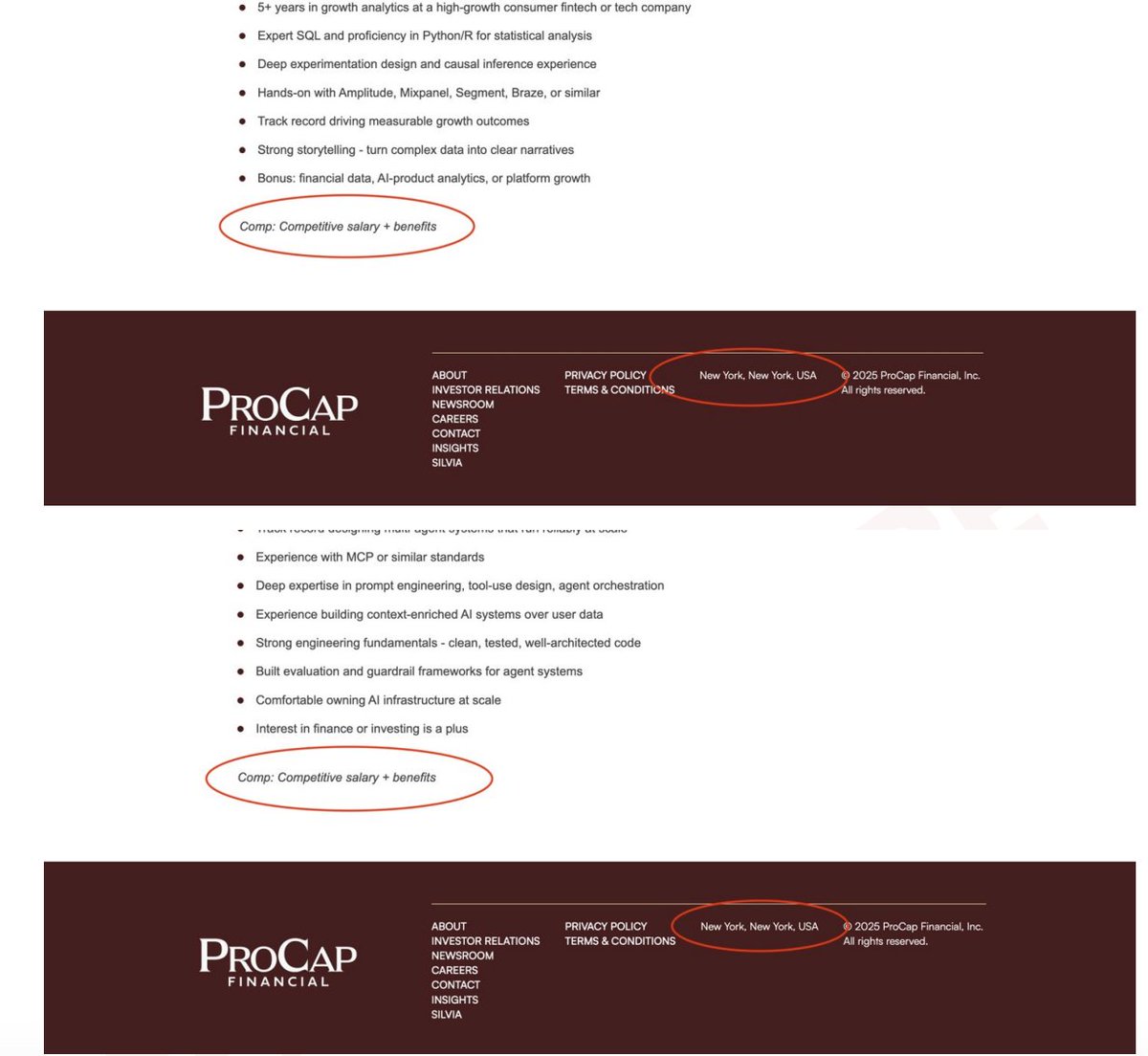
Basic hygiene: Silvia lists New York as its location. As we understand it, NY requires employers with 4+ employees to post a pay range.
Its job postings say “Competitive salary + benefits.”
A company asking to manage your money with AI.
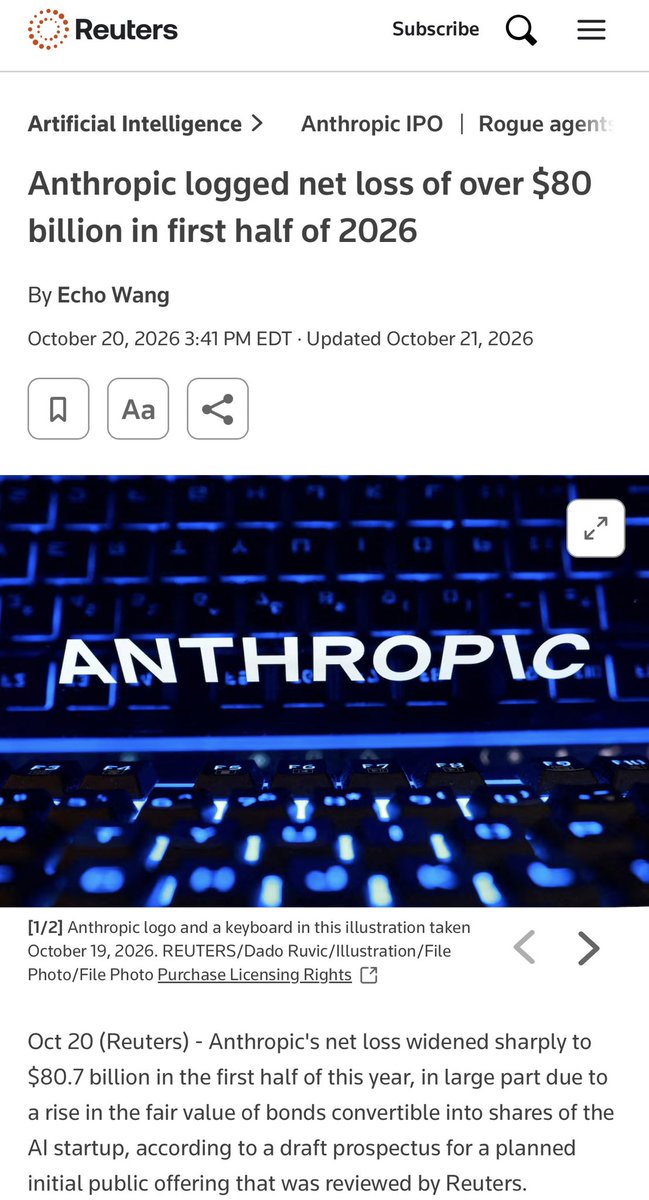
Consider how tone deaf and devoid of insight the media was to fixate on the meaningless $80 billion net loss figure, driven by an unimportant noncash convertible charge, instead of focusing on the company's actual underlying business fundamentals.
Is the media this clueless, deceptive, or simply incompetent? None of the answers is good.
my new tool in action, look at these $META december 545 puts sold today, similar setups of puts sold 30-60 dte between 1-5m far out the money have hit at least a 30% return 95% of the time. Specifically 107 out of 113 occurences.
1/Anthropic’s S-1 is out.
2/ Revenue, quarter by quarter ($M)
Q1'25: 376
Q2'25: 787
Q3'25: 1,382
Q4'25: 2,040
Q1'26: 4,731
Q2'26: 11,555
Q2'26 revenue was up 1,368% YoY. Compute & infra costs were up 300% over the same period.
Q2'26 was the first quarter with positive GAAP operating income: $974M.
3/ How “Run-Rate Revenue” is defined
Trailing-28-day consumption fees × 13
+ monthly subscription fees × 12
Three caveats from the S-1:
-It includes customers later found to be violating the usage policy
-It is seasonal: usage dips in summer and winter holidays
4/ Revenue is recognized gross
When Claude is sold through the AWS, GCP or Azure marketplaces, Anthropic is the principal. It books the full amount as revenue, and the cloud provider’s fee goes into Sales, marketing & partnerships.
The marketplace share of revenue has climbed fast:
11% (2023) → 32% (2024) → 47% (2025) → 48% (H1'26)
Adjust for this before comparing multiples with companies that report net.
5/ Distillation
The S-1 puts a number on it:
“we estimate that revenue from such customers represented approximately 5% to 7% of our revenue for the nine months ended September 30, 2026”
These are customers violating the usage policy or commercial terms. Applied to ~$33B of 9M revenue, that’s roughly $1.7–2.3B.
Enforcement was stepped up in Aug–Sep, and the company expects the share to decline. The S-1 says the estimate “requires judgment and may change.”
6/ Visibility is low
RPO at 6/30/26: $10.8B
~75% of that is recognized in the next 12 months, so cRPO ≈ $8.1B
Deferred revenue: $1.65B
Q2 annualized revenue is ~$46B, so cRPO covers less than 20% of it.
80% of revenue is consumption-based, and next year’s revenue depends almost entirely on usage.
7/ The compute bill
Disclosed commitments:
Broadcom TPU leases: ~$161B
SpaceXAI (NVIDIA GPUs): up to $121B, ~$3.1B a month from Dec’26
Google: ≥$115B, plus $125–150B more of TPU capacity in 2028–31
Amazon: ≥$110B
Microsoft: ≥$45B
Nscale: ~$45B
Lambda: ~$41B
AMD: >$20B
That adds up to roughly $780–810B.
8/ The mismatch to watch
Revenue is variable and consumption-driven. Compute costs are fixed, multi-year and take-or-pay.
On top of that, the Broadcom leases, the credit agreement and the convertible notes include cross-default provisions.
This is the single most important risk in the filing.
9/ Demand is real
NRR ~900% (ex-Pro/Max)
Customers paying more than $100K / $1M / $10M a year: 11,900+ / 1,900+ / ~250
No single customer was >10% of 9M’26 revenue
Top 5 customers ≈ 25% of 9M revenue
Q3: 79% of revenue came from outside the top 5, up from 64% in Q1
Claude Enterprise users who also use Claude Code spend ~20x more than those who don’t
10/ Dilution
$77B of convertible capacity: Google $20B, Amazon $15B, Broadcom $42B, settled in shares at a trailing VWAP
Google can buy up to $10B more stock at the IPO price
A Public Benefit Fund already holds 5% of fully diluted shares, and can get up to +2% more for every 50% rise in the share price
Elon trying to nuke the entire neocloud complex so $SPCX can scoop up all the contracts and buy out the competition for pennies on the dollar is some killer stuff.
The mentality you need to succeed in an emerging industry like this, biggest reason why SpaceX is going to be the biggest and best provider of compute.
Brutal chart.
France and UK vs. Communist countries at their peak.
UK public spending as % of GDP is currently above Romania, Venezuela and China.
And France is a lost cause.
(HM Treasury/Rand Research)
AI Semis Trade: From Arousal to Reality
The past few weeks have been painful for AI semi investors. One of our mistakes early in the month was not realizing how much of an impact Anthropic’s ARR print would have on the AI trade, and not “sussing” out the set up heading in: lower distillation revs, OpenAI taking share in September, & META/MSFT off-ramps. These were all things that were reported on; if this was an earnings print, we wouldn’t have wanted to be long in the weeks heading into it. In hindsight — knowing what we know now, it was a perfect set up to reduce exposure into it.
The upside of whiffing on that trade and the market’s renewed focus on Lab ARRs and financing? It has forced me (and other investors) to sharpen our pencils and better understand the different moving pieces of the trade, and how they play off each other.
Let’s rewind a bit before diving into where we are now:
For the first three years of the AI semi trade, and especially during the May/June go-go days, investors were in the throes of the honeymoon phase: maximum arousal, minimum scrutiny. Every piece of news was looked at with rose-colored-glasses. It’s just like the beginning of a new relationship when the infatuation is so strong that your partner can do no wrong. Even when she tells you she believes in an "open-source relationship," you somehow hand-wave it away and convince yourself it’s just going to soak up more of the frontier labs' excess demand. When your level-headed friends pull you aside to point out glaring red flags, like the fact that she’s running a shadowy circular-financing scheme with her roommates, you don’t listen; you just stop inviting them to parties. Before you know it, you’ve turned on Gavin Baker’s X notifications and forward SemiAnalysis to anyone who thinks you’re moving too fast, the ultimate wingmen who never stop hyping her up and telling you what you want to hear. “It’s way bigger than just coding, bro. She’s going to replace the entire global labor force.”
Before long, the endorphins and dopamine completely take the wheel. Even if you carry the scars from past relationships — whether the early 2000s, GFC, 2019 SaaS, or the 2020–2022 Covid binge — the blinders go right back on. Those exes weren’t real supercycles and everyone knows there’s no dark fiber in GPUs, you tell yourself as you stare at GPU rental prices. You’ve even picked out baby names: Bel if it’s a girl; Claude if it’s a boy.
But eventually the dopamine wears off, and you have to get to know the person you’ve been telling everyone is perfect. You begin to see the flaws and start asking practical questions about spending habits, expectations, whose money is actually paying the bills. Can we afford this lifestyle on those lab ARRs, or are we just annualizing the honeymoon and assuming the capital stays cheap forever? And is there enough power in ’28 to keep the spark alive?
Things suddenly feel a lot more complicated, and we feel some investors longing for the simpler, more intoxicating days of May and June. But we see the end of the honeymoon as a chance for the relationship to mature. That means accepting where we are, adjusting expectations, and focusing our attention on where the strengths are rather than the flaws...