$99 billion of that profit came from a line called other income. Alphabet describes it as "primarily the result of net unrealized gains on equitysecurities." So Google did not sell anything. It marked up shares it already owned and ran the increase through its income statement.
Google just reported $99 billion in profits it never actually received.
Alphabet posted net income of $112.1 billion for a single quarter. Earnings per share came in at $9.11 against a Wall Street estimate of $2.87.
That is one of the largest profit quarters any company has ever printed.
Yet the stock fell about 7% the same day.
When people read past the headline and opened the earnings release, they found the reason sitting in one footnote...
$99 billion of that profit came from a line called other income. Alphabet describes it as "primarily the result of net unrealized gains on our equity securities."
So Google did not sell anything. It marked up shares it already owned and ran the increase through its income statement.
That single line added $77.1 billion to net income after tax. It accounted for $6.26 of the $9.11 in earnings per share.
Strip it out and adjusted earnings per share were $2.85. Analysts wanted $2.89. The ACTUAL business missed.
Now here is what makes this insane:
Most of that $99 billion came from two holdings, SpaceX and Anthropic.
SpaceX went public on June 12 at roughly $1.77 trillion, up from about $400 billion a year earlier. Alphabet's stake is worth $94.1 billion, and roughly $80 billion of it sits under sale restrictions.
Anthropic went from a $350 billion valuation to $965 billion inside the same quarter. Alphabet's private company holdings were worth about $124.3 billion on June 30, and the vast majority of that is Anthropic.
Google cannot sell either position right now.
Now trace where that valuation came from:
Google started putting money into Anthropic in 2023. A $300 million bet has grown into a $13.3 billion position with commitments of up to $30 billion more.
Anthropic committed to buying at least five gigawatts of computing capacity from Google Cloud.
Google Cloud revenue then grew 82% to about $24.8 billion, the strongest quarter that business has ever had.
That growth is part of the story the market uses to price both companies.
And when Anthropic's valuation jumped, Google booked the jump as its OWN profit.
Google is the investor, the supplier, and the party deciding what the asset is worth. A tax and accounting consultant named Robert Willens flagged this back in April, pointing out that Alphabet is able to influence the value of one of its own assets.
And Alphabet's free cash flow for the quarter was negative $5.9 billion. That is the first negative quarter since Google went public in August 2004.
Capital spending hit $44.9 billion. Operating cash flow was $39.1 billion. Capex now eats about 37.5% of every dollar of revenue, the highest share in the company's public life.
To fund it, Alphabet has taken on roughly $100 billion of debt this year and raised about $85 billion in a June share sale, its first in more than two decades. This is a company that spent years buying its own stock back.
What happens next:
Alphabet raised 2026 capital spending guidance to between $195 billion and $205 billion, the second raise in three months. The finance chief told analysts 2027 spending will rise significantly.
The company also disclosed $811 billion in contracted future spending commitments as of June, up nearly $500 billion from March.
Those commitments are signed contracts that get paid in cash. The profit is an estimate of what a private company might be worth on a given day.
Estimates move in both directions. If Anthropic or SpaceX gets repriced downward, the same line that produced the biggest quarter in Google's history runs backwards, and this quarter produced no free cash flow to absorb it.
Meta, Microsoft and Amazon are all carrying their own private AI stakes into their own earnings reports.
Watch how much of their profit they actually collected in cash...
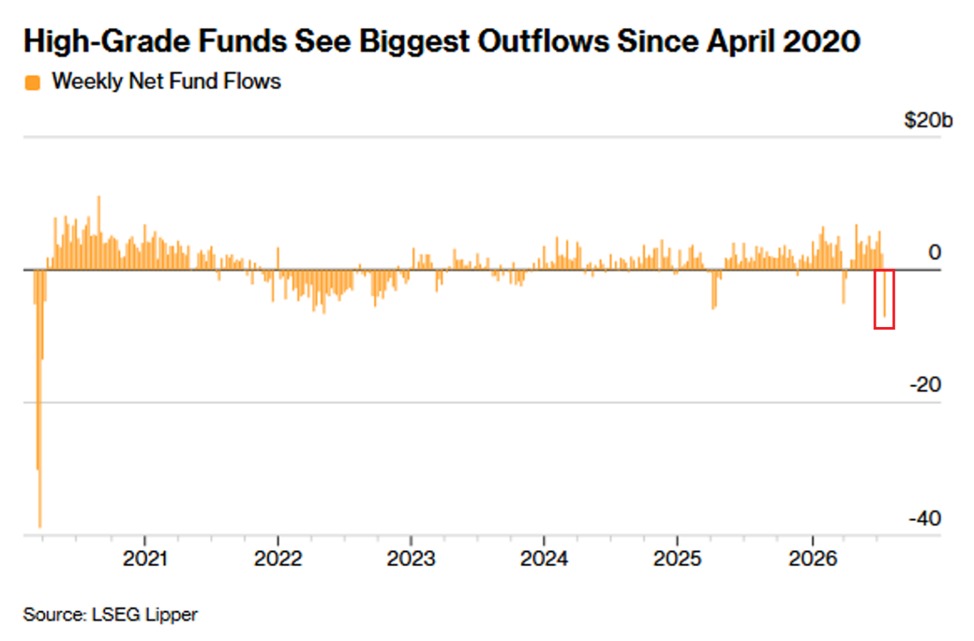
BREAKING: US investment-grade corporate bond funds posted -$7.1 billion in outflows last week, their largest weekly withdrawal since the 2020 pandemic.
On Monday alone, these funds recorded -$8.2 billion in outflows, the biggest daily outflow in over 6 years.
By comparison, during the 2022 bear market, weekly outflows peaked at -$6.5 billion.
This comes as rising oil prices reignited inflation fears, while Alphabet's, $GOOGL, higher AI spending forecast on Wednesday intensified investor concerns over ramping CapEx.
Meanwhile, the investment-grade corporate bond ETF, $LQD, has declined -2.8% since June 30th, to the 2nd-lowest level since September 2025, and is down -1.4% year-to-date.
Investor appetite for corporate bonds is fading.
By comparison, throughout the 2008 Financial Crisis, the net credit balance remained positive, meaning investors held more cash than margin debt amid widespread deleveraging and a flight to safety.
BREAKING: Net credit balances fell -$70 billion in June, to a record -$1.06 trillion.
This metric tracks how much margin debt investors carry relative to the cash in their brokerage accounts.
Since the 2022 bear market, this figure has more than quadrupled.
This comes as margin debt has surged +$895 billion over this period, to a record $1.50 trillion.
By comparison, throughout the 2008 Financial Crisis, the net credit balance remained positive, meaning investors held more cash than margin debt amid widespread deleveraging and a flight to safety.
Investor risk appetite is at unprecedented levels.
USD/JPY IS APPROACHING A VERY DANGEROUS LEVEL.
The pair hit 163.807 today.
It is rapidly approaching the 164 level that JPMorgan and Credit Agricole say Japan won't let the yen fall past.
Japan's Ministry of Finance still has enough reserves for more than 15 further interventions at the scale of April and May, and hasn't used them yet.
With the speed of this move, it looks like we are very close to a massive yen intervention.