At a conference on AI & legal profession. I'm sorry folks, but you are over-indexed on hallucinations. You aren't calibrated on the magnitude of the problem and it's possible that one reason is psychological. It's comforting to think that the robots will never be as accurate & diligent as we are.
*I am NOT saying that AI doesn't hallucinate or never makes mistakes; indeed, I believe that it does.
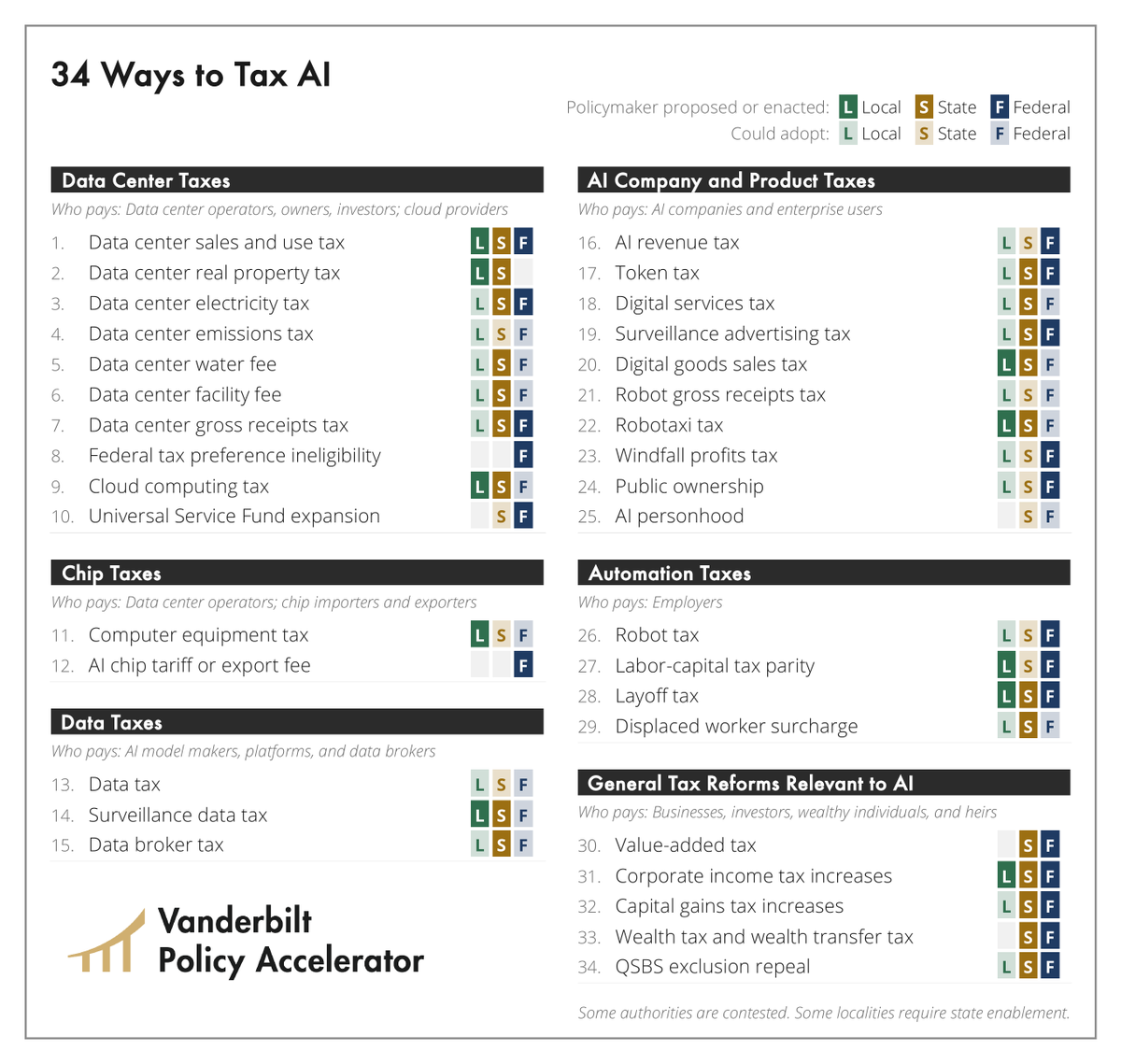
From city councils to Congress, there’s a growing desire to tax AI, but policymakers don’t always know their options. My new paper outlines 34 ways to tax AI across data centers, chips, data, AI cos. & products, automation & general tax reforms. https://t.co/EdEuVv1RiN
VAILL has announced several important updates for the school year, including the well-deserved promotion of Lecturer Emily Pavuluri to Associate Director.
Learn more about the GenAI bootcamps, industry partnerships, and student-facing initiatives here: https://t.co/r4Q4kFET6Y
.@polynoamial on @dwarkesh_sp: I don't know what will happen in 3 months.
Legal academics: my article should be out by the end of 2027.
We've got to seriously reexamine how academics share their research...
If lawyers don't define what the "practice of law" means as AI takes on more legal work, insurers will define it for them through underwriting requirements.
Professors @markjwill and @inspiredcat make the case via @BLaw
Read more: https://t.co/ObIwWMqGR1
i've tried and failed to make this point as clearly as i want to, but:
AI is weird, in that ppl who are optimistic about the technology's growth are often doomy about its implications; while ppl who are extremely skeptical about AI's capabilities are by default optimistic about it being a "normal" technology that won't change much in the world.
so you have this weird situation where a lot of AI skeptics who haven't been following AI news for the last few years (bc they wrote the whole thing off as NFTs 2.0) have no idea that there exists an enormous contingent of AI ppl who have for 10+ years said that very fast AI progress could be really bad for the world, and therefore they suspect that a conspiracy was concocted in the last two weeks to invent the case for AI safety
Teams during rivalry week:
- Ohio State: We don’t give a damn for the whole state of Michigan
- Alabama: Go East until you smell it, go South until you step in it
- Kansas: John Brown did nothing wrong. 260,000 dead confederates was not enough.
A thing to remember about AI-generated LinkedIn slop is many of those people (marketing people, corporate division chiefs, comms and PR professionals) are objectively among the most educated and literate people to have ever walked the face of the earth.
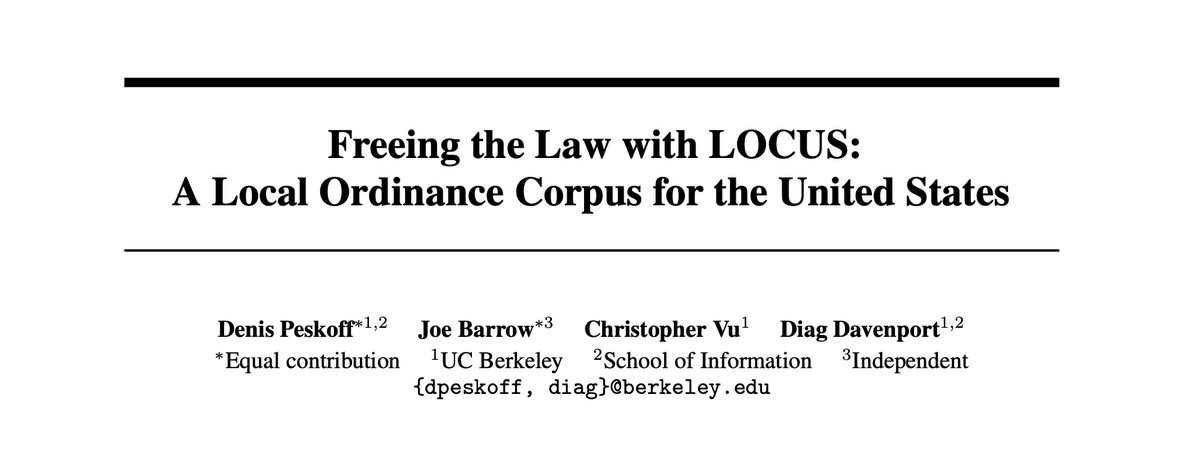
New paper: every law in America is technically public. But not really, until now!
With @DenisPeskoff at UC Berkeley, we built a corpus of ~every publicly accessibly city and county law, and released a huge chunk of it!
2.2 million laws, you're (probably) covered in it!
🧵
Make no mistake: post-Mythos, the United States has a licensing regime for AI. It’s just informal, with no consistent rules or firm boundaries on state power or public transparency. Cobalt mining in the Congo is vastly more institutionalized than frontier AI licensing in the US.
There is a lot of justified anger at Anthropic for sandbagging Fable 5 for AI development tasks. But an unanticipated side effect is that third-party evaluators can no longer credibly use the model for evaluations.
Case in point: we are in the middle of running *really hard* AI R&D evaluations. Fable 5 would be a perfect test candidate. But because of Anthropic's guardrails, we can't know if the model failed or if their classifiers blocked the capability.
By the way, this is not just true for AI R&D. Since Anthropic doesn't make it clear when they are sandbagging, this could seep into any number of technical tasks, and the evaluators wouldn't have any way to know. So they can't credibly claim to evaluate state-of-the-art accuracy using the model.
Are Berkeley Law faculty prohibited from using AI-detection tools, or merely warned that AI-detection tools may be inaccurate and biased? I'm curious what schools are doing about this, as I've only seen warnings.
It's news to me that it was obvious in the 2000s that ML is biased. If that were accurate, a number of groundbreaking studies published starting around 2016 wouldn't have been such a big deal.
Prohibiting AI detection tools does not solve the bias problem. As @olawaleidowu_ pointed out, the concern is AI Police who overconfident in their ability to identify AI-generated content. https://t.co/EXgoRyD6vm
Personal update: I've joined Anthropic. I think the next few years at the frontier of LLMs will be especially formative. I am very excited to join the team here and get back to R&D. I remain deeply passionate about education and plan to resume my work on it in time.
we’ve developed proprietary benchmarks for legal reasoning maintained by attorneys at Norm.
because Norm Law attorneys, while serving as outside counsel to hedge funds, PE firms, etc. deploy AI agents in their day-to-day work, we can uniquely build real legal AI benchmarking.
we've been tracking frontier models across generations, and the trend is clear: models are improving substantially in their legal reasoning capabilities.
the latest generation of models are nearly indistinguishable from each other in accurately answering legal questions.
most models are increasingly consistent, with the most recent generation of frontier models reaching the same conclusion ~90% of the time.
but for high-stakes legal work, even the best models on this benchmark reach a different answer often enough that, at scale, users receive contradictory answers to the same question every week.
to integrate ai agents into high-stales legal workflows, you need both (1) purpose-built systems that can constrain, verify, and govern AI reasoning automatically, and (2) the human overlay of expertise for live workflows fully intertwined/integrated w/ ai agents in a deliberate process.
If you think clients buy documents and hours from law firms, this is bad news for lawyers. But if you believe that clients seek discernment, counseling, risk management, and advice from law firms, and documents are just artifacts, this is terrific news for lawyers and clients.
Think about the power Hegseth is asserting here. He is claiming that the DoD can force all contractors to stop doing business of any kind with arbitrary other companies.
In other words, every operating system vendor, every manufacturer of hardware, every hyperscaler, every type of firm the DoD contracts with—all their services and products can be denied to any economic actor at will by the Secretary of War.
This is obviously a psychotic power grab. It is almost surely illegal, but the message it sends is that the United States Government is a completely unreliable partner for any kind of business. The damage done to our business environment is profound. No amount of deregulatory vibes sent by this administration matters compared to this arson.
The belief that AI is mostly fake remains shockingly common, including, as Derek points out, among journalists and takesmen, but also *people with AI in their job titles.* There are people *who do AI policy for a living* who think AI is mostly fake and don’t use it.