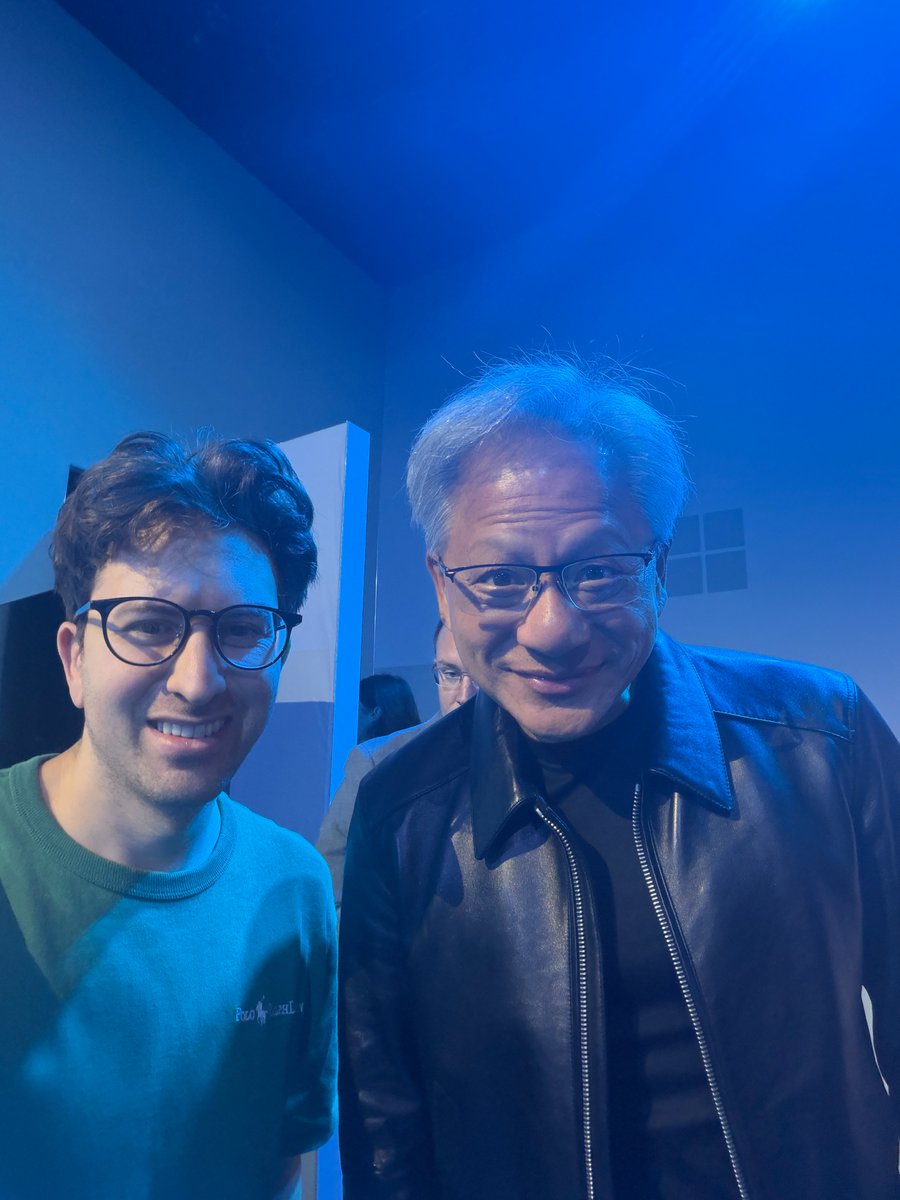
New newsletter: THE JENSEN HUANG FAQ: WINNERS, LOSERS, WORST CASE SCENARIOS
My basic summary for people who aren't deep AI nerds: It’s sketchy for chief executives to have affairs with their major clients; sketchier still for them to have affairs with clients whose business is suspected of violating federal law; even sketchier for that paramour to also be a suspected secret agent of a foreign government; maximally sketchy if that foreign government is America’s top geopolitical adversary; and beyond all reckoning of sketchiness if the US government knew of these allegations and revelations and did approximately f*ck-all about it for months.
The biggest losers:
- Nvidia, obviously: Huang was the founder, rockstar mascot, and chief spokesperson, with 60 direct reports and no succession plan. The plane is entering turbulent air and the pilot just got thrown out the back window.
- "Just sell to China, it's cool" loses its top spokesperson
- Open-weight models lose a top advocate
- Neoclouds and other less-capitalized AI players lose their bank, as Nvidia's circular financing likely pulls back with collapsing stock price
The biggest winners
- China hawks—ie, those who want to restrict chip sales to China—since their policy case gets a heavy serving of righteousness
- Alternative chipmakers, including AMD, Google, Amazon, and smaller chipmakers, who might find more buyers in a world where Nvidia innovation slows down and the company loses its best salesperson.
- Hyperscalers: If neoclouds struggle without the bank of Nvidia, established clouds like Microsoft and Google might gain at the expense of those upstarts
- uhh, Anthropic? Dario was always on the other side of the China debate with Trump/Jensen and the company is among the least dependent on Nvidia tech
The worst-case scenario: I mean, look ... If one of Nvidia’s largest overseas clients was an illegal backdoor to China, overseen by a spy with whom Jensen Huang was having an affair, and the US govt had information on all of the above and did nothing to arrest China's espionage/legal violations because they wanted to preserve an intimate state-business relationship? Many "if"s there, but sweet JESUS, that looks bad.
https://t.co/PjqzjaJMSn
I spent 48 hours in SF hanging out with billionaires, data labs and AI founders and execs running $1B to $100B companies.
My observations:
1. Sooo MANY stories of data brokers making like $2M a WEEK selling company data to labs. I can't tell if it's the beginning or a bubble, and I kept wondering which niches are left. Digging into it actively.
2. At dinner, someone asked the table, "If a new model drops next month, does your company get better or worse?" HALF the table went quiet! I think that's the best question to ask about any AI startup right now.
3. The bar people talk about now is hitting $1B in revenue in 12 months (I guess that's the new unicorn?). What I didn't hear much about is retention. AI revenue can come in fast and leave fast, and I think we're going to see a lot of stories of AI companies with huge revenue and terrible retention.
4. It's pretty clear we're living through the reinvention of the computer. The model is the CPU, the harness is the operating system, and skills and plugins are the apps. Thinking about it that way makes it easier to see where the whitespace is.
5. We're maybe 12 months from an agent that can watch you work for a week and then do your job without any instructions. The screen recording plus agent memory plus local model combination makes this possible right now.
6. Agent harnesses feel like the new GPT wrappers, in a good way, especially vertical ones. The best teams I talked to treat the model as swappable. One founder walked me through routing different models to different jobs: one for taste and visuals, a cheaper one for the everyday stuff, another for text.
They use prompts they can move across models over fine-tuning, and A/B test the output on what users actually do with it: do they edit it, export it, share it? A vertical harness is basically four things: the connectors for that industry's data, evals written by people who know the work, rules for what the agent can and can't touch, and a clean screen for a human to review. The model is maybe 20% of it.
7. There's a lot of reverse engineering going on/cloning going on more than I've ever seen. People are decompiling software and rebuilding it with agents, and someone showed a suite of like 10 apps that are worth $5B+ each all that he cloned open source. Me and everyone are still thinking through what it means when software gets this easy to copy.
8. My guess is the value moves to data. If the software can be rebuilt quickly, what's worth paying for in a legacy SaaS company is the years of customer data and workflows inside it. Some SaaS companies are secretly data companies.
Gets me thinking about how do you truly value data for this saas companies? Like if we were buying these dying saas companies at 2x ARR before (as example), maybe there is a better metric. Idk, just thinking out loud here.
9. It feels like a good chunk of legacy software won't make it to the agentic era, especially anything built around people clicking through a lot of screens.
10. Every company I talked to wants to pipe its internal data into one place and expose it to agents through MCP. Then they look at the data and realize it's a mess: five versions of the same customer, old Slack channels, PDFs nobody can search. Cleaning that up feels like a big consulting opportunity!
11. A lot of founders are building the basic building blocks for agents: APIs, data layers and tools. Some of the companies I saw barely have a UI because the main user is an agent. I really believe the startups that build primitives to this agentic era will do extremely well. Building blocks is the best way to think about it.
12. Labs can get plenty of training data, but it's harder to get real examples of agents failing inside companies. Whoever has those logs has something valuable.
13. Someone running a big consumer company told me the next fight is over memory. The model that remembers the most about you wins, and the smartest model matters less than people think.
14. Physical AI came up a lot. Astra I think was the first model that got people into AI can actually do CAD, and I think a lot of people are thinking what does vibe manufacturing really look like. The line I keep thinking about came from a robotics founder: the hardest problems in AI are deployment problems now, not research problems. Their robots work on their own, call a human when they get stuck, and every one of those calls becomes training data.
15. Cybersecurity companies are having a moment and are actually cool companies to build now, especially the ones that clean up after a breach. Every agent with access to your systems is a new door into your company, and a lot of those doors were left open.
16. Some startups are worth more dead than alive now. A shutdown company with 5 years of Slack, email and code can get paid for licensing all of it. I wouldn't be surprised if founders start factoring that into when they shut down.
17. People are starting to talk about monetizing the agent web. It feels really early, but when the most popular user of the internet is an agent, what startups should you be building?
18. I think agent insurance is coming. Once an agent makes an expensive mistake, insurers will want audits before they cover anyone.
19. Several people said the hire they want most is someone with taste who can write evals. The models are getting good at generating ideas, so the hard part is judging which ones are good.
20. New trend I observed: startup raises VC, uses venture dollars to become a creator, startup fails, founder falls back on being a full-time creator and incubates other products bootstrapped.
21. Getting SIGNIFICANT distribution is HARD right now. Founders are sponsoring buses, buying billboards like crazy and throwing parties with famous DJs to get noticed. Kinda feels dotcom era in that sense.
Attention is what's scarce! The growth guy going viral sharing his UGC strategy from Wispr Flow is a good example. It's the sauce everyone wants, and I truly believe there are probably only 50 people on the planet who know how to scale these types of businesses efficiently in this era.
Always good to get that dose of SF. I felt sooo lucky to have such an incredible trip during such an incredible time in building businesses. Surreal in so many ways.
Happy to be home and locked in.
Until next time!
I’m not doing it again this week. Great 2:30 slate.
Terribly coached, picked the wrong QB, still don’t hate the go-go. Absolutely will still be at Folsom, just can’t with the football anymore. It’s year 4.
Gross football. There’s no plan, there’s no commitment to a rebuild.
I'm going to become the joker with all of these conservatives discrediting liberal arguments about AI by spookily whispering that money might be involved.
The birth of the Tech Right involved the realization, in the 2020s, that conservative people in tech should use their money to do stuff in politics. The All In podcast hosts threw fundraisers for the president!
I don't know what the principle is at stake here other than "when conservative money seems like it'll get its way, we're a movement; but when liberal money seems like it'll get its way, it's a conspiracy." In 2024, when (per the Washington Post) about 80% of federal campaign spending by the 100 wealthiest Americans went to Republicans, you didn't hear a lot from the Tech Right back then about the danger of money in politics. But now that Trump is polling below the Mendoza Line and several upcoming IPOs will unlock billions of dollars of cash among Chamath's political enemies, these guys are suddenly Woodward and Bernstein, exposing the evils of rich ppl using their money to do stuff in politics.
Garrett Wilson says the Jets feel like they owe it to the fanbase to give them football to cheer about:
"Their loyalty is never in question. There hasn't been much to root for, and we're all aware of that. We owe it to them...our fans are special."
"Sounds of Seattle" 1991, festival gratuito pagado por el ayuntamiento para publicitar el talento local. Pearl Jam cierran el concierto a tres días de publicar su primer álbum "Ten" y a un mes de que saliera el "Nevermind" de Nirvana que cambiaría la industria musical de un día para otro.
"Ten" no cuajó en un primer momento tras su lanzamiento y tuvieron que pasar ocho meses hasta que la fuerza de arrastre de "Smells Like Teen Spirit" —y el repentino interés hacia otras bandas grunges por parte de la MTV—, alzaran al icónico álbum al número dos de las listas estadounidenses.
Este fue el último momento en que Pearl Jam no fueron nadie. Tocando en su ciudad, para una mezcla de fans tempraneros del grupo y paisanos que pasaban por ahí y no tenían nada mejor que hacer.
Documentazo.