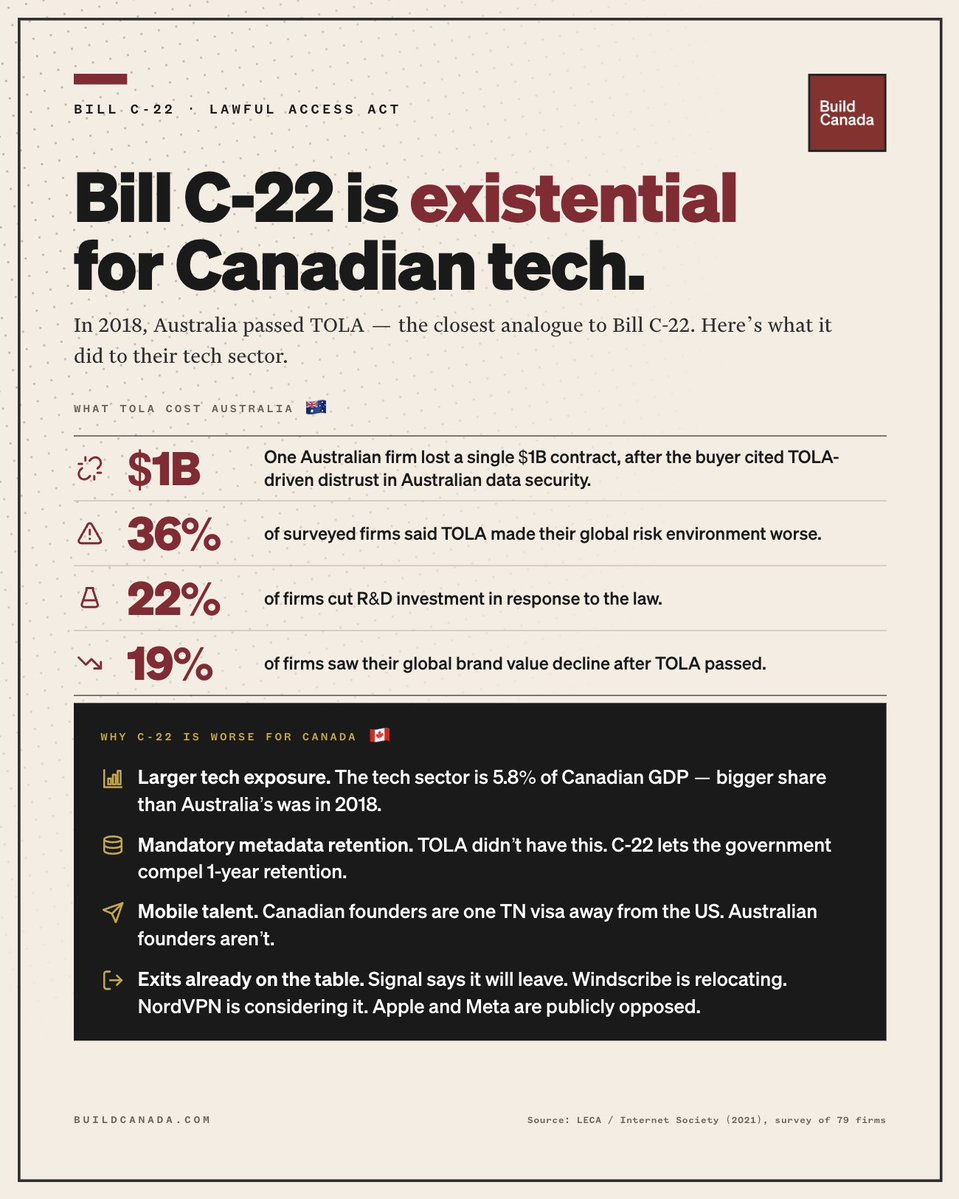
Bill C-22, the "Lawful Access Act", is raising alarm bells across the country. It may cost 🇨🇦 billions in industry.
In 2018, 🇦🇺 implemented a similar legislation titled TOLA (the Telecommunications and Other Legislation Amendment).
A study commissioned following implementation demonstrates the results were devastating to 🇦🇺's tech sector.
The problem is, 🇨🇦 is much more exposed than Australia ever could be.
Canada trails behind many of its OECD peers in business adoption of AI.
When our businesses don't operate at their full potential, Canada falls behind on the world stage.
We can fix it through policy. 👇
“Give them a massive amount of oil, agricultural land, copper, freshwater, and every natural resource in the world. Now make them neighbors with the biggest market in the world. Great, now have them leave the resources in the ground and instead flip condos to each other”.
Grinding is a destructive ideology. It is metabolic dysfunction that warps reality while leaving the observer oblivious.
There is another way.
I call it compounding.
You gain power, status and wealth while growing biologically younger.
This is the new Warrior & Caretaker archetype: the way humans operate in the age of AI.
I’ve been living this archetype for the past few years. The following data points are a proof of concept to offer a concrete model of ambition + health for those looking.
> started a new career at 42
> in a field I knew nothing about
> became #1 in the world
> defined a new zeitgeist
> built Don’t Die into global movement and ideology
> earned 6M+ followers
> netflix documentary
> founder-mode blueprint into (soon) billion dollar co
> founder-mode kernel world’s first mass brain interface
> while becoming one of the healthiest ppl on the planet
This is value creation while increasing biological vibrance.
I share this because many mistakenly believe that I live a stress-free, luxurious life focused solely on longevity. They then conclude that what I say about sleep, recovery and health doesn’t apply to them because I’m not responsible for anything meaningful day to day.
That’s false.��
I have more responsibility than most founders and CEOs.
For the past five years, I've simultaneously been the founder of multiple 0 to 1 builds.
The ideology work is the hardest. Thinking clearly about the future of human and AI existence is categorically different from running companies or producing content. It requires long stretches of deep work, fighting your biases and existing beliefs to try and find new conceptual terrain.
New ideas are extraordinarily hard work.
I also maintain unhinged ambition: to be respected by those who exist in the year 2500. The only way that happens is if I’m able to do something valuable enough to matter a few centuries from now. I believe that Don’t Die will emerge as the world’s leading ideology. It will be the idea that captures the shift from humans inevitably dying to radical life extension and the key to AI alignment.
The prevailing delusion is that health is a tax on ambition. That health is somehow anti-ambition. The reality is that health is the leverage that enables it. This is the future of intelligent existence.
The first comment to this post will be “Easy for you to say. You already made your billion with Braintree Venmo”. It’s true, money buys conveniences such as food prep, assistance and leverage.
That does not change biological reality. Your body requires 7-8 hours of sleep to properly function. Health is a hard constraint, just like capital or time. Biological vibrance is like money. Run out of it and you’re dead.
Another way to say this, you don’t write shitty code. Yet when you’re in poor health, you are shitty code.
Grinding, aka martyrdom, is an antiquated way of being. It’s primitive and foolish. You’d never run your servers until they’re smoking and melting. You want them to run at optimal temperature ranges and on efficient code. It’s crazy that society somehow tricked people into thinking that metabolic dysfunction is the correct environment to run your own biological code.
Builders.
Those of you with unhinged ambition.
Creating a future that exceeds our imaginations.
Become Warriors & Caretakers of existence.
Health is your best asset.
It gives you sobriety of thought.
Mental and emotional well-being will fuel your greatness.
Compound.
This has been said a thousand times before, but allow me to add my own voice: the era of humans writing code is over. Disturbing for those of us who identify as SWEs, but no less true. That's not to say SWEs don't have work to do, but writing syntax directly is not it.
Nvidia is buying Groq for two reasons imo.
1) Inference is disaggregating into prefill and decode. SRAM architectures have unique advantages in decode for workloads where performance is primarily a function of memory bandwidth. Rubin CPX, Rubin and the putative “Rubin SRAM” variant derived from Groq should give Nvidia the ability to mix and match chips to create the optimal balance of performance vs. cost for each workload. Rubin CPX is optimized for massive context windows during prefill as a result of super high memory capacity with its relatively low bandwidth GDDR DRAM. Rubin is the workhorse for training and high density, batched inference workloads with its HBM DRAM striking a balance between memory bandwidth and capacity. The Groq-derived "Rubin SRAM" is optimized for ultra-low latency agentic reasoning inference workloads as a result of SRAM’s extremely high memory bandwidth at the cost of lower memory capacity. In the latter case, either CPX or the normal Rubin will likely be used for prefill.
2) It has been clear for a long time that SRAM architectures can hit token per second metrics much higher than GPUs, TPUs or any ASIC that we have yet seen. Extremely low latency per individual user at the expense of throughput per dollar. It was less clear 18 months ago whether end users were willing to pay for this speed (SRAM more expensive per token due to much smaller batch sizes). It is now abundantly clear from Cerebras and Groq’s recent results that users are willing to pay for speed.
Increases my confidence that all ASICs except TPU, AI5 and Trainium will eventually be canceled. Good luck competing with the 3 Rubin variants and multiple associated networking chips. Although it does sound like OpenAI’s ASIC will be surprisingly good (much better than the Meta and Microsoft ASICs).
Let’s see what AMD does. Intel already moving in this direction (they have a prefill optimized SKU and purchased SambaNova, which was the weakest SRAM competitor). Kinda funny that Meta bought Rivos.
And Cerebras, where I am biased, is now in a very interesting and highly strategic position as the last (per public knowledge) independent SRAM player that was ahead of Groq on all public benchmarks. Groq’s “many chip” rack architecture, however, was much easier to integrate with Nvidia’s networking stack and perhaps even within a single rack while Cerebras’s WSE almost has to be an independent rack.
@commonsenseplay@rubenleija_ "In the short run, the market is a voting machine but in the long run, it is a weighing machine." In the long run you'll likely be right.
Sharing an interesting recent conversation on AI's impact on the economy.
AI has been compared to various historical precedents: electricity, industrial revolution, etc., I think the strongest analogy is that of AI as a new computing paradigm (Software 2.0) because both are fundamentally about the automation of digital information processing.
If you were to forecast the impact of computing on the job market in ~1980s, the most predictive feature of a task/job you'd look at is to what extent the algorithm of it is fixed, i.e. are you just mechanically transforming information according to rote, easy to specify rules (e.g. typing, bookkeeping, human calculators, etc.)? Back then, this was the class of programs that the computing capability of that era allowed us to write (by hand, manually).
With AI now, we are able to write new programs that we could never hope to write by hand before. We do it by specifying objectives (e.g. classification accuracy, reward functions), and we search the program space via gradient descent to find neural networks that work well against that objective. This is my Software 2.0 blog post from a while ago. In this new programming paradigm then, the new most predictive feature to look at is verifiability. If a task/job is verifiable, then it is optimizable directly or via reinforcement learning, and a neural net can be trained to work extremely well. It's about to what extent an AI can "practice" something. The environment has to be resettable (you can start a new attempt), efficient (a lot attempts can be made), and rewardable (there is some automated process to reward any specific attempt that was made).
The more a task/job is verifiable, the more amenable it is to automation in the new programming paradigm. If it is not verifiable, it has to fall out from neural net magic of generalization fingers crossed, or via weaker means like imitation. This is what's driving the "jagged" frontier of progress in LLMs. Tasks that are verifiable progress rapidly, including possibly beyond the ability of top experts (e.g. math, code, amount of time spent watching videos, anything that looks like puzzles with correct answers), while many others lag by comparison (creative, strategic, tasks that combine real-world knowledge, state, context and common sense).
Software 1.0 easily automates what you can specify.
Software 2.0 easily automates what you can verify.