New research from us @CompCatJYU, @jyuscience with Tongwei Wu et al. The combination of simulations and experiments show how the potential-dependent polaron formation activates TiO2 for the hydrogen evolution reaction: https://t.co/DShYbVYa4E
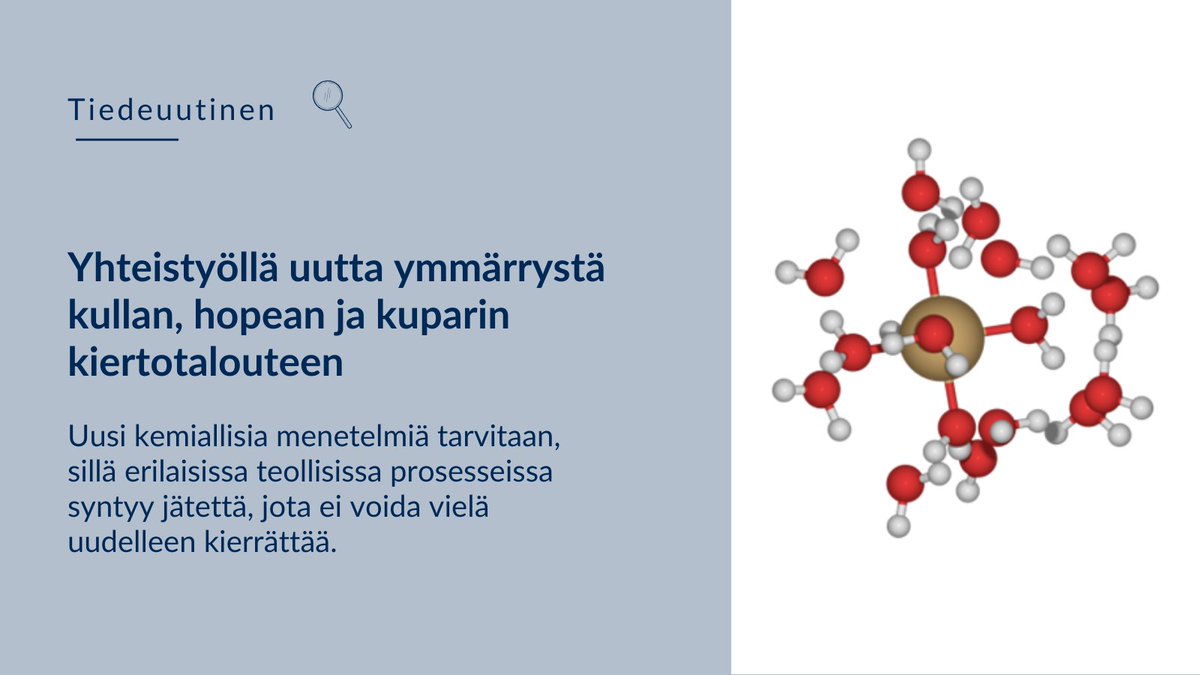
Metallit kiertoon! @jyuscience tutkijamme ovat olleet mukana kehittämässä uutta liuotusmenetelmää kullan, hopean ja kuparin talteenottamiseksi elektroniikkajätteestä. Teoreettisella mallilla voidaan ymmärtää paremmin liuotusprosessia. 👉 https://t.co/TmUsTqE8yB @KumpulaScience
Metal-water interfaces are central to electrochemistry, electrocatalysis, materials science etc. But what drives their formation and dictates their thermodynamic properties? With @AxelGro4's group we addressed this in detail through DFT-MD: https://t.co/9jvWZu9yN1
The results can be used for e.g. benchmarking and developing other methods used for simulating (electrochemical) water-metal interfaces; in particular, the data can be used for parameterizing metal-surface specific implicit solvent models.
Our first venture in circular chemistry and recycling multi-metal wastes. An experiment-theory-simulation collaboration between @KumpulaScience, @jyuscience, and @CompCatJYU to explain how ionic solvents and green oxidants can recover Cu, Ag and Au: https://t.co/B7M632eXiN
Vajaassa vuorokaudessa tällä kirjoituksella on 78 000 lukijaa. Voisitteko @anna_maja kiinnittää esille nostamaani ongelmaan huomiota ennen kuin Campus Online sulautuu osaksi Digivisio 2030 -hanketta? https://t.co/k3VXsCqhVM
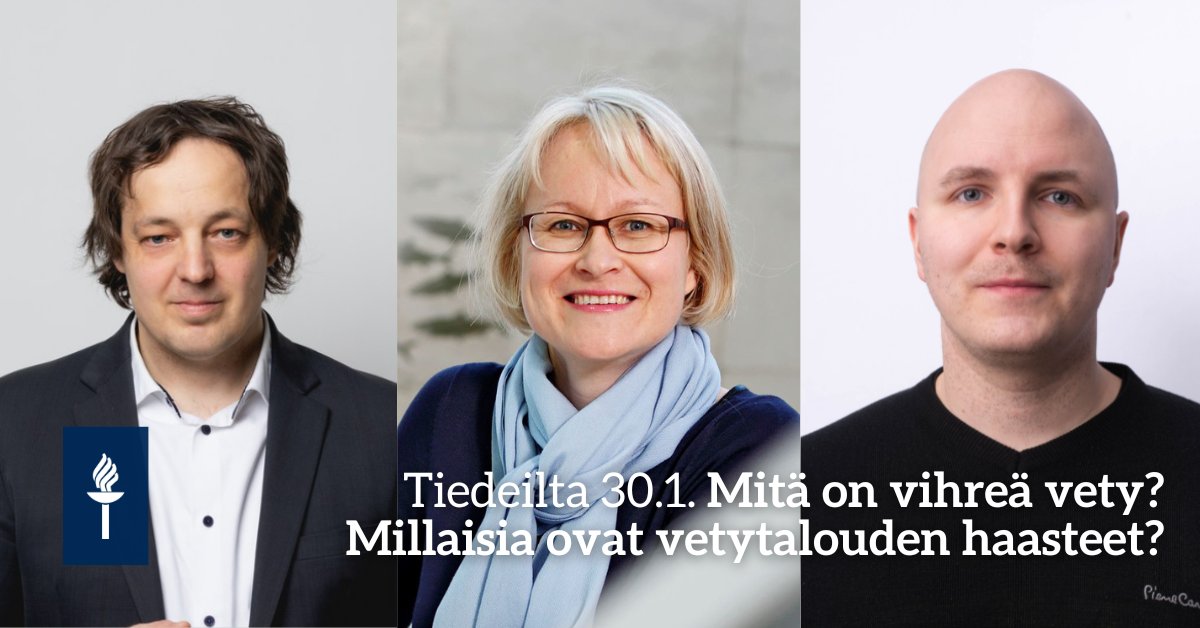
Miten vetytalous muuttaa Keski-Suomea? Tiedeillassa 30.1. pureudutaan vihreän vedyn kemiaan, teknologiohin ja näkymiin. Asiantuntijoina Karoliina Honkala @uniofjyvaskyla, Mikko Lappalainen @VTTFinland ja Timo Harju @JKLn_kaupunki ➡️ https://t.co/0yp6rLFPfp #JYUnique#vetytalous
I am looking for people for two postdoctoral positions in theoretical condensed-matter physics. One is related with the https://t.co/ietPz7kqSk collaboration and another one on a project studying dynamical response of quantum materials. @jyuscience https://t.co/ZNjguvCcFK
I'm in my 4th year of #PhD, worked in different labs around the world, heard from several postdocs, PhDs and UG's...
Dear supervisors, here are my suggestions to make your research lab a better place & attract talent!
@PhDVoice@PhD_Genie@AcademicChatter@AcademicDilemma
I have an opening for a postdoc to work on TD-DFT development. Details and application: https://t.co/nXAIwXtvyp Application deadline: 31 Jan 2024.
RT appreciated #compchem
Kemian laitos on ollut mukana yhteistyöprojektissa, jonka avulla opittiin ymmärtämään useita mekanismeja, joilla elektrolyytit vaikuttavat sähkökemiallisiin reaktioihin. Se edistää parempien sähkökemiallisten teknologioiden kehittämistä! Lue lisää: https://t.co/uscvX7gEtE
@hw_ding1840 VASP already has many implementations of GCE-DFT. In my opinion, this is currently the best one: https://t.co/NvTZeUcJkJ and the code should be open source. Also other (free) codes can do GCE-DFT-MD, GPAW being my favorite.
#Electrocatalysis and #compchem: There are too many names for DFT simulations at fixed electrode potential. Constant potential method, constant Fermi-level, constant work function, controlled-potential, grand canonical (ensemble) GCE-DFT. Confusing but these are all same. 1/2
We are looking for a PhD student to work on low-temperature scanning tunneling microscopy experiments on correlated 2D materials. Details can be found at https://t.co/WCSftPVqLM
The cations for instance affect 1) the surface coverage, 2) reaction and thermodynamics, 3) mechanism, and 4) the solvent reorganization through short-range Coulombic interactions. For the complete stories, have a look at https://t.co/l5DRDTZpXj and https://t.co/jbLoRFCNUW
In two recent publications we have gained insight on the role of electrolyte cations in two alkaline reduction reactions: the O2 and CO2 reduction reactions. Long stories short: the cations critically impact the activity and selectivity of these reactions through multiple effects