If I had a dollar for every time someone called me Mark because of our company name, I’d be retired by now.
At this point, I see two options:
- Change my name to Mark Prompt
- Change the name of our company
One of those feels slightly more reasonable than the other…
Thoughts?
Building a composable, type-safe agent framework in Effect, powering @markprompt's customizable AI customer support agents.
▸ A typed DSL for Actions & Workflows
▸ Recursive Subagents
▸ Deterministic Flows with LLM fallback
Full talk from Effect Days 2025 in the next post ⤵️
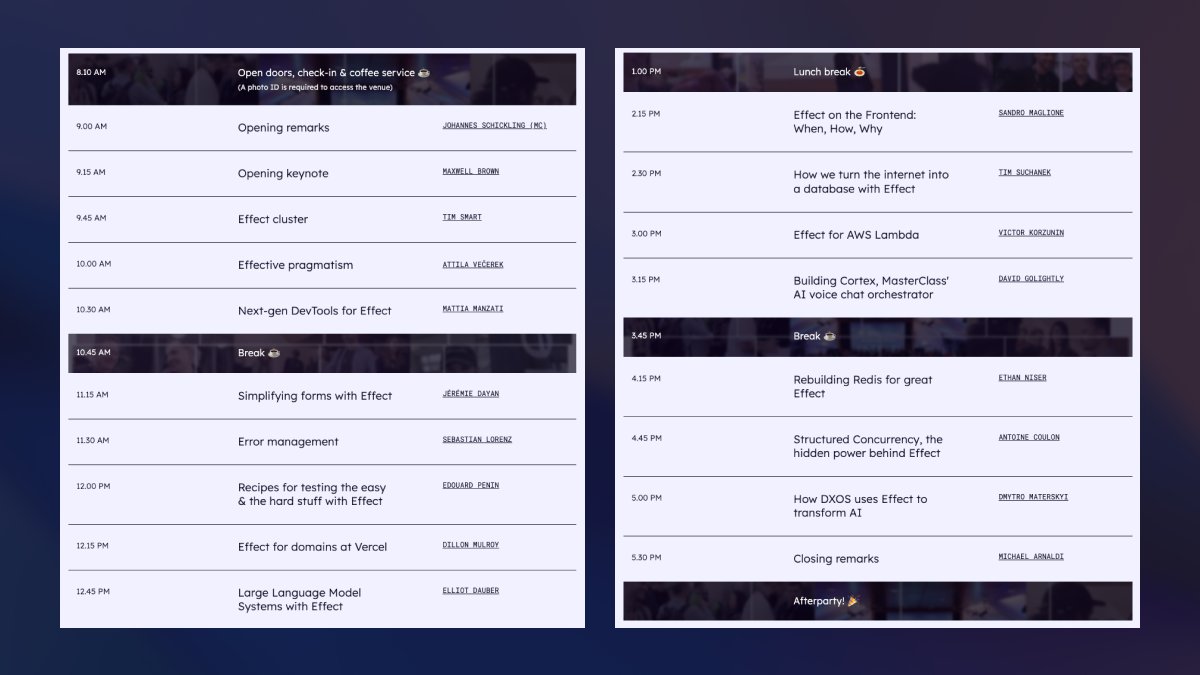
The Effect Days schedule is here! 🚀
Talks on AI Agents, DevTools, Effect Cluster, Error Management, and real-world use cases from @Zendesk, @MasterClass, @Vercel, @inatohealth, @markprompt, @dxos_org & more!
Take a look at the 3-day schedule below:
https://t.co/bnvr7qfnh7
🎙 Cause & Effect Podcast – Episode #2
We chat with Michael Fester, co-founder Markprompt, on scaling AI-powered support with Effect & key engineering lessons.
◆ Migrating from TypeScript to Effect
◆ Handling API failures & cyber attacks
◆ Scaling AI infrastructure reliably
Excited to announce our new Slack integration!
When we partner with a company, we embed into their team - sitting down with them to understand exactly what their ideal support system would look like if they had the resources and expertise. Then we build it. Not a one-size-fits-all solution. Their solution.
Our new Slack integration is just one example. A fully white-labeled AI assistant that handles support directly in Slack, escalating seamlessly to Zendesk or Salesforce when needed, with all the customer fields they need to track on their end.
Excited to announce that Elliot, our founding engineer @markprompt, is giving a talk at the Effect Days conference on March 19-21. If you are building complex systems, you should sign up and come to Italy! 🇮🇹
Building LLM applications at scale – that’s what Elliot Dauber, Founding Engineer at @markprompt, will cover at Effect Days!
Join us this March in Italy 🇮🇹 to learn from real-world projects building AI systems in production with Effect.
🎟️ https://t.co/3oidlgyv1K
Over the past few weeks, we worked hand-in-hand with one of our flagship customers to overhaul the retrieval system behind our Agent Assist drafting functionality.
The process? Meticulous and methodical.
We carefully distilled each step in the reasoning process, mirroring what a skilled human would intuitively do if they had the time. This included fact-checking, synthesizing knowledge across sources, applying critical reasoning, and reranking outputs to ensure the result was both accurate and contextually relevant—whether it came from past tickets, knowledge bases, standard operating procedures, and custom instructions.
The result?
✅ Evaluations against calibration dataset? All passing.
✅ Evaluations across remaining dataset? 95% success, no modifications needed.
The second point was particularly exciting—it meant that our system was now able to generalize well beyond what it was tested for. We are now confident it will continue to do so for future, untested scenarios. We will keep monitoring as we collect new feedback, but the blueprint is there.
This wouldn’t have been possible without breaking the problem down into manageable, measurable steps, with heavy use of sampling and structured outputs. Combining this with continuous human feedback from our customer, we built a retrieval system that generalizes beautifully while staying true to the content as it continually evolves.
When set up right, a carefully designed RAG setup can go further than we had imagined—and we’re just getting started.
Tom @t0m_win flew nine hours during the December holidays to our Markprompt HQ in San Francisco for a hiring trial. The next day (on Christmas Eve 🎄), we made him an offer—and he signed!
We don’t hire fast, but when we do, it’s the kind of people we’d bet on a thousand times over. Watching them bring their A-game even before writing a single line of code only helps us build even stronger conviction and excitement.
One thing we’ve learned over the years is that great talent rarely falls into your lap—you have to go out and find it. That’s why we spend a lot of time doing outbound, working in close collaboration with our incredible recruiting partners, Steph and Eric, to identify exceptional candidates and reach out directly. In Tom’s case, I proactively messaged him through @ycombinator Work at a Startup (we’re part of the W24 batch).
This hiring playbook was a decade in the making. At my previous venture, we scaled our team to 50+ ML researchers and engineers, working on complex, privacy-respecting voice AI, which ultimately led to an acquisition by Sonos. From day one, hiring was our top priority—and one of our greatest challenges. While technical excellence is table stakes, what’s truly difficult is finding people with agency and grit, who ship fast, and thrive in the trenches, solving customer problems day in and day out.
This experience shaped how we hire at @markprompt today. So now, when we spot great talent, we go all in. We fly them down to our HQ, where we have space for visiting engineers. These in-person days give us a window into their mental models and whether we share the same work ethic, customer empathy, and striving for excellence.
Here is a picture taken on December 23rd during Tom’s trial, hacking with our Founding Engineer Elliot on a very exciting new Grafana integration!
When two of our enterprise clients shared, a couple of weeks ago, that they spent 100+ hours every quarter compiling customer reports based on their support tickets—for their product, engineering, and executive teams—we immediately got to work.
The result is now here, in the form of self-serve reports.
These aren’t your traditional compilations of CX metrics. These are agents that, among others,
- Analyze large volumes of customer interactions
- Hone in on specific customers or topics
- Extract highly precise actionable information
Whether it’s identifying friction points in your product, recurring issues from a likely-to-churn customer, or monitoring a newly released feature closely, you can ask, and we report back.
The reception so far has surpassed our expectations!
How do you capture the quality of a support interaction?
It’s a nuanced question. A short chat can still feel draining, while a longer, step-by-step exchange might actually reduce customers’ effort if it effectively guides them or teaches something new.
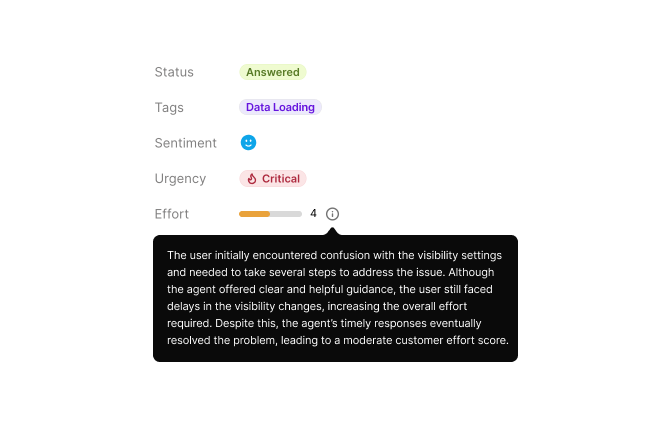
At @Markprompt, we’re tackling this problem in multiple ways. One of them is using a Customer Effort Score (CES), powered by LLMs.
Pre-LLM, traditional measurements either demanded manual review or relied on crude metric combinations. This has some obvious pitfalls:
- Fragmented analysis: Counting messages or flagging sentiment often misses the full story.
- Rigid models: Fixed scoring rubrics don’t adapt well to evolving behaviors and don’t account for cross-correlations.
- Lack of “Why?”: Traditional scores rarely tell why an interaction feels easy or difficult, especially when qualitative factors are linked.
In contrast, using LLMs offers a much richer and detailed perspective:
- Contextual understanding: Our LLMs read entire transcripts, evaluating multiple aspects—tone, complexity of the problem, time to the “aha” moment, and so on.
- Adaptive: The scoring logic can be tailored to the specific factors that matter to you, while omitting others.
- Explanatory feedback: Instead of a single score, our LLMs also explain why they gave a particular assessment, highlighting, for instance, the main friction points that led to a high effort score. When tracked at scale, these insights become a clear roadmap for product improvements.
In short, that’s how we as humans would look at it—if we only had the resources!
The last major OpenAI downtime, which happened on Wednesday, lasted 1.5 hours.
When you’re running critical LLM infrastructure for enterprise customer support, you can’t sit back and wait for the systems to fix themselves up. Customer support needs to be always on, and fast.
Even with 99.85% uptime for OpenAI and 99.64% for Anthropic, there’s no margin for error at @markprompt . Downtimes happen. APIs fail. Systems slow down. It’s the nature of working with LLMs these days. That's why we have robust fallback mechanisms throughout our pipeline.
For each model from one provider, we have a second, equivalent model from another provider on standby. And a third one.
If the primary model goes offline, or even slows down, our system’s switching logic ensures a seamless transition, so our clients don't ever feel the disruption or sluggishness.
For us, the real grind is making sure our clients never have to worry about downtime. That’s what reliability looks like and it’s what we’re building every day at Markprompt.
Learning Effect by Elliot Dauber, Founding Engineer @markprompt
At our October meetup in SF, Elliot shared his experience of working with Effect for the first time and quickly discovering the transformative power it brings to their development team.
https://t.co/DgbHmJlVqH
Introducing @Markprompt Voice Agents.
“Use the same intelligence across all channels.”
In addition to text-based interactions, users can now receive support through voice using state-of-the-art voice models. Seamlessly integrated into the Markprompt core platform and pluggable into your existing IVR systems, Voice Agents are grounded in your enterprise data, adapt to your brand’s tone, and follow your policies and agentic workflows.
Why we decided to stay in San Francisco after the @ycombinator batch? To be close to our users. Nothing beats sitting down by their side and see them in action. Thank you @gabe__nunez for your time, this was very fruitful!