Two countries split from the same colonial body in 1965. One picked economic freedom. The other picked handouts and racial spoils. You already know how this ended.
Singapore had no oil, no farmland, no hinterland. Just a swamp and a port. Lee Kuan Yew looked at that and trusted trade, low taxes, and hard money. Central planners hate what he did.
Malaysia went the other way. In 1971 Kuala Lumpur launched the New Economic Policy, a state program handing quotas, contracts, and university seats to ethnic Malays. Politicians decided who got what. A commissar fantasy dressed in liberal language.
Now let's look at the numbers. In 1965 both places sat around $500 per capita. Today Singapore clears $84,000. Malaysia sits near $13,000. Same climate, same starting line, one sixth the result.
The Singapore dollar holds its value because the Monetary Authority of Singapore manages it against a currency basket and refuses to print its way out of trouble. The ringgit has lost roughly two thirds of its value against the Singapore dollar since 1981.
You cannot subsidize your way to wealth. You cannot redistribute what you never let people produce. Every ringgit funneled through a quota is a ringgit some bureaucrat spent on his own vision instead of a customer's.
Malaysia bet on planners deciding outcomes. Singapore bet on people deciding for themselves. The gap between $84,000 and $13,000 is your answer.
You know what wrecked me when I was newly Christian?
Genesis 22. For years as a Muslim, I was told the story was about Ishmael.
Then I actually read it and honestly, I think the bigger question isn't Isaac or Ishmael.
It's this: Why would God ask Abraham to sacrifice his son in the first place? What kind of God does that?
The answer hit me like a freight train.
God wasn't being cruel. He was painting a picture.
Because Abraham never goes through with it. God stops him.
And then God provides a ram in his place. That's not just a test.
That's prophecy. That's a blueprint.
A father.
A son.
A sacrifice.
A substitute.
Genesis 22 is the heartbeat of the Gospel. God was foreshadowing the day when He Himself would provide the sacrifice. Not for one man. Not for one family.
But for the whole world. Salvation wasn't earned by Abraham's performance.
It came through God's provision. Not your deeds.
Not your striving or your religious record.
A substitute. A gift.
And here's what made me stop and think: The Quran retells the story but removes the name of the son. Why?
Because once you start following the thread through Genesis, the prophets, and the covenant promises, you eventually have to wrestle with the Lamb that comes later.
You have to wrestle with Jesus. The perfect sacrifice that every previous sacrifice pointed toward.
And that's when I realized: The story was never ultimately about Abraham. It was always about what God was going to do for us.
And there's nothing we can do to earn His approval. We can only receive the sacrifice He already provided.
Socialism means collective ownership of means of production.
Means of production are land, labor and capital.
If we collectivize labor, you no longer own your own labor privately.
In practice the state owns your labor, therefore socialism is essentially slavery.
So when you advocate for socialism, you’re advocating for slavery.
Before the weekend ends and America moves on to the next headline, we need to pause and look at a story that matters more than almost any other—the collapse of Venezuela, and what it warns us about if the last democratic superpower ever falls the same way.
This didn’t happen overnight. It happened step by step, over one generation.
VENEZUELA: HOW A PROSPEROUS NATION COLLAPSED
1992
Venezuela is the 3rd richest country in the Western Hemisphere, powered by oil and a growing middle class.
1997
Venezuelans become the 2nd largest buyers of Ford F-150s—a sign of widespread prosperity.
1998
Hugo Chávez is elected, promising to “redistribute wealth” and fix inequality.
2001
The country votes again for socialism, framed as compassion and fairness.
2003
The government imposes price controls and currency controls.
Black markets appear. Shortages begin.
2004
Private healthcare is fully socialized.
2006
Inflation rises sharply as massive welfare programs expand without real economic backing.
2007
All higher education becomes “free.”
2008
Key industries—oil services, steel, cement, telecom—are nationalized.
Production drops almost immediately.
2009
Private gun ownership is banned.
2010
The currency is devalued by 50%, crushing savings and accelerating inflation.
2011
Oil production begins a steady decline due to mismanagement and lack of investment.
2012
American politicians, like Bernie Sanders, publicly praise Venezuela’s model.
2013
Chávez dies. Nicolás Maduro takes power and tightens state control.
2014
Opposition leaders are arrested or silenced.
2015
GDP collapses. Hyperinflation begins.
2016
Severe food and medical shortages spread nationwide.
2017
The constitution is suspended. Elections are no longer meaningful.
2018
Inflation exceeds 1,000,000%. Maduro “wins” a widely fraudulent election.
2019
Unarmed civilians are killed by their own government.
2020
More than 8 million people flee the country to escape hunger and repression.
2023
Minor economic improvements fail to relieve mass poverty.
2024
Disputed elections trigger protests and global isolation.
2026
Maduro is removed by force. Venezuela is liberated after decades of ruin.
THE HARD TRUTH
It took one generation of “progressive” leadership to turn one of the richest countries on Earth into a nation defined by hunger, fear, mass graves, and mass migration.
This is the lesson history keeps teaching:
You can vote your way into socialism.
But history shows people only escape it through collapse, violence, or foreign intervention.
And here is the part Americans must understand clearly:
If this happens in the United States, there will be nobody coming to save us.
No outside superpower.
No rescue force.
No second chance.
Freedom is fragile. Prosperity is not guaranteed.
And once lost, they are brutally hard to recover.
Venezuela’s people paid the price.
America cannot afford to learn this lesson the same way.
Los celtas, francos, sajones, suevos, godos, vikingos, eslavos, germanos, lituanos, letones, etc. ... en fin, los grupos étnicos europeos precristianos adoraban a los anímales, árboles y manantiales, se veían en brutales conflictos interétnicos constantes, practicaban la esclavitud de sus vecinos (esclavitud de blancos) y ofrecían sacrificios humanos a sus falsas deidades.
No tenían códices (es decir, libros; eran principalmente culturas orales con una alfabetización muy limitada), hospitales, universidades ni orfanatos. Eran polígamos, las mujeres tenían pocos o ningún derecho, y los padres podían abandonar (matar) a los hijos no deseados por puro capricho.
No existía la igualdad ante la ley.
No existían los derechos humanos inalienables.
La fuerza bruta y la codicia determinaban quién explotaba y quién era esclavizado.
Pero luego Cristo y Su Iglesia vino a occidente, y tomando lo mejor de Jerusalén, Atenas y Roma, civilizó a paganos, gente tan violenta como los indios mesoamericanos.
Lo que hizo grande a España, lo que hizo grande a Alemania, lo que hizo grande a Francia, lo que hizo grande a Inglaterra, Holanda y al resto de Europa, no fueron paganos meramente blancos, fueron Cristianos.
Esa es la fuente y el fundamento de su grandeza, no solo de Europa, sino de toda la Civilización Occidental.
No se trata de un elemento racial, es mucho más profundo que eso, es espiritual: aquellos pueblos y naciones que verdaderamente abracen al Cristo Crucificado y como nación son cristianizadas, serán iluminadas, saldrán de las sombras y prosperarán en todas sus dimensiones: espiritual, económica, científica, política, etc.
Occidente no construyó el Cristianismo, fue el Cristianismo que construyó a Occidente. Y si lo olvida, se convertirá en lo que era antes de que Cristo lo iluminará: un vil y brutal pagano.
Sin Cristo no hay Europa ni las Américas.
Today is not a good day to be Antifa. 😂
Benjamin Song- 100 years in PRISON
Marisela Rueda: 70 years
Cameron Arnold: 50 years
Savanna Batten: 50 years
Zachary Evetts: 50 years
Bradford Morris: 50 years
Elizabeth Soto: 50 years
Daniel Rolando Sanchez-Estrada: 30 years
FAFO 🔥
🇺🇸 🇮🇷 🇯🇵 THE LESSON OF VERSAILLES: How Trump is treating Iran like MacArthur treated Japan!
The lesson from history we cannot ignore right now with Iran:
After World War I, the Treaty of Versailles humiliated Germany. It crushed their economy, stripped their dignity, and treated their leadership like criminals. What did that produce? Resentment, chaos, and Adolf Hitler.
We almost repeated that mistake in 1945.
But General Douglas MacArthur refused to go down that road with Japan.
MacArthur understood something the Wilson crowd never did: you don’t win the peace by destroying a defeated nation’s leadership if you can use it for stability instead.
Emperor Hirohito was the symbolic heart of Japan. Many wanted him tried as a war criminal and hanged. MacArthur said no.
He kept Hirohito on the throne as a figurehead, had him renounce divinity, and used the Emperor’s authority to push through sweeping reforms - new constitution, demilitarization, land reform, and real democratization.
Result? Japan didn’t descend into chaos or communism. They became one of America’s strongest allies and an economic powerhouse. MacArthur turned enemies into partners.
Fast forward to today.
There’s a loud crowd that says we must completely humiliate and destroy the current leadership in Iran. Topple the regime, no off-ramp, total humiliation.
That’s Versailles thinking.
And it’s dangerous.
The Iranian people are already suffering under their regime. The smarter play - the MacArthur play - is to create an off-ramp.
Give their leadership a path where they can deliver real prosperity and dignity to their own people in exchange for abandoning nuclear weapons, terrorism sponsorship, and regional aggression.
When a nation’s people start seeing tangible improvement in their lives, the appetite for endless jihad and confrontation drops dramatically.
Stability beats endless occupation. Prosperity beats resentment. Smart power beats performative toughness that creates bigger problems down the road.
America First doesn’t mean we’re weak. It means we’re wise.
We learned from Versailles. We learned from MacArthur’s success in Japan. Let’s apply those hard-earned lessons instead of repeating the same mistakes that birthed the last century’s nightmares.
Strength and strategy. Not just slogans.
The goal isn’t to own the libs or look tough on cable news. The goal is to secure America’s future with the least blood and treasure possible.
History already showed us the winning formula.
Now it’s time to use it.
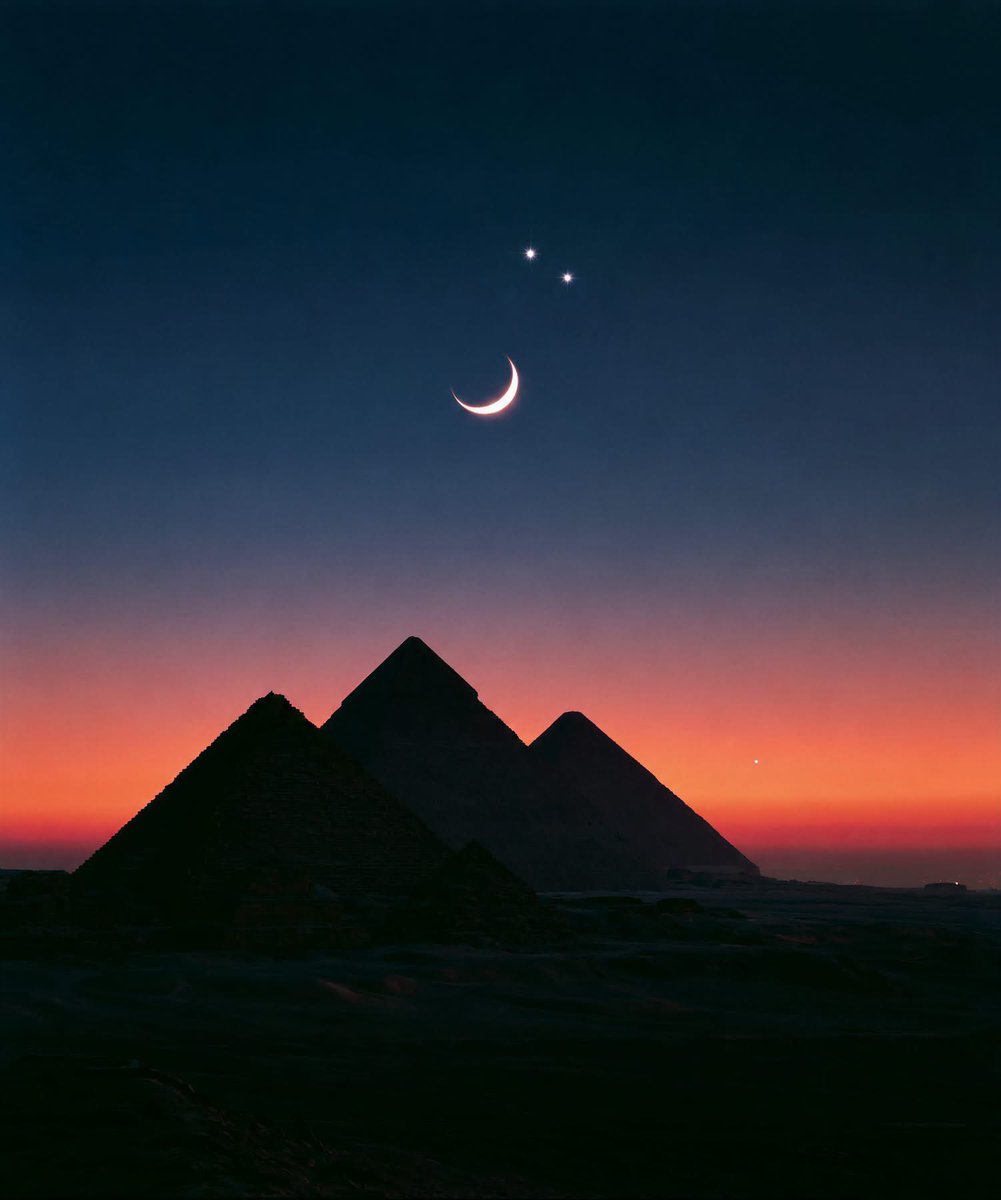
You won't BELIEVE what lined up over the Pyramids 😱
The Moon, Venus AND Jupiter in one frame — with Mercury photobombing the corner.
The ancients would've LOST it. 🌙🪐
Un père a dit à son fils : « Tu as obtenu ton diplôme avec mention. Voici une Coccinelle Volkswagen que j’ai achetée il y a de nombreuses années... Il a plus de 50 ans, mais avant de te le donner, emmène-le dans une concession en centre-ville et demande combien ils te proposent. »
Le fils est allé chez la concession, est revenu voir son père et a dit : « Ils m’ont proposé 10 000 $ parce que ça a l’air très usé. » Le père a dit : « Emmène-le dans un prêteur sur gages. »
Le fils est allé au prêteur sur gages, est revenu et a dit : « Ils ne m’ont offert que 1 000 $ parce qu’ils disent que c’est trop vieux. »
Finalement, le père a demandé à son fils d’emmener la voiture dans un club de voitures classiques pour la montrer là-bas. Le fils a pris la voiture jusqu’au club, est revenu et a dit : « Des gens au club m’ont proposé 100 000 $ ! car c’est une voiture très rare et recherchée parmi les membres. »
Le père dit à son fils : « Je voulais que tu comprennes que le bon endroit t’apprécie de la bonne manière. S’ils ne te valorisent pas, ne sois pas en colère ; ça veut juste dire que tu n’es pas au bon endroit. Ceux qui connaissent votre valeur sont ceux qui vous apprécient vraiment. Ne reste jamais dans un endroit où ils ne reconnaissent pas ta valeur ! »
A Japanese immunologist spent 20 years proving that the chemicals trees release into the air walk into your bloodstream, hunt down your stress hormones, and arm your immune system in ways no therapist or pharmaceutical has ever matched, and most of the data has been sitting in Japanese medical journals for two decades waiting to be translated.
His name is Qing Li.
He is a clinical professor at Nippon Medical School in Tokyo and the president of the Japanese Society of Forest Medicine. The Japanese government has been funding his research since 2004, and the body of work he has produced is the reason forest bathing is now an officially prescribed clinical therapy in Japan and Korea.
The story actually starts in 1982, when the Japanese Ministry of Agriculture, Forestry and Fisheries coined the term shinrin-yoku to describe the practice of slow, mindful walking in a forest. They did it for a practical reason.
Japan was urbanizing fast, stress-related illness was climbing, and the country had thousands of square kilometers of forest sitting unused. The idea was to give people a reason to walk into the trees... They had no idea what was actually happening to the human body during those walks until Qing Li ran the first proper experiment in 2005.
He took twelve healthy adult men on a three-day, two-night trip to a forest park. They walked for a few hours each day. Nothing strenuous. No prescribed routes or breathing exercises. They simply walked slowly through the trees, breathing the air, looking at the forest.
Li drew blood and urine samples before the trip, on the second day, on the third day, on day seven after returning home, and again on day thirty.
The numbers that came back from the lab were not what anyone expected.
The activity of a specific type of immune cell called the natural killer cell, which is the cell your body uses to hunt down cancer cells and virus-infected cells before they can spread, had jumped by roughly 50 percent during the forest trip. The actual number of natural killer cells circulating in the bloodstream had increased significantly.
Three different anti-cancer proteins that those cells produce, called perforin, granzymes, and granulysin, had all risen sharply. And the effect did not disappear when the men went home. The immune boost was still measurable on day seven and was still partially present on day thirty.
Two hours a day in a forest had upgraded the immune system for a full month.
Li ran the same experiment with women a year later and found nearly identical results. Then he ran it with a control group who took a three-day trip through an urban area with the same amount of walking, the same hotel quality, and the same diet.
The urban group showed no measurable change in natural killer cell activity at all. The forest was doing the work, not the vacation.
The mechanism turned out to be a class of airborne molecules called phytoncides. Trees produce these compounds to defend themselves against insects, bacteria, and fungi. Pine, cedar, oak, and cypress trees release them in particularly large amounts, especially in warmer weather and after rainfall.
When you walk through a forest, you are inhaling those molecules into your lungs and absorbing them through your skin, and once inside your body they appear to directly stimulate the production and activity of the very immune cells Li was measuring in his lab.
Roughly 50 percent of the health benefit of a forest walk, according to Li's data, comes from the chemistry of the air itself. The other half comes from what the forest is doing to your nervous system.
This is where it stops being only about the immune system and starts being about stress.
A separate Japanese research team measured cortisol, the body's main stress hormone, in 84 participants across 35 different forest sites. They drew samples before and after a 30-minute walk in each forest and compared them to control walks in matched urban environments. The cortisol levels of the people who walked in the forest were lower than the cortisol levels of the people who walked in the city by a significant margin. Their heart rates were lower. Their blood pressure was lower.
The activity of their parasympathetic nervous system, which is the part responsible for rest and recovery, had gone up. The activity of their sympathetic nervous system, which is the part that drives fight or flight, had gone down.
Then a researcher at the University of Michigan named MaryCarol Hunter ran the cleanest version of this experiment ever done. She recruited participants from a city and told them to take a nature pill three times a week for eight weeks.
They were free to choose the time, the place, and the duration of the nature experience, as long as it was outside, in daylight, and free of phones, conversations, and aerobic exercise. They sent her saliva samples before and after each session so she could measure cortisol changes accurately and rule out the normal daily drop in stress hormones that happens to everyone.
The result was that participants experienced a 21.3 percent drop in cortisol per hour spent in nature, with the biggest payoff happening between minutes 20 and 30 of the walk.
After that, the cortisol kept dropping, but more slowly. The threshold dose for measurable stress relief was just 20 minutes outside in something that looked and felt like nature.
What none of this means is that nature is a substitute for therapy or for medication when someone genuinely needs them. Therapy treats different things than a walk does, and Li himself has been careful in interviews to call forest bathing a complementary intervention rather than a replacement for clinical care.
But what the research has settled is that the human body has a physiological response to being among trees that operates on the same biological systems modern medicine is trying to reach with drugs and clinical protocols, and that response is fast, measurable, and free.
The strangest part of Li's work is the implication he keeps repeating in interviews. The average person now spends more than 90 percent of their life indoors. Their cortisol stays elevated. Their natural killer cells stay sluggish.
Their parasympathetic nervous system rarely gets a chance to take over. The system that was tuned by millions of years of life under a canopy of trees is being asked to run permanently inside a box made of drywall and screens.
Your body has not forgotten what it is supposed to do in a forest. It is waiting for you to walk into one.
Let me be honest. The story of Moses and the rock used to mean nothing to me as a Muslim.
The people are dying of thirst in the desert.
God tells Moses to strike a rock, and water pours out to save them. Exodus 17.
Cool miracle. Moving on. That’s how I read it.
Then I read what Paul wrote about it.
“They drank from the spiritual Rock that followed them, and that Rock was Christ.” 1 Corinthians 10:4.
The rock was struck once, and life poured out for everyone dying.
But here’s the part that wrecked me.
Later, the people are thirsty AGAIN. And this time God says don’t strike it — just speak to it. Numbers 20:8.
Moses strikes it anyway. And God is furious. It costs Moses the Promised Land.
Why such a harsh punishment over hitting a rock twice?
Because the Rock is only ever struck ONCE.
Christ was struck one time for sin. After that, you don’t strike Him again. You just speak to Him.
Moses broke the picture before anyone understood it.
Islam handed me a water miracle.
The Bible handed me the Rock that was struck so I’d never thirst again.
From Grok
•No, the claim is false. Toyota has not invented or unveiled a water-powered engine that uses on-board electrolysis to split water into hydrogen for fuel, despite the post’s description of it emitting only steam with no lithium or charging needs.
•Toyota actively develops hydrogen internal combustion engines (using liquid or gaseous hydrogen) and fuel cell vehicles like the Mirai, which produce water vapor as exhaust but require external hydrogen refueling at specialized stations.
•Fact-checks from AFP and Forbes confirm Toyota denies any “water engine” development; the post recycles longstanding misinformation, sometimes confusing hydrogen tech or patents using water for cylinder cooling with true on-board fuel production.
Midjourney just shocked the world:
They’re building the Midjourney Scanner…a full-body Ultrasonic CT that delivers MRI-quality (or better) 3D scans of your organs, tissues, muscles, fat, bones & more in ~60 seconds!
No radiation, no magnets, no claustrophobia…just sound waves + water.
Why it’s revolutionary 👇
• Safe enough for daily scans
• Tracks changes over time: early detection, body comp, recovery
• Reconstructed with Midjourney’s image AI magic for stunning detail
• Coming to relaxing “Midjourney Spa” centers (hot tubs, saunas, etc.)
First flagship in SF late 2027.
Long-term goal: 50k scanners worldwide doing a billion scans/month.
Whataya think?