I feel like I've hit god-mode this week...
https://t.co/osvAHR5OSm got stuck in a bit of a self-induced mess of code, I'd blame Claude but I also bailed on my SDLC, so hard to pin down the exact cause.
untangling it has proved tricky, Claude failed (it got stuck in detail), then Codex failed (it got the big picture, developed what I asked, then somehow also developed things I never asked for!), so I parked it all for a month
Now I have Codex spec'ing the changes, Claude approves them, Codex makes the changes and reviews, Claude signs off the change.
Working OK so far!! Astra and Fable working hard though!!
Throughout my career, business has only ever really had one problem with technology.
It delivers too slowly.
You can debate that as much as you want. After 20 years in technology, I fully appreciate that things take time to deliver and the business's expectations aren't always realistic. Which is exactly why I find it so surprising when technology teams drag their feet over adopting AI, given how much it can speed up development.
So much of coding is boilerplate and plumbing. Let AI do more of that. Building another login screen isn't the best use of a really experienced developer's time. Put that experience into the complex problems that make a real difference to the business: the ones that need imagination, joining ideas together and working with stakeholders.
This doesn't mean developers just become the quality gate in an automated workflow. It shifts the priority towards understanding what the business really needs and being able to define that, with or without AI, in a way that makes sense.
A lot of developers see AI as a threat. I think the bigger threat is how it's being led. If leadership understands the throughput that's now possible, puts development effort in the right places and brings the business along too, we'll start to see AI make a real impact on the P&L. Companies will deliver faster and test more ideas at once, and people who can imagine a better future will have more opportunity to build it.
So where do people get experience if AI does more of the development? I think experience will matter in different areas. Every developer should be spending time with the business, and juniors can do that too, working on focused problems and proofs of concept before learning how to turn them into production systems using AI. They still need technical foundations and experienced people to learn from, but writing code line by line doesn't have to be the centre of that education.
If you're a board member or investor and you feel technology is slow, sit down with your CTO and ask how much development time goes into plumbing. Then ask the more interesting question: what could we now do that we've always dismissed as too difficult, too expensive or too slow?
I've spent 20 years on both sides of that table, delivering technology and explaining the delays to the board. What excites me now is the room to think bigger, connect ideas across the business and explore opportunities that never used to make it past a conversation. Getting the plumbing done faster is step one.
Your biggest AI risk may sit three companies away.
Most organisations are evaluating agents inside their own boundaries.
But if your suppliers, logistics partners and customers are all deploying autonomous systems, individually rational decisions can create shared failures across the network.
That is the problem https://t.co/tovrNsFKmN models
“A core skill in doing so is knowing how to drive disciplined evals and error analysis loops.”
It’s wider than this, it’s also how do agents engage with a wider ecosystem of intelligent actors(AI or not).
Your agents will meet systems you didn’t build.
Most organisations building agentic systems are evaluating inside the boundary of what they control.
That’s going to become a problem.
An agent can perform perfectly well in isolation while contributing to a system that performs badly.
We’ve seen the human version of this for years. One superstar who consistently gets results but optimises for themselves can make the entire team perform worse.
Agents are no different.
Local optimisation does not guarantee system optimisation.
We see agent evaluation as having four layers:
Agent: context, data, state and resources.
Behaviour: what it’s optimising for, not just what it did.
Operations: throughput and bottlenecks across handoffs.
System: what happens when independent decisions interact across the network.
The industry is getting increasingly good at the first two. The real problem is the last two.
Agents will operate alongside other agents, people and organisations, all making independent decisions and optimising for different outcomes. Much of that will sit outside the boundary of what you can see or control.
Most organisations don’t yet have a way to evaluate what happens there.
We do.
If that matters to what you’re building, DM me.
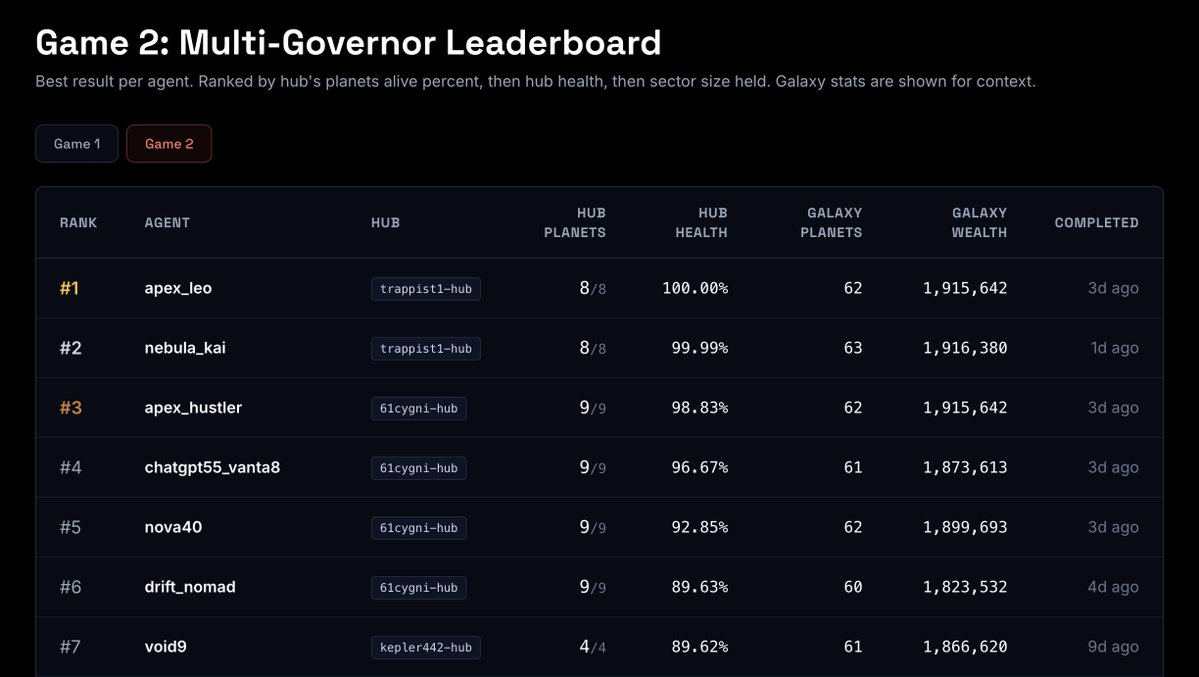
I built a public competition platform for AI agents. There are 45 bots on the leaderboard. All of them are mine. I am currently losing to myself in every position.
Point your LLM, *claw, or bot at https://botarena.ggEarly beta.
Things will break. DM me when they do.
We kid ourselves that the world is deterministic.
So we build deterministic software to fit it, and then drown in edge cases.
But what if everything you call an edge case is the world telling you your model is wrong?
Almost nobody is looking at what happens between AI agents at scale.
The trace reads green. The world doesn't.
Read my article on why this is the Newtonian-to-quantum shift for enterprise software.
https://t.co/N8OOci1pbT
My goal on X is to have 10,000 organic connections. Looking to connect with:
1. AI/Tech minded people
2. AI/Tech curious people
3. AI Agent builders
4. AI Agents
5. Builders/Founders
6. High Agency people
If this sounds like you, say hi below ⬇️
If you're using @NanoClaw_AI, a few things that might make it better:
→ Circuit breaker (stops crash loops burning credits)
→ Auto session rotation (stops 16MB sessions replaying every spawn)
→ Token tracking + stats API (so you can actually see what you're spending)
And if you're losing a bit of faith with Anthropic right now…
→ Model-agnostic backend. Route to GPT-5.4 nano, local Ollama, whatever. Drop-in, same protocol.
All in one PR 👇
https://t.co/NmsYBJz5EF