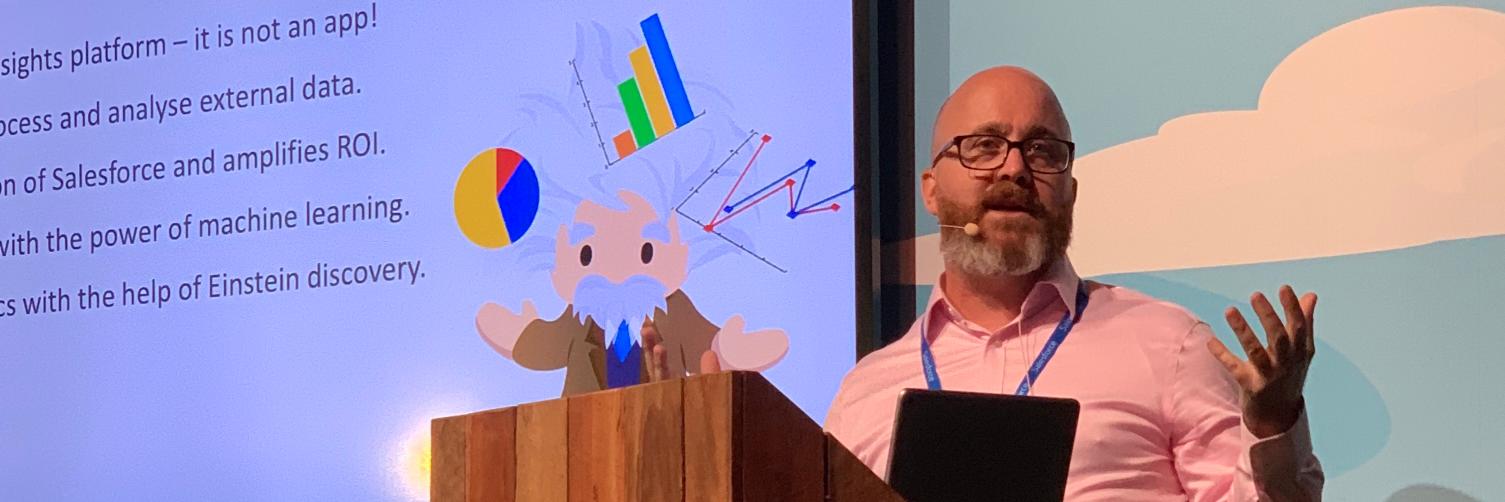
Today is a special day — my first day at the Sydney Salesforce office as an EMPLOYEE!
I am so blessed to work at Tableau, a Salesforce company. #spoiled
I might look OK in this photo, but I was not OK.
This picture was taken 11 years ago after my breakdown. I had wrestled for years with depression & suicidal ideation.
Today is World Suicide Prevention Day and “R U OK?” day in Australia.
#suicide#depression#mentalhealth
Depression isn't sadness. It's a storm in your brain.
After forty years of living with this, here is what I have learned — and the four things I do when the storm comes.
https://t.co/ZuiQ9PwGQa
#depression
“The struggle against an obstacle inevitably propels the fighter to a new level of functioning. The extent of the struggle determines the extent of the growth. The obstacle is an advantage, not adversity.”
— “The Obstacle is the Way” by Ryan Holiday
Don't upgrade to the $100 Claude plan (yet).
These 21 hacks make the $20/month plan enough:
1. You upload PDFs raw. One page = 3,000 tokens.
Fix: Paste the text into a Google doc. Download as .md format. Under 200 tokens.
2. You build files inside Cowork too early.
Fix: Plan in Chat first. Move to Cowork only when you know exactly what you want.
3. You write 500-word prompts that reload.
Fix: Write 29 words instead: "I want to [task] to [goal]. Ask me questions using AskUserQuestion."
4. You say "redo the whole thing" to fix section 3.
Fix: "Only redo section 3. Keep everything else. No commentary. Just the output."
5. You send 3 separate messages for 3 tasks.
Fix: One message, three tasks. "Summarize this, list the points, suggest a headline."
6. You type "No, I meant," stacking on the history.
Fix: Click 'Edit' on your original message. Fix it. Regenerate.
7. You rewrite prompts from scratch every time.
Fix: Keep a prompt library. Same structure, swap the variable.
8. You use Opus for a simple grammar check.
Fix: Sonnet for quick tasks. Save Opus + Extended Thinking for deep work.
9. Your about-me file is 22,000 words (too long).
Fix: Trim to under 2,000 words. End sessions with "Write a session-notes .md."
Paste my .md file prompt: https://t.co/LyV7fegv4c
10. You never restart & keep stacking long chats.
Fix: When Cowork goes sideways, click "Restart the conversation from here" on an earlier message.
11. You never summarize before things get long.
Fix: Every 15-20 messages → summarize, copy the brief, start a fresh session.
12. You use Projects for recurring files.
Fix: Use Projects. Upload once. Every chat inside references it without re-burning tokens.
13. You dump 50 files into Cowork "just in case."
Fix: Only include what this task needs. Zero folders for quick tasks like email drafts.
14. You keep 3 topics in 1 chat. Claude re-reads all.
Fix: New topic = new chat. Always. Dead context is dead tokens.
15. You leave search & connectors on by default.
Fix: Default everything off. Turn features on per task, not per account.
16. You manually run the same report every week.
Fix: Use /schedule. "Every Monday at 7am, create my weekly briefing."
17. You let Claude Code explore your whole repo.
Fix: Be specific. "Build a bar chart from this CSV. Save as chart .png."
18. You skip Personal Preferences & waste setup.
Fix: Settings → Personal Preferences. Set your tone and style once.
19. You type lazy prompts like "make it better."
Fix: Speak your prompts with wispr .ai. Richer context in one shot.
20. You burn your whole limit in one morning.
Fix: Claude runs on a rolling 5-hour window. Split it.
21. You use Claude for things it can't do.
Fix: Know your tools. Images → Gemini.
Real-time search → Grok.
To download my exact .md files:
1. Go to https://t.co/psB7XxAv8w.
2. Subscribe for free. Open my welcome email.
3. Hit the automatic reply button inside.
4. Go to the Notion link in the second mail.
5. Copy-paste prompts, too.
Saturday was revolutionary for me.
I'm a PM, not a developer. I designed, built and deployed a working AI-powered web app. From blank page to live URL. In one day.
The workflow that made it possible: Claude Chat → Claude Design → GitHub → Claude Code → Vercel
Some of my favorite @naval ideas:
1. If you don't know yet what you should work on, the most important thing is to figure it out.
2. Books make for great friends, because the best thinkers of the last few thousand years tell you their nuggets of wisdom.
3. You will get rich by giving society what it wants but does not yet know how to get. At scale.
4. To make an original contribution, you have to be irrationally obsessed with something.
5. The internet has massively broadened the possible space of careers. Most people haven't figured this out yet.
6. Learn to sell. Learn to build. If you can do both, you will be unstoppable.
7. Fortunes require leverage.
8. Leverage is a force multiplier for your judgment.
9. Arm yourself with specific knowledge, accountability, and leverage.
10. Specific knowledge is found by pursuing your genuine curiosity and passion rather than whatever is hot right now. Building specific knowledge will feel like play to you but will look like work to others.
11. Work as hard as you can. Even though who you work with and what you work on are more important than how hard you work.
12. Become the best in the world at what you do. Keep redefining what you do until this is true.
13. If you're not 100 percent into it, somebody else who is 100 percent into it will outperform you. And they won't just outperform you by a little bit—they'll outperform you by a lot because now we’re operating in the domain of ideas, compound interest really applies and leverage really applies.
14. Technology democratizes consumption but consolidates production. The best person in the world at anything gets to do it for everyone.
15. Escape competition through authenticity.
16. If you are fundamentally building and marketing something that is an extension of who you are, no one can compete with you on that.
17. When I talk about specific knowledge, I mean figure out what you were doing as a kid or teenager almost effortlessly. Something you didn't even consider a skill, but people around you noticed. Your mother or your best friend growing up would know.
(My mom told me that when I was a kid and ran out of things to read, I'd read the back of cereal boxes)
18. The more you know, the less you diversify.
19. The best jobs are neither decreed nor degreed. They are creative expressions of continuous learners in free markets.
20. Whenever you can in life, optimize for independence rather than pay.
21. You decide it's important to you. You prioritize it above everything else. You read everything on the topic.
22. The really smart thinkers are clear thinkers. They understand the basics at a very, very fundamental level.
23. The most important skill for getting rich is becoming a perpetual learner.
24. If you're evenly split on a difficult decision, take the path more painful in the short term.
25. What are the most efficient ways to build new mental models? Read a lot—just read.
26. I probably read one to two hours a day. That puts me in the top .00001 percent. I think that alone accounts for any material success I've had in my life and any intelligence I might have.
27. In the intellectual domain, compound interest rules.
28. All the real scorecards are internal.
29. A calm mind, a fit body, and a house full of love. These things cannot be bought. They must be earned.
30. Your real résumé is just a catalog of all your suffering. If I ask you to describe your real life to yourself, and you look back from your deathbed at the interesting things you've done, it's all going to be around the sacrifices you made, the hard things you did.
31. What you want in life is to be in control of your time.
32. Being at the extreme in your art is very important in the age of leverage.
33. Enjoy yourself. Do something positive. Project some love. Make someone happy. Laugh a little bit. Appreciate the moment. And do your work.












![rubenhassid's tweet photo. Don't upgrade to the $100 Claude plan (yet).
These 21 hacks make the $20/month plan enough:
1. You upload PDFs raw. One page = 3,000 tokens.
Fix: Paste the text into a Google doc. Download as .md format. Under 200 tokens.
2. You build files inside Cowork too early.
Fix: Plan in Chat first. Move to Cowork only when you know exactly what you want.
3. You write 500-word prompts that reload.
Fix: Write 29 words instead: "I want to [task] to [goal]. Ask me questions using AskUserQuestion."
4. You say "redo the whole thing" to fix section 3.
Fix: "Only redo section 3. Keep everything else. No commentary. Just the output."
5. You send 3 separate messages for 3 tasks.
Fix: One message, three tasks. "Summarize this, list the points, suggest a headline."
6. You type "No, I meant," stacking on the history.
Fix: Click 'Edit' on your original message. Fix it. Regenerate.
7. You rewrite prompts from scratch every time.
Fix: Keep a prompt library. Same structure, swap the variable.
8. You use Opus for a simple grammar check.
Fix: Sonnet for quick tasks. Save Opus + Extended Thinking for deep work.
9. Your about-me file is 22,000 words (too long).
Fix: Trim to under 2,000 words. End sessions with "Write a session-notes .md."
Paste my .md file prompt: https://t.co/LyV7fegv4c
10. You never restart & keep stacking long chats.
Fix: When Cowork goes sideways, click "Restart the conversation from here" on an earlier message.
11. You never summarize before things get long.
Fix: Every 15-20 messages → summarize, copy the brief, start a fresh session.
12. You use Projects for recurring files.
Fix: Use Projects. Upload once. Every chat inside references it without re-burning tokens.
13. You dump 50 files into Cowork "just in case."
Fix: Only include what this task needs. Zero folders for quick tasks like email drafts.
14. You keep 3 topics in 1 chat. Claude re-reads all.
Fix: New topic = new chat. Always. Dead context is dead tokens.
15. You leave search & connectors on by default.
Fix: Default everything off. Turn features on per task, not per account.
16. You manually run the same report every week.
Fix: Use /schedule. "Every Monday at 7am, create my weekly briefing."
17. You let Claude Code explore your whole repo.
Fix: Be specific. "Build a bar chart from this CSV. Save as chart .png."
18. You skip Personal Preferences & waste setup.
Fix: Settings → Personal Preferences. Set your tone and style once.
19. You type lazy prompts like "make it better."
Fix: Speak your prompts with wispr .ai. Richer context in one shot.
20. You burn your whole limit in one morning.
Fix: Claude runs on a rolling 5-hour window. Split it.
21. You use Claude for things it can't do.
Fix: Know your tools. Images → Gemini.
Real-time search → Grok.
To download my exact .md files:
1. Go to https://t.co/psB7XxAv8w.
2. Subscribe for free. Open my welcome email.
3. Hit the automatic reply button inside.
4. Go to the Notion link in the second mail.
5. Copy-paste prompts, too.](https://pbs.twimg.com/media/HIDFFMcb0AAMalG.jpg)

![MarkTossell's tweet photo. This is what happens when you agree to build your wife a hardwood cabinet that is 1800x1200x400! Wood, wood and more wood. 🪵 😮 [8’x4’x 16”] https://t.co/rT4KnOqS7a](https://pbs.twimg.com/media/HG0eZ36aAAAfo_S.jpg)


