The older I get, the more I realize the power of always having something on the calendar you're excited about. It can really be anything. Difficult physical challenge, big project, fun trip, ambitious goal, whatever. It creates energy and gets you through the lows. Life hack.
Zyphra Research continues to explore architecture innovations beyond standard transformers.
Today we’re releasing Zamba2-VL, extending our prior Zamba2 hybrid SSM-Transformer work into vision-language modeling. 🧵
Anthropic reports Claude now writes over 80% of its own production code — meaning an AI is the primary author of the systems training future versions of itself. Claude's research judgment matched human experts 22% of the time in 2024. Today it's 64%.
The recursive loop has started.
The greatest superpower is being able to reset fast. Bad day? Start fresh tomorrow. Poor decision? Write down the mistake and move on. Rejected? Shrug it off. Forgot to work out? Hit the gym harder tomorrow.
It’s pretty insane to see founders having to juggle fundraising, managing runway, making product decisions, traveling to the edges of the earth to meet customers, managing board expectations, keeping the culture alive.. all with utmost composure like everything is going to be okay.
Very few jobs have that much context switching, chaos, competing priorities, and uncertainty.
Just superhuman stuff.
Be your self, not someone you were assigned to be!
Bezos won on time horizon, not AWS or 1-Click.
If your bets have to work in 3 years, you compete with everyone. Every smart, funded team is chasing the same 3-year problems. Short horizon, crowded field.
Stretch to 7 and the field collapses. Investors want returns, employees want vesting, founders want proof. Almost nobody can sit in a bet that doesn't pay for most of a decade. The patience is the moat, and it costs you, that's why it works.
But you can't fake a 7-year horizon on a problem you don't actually care about. Pick the users and the problem Moloch assigned you, the safe ones, the fundable ones, and you'll bail the first hard year. Pick the ones that are actually yours and you'll still be there when everyone else has quit.
So the real prerequisite isn't discipline. It's knowing yourself well enough to choose a problem and a set of people you care about that you'll serve them for decades.
The events of the last 6 months in technology are arguable amongst the most important in human history
The tools now increasingly exist for recursive self improvement of models & agents
We are likely in very early lift off & exponential
Largely unnoticed outside of tech
AI investing is shifting toward firms that understand infrastructure before it becomes consensus.
@DefinedVC, founded by @marktrevitt with operators like Sean Brownlee, David Roberts, and Gautam Chintapenta, is deploying early capital across the AI stack, backing companies from compute to application with a product-first lens and a track record tied to $20B+ in enterprise value and exits like GaN Systems and Bit Stew.
The next wave of venture returns will come from investors who enter before categories form and stay close enough to shape how they scale.
#venturecapital #aiinvesting #startupecosystem #deeptech #nyctech
This is a once-in-human-history moment. Rethink how you spend time. Rethink how you spend money. Whatever you do, don't stay stuck or frozen in the past.
The man who turned $225 million into $13.7 billion said something two years ago that the entire AI industry is still catching up to (Save this).
Everyone is talking about AI safety but almost nobody is actually working on it.
That is not a hot take, that is Leopold Aschenbrenner doing the math out loud after going inside the actual labs and looking at the actual research happening.
"There's barely anybody working on it. You could basically just talk to a couple few dozen people who are actually kind of good on the issue. And that's maybe even overstating it."
He ran the numbers directly, and the ratio was staggering even then.
Approximately 300 people were working on AI alignment globally against roughly 100,000 ML researchers, a ratio of 300 to 100,000.
At the time, OpenAI had 400 employees and exactly seven people on its scalable alignment team, the group responsible for solving the long-term safety problem.
DeepMind had thousands of researchers and roughly 20 working on alignment, and as Aschenbrenner pointedly noted, they were not exactly deploying their strongest scientists to the job.
Two years later, it has only gotten worse.
In February 2026, OpenAI dissolved its Mission Alignment unit entirely, a six-person team that had existed for just 16 months and redistributed the staff into product lines.
The Future of Life Institute's AI Safety Index called out OpenAI by name this year, urging the company to rebuild lost safety team capacity.
Stanford's 2026 AI Index confirmed that responsible AI is simply not keeping pace with AI capability, with safety benchmarks lagging while incidents rise sharply.
The International AI Safety Report 2026, backed by 29 nations and over 100 experts, explicitly warned that capabilities are scaling faster than any mechanism we have to verify they are safe.
What makes this clip so important is where Aschenbrenner started from.
When he first encountered the AI safety discourse, he assumed the problem was covered, everyone was talking about it, so surely everyone was working on it.
Then he actually looked at the research, sat with the systems, and came face to face with what was really there.
"I was like, oh my god, this sucks. Nobody's actually doing anything. Like you've got to actually do things, people."
The gap between the volume of online discourse and the actual number of people doing hard technical alignment work was not a minor mismatch two years ago and the labs have spent the time since making it larger, not smaller.
We need more safety!
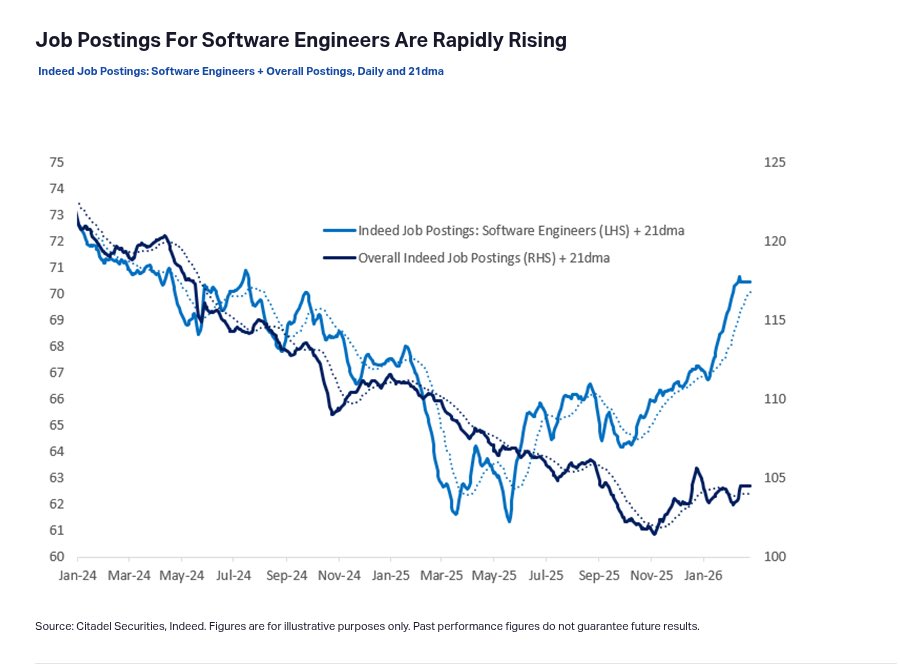
Q: How are job postings for software engineers rising rapidly despite AI agents automating coding?
A: Because there’s far more code to manage than ever before. We’re already seeing a 14x YoY increase in GitHub commits, and it’s accelerating.
AI has dramatically lowered the cost of writing code, so it’s now being used across far more businesses, applications, and use cases.
We’re at the beginning of a massive productivity boom driven by the proliferation of bespoke software throughout the entire economy.
Coding has been AI’s breakout use case this year. The fact that it’s increased demand for software engineers — rather than decreased it — should call into question the entire “AI will cause mass job loss” narrative.
Elon Musk's first wife once described what it's like to watch him fail.
She said he doesn't react the way normal people react. When a rocket explodes, most people in the room go silent. Some cry. Some start calculating the financial damage.
Musk pulls out his phone and starts making calls. Not emotional calls. Engineering calls. "What failed. When can we fix it. When's the next launch." His voice doesn't change. His face doesn't change. The rocket that just cost $60 million is already in the past. The next one is all that exists.
She said it was the most unsettling thing she'd ever witnessed. Not because he was cold. Because he genuinely wasn't affected. The failure didn't register as failure. It registered as data. An experiment that produced results. Results that inform the next experiment.
This is why he wins. Not because he doesn't fail. He fails more spectacularly than anyone in history. He wins because failure occupies zero psychological space. It enters as data and exits as action.
Most people lose not because they fail but because they spend weeks processing the failure before acting again. Musk spends zero seconds. The gap between failure and next attempt is a phone call.
- @multiplanet1
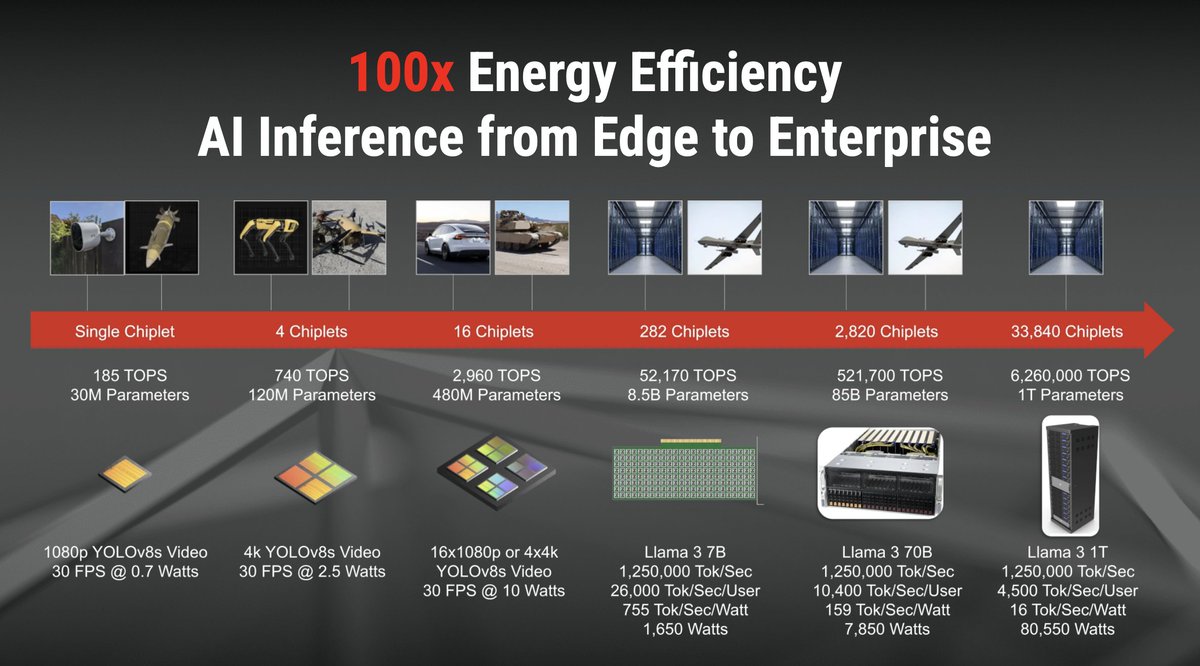
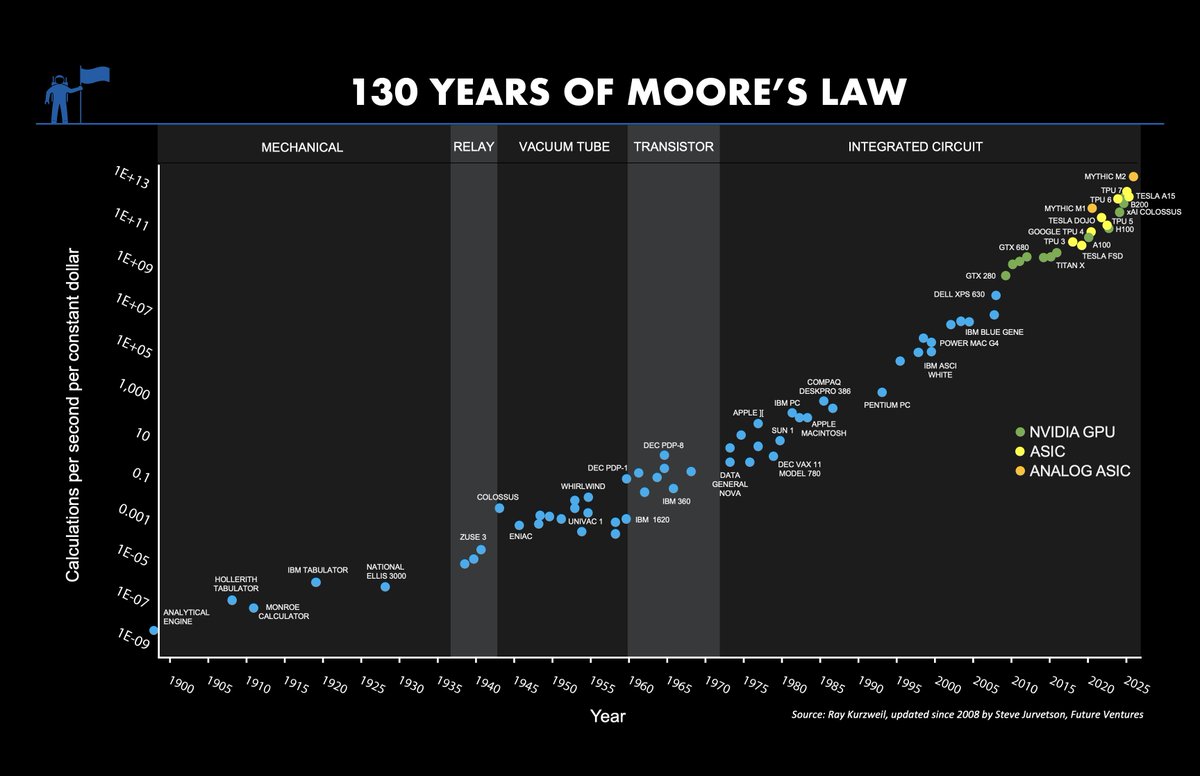
On the silicon side, it's the era of analog inference.
This company combo will deliver the first hybrid AI platform with 100x more compute per watt than the best GPUs.
How? Mythic performs the core AI operation (8-bit multiply & add) in a single flash memory transistor. Compare this to ~3,000 transistors in a digital circuit, the kind every other AI chip uses.
· Mythic acquires Videantis news today: https://t.co/UH5NYqTHLo
· Company: https://t.co/sDWw2pJ4cE
Peter Thiel says that when he invested in @elonmusk’s SpaceX in 2008, people emailed him, glad they didn’t invest in Founders Fund — because “anyone investing in something as crazy as rockets shouldn’t be in venture capital.”
“Great investments may look crazy but really not be.”
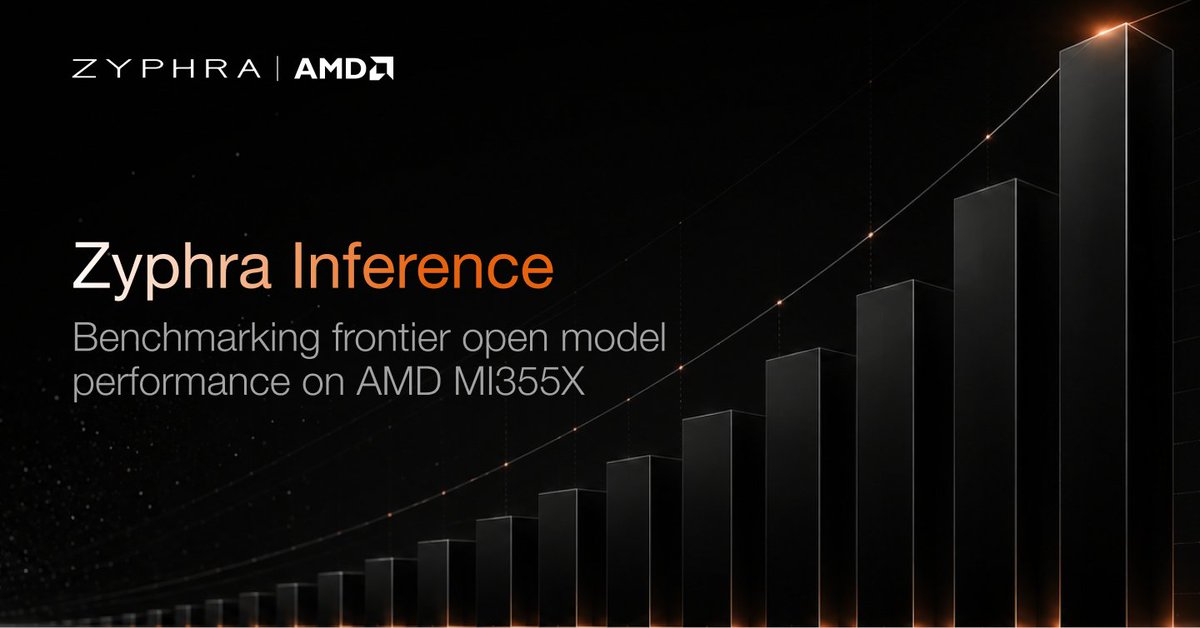
We're publishing our first end-to-end benchmarks for Zyphra Inference on @AMD Instinct MI355X.
Our inference optimizations strongly outperform the AMD baseline and narrows the gap between MI355X and B200 for serving Kimi K2.6, GLM 5.1, and DeepSeek V3.2 🧵
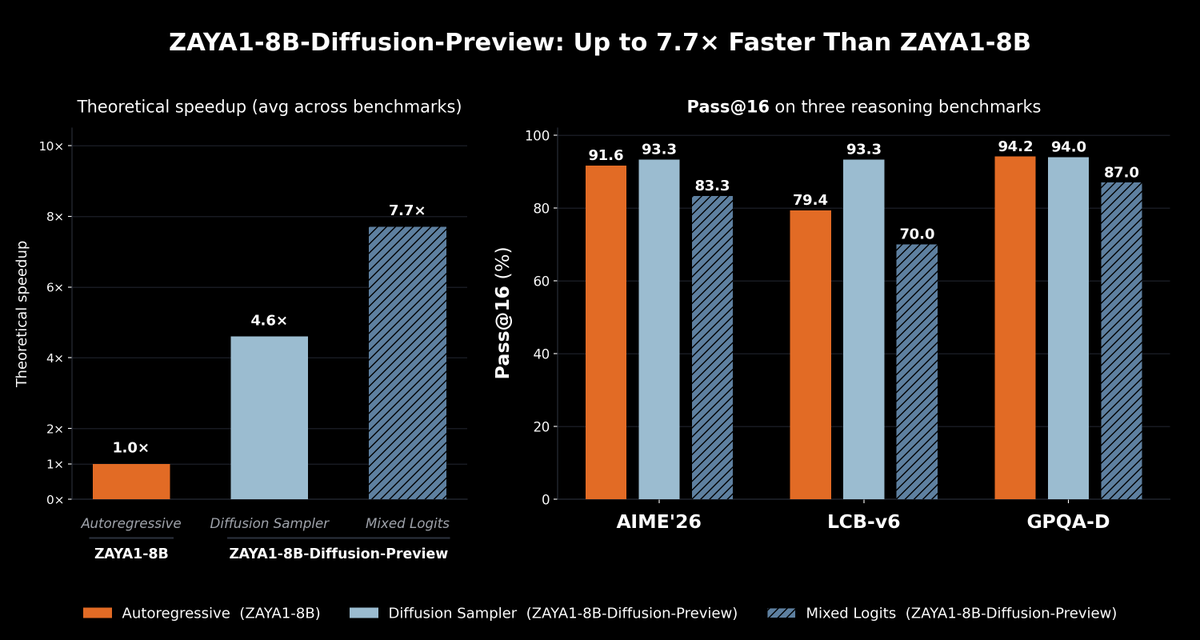
We present ZAYA1-8B-Diffusion-Preview, the first diffusion language model trained on @AMD.
Autoregressive LLMs generate one token at a time; diffusion generates a block in parallel, speeding up inference.
We show a 4.6-7.7x decoding speedup with minimal quality degradation 🧵
@eladgil BS.
Attention was born in Montréal
PyTorch in NYC.
AlphaGo in London
AlphaFold in London
ESMFold in NYC
Llama 1 in Paris.
Llama 2 in Paris+NYC+SV
DeepSeek in Hangzhou
Plus:
DINO in Paris
JEPA in Montréal+Paris+NYC
SV is 3 mos ahead on topics SV is singularly obsessed with.
You raise your seed round.....now what?
The first thing you do when $1-2M hits the bank account is open the app, look at the number, take the screenshot, smile, send it to your family group chat to make your dickhead brother jealous....then close it.
You just got 18-24 months if you're disciplined, 8-10 if you're stupid.
Firstly,
Don't change your fucking life.
Pay yourself enough to not stress about rent. $80-120k depending on city, even lower if you can stomach it.
If you pay yourself $350k after a $2M raise.....chances are, you will not last. You're not running a company just yet.....it's an experiment...one that will end quickly if you prioritize short term gains > long term greatness.
Same with office. You don't need one. The "we need a real space for the culture" is bullshit.
Work from home.
Your only job for the first 6 months is to talk to users and ship quickly.
If you raised $2M and you're not doing (minimum) 5 customer calls a week as a founder........your priorities are messed up.
You need to understand as quickly as possible if the people who use your product, come back without you begging them to do so!
Almost everything else is a vanity exercise.
Series A timeline in 2026 is 600+ days from seed.
Less than 15% of seed-funded startups ever raise an A.
So track burn weekly.
Know your runway to the day.
Every dollar should ship product or facilitates customer feedback .
If a tool, hire, or expense doesn't do that, stop it.
Conference tickets? No. PR firm? Absolutely fucking not. "Brand consultant" don't be stupid. Logo redesign? GTFOH.
72% of seed stage burn is "people".
74% of startup failures involve premature scaling.
You raise, you feel pressure to "build the team," you hire 4 people in 90 days, burn goes from $40k/mo to $180k/mo, the new hires don't have product to work on because there isn't one yet, you spend your time managing them instead of talking to users, runway evaporates, you're back fundraising at month 9 with worse metrics than when you started.
Stay 2-3 founders + AI for as long as humanly possible.
The teams crushing right now have 4 people doing what 15 used to do just 24 months ago.
When/If you do hire.......focus on builders, forget managers. Focus on operators, not "credentials".
If you're not using AI for code (Cursor, Claude Code), customer support, sales prospecting, content, ops, brand, recruitment vetting......your competition is winning.
Tech is commodity now. GTM and data are the moats. Use AI to compress everything that isn't either of those things.
Try to avoid giving advisors equity.
An "advisor" (who you mistakenly thought would enhance "credibility optics") who takes 1%, for doing absolutely nothing, is the same prick that costs you seven figures in a future round.
Model dilution before signing every SAFE.
Don't talk to VCs for 6 months. (forget the "always raising" mindset for now) Keep relationships warm with periodic updates but take the foot of the gas slightly.
I know. I'm a VC saying this. But I mean it. The gravitational, distractional pull of the next round, will fuck up your focus harder than anything else.
Send your existing investors a 5 line monthly email. Don't go to investor dinners. Don't "build relationships for the A." If you're talking to VCs more than building, again, your priorities are misjudged and it will show up against your development goals.
The money will fuck with your head. People will ultimately treat you differently. Nobody really prepares you for that.
You'll get DMs from people you haven't talked to since school. You'll feel the urge to announce, to LinkedIn post, to look like a "real founder."
You'll also be lonelier than ever. You raised, your "friends" think you've made it, you can't tell them you're scared shitless and don't know if it'll work.
I would recommend finding 1-2 founders.....who are 6 months ahead of you, and text them weekly.
That's effective therapy (at least from my personal experience).
Last thing.
The party ended when the money hit.
Now you have a shot and a clock.....the only thing that matters is whether you ship something people genuinely want before that timer runs out.
Most people who give you advice in the next 6 months are probably going to try selling you something. Filter everything ruthlessly. Trust your user feedback and trust the burn rate.
Now go build and say "no"...... consistently.
Godspeed.