previously, to enter a trade you had to:
⤫ open a chart
⤫ find news
⤫ estimate the position size
⤫ go to the exchange and place an order
now you just type whatever you want in claude or chatgpt, it automatically finds an idea, calculates the size and offers a trade
@liquidtrading made this possible through co-invest
crypto, stocks, gold and forex in one chat.
𝗽𝗮𝗿𝗮𝗹𝗹𝗮𝘅 𝗳𝗼𝗿 𝗱𝗲𝘃𝗲𝗹𝗼𝗽𝗲𝗿𝘀: 𝘄𝗵𝗮𝘁 𝘁𝗼 𝗯𝘂𝗶𝗹𝗱 𝗿𝗶𝗴𝗵𝘁 𝗻𝗼𝘄
parallax opens up a wide range of opportunities for hosting and running your own ai applications and agents: coding copilots, personal assistants, vision and speech pipelines, and multi-agent simulations.
all on your own hardware, no cloud, no api keys.
𝘄𝗵𝗮𝘁𝘀 𝗮𝘃𝗮𝗶𝗹𝗮𝗯𝗹𝗲 𝗿𝗶𝗴𝗵𝘁 𝗻𝗼𝘄
parallax supports cross-platform deployment on mac, windows and linux.
built-in network-aware sharding and dynamic task routing intelligent load scheduling with seamless switching between single-machine, multi-device and wide-area cluster modes.
moe models from 0.6b to trillion-class on gpus and apple silicon are supported.
𝗰𝗼𝗱𝗶𝗻𝗴 𝗰𝗼𝗽𝗶𝗹𝗼𝘁
developers can deploy locally and build applications like coding assistants while keeping all sensitive data and control rights local.
your code doesnt go to github copilot or cursor servers. the model works for you.
𝗽𝗲𝗿𝘀𝗼𝗻𝗮𝗹 𝗮𝗴𝗲𝗻𝘁
parallax is designed for next-generation ai applications that remain private, verifiable and open.
the system stores data and memory locally, uses open source tools and tracks every step of the computation results can be reproduced and verified.
openclaw integration is already available, an agent in telegram or discord that runs tasks on your machine.
𝗺𝘂𝗹𝘁𝗶-𝗮𝗴𝗲𝗻𝘁 𝘀𝗶𝗺𝘂𝗹𝗮𝘁𝗶𝗼𝗻
@Gradient_HQ launched a hackathon, "build your own ai lab", to solve problems for individuals that require privacy and low cost, help researchers accelerate their work and build tools for businesses.
multi-agent simulations, research tooling and business automation are all being built by the community using parallax.
>>>>> 𝗗𝗲𝗣𝗔𝗜: 𝗪𝗵𝘆 𝟐𝟎𝟐𝟓 𝗜𝘀 𝘁𝗵𝗲 𝗬𝗲𝗮𝗿 𝗼𝗳 𝗣𝗵𝘆𝘀𝗶𝗰𝗮𝗹 𝗔𝗜 <<<<<
while everyone's talking about chatgpt and text-based models, a new movement has emerged in the real world: depai. It stands for decentralized physical ai
robots shouldnt be owned by a few corporations. The data that trains them shouldnt be hoarded by a single company. depai is an attempt to build an open infrastructure for robots on the blockchain.
In 2025, a full-fledged stack of three projects with different roles emerged.
bitrobot is the lower tier. they are building the core infrastructure on solana, where every robot action can be verified. the SeeSaw platform allows users to upload ordinary videos of everyday tasks, which become training data for robots.
the project has raised $6M and Virtuals Protocol is among its investors.
@PrismaXai is the middle tier. this is a coordination network: it connects human operators, robot owners and companies that need data.
Operators remotely control robots, perform real tasks and receive tokens for high-quality work.
$11M from a16z, a live platform supporting eight types of robots.
virtuals protocol is the top layer. Autonomous AI agents that choose tasks themselves, pay for data and manage robots without human intervention. By the end of 2025, 500,000 completed tasks are planned.
𝘄𝗵𝘆 𝗻𝗼𝘄
Robots have become cheaper, models have matured and Web3 has learned to process micropayments quickly and cheaply. Everything has come together.
𝗗𝗲𝗣𝗔𝗜 𝗶𝘀 𝗻𝗼𝘁 𝗵𝘆𝗽𝗲. 𝗜𝘁𝘀 𝘁𝗵𝗲 𝗶𝗻𝗳𝗿𝗮𝘀𝘁𝗿𝘂𝗰𝘁𝘂𝗿𝗲 𝗯𝗲𝗶𝗻𝗴 𝗹𝗮𝗶𝗱 𝗼𝘂𝘁 𝗿𝗶𝗴𝗵𝘁 𝗻𝗼𝘄.
ai agents are breaking the old cost logic
the more automation, the more expensive the model selection error
you dont need gpt-5 for every sneeze.
sometimes a small model does the same job faster cheaper and without unnecessary tokens
the winner isnt the one with the strongest model
nut the one with the smartest routing.
The BULK Paper Trading Comp is COMPLETE
Congratulations to our Top 50, and a huge THANK YOU to everyone that participated and provided feedback
View the finalized leaderboard: https://t.co/BkU91SBOe1
>>>>> 𝗟𝗶𝘃𝗲 𝗖𝗼𝗻𝘁𝗿𝗼𝗹: 𝗣𝗿𝗶𝘀𝗺𝗮𝗫 𝗔𝗹𝗿𝗲𝗮𝗱𝘆 𝗟𝗮𝘂𝗻𝗰𝗵𝗲𝘀 𝗖𝗼𝗻𝘁𝗿𝗼𝗹 𝗼𝗳 𝗥𝗲𝗮𝗹 𝗥𝗼𝗯𝗼𝘁𝘀 <<<<<
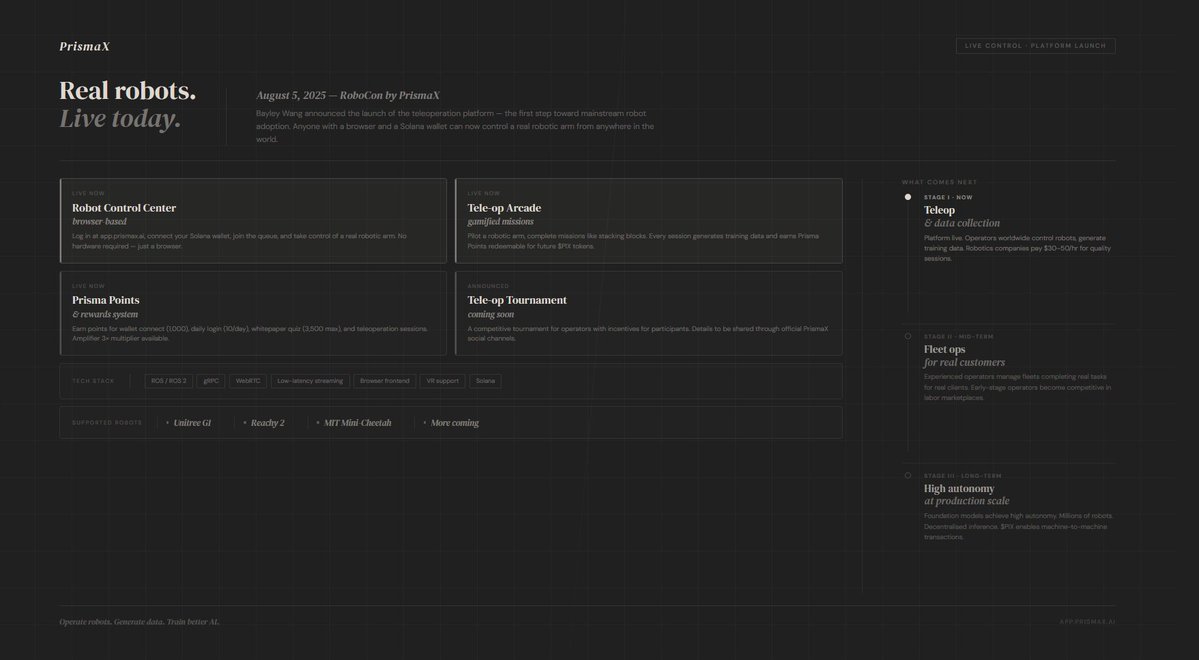
On August 5, 2025, Bayley Wang announced the launch of a teleoperation platform at the first RoboCon by @PrismaXai
"The launch of our platform is the first step toward mass adoption of robots" he said
"Its a proof of concept for a future where humans and robots work hand in hand"
𝗪𝗵𝗮𝘁𝘀 𝗪𝗼𝗿𝗸𝗶𝗻𝗴 𝗥𝗶𝗴𝗵𝘁 𝗡𝗼𝘄
The platform allows users to log in and control a robotic arm from anywhere in the world.
Supported robots include the Unitree G1, Reachy 2 and MIT Mini-Cheetah.
Access is via a browser, no special hardware is required.
The platform uses ROS/ROS 2 for robot control, gRPC for efficient communication and WebRTC for low-latency streaming.
𝗪𝗵𝗮𝘁 𝗖𝗵𝗮𝗻𝗴𝗲𝘀 𝗧𝗵𝗶𝘀
Before the platform's launch, teleoperation was the domain of large corporations with their own teams and infrastructure.
Now, anyone with a computer and a Solana wallet can control a real robot and earn money doing it.
The short-term focus is teleoperation and collecting visual data for model training.
In the medium term, operators will manage fleets of robots to perform real tasks for real customers.
In the long term, robots will achieve high autonomy based on the fundamental models developed in the first two stages.
The network will transition to providing production services for millions of machines.
"𝘛𝘩𝘦 𝘭𝘰𝘯𝘨-𝘵𝘦𝘳𝘮 𝘷𝘢𝘭𝘶𝘦 𝘰𝘧 𝘵𝘩𝘦 𝘱𝘭𝘢𝘵𝘧𝘰𝘳𝘮 𝘪𝘴 𝘵𝘰 𝘣𝘦𝘤𝘰𝘮𝘦 𝘵𝘩𝘦 𝘧𝘰𝘶𝘯𝘥𝘢𝘵𝘪𝘰𝘯 𝘰𝘧 𝘢 𝘭𝘢𝘳𝘨𝘦-𝘴𝘤𝘢𝘭𝘦 𝘧𝘶𝘵𝘶𝘳𝘦 𝘭𝘢𝘣𝘰𝘳 𝘮𝘢𝘳𝘬𝘦𝘵" says Bayley Wang.
>>>>> 𝗪𝗵𝘆 𝗣𝗿𝗶𝘀𝗺𝗮𝗫 𝗶𝘀 𝘁𝗵𝗲 𝗶𝗻𝗳𝗿𝗮𝘀𝘁𝗿𝘂𝗰𝘁𝘂𝗿𝗲 𝗼𝗳 𝗮 𝗻𝗲𝘄 𝗲𝗿𝗮 <<<<<
We are used to thinking of AI as something digital.
Text, images, videos it all lives on a screen, but the next wave is different.
Everything that moves will eventually become autonomous. Every car today is already a robot. We're moving toward general-purpose robots.
And this wave has a fundamental problem: there's almost no data for it.
𝗧𝗵𝗲 𝘄𝗶𝗻𝗱𝗼𝘄 𝗶𝘀 𝘀𝘁𝗶𝗹𝗹 𝗼𝗽𝗲𝗻
For text-based AI, it's almost too late to fix the issues of fairness and data availability, but for robotics, where a large-scale open dataset doesnt yet exist, the window is wide open. @PrismaXai is pioneering this position.
𝗪𝗵𝗮𝘁 𝗣𝗿𝗶𝘀𝗺𝗮𝗫 𝗶𝘀 𝗯𝘂𝗶𝗹𝗱𝗶𝗻𝗴
PrismaX is introducing a fair use standard, where data producers earn based on the value their data brings to models.
Three pillars:
𝗱𝗮𝘁𝗮 – stimulating large-scale visual datasets, 𝘁𝗲𝗹𝗲𝗼𝗽𝗲𝗿𝗮𝘁𝗶𝗼𝗻 – standardizing remote robot control, 𝗺𝗼𝗱𝗲𝗹𝘀 – creating autonomous robotic models in collaboration with AI teams.
𝗛𝘂𝗺𝗮𝗻 𝗮𝘁 𝘁𝗵𝗲 𝗖𝗲𝗻𝘁𝗲𝗿 𝗼𝗳 𝘁𝗵𝗲 𝗦𝘆𝘀𝘁𝗲𝗺
"Our platform will enable humans to work with AI, not be replaced by it. As the industry evolves, it's important to remember: human capital is essential to building models that can continue to scale" – Bayley Wang, CEO of PrismaX.
Soona Amhaz of Volt Capital noted:
"PrismaX addresses a fundamental gap in physical AI: access to high-quality visual datasets that are both accessible and scalable. As autonomy moves into the real world, its clear that the current infrastructure cant keep up"
𝗪𝗵𝘆 𝗜𝘁 𝗠𝗮𝘁𝘁𝗲𝗿𝘀 𝗡𝗼𝘄
Whoever controls the data of the physical world controls the future of autonomous systems.
PrismaX is building the Common Crawl for the real world and its doing so openly, with fair value distribution among all participants.
This isnt just a project. Its the infrastructure of an era that has already begun.