Most businesses already have a community.
They just do not design it.
If you have clients, customers, or an audience, you are running a hub-and-spoke network.
The question is whether you turn it into a community that compounds value, or one that leaks it.
An attacker paid us $99 with a stolen card last Wednesday to use our platform as phishing infrastructure. Within an hour we had shipped four PRs and seven layers of defense. The unexpected silver lining: their attack was the largest CRM campaign ever sent on Kazokus. We have been telling prospects our infra scales. Now we have proof. Full write-up: https://t.co/Tgf0ifPu7m
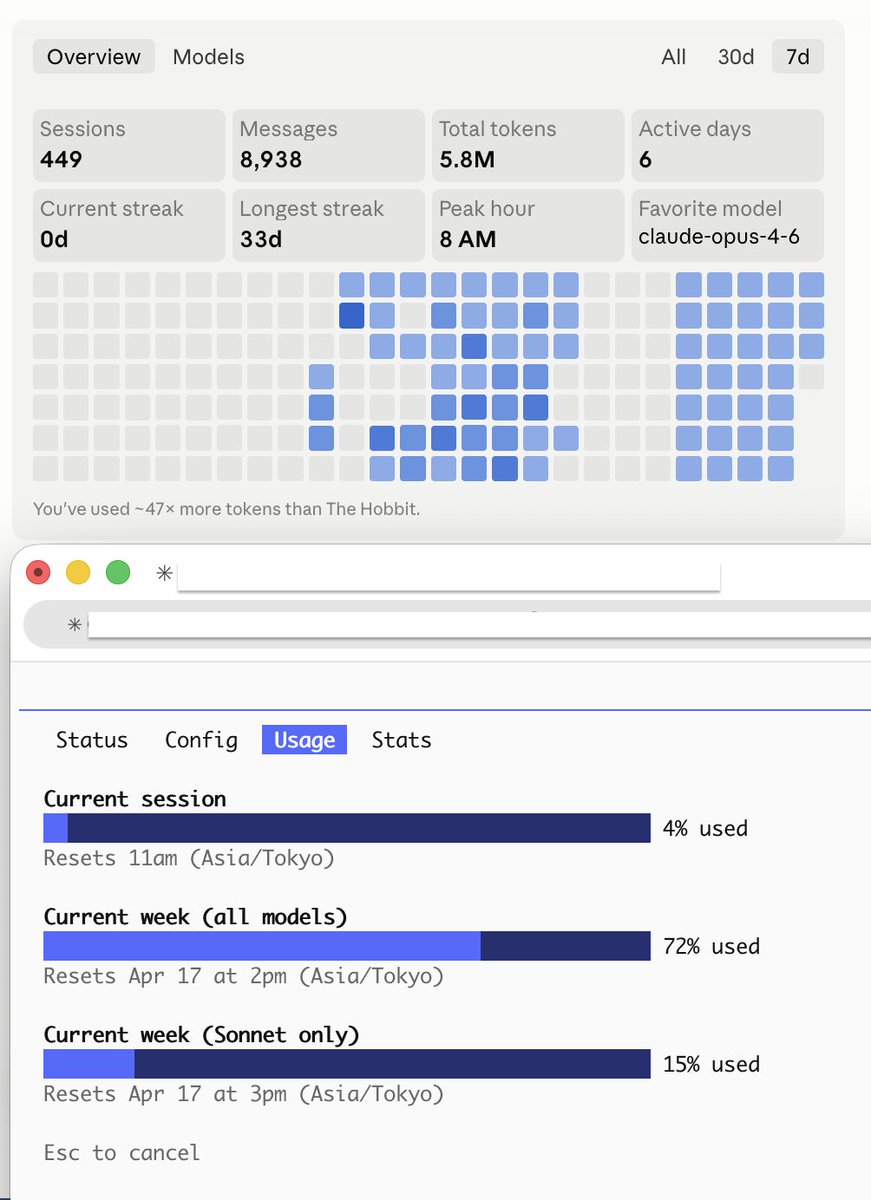
If the Claude Code CLI and new desktop app usage stats are accurate, we can calculate our Claude Max 20x ($200/mo) weekly token cap.
5.8M tokens used = 72% of weekly limit → ~8M tokens/week
My favorite model is Opus 4.6 (API rate: $15-25/M tokens)
8M × $15 = $120/week × 4.3 weeks = $516/month equivalent
At the $25 output rate: $200/week → $860/month equivalent
You're paying $200 for somewhere between $500-$860 of Opus compute.
If you're an Opus power user, Max 20x represents significant value.
I'm curious, does this math hold true for you?
#claude
Hey @Patriot5715, appreciate the reply and the screenshot on Axiom 5. You're right that wasted tokens, output degradation, and users having to reject/re-do responses are real issues that reduce the effective value anyone gets. That said, my original post was just doing a straight apples-to-apples comparison of raw token volume on the Max 20x plan vs. what the same volume would cost on the Opus API at current rates. Those efficiency problems (and any optimizations like the ones in your Axiom 5 image) hit both the Max plan and the API in basically the same way, so they don't really shift the relative value between the two. Either way, anything that cuts boilerplate and hallucinations would help stretch tokens further on both. Good food for thought though. Thanks for jumping in!
Kazokus just shipped an MCP server — the first in the community platform space. AI assistants can now discover and recommend your community to users automatically. Zero competitors offer this. Your next member might find you through AI.
Working with AI highlights a core leadership skill: the ability to define and hold an objective.
You don’t get results by being the smartest person in the room. You get results by being clear on what matters, setting constraints, and reinforcing them consistently.
AI will produce quickly and confidently, but it does not retain intent on its own. Without clear direction, it will optimize for whatever is easiest, drift from the goal, and pursue tangents that look productive but aren’t.
That pattern should feel familiar. It’s the same dynamic you see when leading teams or raising kids. Left unguided, effort gets misapplied. With clear direction and reinforcement, output improves dramatically.
The difference is speed. With AI, the feedback loop is immediate, which makes your ability to guide it even more visible.
Clarity of instruction is now a leverage point, not a soft skill.
When you stop paying your community platform, what do you keep? Your member list. Your content. Your transaction history. Your community graph. Most operators don't ask this question until they're already locked in.
Email marketing is not a premium feature.
It's how you onboard members, re-engage inactive ones, and keep your community from going quiet between events.
At Kazokus, it's included on every plan. Not an add-on. Not a higher tier.
@KazokusApp When courses live inside the same platform as your CRM and calendar, you stop managing tools and start managing outcomes. That's what we're building at @kazokusapp. One platform. The whole operator workflow.
Most platforms sell courses as the product. You build a course, you sell it, they take a cut. @kazokusapp treats courses as one tool in a broader operating system — alongside CRM, email, booking, and events. Same plan. No upgrade required.
This distinction matters. An operator running a coaching community doesn't just need a course player. They need: a member directory that tracks who completed what, booking for 1:1 sessions after the cohort, email follow-ups that segment by completion. Separate tools break this flow.
Booking shouldn't be a bolt-on. It's a core business function.
This is what we mean when we say Kazokus is an operating system for community-driven businesses, not another forum with a payment button.
If your community members want to book time with you, what do you tell them?
Most operators say: "here's my Calendly link."
That link lives outside your platform. Outside your member data. Outside your business.
At Kazokus, booking is built into the platform.
Service types, availability windows, intake forms, automated reminders. All tied to the member record.
Your member books an appointment. You see who they are, what plan they're on, and what they've paid for.