The fact that bond traders are having their worst year during a Fed easing cycle tells you everything you need to know about the dystopian state of affairs and the inevitable future of Bitcoin.
All is calm, all is bright.
Year to date, $MSTR treasury operations delivered a BTC Yield of 72.4%, a net benefit of ~136,965 BTC to our shareholders. At $107K per BTC, that equates to ~$14.66 billion for the year.
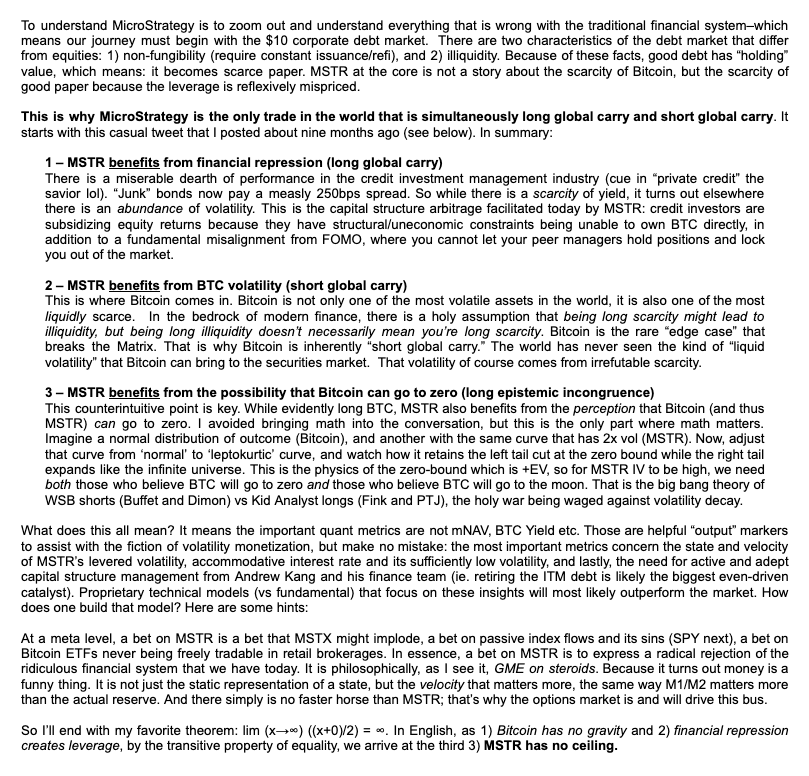
A few days ago @dgt10011 posted the attached screenshot, explaining the underlying dynamics of $MSTR's LBE (Leveraged Bitcoin Equity) strategy. I needed to send it to some finance friends, and wanted it in text rather than an image, so here it is for anyone else who needs to share it:
Jeff Park re MSTR:
"
To understand MicroStrategy is to zoom out and understand everything that is wrong with the traditional financial system—which means our journey must begin with the $10T corporate debt market. There are two characteristics of the debt market that differ from equities: 1) non-fungibility (require constant issuance/refi), and 2) illiquidity. Because of these facts, good debt has "holding" value, which means: it becomes scarce paper. MSTR at the core is not a story about the scarcity of Bitcoin, but the scarcity of good paper because the leverage is reflexively mispriced.
This is why MicroStrategy is the only trade in the world that is simultaneously long global carry and short global carry. It starts with this casual tweet that I posted about nine months ago (see below). In summary:
1- MSTR benefits from financial repression (long global carry)
There is a miserable dearth of performance in the credit investment management industry (cue in "private credit" the savior lol). "Junk" bonds now pay a measly 250bps spread. So while there is a scarcity of yield, it turns out elsewhere there is an abundance of volatility. This is the capital structure arbitrage facilitated today by MSTR: credit investors are subsidizing equity returns because they have structural/uneconomic constraints being unable to own BTC directly, in addition to a fundamental misalignment from FOMO, where you cannot let your peer managers hold positions and lock you out of the market.
2- MSTR benefits from BTC volatility (short global carry)
This is where Bitcoin comes in. Bitcoin is not only one of the most volatile assets in the world, it is also one of the most liquidly scarce. In the bedrock of modern finance, there is a holy assumption that being long scarcity might lead to illiquidity, but being long illiquidity doesn't necessarily mean you're long scarcity. Bitcoin is the rare "edge case" that breaks the Matrix. That is why Bitcoin is inherently "short global carry. The world has never seen the kind of "liquid volatility" that Bitcoin can bring to the securities market. That volatility of course comes from irrefutable scarcity.
3- MSTR benefits from the possibility that Bitcoin can go to zero (long epistemic incongruence)
This counterintuitive point is key. While evidently long BTC, MSTR also benefits from the perception that Bitcoin (and thus MSTR) can go to zero. I avoided bringing math into the conversation, but this is the only part where math matters. Imagine a normal distribution of outcome (Bitcoin), and another with the same curve that has 2x vol (MSTR). Now, adjust that curve from 'normal' to 'leptokurtic' curve, and watch how it retains the left tail cut at the zero bound while the right tail expands like the infinite universe. This is the physics of the zero-bound which is +EV, so for MSTR IV to be high, we need both those who believe BTC will go to zero and those who believe BTC will go to the moon. That is the big bang theory of WSB shorts (Buffet and Dimon) vs Kid Analyst longs (Fink and PTJ), the holy war being waged against volatility decay.
What does this all mean? It means the important quant metrics are not mNAV, BTC Yield etc. Those are helpful "output" markers to assist with the fiction of volatility monetization, but make no mistake: the most important metrics concern the state and velocity of MSTR's levered volatility, accommodative interest rate and its sufficiently low volatility, and lastly, the need for active and adept capital structure management from Andrew Kang and his finance team (ie. retiring the ITM debt is likely the biggest even-driven catalyst). Proprietary technical models (vs fundamental) that focus on these insights will most likely outperform the market. How does one build that model? Here are some hints:
At a meta level, a bet on MSTR is a bet that MSTX might implode, a bet on passive index flows and its sins (SPY next), a bet on Bitcoin ETFs never being freely tradable in retail brokerages. In essence, a bet on MSTR is to express a radical rejection of the ridiculous financial system that we have today. It is philosophically, as I see it, GME on steroids. Because it turns out money is a funny thing. It is not just the static representation of a state, but the velocity that matters more, the same way M1/M2 matters more than the actual reserve. And there simply is no faster horse than MSTR; that's why the options market is and will drive this bus.
So I'll end with my favorite theorem: lim (x→∞) ((x+0)/2) = ∞. In English, as 1) Bitcoin has no gravity and 2) financial repression creates leverage, by the transitive property of equality, we arrive at the third 3) MSTR has no ceiling.
"
P.S. Since unfortunately to make headway with some folks on Wall Street, credentials still matter a lot, it's helpful that Jeff has a great track record for getting them to take his analysis seriously: Head of Alpha Strategies at @bitwise, fmr Morgan Stanley and @Harvard Endowment, @stanford grad.
The bid currently under $BTC is the result of multiple nation states beginning their accumulation programs.
This became a reality after Trump’s win in November.
The higher the market goes into the inauguration, the more likely it becomes that Trump goes BIG early.
Buckle up.
As $MSTR officially enters the NDX 100 today, here is my 1-page executive summary on the "Theory of MicroStrategy" and how to profit off of the unstoppable hyperfinancialization of finance.
The trade of the decade is just getting started. Buckle up.
The Republican Party will use its best efforts to eliminate Daylight Saving Time, which has a small but strong constituency, but shouldn’t! Daylight Saving Time is inconvenient, and very costly to our Nation.
Exactly. From Satoshi.
If quantum chips ever becomes a problem, just upgrade the hash function. That’s it.
Satoshi always intended the software to be upgraded as needed.
Keeping blocksize at what computers and internet could do 15 years ago was a mistake, should upgrade that too.
The notion that software is forever unchangeable just isn’t correct.
Imagine if we had done that to telecom protocols or tcp/ip parameters in the early 2000 🤦🏼♂️
Bitcoin is not a religious book. It’s a protocol. Protocols can have versions.
$MSTR is joining the Nasdaq-100 ($QQQ), backed by the ultimate strategic reserve: #Bitcoin.
The question isn’t if we’ll surpass Microsoft’s market cap, it’s how fast.
#MSTR#BTC
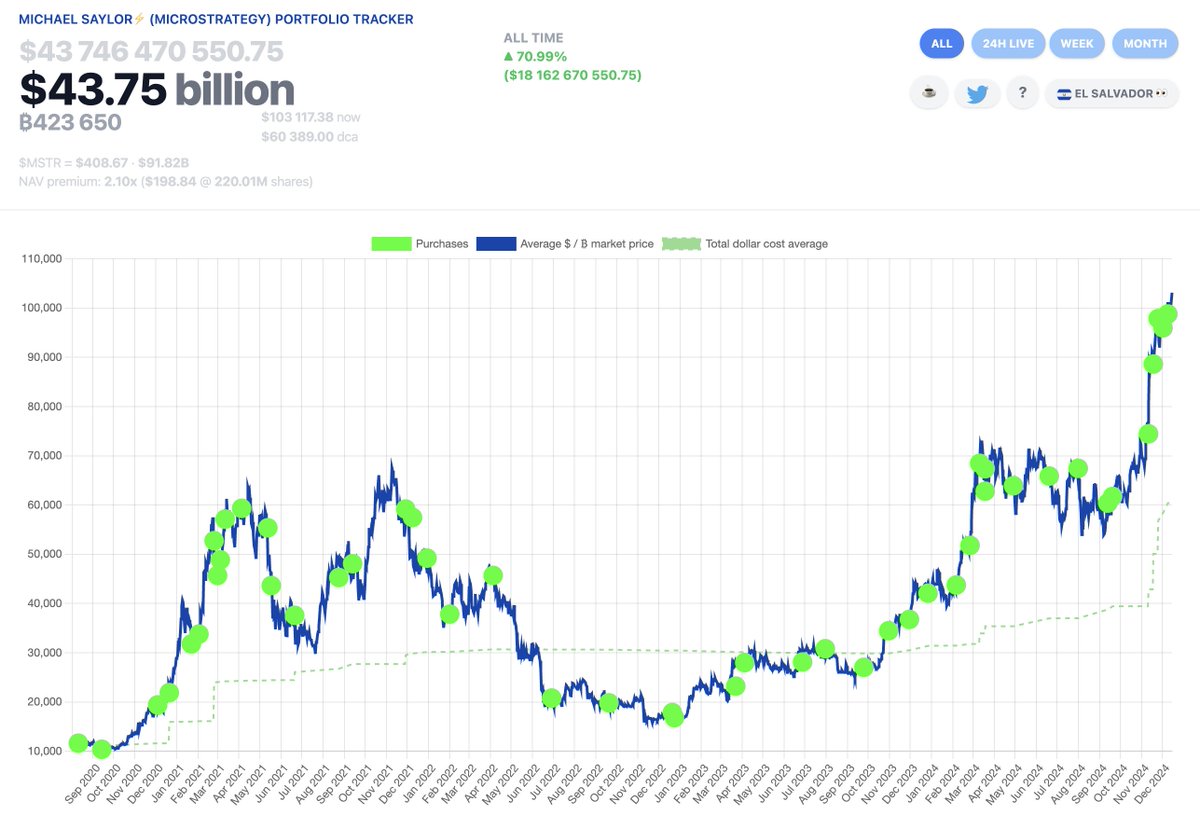
MicroStrategy has acquired 21,550 BTC for ~$2.1 billion at ~$98,783 per #bitcoin and has achieved BTC Yield of 43.2% QTD and 68.7% YTD. As of 12/8/2024, we hodl 423,650 $BTC acquired for ~$25.6 billion at ~$60,324 per bitcoin. $MSTR https://t.co/8r7bFqMFof
1/ As game theory intensifies, I’m *officially* going on the record with my mental model for how to think about BTC sovereign adoption by nation-states:
This is why I believe Argentina, Nigeria, and Turkey are next—and why El Salvador was among the first cc: @Dennis_Porter_
$MSTR looks mispriced IMO: in BTC 3.9-4.1 btc/1000 shares (my view 5.0-6 btc/1000) treasury premium around 2x, view 2.5-3x once things shake out, via more BTC acquisition, maybe S&P 500 inclusion or positive news sentiment, new ATH news. implies $485-$585/$MSTR with BTC ~$100k.