People really keep missing the point
The goal of PE firms is to be top quartile, not save 2 associates salaries (peanuts)
Let me remind you about the Economics of a PE firm
Let's look at a $5bn private equity firm with some basic assumptions
We will assume the management fee is 2%, that is $100mm/yr.
For simplicity, let's just see carry as a yearly component of revenue, and we can be conservative and say that is 50% of the management fee (implying pretty poor results), so that is $150mm of revenue per year (we are assuming carry is spread equally)
A firm of this size will have ~10 associates (24-year-olds who did 2 years in banking before)
A private equity associate salary is usually $350k. Total salary of associates is $3.5mm, which is 2% of revenue
2% of revenue, read that again, do you think this is the first place to cut costs?
Do you think vice presidents want to be turning managing partners’ comments at 2am, asking Claude to do them? What happens when Claude cannot figure out the model? Or it cannot read the handwriting? Or when it needs to create something without any guidance?
Upside Opportunity
This brings us to our next point, the competitiveness of capital markets.
People who have never worked in investing do not realize how hard it is to make money (in both private and public markets).
Regardless of how useful you think associates are, do you think firms will want to save 2% of revenue and give up the people doing the grunt work? Would it not be better to keep them on payroll, give them these AI tools, and try to outperform peers?
Go back to upside vs. downside. Always think in terms of upside vs. downside.
Upside: you keep your associates, outperform, and make $100M more.
Downside: you keep your associates, they make you money, and you paid them $3M
That is a 33x upside / downside decision, do you think an investment firm will take that bet?
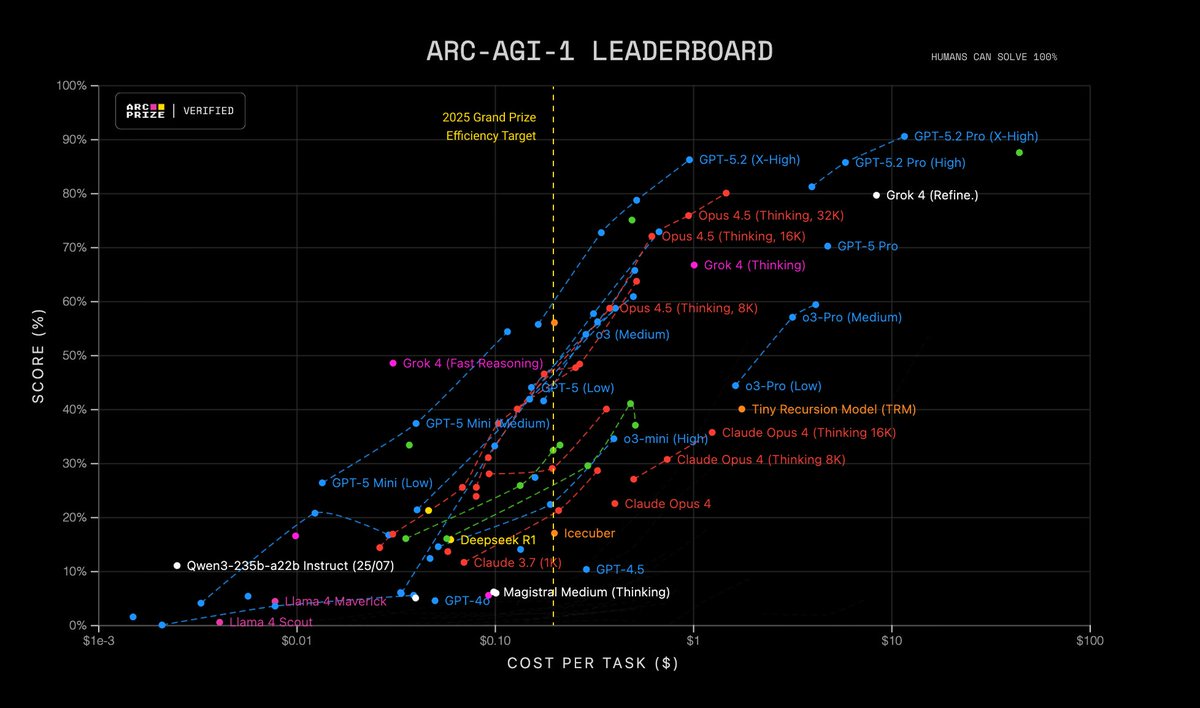
A year ago, we verified a preview of an unreleased version of @OpenAI o3 (High) that scored 88% on ARC-AGI-1 at est. $4.5k/task
Today, we’ve verified a new GPT-5.2 Pro (X-High) SOTA score of 90.5% at $11.64/task
This represents a ~390X efficiency improvement in one year
A new product, a new customer, a new financing!
Introducing Superpower: a 42MW natural gas turbine optimized for AI datacenters, built on our supersonic technology. Superpower launches with a 1.21GW order from @CrusoeAI Backstory 🧵👇
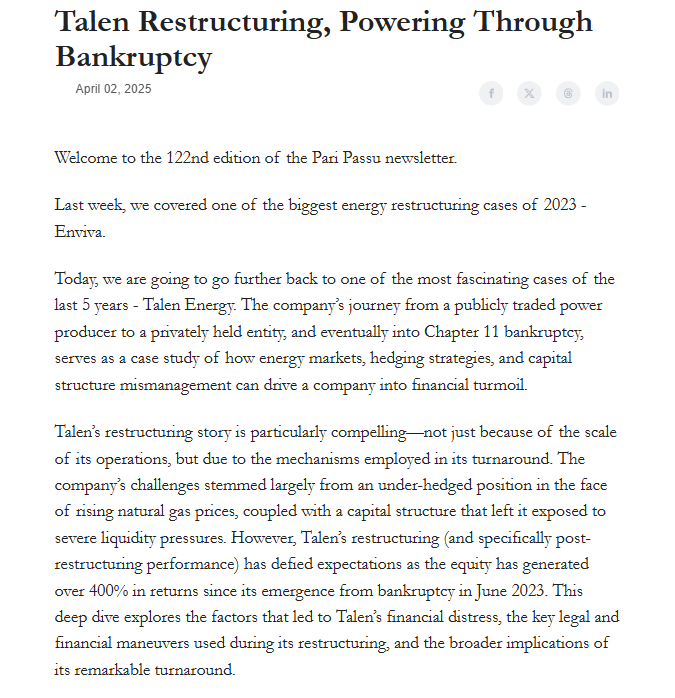
TALEN RESTRUCTURING | PREVIEW
Friday, we will publish one of the most exciting write-ups of the year
Retweet + comment "Talen" and I will pass you the article right now.
You do not want to miss this one. Pari Passu articles go behind paywall after being published, subscribe NOW to get all future articles for free - Link Below!
Jensen Huang says the single greatest potential of AI is to transform biology from a life science into life engineering to improve healthcare and he "can't imagine" what the field will be like in 10 years
@CorneliaLake Unlike what has happened in PE, few HF have institutionalised the organisation in a way that it doesn’t depend on a handful of key people. Perhaps, it has to do with trading culture, or insufficient focus on managing the business (vs. the portfolio), or with the comp structure
A client of mine building a world class data/information operation said -
"AI won't replace people. People who use AI will replace people who don't use AI."
This is a great illustration of that concept.
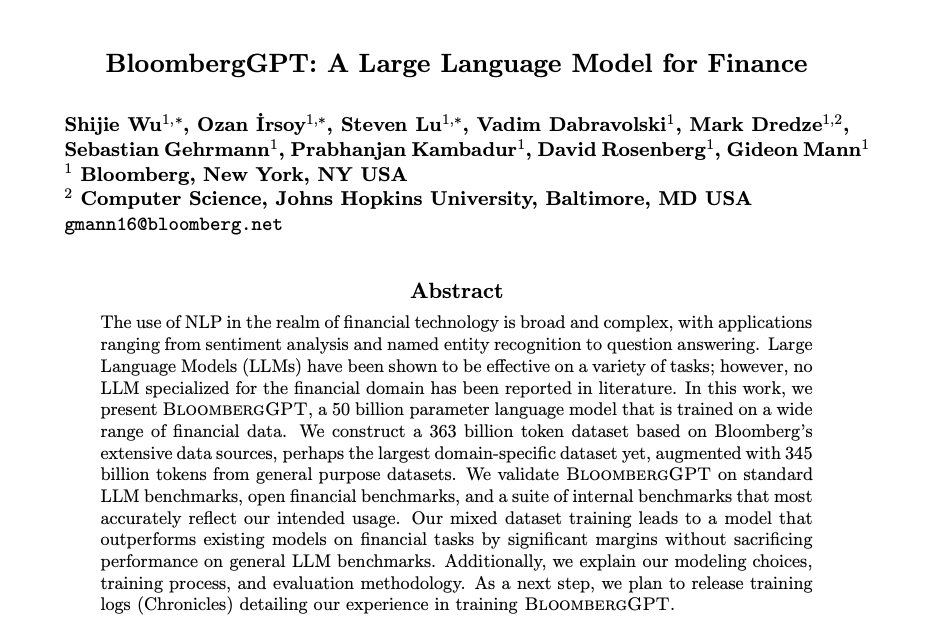
BloombergGPT: A Large Language Model for Finance
a 50 billion parameter language model that is trained on a wide range of financial data. Construct a 363 billion token dataset based on Bloomberg’s extensive data sources, perhaps the largest domain-specific dataset yet, augmented with 345 billion tokens from general purpose datasets
abs: https://t.co/53w2rTN4wB
This was not a bailout. During the GFC, the gov’t injected taxpayer money in the form of preferred stock into banks. Bondholders were protected and shareholders were diluted to varying degrees. Taxpayer money was put at great risk. Many people who screwed up suffered minimal to no consequences. Those were bailouts.
Here, shareholders and bond holders have been wiped out. The @FDICgov insurance fund capitalized by premiums paid by banks will absorb any losses. The fund will recoup any losses by assessing more premiums on the banks.
Had the @FDICgov@USTreasury and @federalreserve not intervened today, we would have had a 1930s bank run continuing first thing Monday causing enormous economic damage and hardship to millions.
More banks will likely fail despite the intervention, but we now have a clear roadmap for how the gov’t will manage them.
Bank boards and managements have received a massive wake up call. Being a director or CEO of a bank that fails is no fun: years of litigation, regulatory investigations, personal liability, potential civil and criminal charges, and enormous reputational damage.
Our gov’t did the right thing. This was not a bailout in any form. The people who screwed up will bear the consequences. The investors who didn’t adequately oversee their banks will be zeroed out and the bondholders will suffer a similar fate.
Importantly, our gov’t has sent a message that depositors can trust the banking system. Without this confidence, we are left with three or possibly four too-big-to-fail banks where the taxpayer is explicitly on the hook, and our national system of community and regional banks is toast.
Our government did the right thing for the country. We are very fortunate it did so.
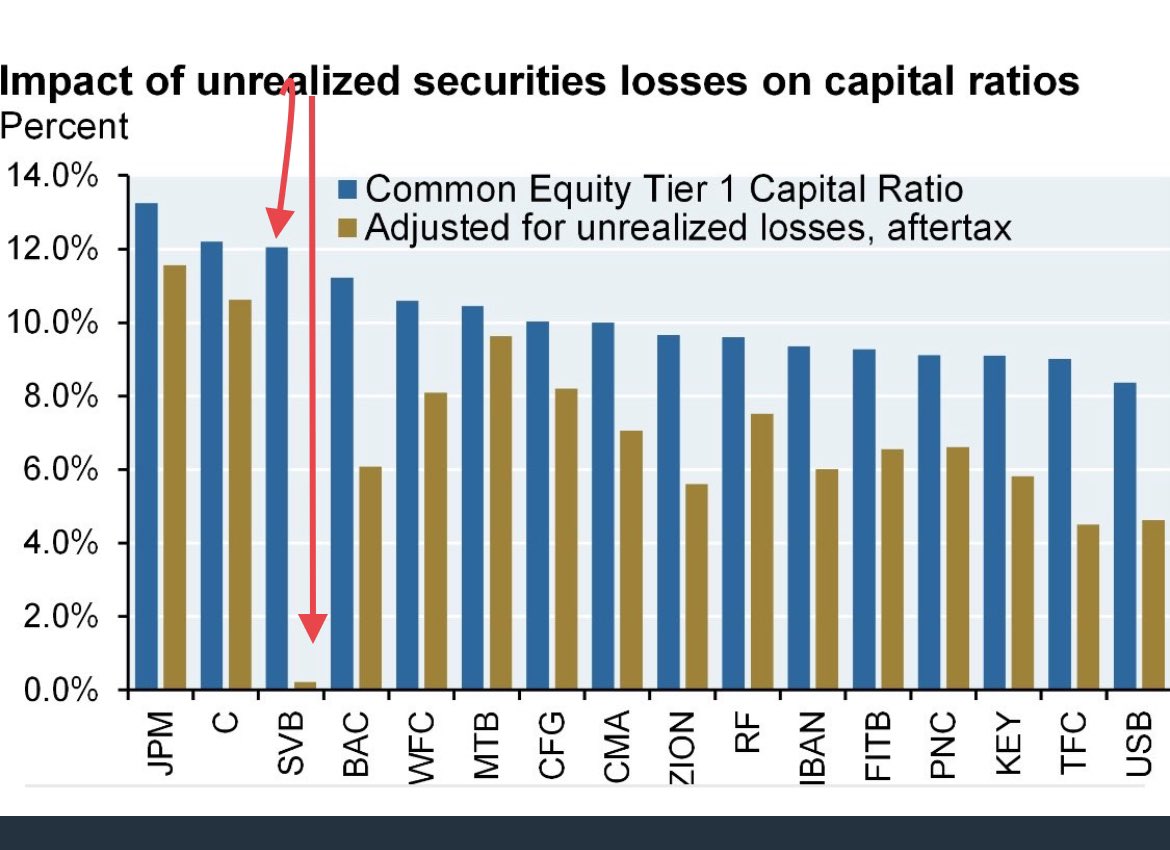
@HarryStebbings SVB’s issues were in the radar of so many people, could regulators have stepped in months ago to ask the bank to strengthen its capital?