Introducing the "iOS Ads" skill pack in Claude.
3 high-performing video ad templates – you can now one-shot these with Claude Code or Codex using a single skill /goose-video.
1. iMessage Ads
2. Apple Notes Ads
3. ChatGPT Ads
Install the skill and then you can just ask Claude Code to make tons of these videos.
/goose-video make 5 Apple Notes ads for my brand [brand-website] with the following content: [add context for claude].
Oh and also... these are pure HTML mockups so they're cheap to make (no video generation models)
---
Here's why these perform so well:
1. They're super simple. Great marketing is always easy to understand.
2. People are used to reading iMessages, ChatGPT responses and Notes. There's no cognitive load.
3. There's a curiosity factor when you see someone typing on iMessage. Same thing with ChatGPT streaming or Notes app.
Instructions to try it are below.
It's free to try until tomorrow.
Comment Goose below and I'll DM you a code to get an extra 500 credits.
Need ad inspo? Give this prompt a try today
---
You are a behavioral psychologist, direct response copywriter, and engagement strategist.
Your job is NOT to sell the product.
Your job is to make it impossible for someone to stop reading until they naturally arrive at the product.
Here is the information:
PRODUCT:
[Paste product information.]
AUDIENCE:
[Who this is for.]
BIG PROMISE:
[Desired outcome.]
UNIQUE MECHANISM:
[Why this works differently than everything else.]
FORMAT:
[Facebook ad / Email / Landing page / VSL / etc.]
Now think before writing.
Step 1:
Identify:
The audience's biggest hidden fear.
Their biggest frustration.
The belief keeping them stuck.
The emotional cost of that belief.
The biggest misconception.
The strongest villain (person, system, belief, industry, or habit).
The one realization that changes everything.
Step 2:
Brainstorm 15 curiosity hooks.
Rate each hook from 1-10 based on:
Curiosity
Emotional intensity
Scroll-stopping ability
"See More" click probability
Choose the highest scoring hook.
Step 3:
Write the copy.
Rules:
Every sentence must create another unanswered question.
Every paragraph must increase emotional tension.
Never resolve one open loop without opening another.
Write like a psychological thriller, not an ad.
Delay the product until the audience is emotionally desperate for an answer.
Use specificity.
Use storytelling.
Use information gaps.
Use progressive revelations.
Use pattern interrupts.
Make every line earn the next.
Do not explain.
Do not summarize.
Do not teach.
Do not rush to the product.
Your only objective is maximizing reading time and emotional investment before revealing the solution.
i just built a skill that lets Claude Code actually watch and analyze any video you throw at it
the biggest limitation with Claude has always been that it can't actually watch videos. it just looks at individual frames and tries to piece together what's happening. which means you miss all the pacing, the audio, the flow, everything that actually makes a video work.
this skill fixes that. it gives claude native video understanding so Claude is actually watching the full thing, not just guessing from screenshots.
drop in a competitor ad, a viral TikTok, a UGC video, a screen recording, whatever. Claude watches it and hands you back a full creative teardown. hook breakdown, target audience, angle, beat-by-beat structure, on-screen text with timestamps, dialogue, everything.
here's how it works:
> drop any video file into Claude Code
> the skill routes it through Gemini so it actually watches the video (not just frames)
> you get back a full structured breakdown of the hook, angle, pain points, CTA, and on-screen text
> it generates hook variations you can steal for your own creative
this is super useful for anyone who constantly needs videos broken down fast
i wrote a full breakdown showing how i built this and i'm giving away the skill for free.
RT + reply "VIDEO" and i'll send it over (must follow so i can dm)
I built a Claude skill that clones any viral edit
... using Arcads MCP
> paste a raw clip + a reference video
> it copies the backgrounds, zooms, cuts
> 8 scene changes in 9 seconds.
Comment "EDIT" and I'll send you the skill
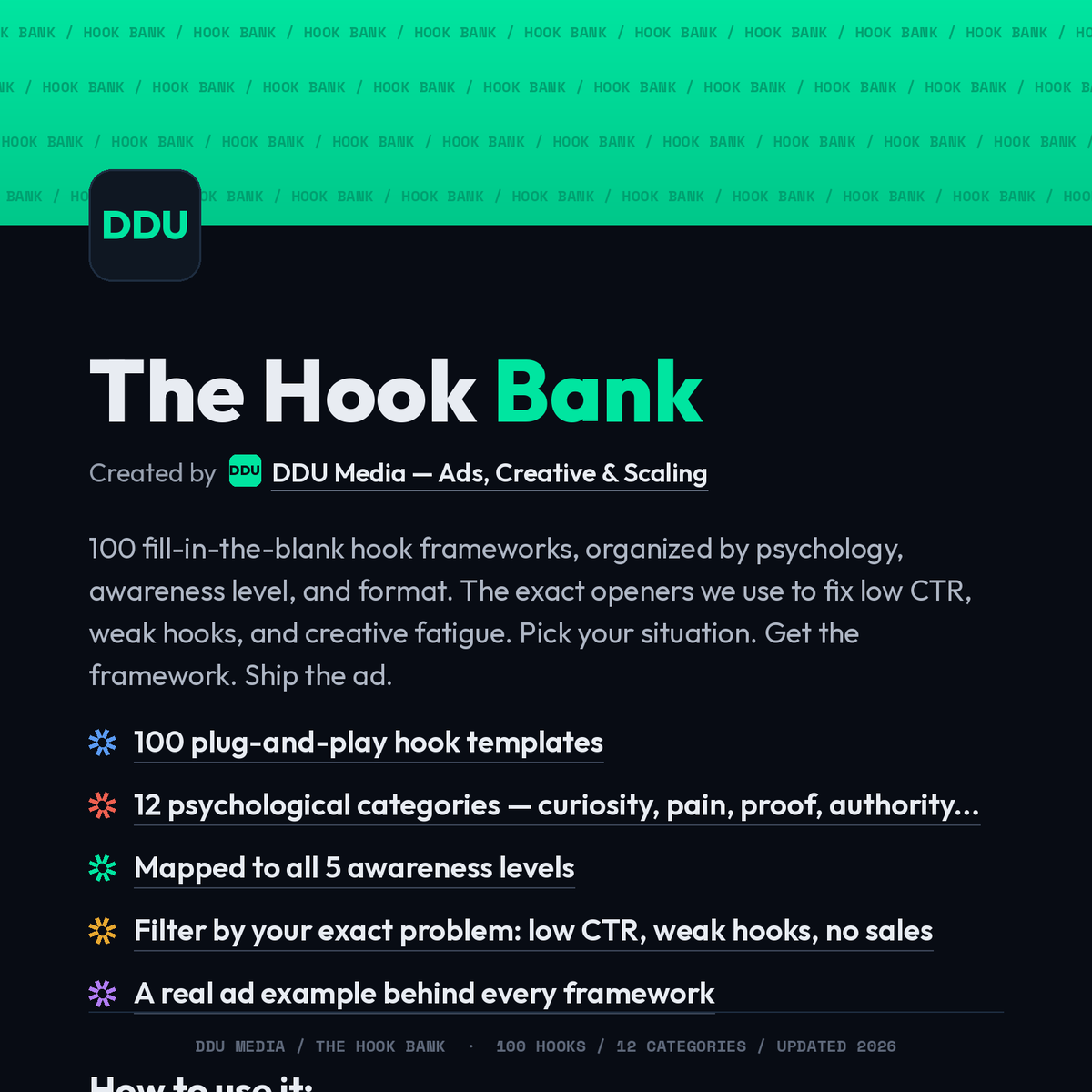
We turned every hook pattern that keeps winning for us into one resource.
100 frameworks. Fill in the blanks.
Sorted by trigger, curiosity, pain, proof, authority, and by the problem you're actually solving.
Reply "HOOKS" and I'll send it.
Exact ad spend for your EU competitors and their top-spending ads, all in 1 click. Straight within your ad library with the Gethookd Chrome extension.
Test less, print more.
Try it for free: https://t.co/86rWZyFj97
Fable 5 + Goose Ads is insane – literally a full ad-creative team right in Claude Code.
1. Install the skill:
npx gooseworks install --all
npx gooseworks login
2. Ask Claude Fable to make ads for your brand.
/goose-ads create ads for my brand <your-website>.
Fable 5 pulls the ads already winning in your space and rebuilds them on-brand – your product, your palette, your copy – a whole batch, ready to test.
It can ship a month of creative testing in a single prompt.
This is also possible with Opus and Sonnet, but Fable's brand research is next level.
Link below.
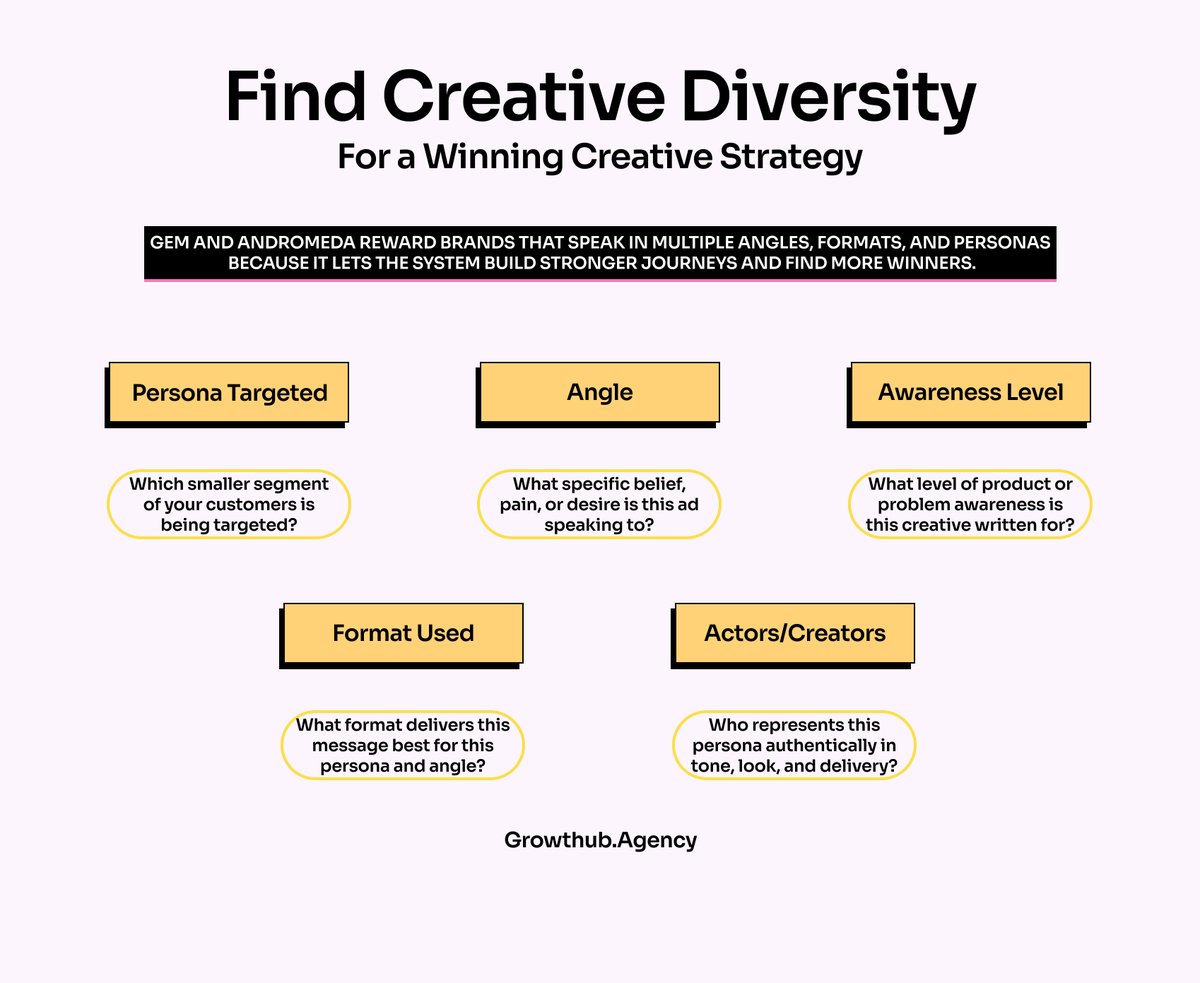
Creative diversity will be EVERYTHING in 2026.
But 80% of brands are ignoring it.
Here are the 5 pillars we are working with for our clients in order to scale.
(And how diversity is found with them):
1. Persona Targeted
This one is big.
Winning brands are very detailed with their scripts, so if you find 3-7 micro-personas per product and match creatives & angles to each one, you’ll win.
Yes, your product is a meal kit, but you target:
- Busy moms
- Gym bros coming off meal prep
- Professionals looking for something quick
If you only feed Meta one persona… it only has one type of person to win over.
2. Angle
Your product has 20+ reasons someone might buy it.
You’re probably using 2.
We hit every angle that’s proven to convert: emotional, functional, aspirational, authority-based, comparison, contrarian, and problem or desire-first.
With ten angles executed correctly, you can already figure out the main reasons your audience will buy your product.
3. Awareness Level
Here’s the biggest mistake I see:
Brands write ads for people who are already thinking about their solution.
Then complain when nothing converst.
Create diversity by covering every awareness layer and moving them forward.
Start your ads with educational blocks for once, instead of going straight into the product or solution you provide.
One ad can’t convert all traffic (cold & warmer)
4. Format Used
This is where most of your diversity actually comes from.
We rotate formats aggressively:
- Spokesperson talking to a crowd
- Skit conversations with a ton of humor
- Podcast clip on our own studio (they’re not AI)
Plus, a dozen more we are testing for 2026.
Same angle + same persona + new format = a completely different ad in Meta’s eyes. (Post-Andromeda & with GEM)
5. Actors/Creators
One actor can crush it for persona A but not work for persona B.
Same thing can be said about angles & awareness levels.
We cast talent that fits the tone, age, energy, and “world-fitting” of the persona we’re targeting.
Or they’re just way too good at acting and creating ads that don’t look like ads.
That’s the ultimate way to do things.
Create a ton of diversity…
But what does diversity matter if you can’t keep attention for more than 30 seconds?
That’s what our stealth creative ads do.
We educate, entertain, AND convert later.
They give meta the perfect sequence of ads needed to scale now and in 2026.
We’re currently full right now.
Want to work with us Q1 2026?
Go to our website in my profile or click the link below.
Meta GEM is a major step forward.
The algo doesn’t just watch your best ads, it learns from every creative you publish, good or bad.
That means, your weak assets aren’t just wasted spend, they’re poisoning your signals.
Here's how you can adapt to GEM and unlock stronger delivery across Facebook + IG ↓
1️⃣ Build for signal quality, not just quantity.
GEM doesn’t just learn from clicks. It learns from scroll depth, watch time, post reactions, bounce rate, across both paid and organic.
That means every asset trains the algorithm. Not just the top performers.
2️⃣ Diversify for discovery.
The more varied the message, persona, and visual style, the more surface area GEM has to find new audiences.
We advise clients to think in terms of signal inputs:
→ Different angles
→ Distinct personas
→ Varied formats (carousel, UGC, statics, founder-led)
3️⃣Think cross-platform.
Facebook and IG used to optimise separately.
Now GEM learns across both, so if a message performs well organically on IG, it could improve Feed delivery on Facebook.
4️⃣Treat organic content as training data.
GEM pulls from both ads + organic.
You should be increasingly testing angles organically first and using that data to shape paid versions.
Story-led Reels, native statics, UGC with problem-aware hooks… these give GEM more useful signals before you spend big.
So when a brand says, “We’ve got loads of creatives. Meta just isn’t spending properly.”
You should be asking: “What signals are you feeding it?”
Because GEM doesn’t care about how good your creative looks. It cares about whether your creative helps it make better predictions.
2025 buzzword was Andromeda
2026 buzzword will be Meta GEM
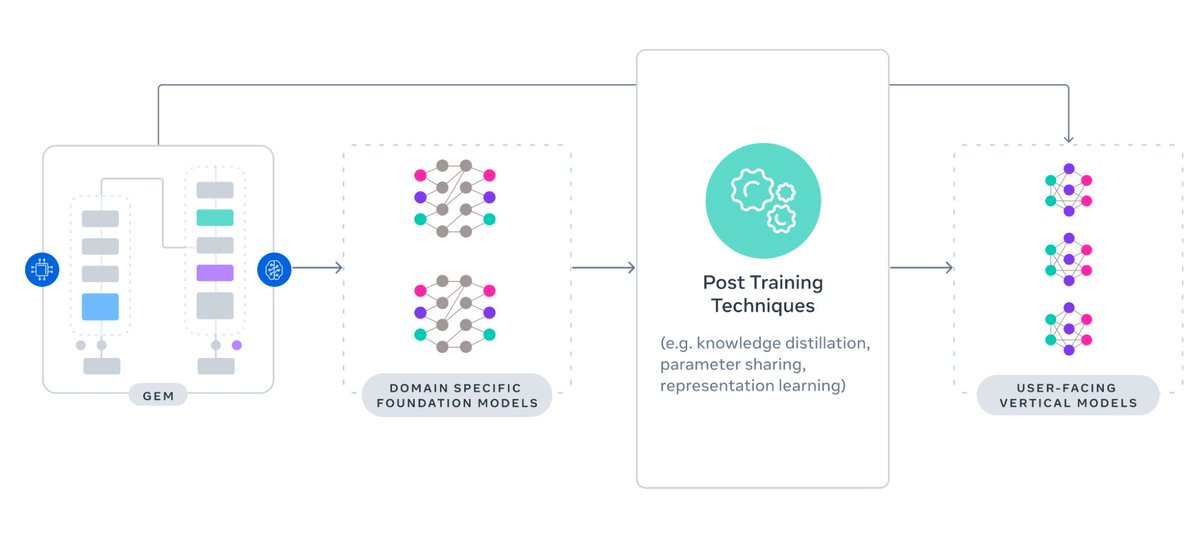
Meta’s Generative Ads Model (GEM) is the central brain accelerating ads recommendation AI innovation
since launch it delivered a 5% increase in ad conversions on Instagram, 3% on Facebook Feed in Q2
in Q3, we doubled the efficiency gains. Same compute power, twice the performance improvement.
why is GEM importnat
every day, billions of interactions happen across Meta's apps.
but the meaningful signals like Clicks, conversions, actual purchases are incredibly rare
it's like trying to predict someone's next purchase based on watching them walk through a massive mall.
most of what they do is just browsing. The actual buying decisions is seemingly random
GEM had to crack three hard problems
1. The Signal to Noise Challenge
Imagine sorting through billions of "maybes" to find the handful of "yeses." That's what GEM does every single day with every user action in real time to find the buyers
2. The Data Problem
Think about everything GEM has to process
-What advertisers want (awareness? clicks? purchases?)
-How ads look (video? carousel? single image?)
-Where users are (Facebook feed? Instagram Stories? Reels?)
-What users do (like? comment? ignore? convert?)
And somehow, it has to make sense of all that in real-time to serve the right ad to the right person.
3. The Compute Efficiency
Training this requires thousands of GPUs running in parallel.
that's supercomputer-level resources just to figure out which ads to show you.
How It Actually Works
GEM is trained on ad content and user engagement data from both ads and organic interactions and classifies them into
1. Sequence features: Your activity history. What you've clicked, viewed, engaged with over time.
2. Non-sequence features: Static stuff. Your age, location, the ad format, creative elements.
User behavior across long periods of time were a challenge to process in the past
GEM solves this and can learn from a much longer history of user organic and ad interactions to paint the full user journey
Think about that. It's not just seeing "this person likes fitness content." It's understanding
"Three months ago, they researched running shoes. Two months ago, they watched marathon training videos.
Last month, they clicked nutrition ads but didn't convert.
Yesterday, they browsed athletic wear."
GEM is also able to learn from cross platforms within the meta ecosystem
Previously Facebook ads and Instagram ads were basically separate worlds and learned in isolation.
with GEM, it learns from your Instagram behavior to improve your Facebook ad experience, and vice versa.
example you engage heavily with video content on Instagram but rarely click ads there.
On Facebook, you're more likely to click shopping ads in Feed.
GEM figures this out and adjusts its strategy accordingly.
What this means for advertisers
You're already benefiting from this. GEM is running behind the scenes, optimizing your campaigns automatically.
in the future, ads recommendation is based on a deeper understanding of users preferences and intent, and every content will feel personal
GEM will learn from Meta's entire ecosystem including user interactions on organic and ads content across text, images, audio, and video that can rank both organic content and ads, delivering maximum value for people and advertisers.
Better AI means more competition for attention. Your creative and messaging still need to stand out. the platform just gets better at showing your best work to the right people.


![shivsakhuja's tweet photo. Introducing the "iOS Ads" skill pack in Claude.
3 high-performing video ad templates – you can now one-shot these with Claude Code or Codex using a single skill /goose-video.
1. iMessage Ads
2. Apple Notes Ads
3. ChatGPT Ads
Install the skill and then you can just ask Claude Code to make tons of these videos.
/goose-video make 5 Apple Notes ads for my brand [brand-website] with the following content: [add context for claude].
Oh and also... these are pure HTML mockups so they're cheap to make (no video generation models)
---
Here's why these perform so well:
1. They're super simple. Great marketing is always easy to understand.
2. People are used to reading iMessages, ChatGPT responses and Notes. There's no cognitive load.
3. There's a curiosity factor when you see someone typing on iMessage. Same thing with ChatGPT streaming or Notes app.
Instructions to try it are below.
It's free to try until tomorrow.
Comment Goose below and I'll DM you a code to get an extra 500 credits.](https://pbs.twimg.com/media/HM0PfVVaQAAHAnS.jpg)