THE SECRET MERCOR MASTER PLAN
Imagine a world where Jeff Bezos is a hedge fund investor, Howard Shultz is a salesman, and Reed Hastings is a teacher. That was the world we lived in, not so long ago. These are the jobs they were doing before they found the best use for their talents.
We founded Mercor because the labor market is the largest, most inefficient market in the world. Better matching people with the work they do everyday is the largest lever on maximizing global utility. While we gained incredible traction with our initial focus on hiring experts to train AI models, this is only the first step in our plan to solve global labor allocation.
THE WEDGE
Marketplaces are hard to get off the ground, but if they do take off they become huge. The successful ones have a wedge into a large and pressing unmet need. For Uber, the wedge was black cars. For Airbnb, it was conferences.
We started 2024 in our apartment with no US employees, under $1M in annual revenue, and only seed companies as customers. Last year we grew 6400% and we now work with the most sophisticated technology companies in the world, making us one of the fastest growing companies in Silicon Valley history.
We believe we can create hundreds of thousands of jobs with AI labs alone, but that pales in comparison to the billions of knowledge work jobs in the world. The technology that we’re been building is generally applicable.
STRUCTURAL INEFFICIENCY
Labor inefficiency stems from two structural challenges in the market:
1. Fragmentation – job candidates apply to a handful of jobs and companies consider a fraction of a percent of candidates in the market. This is because matching supply and demand needs to be solved manually (and previously in person). Companies manually review resumes, conduct interviews, and predict who they believe will perform well. Human time is the limiting factor. However, if you can solve this matching problem at the cost of software it allows you to interview everyone, making way for a global, unified labor market that every candidate applies to and every company hires from.
2. Imperfect Information – When you order a ride on Uber, you know what you’re getting. When you book an Airbnb, the pictures usually do a pretty good job. When you’re hiring someone, it’s extremely difficult to accurately predict how well they will perform on the job. Imperfect human judgement is embedded within every transaction. While LLMs are not perfect at talent assessment, models are quickly surpassing human capabilities. This trend will continue to make transactions more efficient.
Correspondingly, our main objectives are to attract high caliber applicants to come to Mercor and accurately predict candidate’s job performance. Achieving these objectives will solve global labor efficiency more broadly.
Hiring expert contractors to train AI models is the perfect forcing function on these objectives. First, we collect performance data from AI labs within days, compared to the 3 month lag from a traditional enterprise. This allows us to immediately calibrate on the effectiveness of our models and continuously experiment to find the features predictive of success. Second, we need to hire a broad pool of candidates across all knowledge work jobs (law, consulting, medicine, engineering, etc.). This builds the strength of our talent pool across every professional and academic domain. Third, we will service “unreasonable asks” from AI labs like needing to hire 300 people in two days. These high volume requests for quality people on extremely short timelines can’t be fulfilled with a services operation. They force us to build the automations at each layer of the hiring process to deliver.
HIRING FOR ALL WORK
We have the largest comparative advantage from automating talent assessment when the ratio of time spent assessing someone relative to the time spent working with them is the highest. When hiring someone for 5 years, it’s easier to interview them manually. When hiring someone for 5 weeks, efficient matching automation creates a huge comparative advantage. Because of this, we’ve started with shorter duration contract work, but will expand progressively towards longer duration, full-time jobs as our technology matures.
So, in short, the master plan is:
1. Hire people to train AI models
2. Use those contracts to learn how to predict job performance
3. Expand to short-duration contract roles
4. Hire people for all jobs
Don’t tell anyone.
Jeff Bezos never wanted this cartoon to become public.
He killed it, and as a result, pulitzer prize editorial cartoonist Ann Telnaes quit.
Make sure everyone sees this cartoon.
Sam Altman on God, Elon and the mysterious death of his former employee.
(0:00) Is AI Alive? Is It Lying to Us?
(3:37) Does Sam Altman Believe in God?
(6:37) What Is Morally Right and Wrong According to ChatGPT?
(19:08) ChatGPT Users Committing Suicide
(27:21) Will Altman Allow ChatGPT for Military Use?
(29:01) Altman’s Biggest Fear About AI
(31:39) Will AI Bring About Totalitarian Control?
(32:48) How Much Privacy Do ChatGPT Users Have?
(34:28) The Suspicious Death of Altman’s Former Employee
(41:37) Altman’s Thoughts on Elon Musk
(43:00) What Jobs Will Be Lost to AI?
(47:58) What Are the Downsides of AI?
(49:37) Is AI a Religion?
(52:31) The Dangers of Deepfakes
Includes paid partnerships.
A masterclass on Bitcoin credit and corporate treasuries.
Michael @saylor explains the new playbook: perpetual preferred stocks and a yield curve built on Bitcoin.
Plus, $STRK $STRF $STRD $STRC explained simply.
OpenAI fired this 23-year-old from their Superalignment team.
But he turned his insider knowledge into a $1.5B fund that's outperforming Wall Street by 700% this year.
He says maybe ~200 people in SF understand what's *actually* happening in AI right now.
Here's his thesis: 🧵
5/ Contrarianism is the key to outperformance.
The equity prices are at their lowest when external factors like geopolitical or macroeconomic developments lead to poor corporate performanse.
In these times, you have to be optimistic when others are pessimistic.
This is Howard Marks.
He is one of the best value investors alive.
He just went on the My First Million Podcast and shared his investment strategy.
Here are the 7 things you can't miss: 🧵
AI Dev 25 is coming to NYC on November 14!
1,200+ developers will dive into technical topics such as:
- Agentic AI: Multi-agent orchestration, tool use, complex reasoning chains
- Coding with AI: Agentic coding assistants, automated testing, debugging strategies
- Context engineering: Advanced RAG, structured context, memory systems
- Multimodal AI: Vision-language models, audio processing, cross-modal architectures
- Fintech applications: Fraud detection, credit modeling, regulatory compliance
Our Pi Day AI Dev event sold out quickly, so we booked a bigger venue this time. Tickets available here: https://t.co/baLDrB1EPd
On Saturday at the Buildathon hosted by AI Fund and https://t.co/zpIxRSuky4, over 100 developers competed to build software products quickly using AI assisted coding. I was inspired to see developers build functional products in just 1-2 hours. The best practices for rapid engineering are changing quickly along with the tools, and I loved the hallway conversations sharing tips with other developers on using AI to code!
The competitors raced to fulfill product specs like this one (you can see the full list in our github repo; link in reply):
Project: Codebase Time Machine
Description: Navigate any codebase through time, understanding evolution of features and architectural decisions.
Requirements:
- Clone repo and analyze full git history
- Build semantic understanding of code changes over time
- Answer questions like “Why was this pattern introduced?” or “Show me how auth evolved”
- Visualize code ownership and complexity trends
- Link commits to business features/decisions
Teams had 6½ hours to build 5 products. And many of them managed to do exactly that! They created fully functional applications with good UIs and sometimes embellishments.
What excites me most isn’t just what can now be built in a few hours. Rather, it is that, if AI assistance lets us build basic but fully functional products this quickly, then imagine what can now be done in a week, or a month, or six months. If the teams that participated in the Buildathon had this velocity of execution and iterated over multiple cycles of getting customer feedback and using that to improve the product, imagine how quickly it is now possible to build great products.
Owning proprietary software has long been a moat for businesses, because it has been hard to write complex software. Now, as AI assistance enables rapid engineering, this moat is weakening.
While many members of the winning teams had computer science backgrounds — which does provide an edge — not all did. Team members who took home prizes included a high school senior, a product manager, and a healthcare entrepreneur who initially posted on Discord that he was “over his skis” as someone who “isn't a coder.” I was thrilled that multiple participants told me they exceeded their own expectations and discovered they can now build faster than they realized. If you haven’t yet pushed yourself to build quickly using agentic coding tools, you, too, might be surprised at what you can do!
At AI Fund and https://t.co/zpIxRSuky4, we pride ourselves on building and iterating quickly. At the Buildathon, I saw many teams execute quickly using a wide range of tools including Claude Code, GPT-5, Replit, Cursor, Windsurf, Trae, and many others.
I offer my hearty congratulations to all the winners!
- 1st Place: Milind Pathak, Mukul Pathak, and Sapna Sangmitra (Team Vibe-as-a-Service), a team of three family members. They also received an award for Best Design.
- 2nd Place: David Schuster, Massimiliano Viola, and Manvik Pasula. (Team Two Coders and a Finance Guy).
- Solo Participant Award: Ivelina Dimova, who had just flown to San Francisco from Portugal, and who worked on the 5 projects not sequentially, but in parallel!
- Graph Thinking Award: Divya Mahajan, Terresa Pan, and Achin Gupta (Team A-sync).
- Honorable mentions went to finalists Alec Hewitt, Juan Martinez, Mark Watson and Sophia Tang (Team Secret Agents) and Yuanyuan Pan, Jack Lin, and Xi Huang (Team Can Kids).
To everyone who participated, thank you! Through events like these, I hope we can all learn from each other, encourage each other, invent new best practices, and spread the word about where agentic coding is taking software engineering.
[Original text: https://t.co/wJbQMrnZdL ]
I'm teaching a new course! AI Python for Beginners is a series of four short courses that teach anyone to code, regardless of current technical skill. We are offering these courses free for a limited time.
Generative AI is transforming coding. This course teaches coding in a way that’s aligned with where the field is going, rather than where it has been:
(1) AI as a Coding Companion. Experienced coders are using AI to help write snippets of code, debug code, and the like. We embrace this approach and describe best-practices for coding with a chatbot. Throughout the course, you'll have access to an AI chatbot that will be your own coding companion that can assist you every step of the way as you code.
(2) Learning by Building AI Applications. You'll write code that interacts with large language models to quickly create fun applications to customize poems, write recipes, and manage a to-do list. This hands-on approach helps you see how writing code that calls on powerful AI models will make you more effective in your work and personal projects.
With this approach, beginning programmers can learn to do useful things with code far faster than they could have even a year ago.
Knowing a little bit of coding is increasingly helping people in job roles other than software engineers. For example, I've seen a marketing professional write code to download web pages and use generative AI to derive insights; a reporter write code to flag important stories; and an investor automate the initial drafts of contracts.
With this course you’ll be equipped to automate repetitive tasks, analyze data more efficiently, and leverage AI to enhance your productivity.
If you are already an experienced developer, please help me spread the word and encourage your non-developer friends to learn a little bit of coding.
I hope you'll check out the first two short courses here! https://t.co/lTupltSZkT
He predicted:
• The Deep Learning revolution (2008)
• The online education boom (2011)
• China's massive AI dominance (2014)
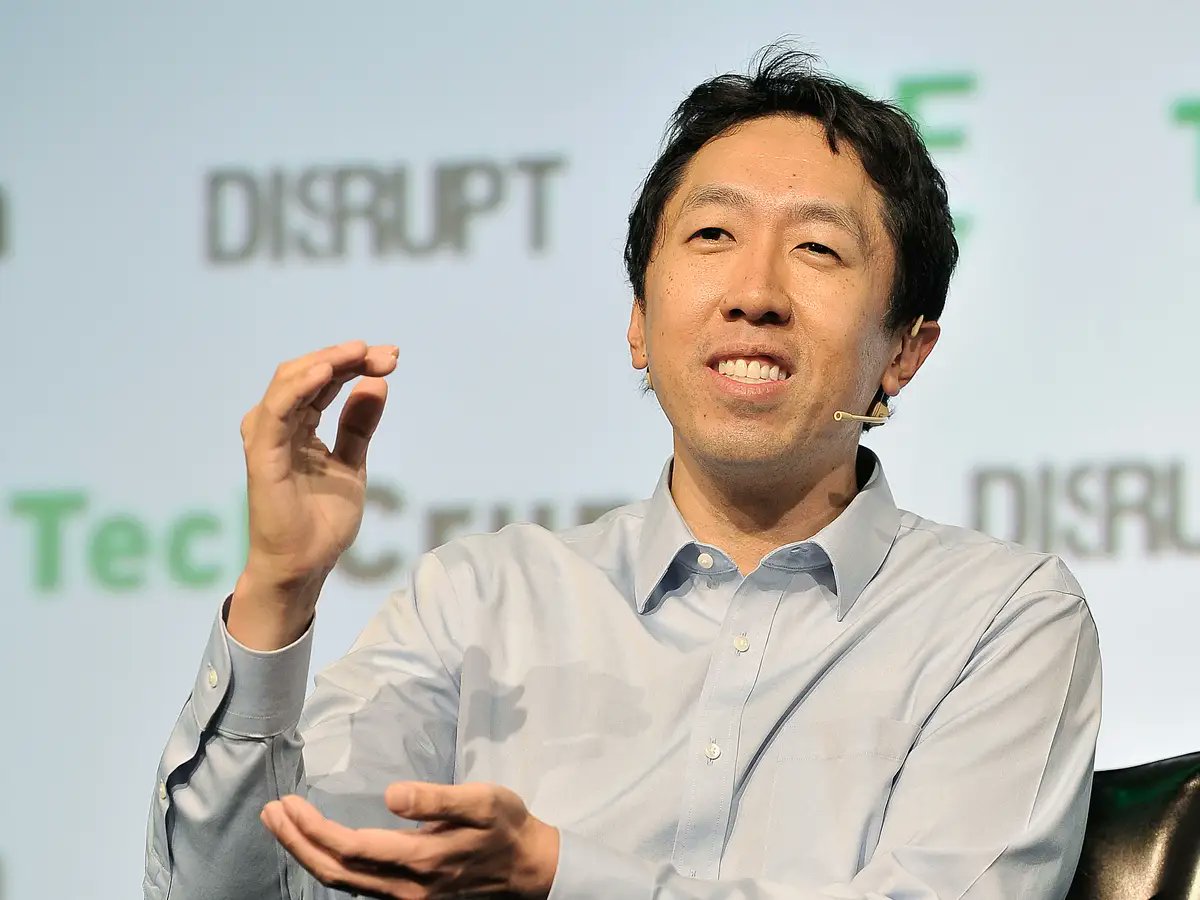
Now Andrew Ng revealed 5 opportunities that will create more millionaires than anything before.
Here's what you should know (& how to prepare): 🧵
Today we launched a new product called ChatGPT Agent.
Agent represents a new level of capability for AI systems and can accomplish some remarkable, complex tasks for you using its own computer. It combines the spirit of Deep Research and Operator, but is more powerful than that may sound—it can think for a long time, use some tools, think some more, take some actions, think some more, etc. For example, we showed a demo in our launch of preparing for a friend’s wedding: buying an outfit, booking travel, choosing a gift, etc. We also showed an example of analyzing data and creating a presentation for work.
Although the utility is significant, so are the potential risks.
We have built a lot of safeguards and warnings into it, and broader mitigations than we’ve ever developed before from robust training to system safeguards to user controls, but we can’t anticipate everything. In the spirit of iterative deployment, we are going to warn users heavily and give users freedom to take actions carefully if they want to.
I would explain this to my own family as cutting edge and experimental; a chance to try the future, but not something I’d yet use for high-stakes uses or with a lot of personal information until we have a chance to study and improve it in the wild.
We don’t know exactly what the impacts are going to be, but bad actors may try to “trick” users’ AI agents into giving private information they shouldn’t and take actions they shouldn’t, in ways we can’t predict. We recommend giving agents the minimum access required to complete a task to reduce privacy and security risks.
For example, I can give Agent access to my calendar to find a time that works for a group dinner. But I don’t need to give it any access if I’m just asking it to buy me some clothes.
There is more risk in tasks like “Look at my emails that came in overnight and do whatever you need to do to address them, don’t ask any follow up questions”. This could lead to untrusted content from a malicious email tricking the model into leaking your data.
We think it’s important to begin learning from contact with reality, and that people adopt these tools carefully and slowly as we better quantify and mitigate the potential risks involved. As with other new levels of capability, society, the technology, and the risk mitigation strategy will need to co-evolve.
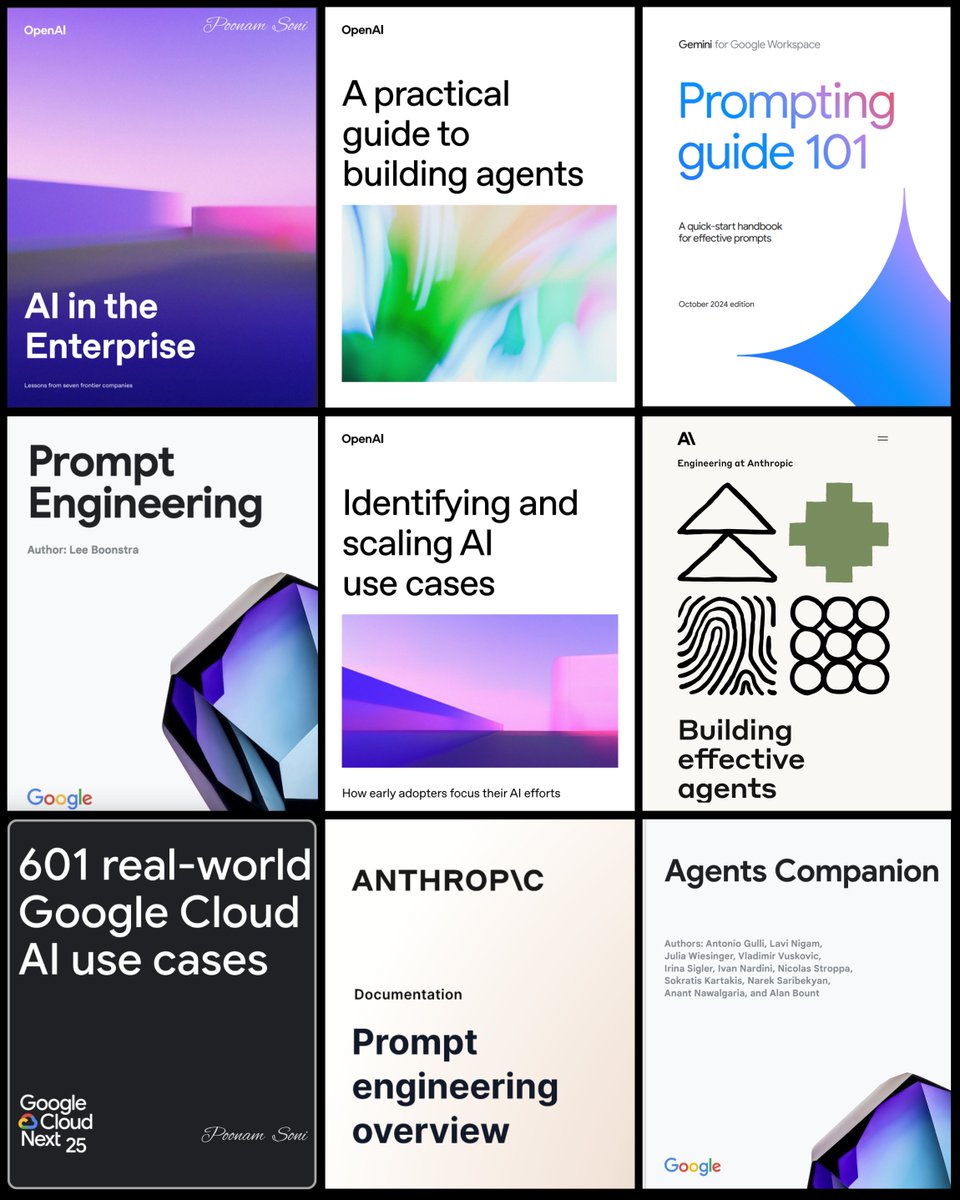
OpenAI, Google, and Anthropic released best guides on:
- Prompt Engineering
- Building AI Agents
- AI in Business
- 601 AI use cases
and so much more...
9 best guides you can’t afford to miss:









![AndrewYNg's tweet photo. On Saturday at the Buildathon hosted by AI Fund and https://t.co/zpIxRSuky4, over 100 developers competed to build software products quickly using AI assisted coding. I was inspired to see developers build functional products in just 1-2 hours. The best practices for rapid engineering are changing quickly along with the tools, and I loved the hallway conversations sharing tips with other developers on using AI to code!
The competitors raced to fulfill product specs like this one (you can see the full list in our github repo; link in reply):
Project: Codebase Time Machine
Description: Navigate any codebase through time, understanding evolution of features and architectural decisions.
Requirements:
- Clone repo and analyze full git history
- Build semantic understanding of code changes over time
- Answer questions like “Why was this pattern introduced?” or “Show me how auth evolved”
- Visualize code ownership and complexity trends
- Link commits to business features/decisions
Teams had 6½ hours to build 5 products. And many of them managed to do exactly that! They created fully functional applications with good UIs and sometimes embellishments.
What excites me most isn’t just what can now be built in a few hours. Rather, it is that, if AI assistance lets us build basic but fully functional products this quickly, then imagine what can now be done in a week, or a month, or six months. If the teams that participated in the Buildathon had this velocity of execution and iterated over multiple cycles of getting customer feedback and using that to improve the product, imagine how quickly it is now possible to build great products.
Owning proprietary software has long been a moat for businesses, because it has been hard to write complex software. Now, as AI assistance enables rapid engineering, this moat is weakening.
While many members of the winning teams had computer science backgrounds — which does provide an edge — not all did. Team members who took home prizes included a high school senior, a product manager, and a healthcare entrepreneur who initially posted on Discord that he was “over his skis” as someone who “isn't a coder.” I was thrilled that multiple participants told me they exceeded their own expectations and discovered they can now build faster than they realized. If you haven’t yet pushed yourself to build quickly using agentic coding tools, you, too, might be surprised at what you can do!
At AI Fund and https://t.co/zpIxRSuky4, we pride ourselves on building and iterating quickly. At the Buildathon, I saw many teams execute quickly using a wide range of tools including Claude Code, GPT-5, Replit, Cursor, Windsurf, Trae, and many others.
I offer my hearty congratulations to all the winners!
- 1st Place: Milind Pathak, Mukul Pathak, and Sapna Sangmitra (Team Vibe-as-a-Service), a team of three family members. They also received an award for Best Design.
- 2nd Place: David Schuster, Massimiliano Viola, and Manvik Pasula. (Team Two Coders and a Finance Guy).
- Solo Participant Award: Ivelina Dimova, who had just flown to San Francisco from Portugal, and who worked on the 5 projects not sequentially, but in parallel!
- Graph Thinking Award: Divya Mahajan, Terresa Pan, and Achin Gupta (Team A-sync).
- Honorable mentions went to finalists Alec Hewitt, Juan Martinez, Mark Watson and Sophia Tang (Team Secret Agents) and Yuanyuan Pan, Jack Lin, and Xi Huang (Team Can Kids).
To everyone who participated, thank you! Through events like these, I hope we can all learn from each other, encourage each other, invent new best practices, and spread the word about where agentic coding is taking software engineering.
[Original text: https://t.co/wJbQMrnZdL ]](https://pbs.twimg.com/media/Gy5T3JNaMAAe9H0.jpg)