🔥 Hot take: harness engineering is masking the real issue with agents.
As a young researcher, I was drawn to #NLProc by the elegance of 𝗰𝗼𝗺𝗽𝗼𝘀𝗶𝘁𝗶𝗼𝗻𝗮𝗹𝗶𝘁𝘆 in syntax trees, and have always been frustrated with neural models' lack of it.
Years later, most of us are building AI agents where neural models run at the outer-most loop: they take the problem, decide the plan of attack, find the tools to attack it, and then orchestrates the solution.
But we know these models are merely simulators of symbolic processes at best -- they are sensitive to variable names, input values, complex instructions, convoluted control flows, to name a few. And once you write an agent this way, you end up with a mountain of text and some code snippets (the "harness") vaguely suggesting what the agent might do at test time, with no guarantees on the agent's actual behavior or a good way to easily edit it without side-effects.
We introduce 𝗔𝗴𝗲𝗻𝘁 𝗕𝗲𝗵𝗮𝘃𝗶𝗼𝗿 𝗮𝘀 𝗖𝗼𝗱𝗲, which uses a definitive piece of code (with LLM calls and subagents that are recursively writing code when possible) to specify the agent's test-time behavior. This generalizes better, is more robust (pass^4 from 47.4% -> 71.9% on tau2 telecom, for instance), and can be surprisingly cost-effective (12.9x lower cost on tau2 telecom). We also show that it generalizes to new tasks when the generalization surface is predictable, and preserves backward compatibility easily when the agent behavior needs to be changed to accommodate new tasks.
I wrote a little bit about my winding story from NLP to this work in a recent blog post: https://t.co/fYX9sZu4sm
Paper (w/ Chunliang Lyu, Gang Li, Fabian Chan, Cheng Chang, Ignacio Cases and Will Lu): https://t.co/GtuSocFyrG
1/ RL for improving task success has made LLMs remarkably capable. But what happens when the model fails? Turns out, training for graceful failure can be surprisingly tricky!
Very excited to share our new paper: Training Language Models to Fail Gracefully
🧵
Fun conversation with @naresh_sunkara.
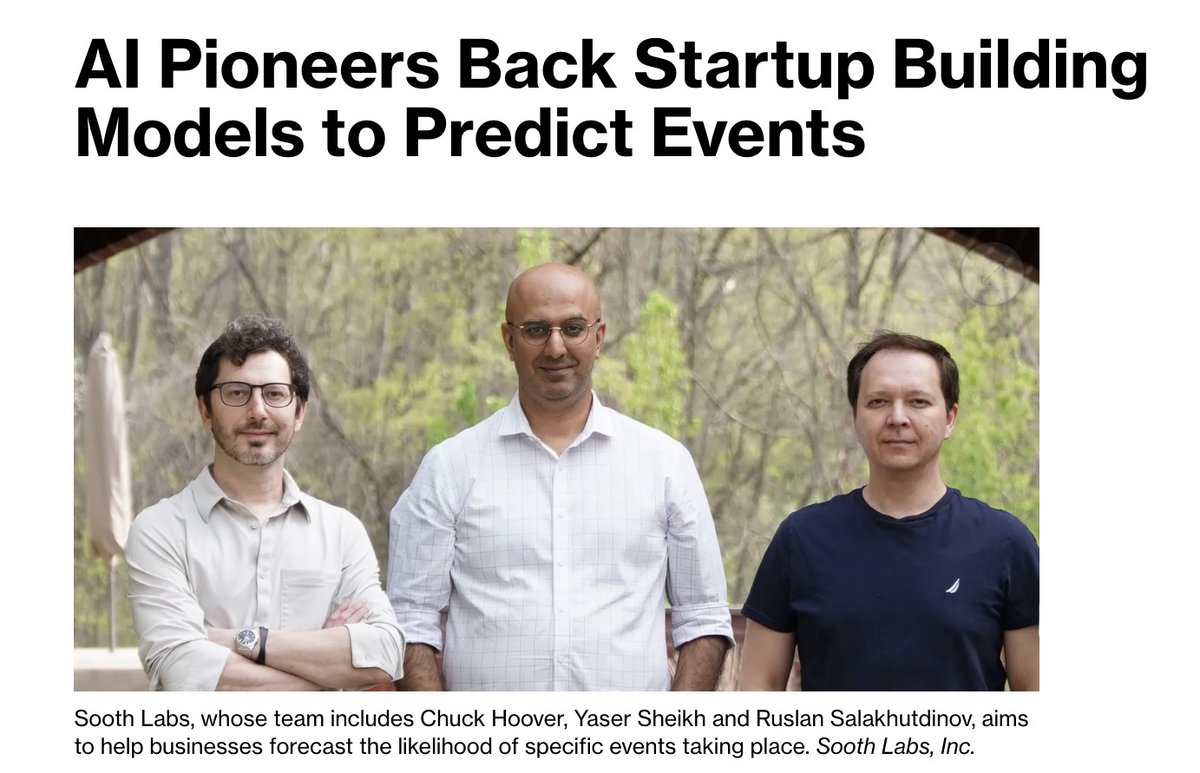
We talked about mentoring PhD students, the freedom to explore ambitious ideas, the differences between academia and industry, from the early days of deep learning to today’s era of scaling, building Sooth Labs, and the opportunities, challenges, and future of AI.
https://t.co/ko5XE5Dg1H
I'll be at #COLM2026 next week! Graduating soon with my PhD from CMU and looking for full-time research scientist roles. My work: post-training for video reasoning + inference-time scaling for video models. Would love to chat — feel free to DM me!
1/9 Thanks to @IFM_MBZUAI for sharing our ICML 2026 work. We ask whether a model can solve a new reasoning problem by recombining skills it already knows -- how does the model attain "reasoning creativity" through this kind of compositional generalization? https://t.co/E2y7LoLXf8
Foresight will be the defining frontier on the path to AGI.
I am excited to start Sooth Labs with my amazing co-founders: Yaser Sheikh @subail, Chuck Hoover @chuckjhoover, David LaRose, and Shih-En Wei.
Deeply grateful to Aydin Senkut @asenkut and Feyza Haskaraman @FHaskaraman at @felicis for leading the round, alongside an exceptional group of partners.
https://t.co/VBE9JIz42h
One more thing… you can also check out this technical report detailing our methodology to build motion models on the dataset, along with an evaluation framework for this type of model: https://t.co/nQfNp5ZCrT
🚀New from Meta FAIR: today we’re introducing Seamless Interaction, a research project dedicated to modeling interpersonal dynamics.
The project features a family of audiovisual behavioral models, developed in collaboration with Meta’s Codec Avatars lab + Core AI lab, that render speech between two individuals into diverse, expressive full-body gestures and active listening behaviors, allowing the creation of fully embodied avatars in 2D and 3D.
These models have potential to create more natural, interactive virtual agents that can engage in human-like social interactions across a variety of settings.
Learn more: https://t.co/vl2jmfE7wX
✨ Love 4o-style image generation but prefer to use Midjourney? Tired of manual prompt crafting from inspo images?
PRISM to the rescue! 🖼️→📝→🖼️
We automate black-box prompt engineering—no training, no embeddings, just accurate, readable prompts from your inspo images! 1/🧵
🚨 NEW PAPER: "Optimizing Test-Time Compute via Meta Reinforcement Fine-Tuning"!
🤔 With all these long-reasoning LLMs, what are we actually optimizing for? Length penalties? Token budgets? We needed a better way to think about it!
Website: https://t.co/G5JTmryx0d
🧵[1/9]
Interacting with the external world and reacting based on outcomes are crucial capabilities of agentic systems, but existing LLMs’ ability to do so is limited.
Introducing Paprika 🌶️, our work on making LLMs general decision makers than can solve new tasks zero-shot.
🧵 1/n
Learning style from a single image is difficult, but what if you had access to an **image pair** instead?
I’m excited to share our #SIGGRAPHASIA2024 work PairCustomization, on customizing text-to-image models with a single image pair!!
project page: https://t.co/TV1cZ2WFIk
New agent benchmarks for OS and website control along with long-context capabilities are pushing the frontiers of what LLMs and VLMs can achieve. Can long-context multimodal models take relevant video input and also perform agentic actions?
What if your web agent could watch you perform your tasks, and learn to perform tasks with your personal preferences and behaviors? Really excited to introduce VideoWebArena, a new benchmark for evaluating long-context multimodal agents with video-based web tasks.
📃Paper: https://t.co/m8bEPptFgN
🌐Website: https://t.co/zDdgk7O86T
💻Code: https://t.co/R4u0XZxPvJ
🧵👇
Can my robot cook my food, rearrange my dresser, tidy my messy table and do so much more without ANY demos or real-world training data?
Introducing ManipGen: A generalist agent for manipulation that can solve long-horizon robotics tasks entirely zero shot, from text input!
1/N
The LTI is holding a virtual info-session for prospective MLT and PhD applicants on Wednesday, November 6 from 12pm -1pm, ET! Our faculty will be answering any questions about the application process. Register at the following link to attend: https://t.co/kEE7L54Zxo
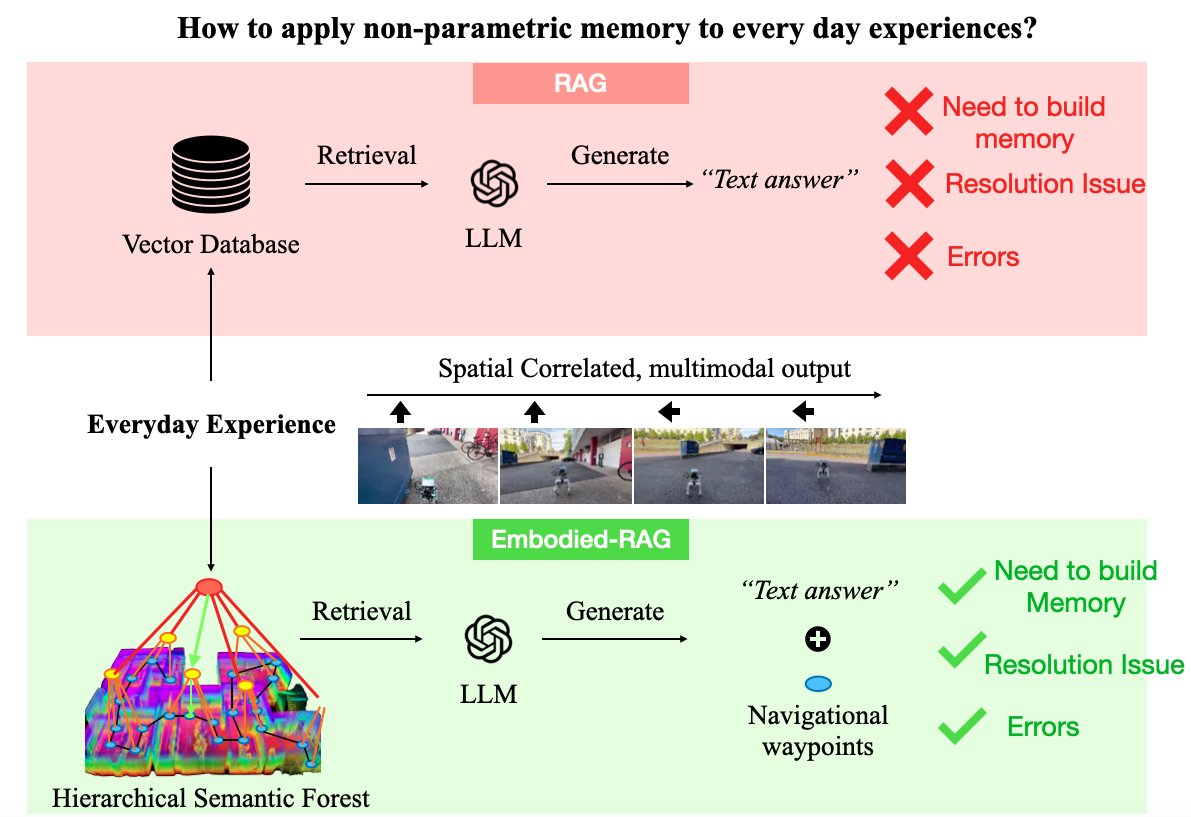
In recent years, we have seen progress of foundation models (RT-X models and V/LLM's) as embodied agents. However, methods to augment these models with general-purpose long-term/large-scale memory has been under-explored. Clearly, as the environment becomes larger (e.g. outdoors) in navigation/"mobile" manipulation, we need a general-purpose external memory.
We introduce Embodied-RAG, a General Non-Parametric Method for Retrieval and Generation. (1/5)
🚀 Just Launched: VideoArena!🎥
Discover head-to-head comparisons of video clips generated from the same prompts across top text-to-video models. Compare outputs from 7 leading models and we're adding more soon!
🔗 Check out the leaderboard: https://t.co/IkQTFB7am5
#Text2Video
Can a single neural network policy generalize over poses, objects, obstacles, backgrounds, scene arrangements, in-hand objects, and start/goal states?
Introducing Neural MP: A generalist policy for solving motion planning tasks in the real world 🤖
1/N