Like every other SNP parliamentarian, I gave the party £250 per month from my personal income after tax. Adding my party membership fees (paid at an enhanced rate) , I think it came to £35,000 over ten years. The £250 sub was an obligation for all MPs and MSPs, but I was happy to pay, as I believed it was going to the cause - not to keep Sturgeon in Smythson handbags and Mountblanc pens (stolen goods she was pictured with in this @TheSun report 👇). I had a good salary. But what of all the decent working people - as @joannaccherry pointed out today - who could ill afford the £10 or £20 donations they made to @theSNP ? It’s disgusting, and requires an internal investigation. Or rather an independent investigation. Who was monitoring the spend within the SNP? How come the former volunteer treasurer and former volunteer officials who questioned the finances were slapped down by @NicolaSturgeon and her acolytes? There remain good people at the top of the party ( of which I remain a member BTW) and I hope they will now abandon their misplaced loyalty to the former leader whose position meant she signed off the accounts, as I understand it. Finally…..well done to @WingsScotland for triggering the investigation - pilloried from all sides but vindicated today.
HMS Hood' Seaman Robert Tilburn of Roundhay (1921–1995), Leeds, one of the three survivors of HMS Hood (out of 1,418), out for a walk with his young brother, June 1941
85 years ago today, in the freezing grey water between Iceland and Greenland, the most famous warship in the world died in under three minutes.
HMS Hood. 48,000 tons. The pride of the Royal Navy for twenty years. The ship British schoolchildren drew in their notebooks. "The Mighty Hood."
She was hunting the Bismarck.
At 05:52 on 24 May 1941, Vice Admiral Lancelot Holland gave the order to open fire at 26,500 yards. He was closing the range hard on purpose, because Hood's weak deck armor could not survive shells falling from above at long range. He needed flat trajectories, and he needed them fast.
He was three minutes too slow.
Bismarck's fifth salvo straddled Hood as she turned to bring her rear guns to bear. A single 15-inch shell punched through her thin armored deck and detonated her aft magazines.
Witnesses on Prince of Wales described a column of flame that rose higher than the mainmast, eerily silent at first, the sound arriving a moment later. Hood broke in two. Her stern rose vertically out of the sea, guns still pointed at the sky, and slid under. Her bow followed.
Of 1,418 men aboard, three survived.
Signalman Ted Briggs, Able Seaman Bob Tilburn, Midshipman Bill Dundas. They floated on a raft of debris in near-freezing water, watching their ship's oil burn around them, until the destroyer Electra found them two hours later. Briggs was 18 years old. He lived until 2008, the last man who had stood on the Mighty Hood.
The Bismarck won the battle. But Prince of Wales, only just commissioned with shipyard workers still aboard fixing her main guns, had landed three hits before retreating. One ruptured a forward fuel tank. Bismarck began trailing oil across the Atlantic like a wounded animal.
Churchill's order to the fleet was simple. Sink the Bismarck.
Every available British warship turned to the chase. Three days later, at the edge of the Bay of Biscay, a Swordfish biplane from HMS Ark Royal, flying through a gale at near sea level, dropped a torpedo that jammed Bismarck's rudder hard to port. She could only steam in a slow circle, straight back into the Royal Navy.
King George V and Rodney closed at dawn on 27 May. They fired on her for ninety minutes. Bismarck absorbed over 400 shells and at least a dozen torpedoes before she rolled over and went down with roughly 2,200 of her crew.
The Royal Navy answered for Hood in 72 hours.
On This Day — May 25, 1948
They put a bullet in the back of his head.
The man they executed that day was Witold Pilecki — the only person in history who voluntarily walked into Auschwitz.
In 1940, this Polish cavalry officer deliberately got himself arrested during a Nazi roundup in Warsaw. Using a false identity, he entered hell as prisoner #4859.
For two and a half years, Pilecki lived as a starving skeleton in striped rags while secretly building a resistance network inside the camp. He smuggled out the first detailed eyewitness reports of the Nazi death machine to the Allies — gas chambers, selections, medical experiments, and the systematic murder of Jews.
While he was there, more than 1,000 Jews per day were being gassed and burned. At its peak in 1944, the killing rate reached more than 6,000 per day.
He saw it all.
He documented it all.
He risked everything so the world would know.
In April 1943, Pilecki escaped by overpowering a guard at a bakery outside the wire. He rejoined the fight, battled in the Warsaw Uprising, and later resisted the Soviet occupation of Poland.
For his courage, the communist regime tortured him, staged a show trial, and executed him on May 25, 1948.
One of the great heroes of the 20th century.
Remember his name: Witold Pilecki.
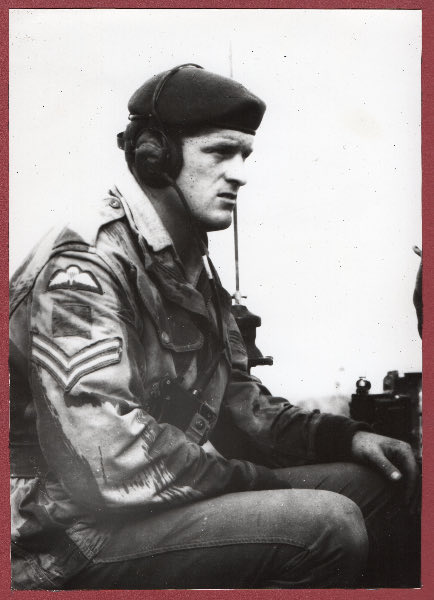
#OnThisDay in 1971 the IRA murdered Michael Willetts, 27, married father of 2. Bomb in case about to explode thrown into Springfield Rd RUC station 8:24pm. Children & adults present. Bomb exploded as Army Sgt Willetts, on guard duty, helped evacuate.
https://t.co/1CVlfRLQlA
#OTD
Today we pause to remember the extraordinary sacrifice of Sergeant Michael Willetts GC, whose brave actions on the evening of 25 May 1971 in Northern Ireland saved the lives of adults and children but tragically cost him his own.
Sgt Willetts was serving with 3rd Battalion, The Parachute Regiment, in Belfast when a terrorist entered the Springfield Road Police Station in Belfast, dumped a suitcase containing a bomb and fled outside.
Inside the room were two adults, two children and several police officers, who raised the alarm and began to organize the evacuation of the hall.
Sgt Willetts was on duty in the inner hall. Hearing the alarm, he sent an NCO up to the first floor to warn those above and hastened to the door towards which a police officer was thrusting those in the reception hall and office. He held the door open while all passed safely through and then stood in the doorway, shielding those taking cover.
In the next moment, the bomb exploded with terrible force and Sgt Willets was mortally wounded.
His duty did not require him to enter the threatened area; his post was elsewhere and he knew the peril of going towards a terrorist bomb, but he did not hesitate to do so.
All those approaching the door from the far side agreed that if they had had to check to open the door they would have perished.
For his act of the greatest gallantry and complete disregard for his own safety in striving to save others, Sgt Willetts was posthumously awarded the George Cross.
🟩
Remembering The heroic sacrifice of Sergeant Michael Willetts GC at Springfield Road Police Station, Belfast, on the 25th May 1971.
At approximately 8:24pm, a Provisional IRA militant entered the reception area of Springfield Road RUC (Royal Ulster Constabulary) station in Belfast. He carried a suitcase (sometimes described as a briefcase) containing a bomb with a visible, smoking fuse, placed it on the floor, and fled. Inside the reception hall were civilians; including a man, a woman, and two children, along with several police officers. One of the officers spotted the smoking device and raised the alarm. Police began evacuating people through the reception office and out a door into a rear passage.
Sergeant Michael Willetts (3rd Battalion, Parachute Regiment), aged 27 and on duty in the inner hall, heard the commotion. He sent an NCO upstairs to warn others, then moved to hold open the critical door, assisting the evacuation. He shielded the civilians and officers with his body as they passed, then stood in the doorway to provide further cover. The bomb detonated moments later with considerable force.
Willetts was mortally wounded (reports note a piece of shrapnel or metal from a locker striking him in the back of the head). He died later that night (after about two hours in surgery at Royal Victoria Hospital). Seven RUC officers, two British soldiers, and 18 civilians were injured in the attack. Local youths reportedly jeered the injured as they were taken away.
Posthumous George Cross citation (London Gazette, 21/22 June 1971):
“His duty did not require him to enter the threatened area: his post was elsewhere. He knew well after 4 months’ service in Belfast, the peril of going towards a terrorist bomb but he did not hesitate to do so. ... By this considered act of bravery, he risked — and lost — his life for those of the adults and children. His selflessness, his courage are beyond praise.”
Willetts was one of the early British soldiers killed during the Troubles (Operation Banner).
He was born on 13th August 1943 in Sutton-in-Ashfield, Nottinghamshire; he had joined the Army in 1962, served in the Parachute Regiment, and left a widow, Sandra, and two children. He is buried at St Mary’s Church, Blidworth, Nottinghamshire.
The event inspired the 1972 song “Soldier” by Harvey Andrews.
This remains a genuine act of bravery amid the escalating violence of 1971. Willetts’ George Cross underscores his selfless courage. We Will Remember
#LestWeForget
@iredalepolitics@BBCiPlayer When running a council we haven’t got time for the Leader to learn the job As for the suggestion they could have training
They were offered training on the VERY specific things they said they didn’t understand
The proof is out there
The longest line of sight in the U.K. has been seen only a few times, and photographed once. In 2015, Kris Williams was atop Snowdon in perfect conditions and managed to snap The Merrick in Southern Scotland. A remarkable distance of 232km (144 miles).
Brian Johnson & Mark Knopfler stopping to watch a street musician absolutely nail the solos to “Sultans of Swing” and “Thunderstruck.”
Not many people can say they’ve played in front of those two legends.
This kid will remember this day for the rest of his life.