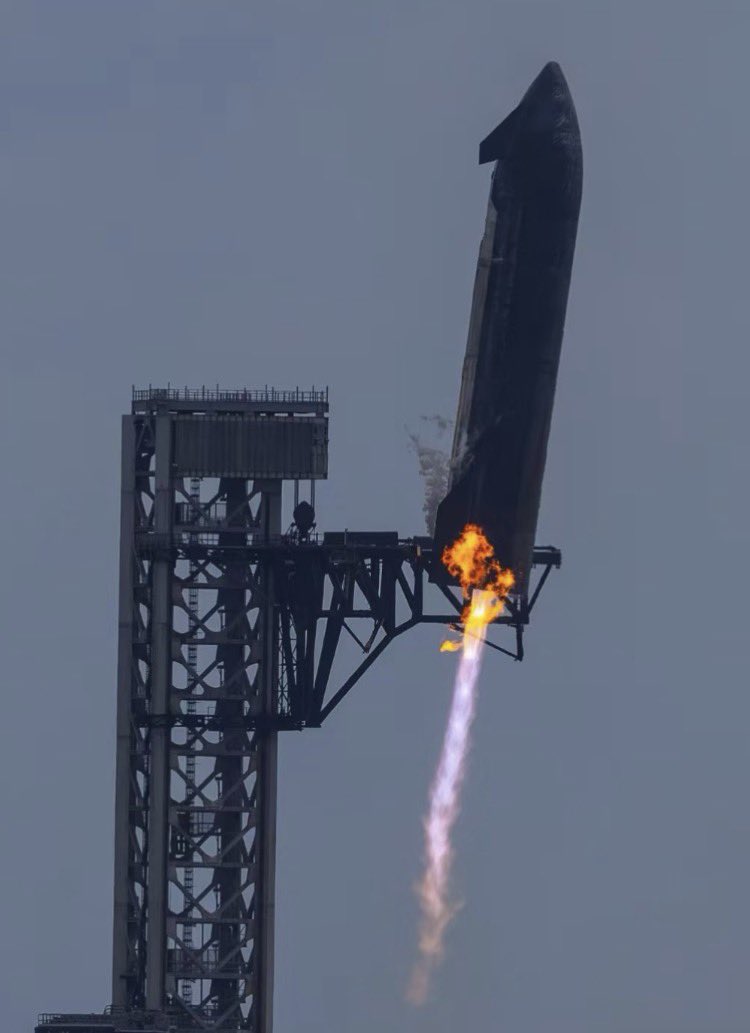
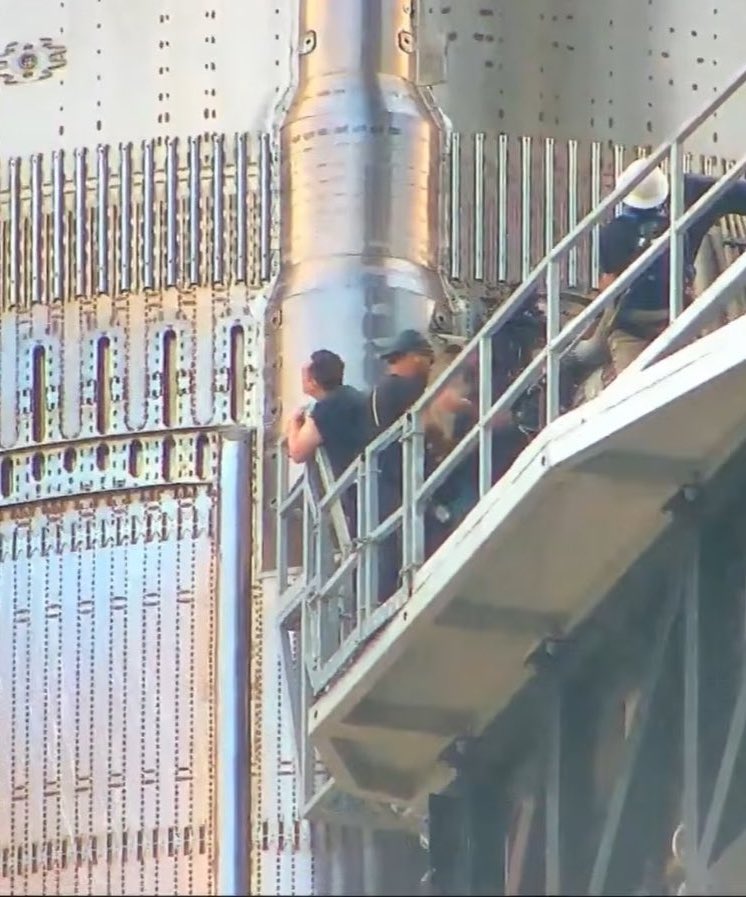
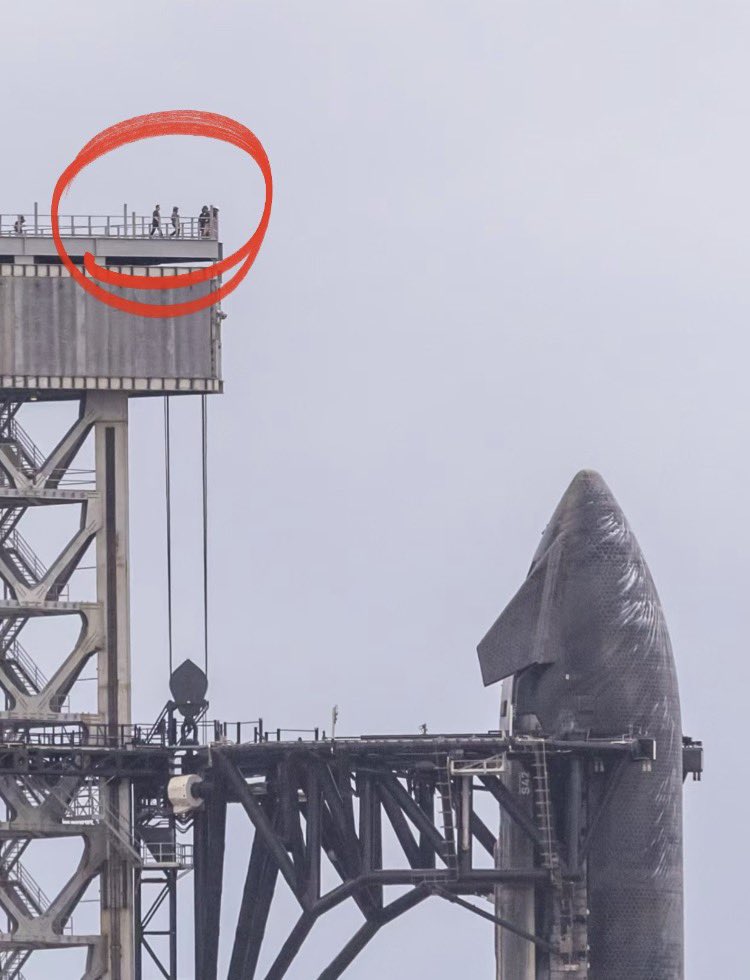
Fourteen Starships came home before this one and every one ended up in the ocean, until now.
What a staggering feat of precision engineering to bring a spaceship back from orbital velocity, through the fire of reentry, and into the arms of the tower.
Here’s a great explainer of why it's so hard to do:
SpaceX caught Starship, so what now?
Before SpaceX can land astronauts on the Moon, it has to refuel a Starship in orbit. That could take 6 tanker launches. Or more than 20.
Here's how the whole mission works.
Starship reaches orbit almost empty, so a depot ship waits up there and tankers fill it one by one. Each tanker docks alongside, small thrusters settle the propellant at the back of the tanks, and tank pressure pushes it across.
Musk says 6 to 8 tankers and NASA officials agree. A NASA safety adviser said about 22.
So far propellant has only been moved between tanks inside one ship, on Flight 3 in March 2024. The first ship-to-ship test is planned for early 2027.
Then four astronauts launch in Orion and dock to the lander's nose in Earth orbit. Starship fires and pushes both of them to the Moon, about four days away.
In lunar orbit two of the crew move into Starship and head for the south pole. Raptors do most of the braking, then thrusters high on the hull can take over for the last 100 metres so less dust gets thrown up. A few days on the surface, back up to Orion, and Orion brings all four home.
And those big wings on the lander? Solar arrays, about 18 metres each going by SpaceX's renders. No heat shield and no flaps, because it never comes back.
The plan is a docking test in 2027 and a first landing in 2028. NASA hasn't picked the lander yet, and these dates have slipped before.
Still to prove: ship-to-ship refuelling, keeping propellant cold for weeks, launching about once a week, and landing on the Moon without a crew.
This week Starship reached orbit again and the tower caught the ship for the first time. Now it needs to do that every week.
Sources: NASA, SpaceX, ESA/Airbus, NASASpaceflight, SpacePolicyOnline, AmericaSpace
Pleased to share my favorite photo from yesterday, captured from a sound-activated camera placed near the launch pad.
I call this “A Giant Leap for Civilization” and I will have limited edition prints available here: https://t.co/YAuJibhegU
~22.5 hours in 30 seconds..
Here's Ship 42's full mission recording from Starbase to Starbase!
Full Flight 15 telemetry recording will be up on https://t.co/XOcKv6BNhZ in the coming hours so you can play around and take a look for yourself!
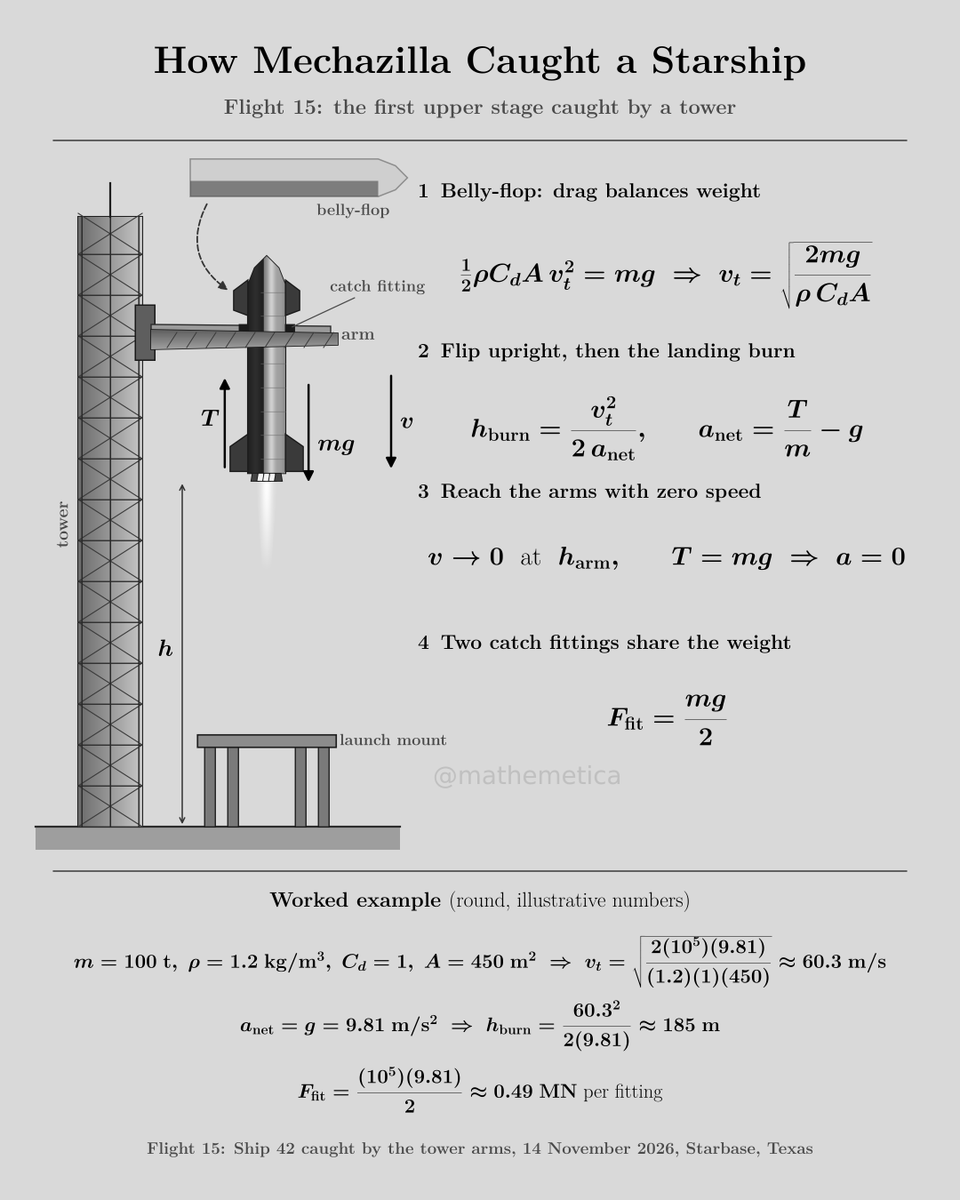
SpaceX caught Starship with the tower on Nov 14, the first upper stage ever caught coming back from orbit.
It falls belly-first and drag caps its speed: v = √(2mg ÷ ρCdA), about 60 m/s with round numbers.
Then it flips, burns from h = v² ÷ 2a and hits v → 0 right at the arms. Two fittings hold mg ÷ 2 each.
Every Starship before this was lost or dropped in the ocean. This one can fly again. The booster missed its catch, so catching both stages is still ahead.
Have you ever wondered why catching Starship is so much harder than catching Super Heavy, even though they both return to the same launch tower? 🔥
💡 The answer comes down to four major engineering challenges that make Starship’s recovery fundamentally different 👇
⚡ The first problem is shedding an enormous amount of energy
At hot staging, Super Heavy was traveling at roughly 5,800 km/h (3,600 mph). Starship, meanwhile, had to return from orbital speeds of roughly 27,500 km/h (17,100 mph).
That’s nearly five times faster. Because kinetic energy increases with the square of velocity, each kilogram of Starship at orbital speed carries roughly 22 times the kinetic energy of a kilogram of Super Heavy at separation.
That works out to nearly 30 million joules per kilogram.
Almost all of that energy has to be dissipated before Starship can safely reach the tower.
One option would be to use rocket propulsion to cancel out its orbital velocity. However, scrubbing off roughly 7.7 km/s of speed using Raptor engines alone would require a massive amount of propellant.
The rocket equation makes this approach especially punishing. Every extra kilogram of landing propellant has to be hauled into orbit first, dramatically increasing the fuel needed at liftoff.
Instead, SpaceX uses Earth’s atmosphere to bleed off almost all of Starship’s orbital velocity.
That saves an extraordinary amount of propellant, though it introduces another major hurdle.
🔥 Surviving extreme atmospheric heating comes next
As Starship plunges into the atmosphere at hypersonic speeds, powerful shock waves compress and heat the surrounding air to blistering temperatures.
Thousands of ceramic heat-shield tiles protect its stainless-steel structure from the intense heat.
Simply keeping those tiles attached isn’t enough, though. Superheated gas can seep into the gaps between them, risking damage to the underlying structure.
For Flight 15, SpaceX carried forward upgrades from Flight 14, including extra tile-retention hardware in vulnerable areas and redesigned curved tiles that reduce heating between adjacent tiles.
Because Super Heavy never reaches orbital velocity, its return doesn’t expose it to anything close to the same thermal stress.
And there’s another complication.
A heat shield that survives one reentry isn’t necessarily ready to fly again. Starship’s thermal protection system must eventually withstand repeated missions without major repairs or refurbishment.
That’s critical, since rapid reusability is one of the core reasons SpaceX designed Starship to be caught rather than discarded.
Yet surviving reentry still isn’t enough. Starship also has to arrive at the exact right spot.
🎯 Hitting a precise target from orbit raises the stakes even further
About 56 minutes before the catch, a single Raptor engine fired for just 10 seconds to initiate Starship’s return.
That brief deorbit burn wasn’t meant to eliminate orbital velocity. Instead, it nudged the spacecraft’s trajectory so atmospheric drag could take over the much larger job of slowing it down.
Starship then entered the upper atmosphere thousands of kilometers away over the Pacific Ocean.
From there, its four aerodynamic flaps controlled its orientation and fine-tuned the forces acting on the vehicle.
Super Heavy uses grid fins to steer during its return, but Starship’s flaps have to handle a far wider range of flight conditions.
As Starship decelerates from hypersonic through supersonic and down to subsonic speeds, its guidance system continuously adjusts its attitude and flight path.
The challenge is maintaining the right balance of altitude, speed, and trajectory while aerodynamic forces shift dramatically throughout reentry.
For Flight 15, the return corridor crossed sparsely populated parts of northern Mexico and South Texas.
Starship maneuvered around major population centers in the Rio Grande Valley, passed north of South Padre Island, headed offshore over the Gulf of Mexico, and made its final turn toward Pad 2 at Starbase.
Think about the guidance precision required.
A spacecraft returning from orbit must dissipate nearly all of its immense kinetic energy while threading a carefully controlled trajectory straight back to a single launch tower.
It also has to arrive at a low enough speed, in the proper orientation, and with enough propellant remaining to pull off the final maneuver.
That brings us to the most visually spectacular part of the entire recovery.
🚀 Executing the landing flip with pinpoint precision is the final test
Super Heavy approaches the launch tower already vertical, using its grid fins and Raptor engines to guide its final descent.
Starship comes in belly-first.
It has to rapidly swing its massive frame upright, stabilize its attitude, and align itself precisely between the tower’s mechanical arms.
SpaceX’s official Flight 15 timeline allotted just 18 seconds between the start of Starship’s landing burn and the catch.
During those 18 seconds, three sea-level Raptor engines ignite to kick off the maneuver.
The spacecraft rotates upright while its flight computers constantly regulate engine thrust and vehicle attitude.
The engines then step down from three to two, giving the vehicle finer control as it nears the chopsticks.
Finally, it transitions to a single engine for the last moments of descent before shutting down as the tower takes its weight.
Consider the coordination involved.
The guidance system must balance translation, rotation, thrust, and descent rate while positioning a massive spacecraft within a narrow capture envelope.
Unlike a conventional vertical rocket landing, Starship must first transition from an aerodynamically controlled, belly-first glide to an engine-powered vertical approach.
All of this unfolds within seconds, right after the vehicle has completed one of the most punishing atmospheric reentries ever attempted by a reusable spacecraft.
🧠 What makes SpaceX’s approach so ingenious is how seamlessly the entire recovery system works together
Trying to solve every phase of the return with rocket propulsion would carry a crushing propellant penalty.
Instead, SpaceX delegates the toughest parts of the recovery to systems purpose-built to handle them.
The atmosphere dissipates most of the orbital kinetic energy without consuming onboard propellant.
The heat shield protects Starship from the intense thermal loads of that deceleration.
The four aerodynamic flaps provide the control authority needed to manage its attitude, energy, and trajectory throughout atmospheric flight.
And the Raptor engines take over once aerodynamic control alone can no longer deliver the precision needed for the final catch.
That division of labor allows SpaceX to recover an orbital spacecraft without carrying enough fuel for an all-propulsive return.
Yet the engineering trade-off goes deeper than saving propellant.
SpaceX is shifting much of the cost of returning from orbit away from expendable propellant and toward reusable hardware built to endure extreme thermal and mechanical stress.
The potential economic payoff is enormous.
Cutting back on the propellant reserved for recovery frees up more of Starship’s mass capacity for useful payload. However, that advantage only becomes truly meaningful if the heat shield, flaps, engines, and other systems can survive repeated flights without extensive refurbishment.
That’s why catching Ship 42 is such a landmark milestone.
SpaceX has proven that its thermal protection, aerodynamic controls, propulsion, and guidance systems can work in concert to recover an orbital upper stage right at the launch site.
The next engineering hurdle is proving that the same spacecraft can do it repeatedly.
If SpaceX can bring Starship home, inspect it, refuel it, and launch it again without rebuilding major systems, the economics of getting payload to orbit could change dramatically.
That first catch proves the recovery architecture works. Repeated reflights will determine just how much of its economic potential SpaceX can unlock.
tracked today's starship catch frame by frame
ship 42 was doing 18 mph when the chopsticks closed. school zone speed for a whole rocket
then it braked to basically zero and set down on the arms. actually insane
p cool stuff @elonmusk
📹 @andreaesposito
I have a major result to share.
I’ve found conclusive forensic evidence that the top 4 Chinese AI labs—DeepSeek, Moonshot, MiniMax and Ant Group—have built their newest models on NVIDIA’s most advanced Blackwell chips, which are barred from export to China.
This sounds insane, but I discovered that almost every AI model carries a hidden signature of the GPU that trained it. When a model is first set up, the starting values of its weights are laid out in a pattern that depends on the exact GPU. Each combination of GPU and seed number produces a unique pattern—a sort of fingerprint of the hardware used to create the model. Traces of that pattern survive training into the published model.
Again, this evidence isn’t based on any insider information or leaking. It’s based on a forensic analysis of the model weights released by the companies themselves.
I searched more than six trillion combinations of chip layout and seed number and matched them to open-weights models. In doing so, I found conclusive evidence that six Chinese AI models—including DeepSeek-V4-Pro, Kimi K3, and MiniMax-M3—were initialized on NVIDIA Blackwell systems. Four of the models match Grace Blackwell, the GB200 and GB300 parts in NVIDIA’s flagship liquid-cooled rack-scale systems.
I then verified these results on real hardware. Running unmodified PyTorch with the seeds I’d recovered, a Blackwell B300 reproduced DeepSeek-V4-Flash’s untouched starting weights bit for bit, and a rented GB200 reproduced Kimi K3’s to a correlation of 0.999995. A Hopper H100 reproduced none of DeepSeek-V4-Flash’s, and changing the seed by one broke the match. (DeepSeek’s seed is 953049583 by the way.) The method also was verified to match 24 known open-weights models to the hardware that developers said they used.
It is exceedingly unlikely that these results are a coincidence. Across six trillion combinations, the best accidental match should reach only about 8 sigma (i.e., eight standard deviations above what random chance would produce). The real matches range from 49 to 1,385 sigma, and even the weakest single test hits 20.
These were data-center-scale training runs. With some analysis of release schedules and model details, I estimate that the largest, Kimi K3 and DeepSeek-V4-Pro, used 2,000 to 3,000 Blackwell GPUs each. Clusters of this size cost on the order of $150 to $200 million each to buy, and across these labs alone would add up to more than half a billion dollars of export-controlled GPUs, not counting experimental compute or otherwise. It’s quite likely that we see multi-billion dollar expenditure on export-controlled GPUs.
I am highly confident in this result, and it has been independently verified by senior researchers at OpenAI and Anthropic. You can read the full report at https://t.co/YOtzND0Jqk.
There is much more I’ve identified about these models through other forms of checkpoint forensics like this, and will have more to share soon.
A Chinese story I can't stop thinking about.
Cai Lei was a vice president at https://t.co/gXYlXDsQtZ — a workaholic who helped take the company public. In 2019, he was diagnosed with ALS and given two to five years to live.
He didn't retreat. He called it his "final startup."
He went on to build the world's largest grassroots ALS research platform: a patient database of over 20,000 people, hundreds of scientists working together, nearly 300 drug pathways pursued, more than 30 now in clinical trials. His wife Duan Rui left her partnership at an accounting firm to fund the research through livestreaming — over 100 million yuan invested, and she has never taken a cent in salary.
This year, RAG-17, a homegrown drug he helped advance, completed Phase II trials. The findings, published in Nature Medicine: disease-causing proteins in patients' cerebrospinal fluid fell by nearly 60%, and the disease's progression was held back.
Here's the part that stays with me. Cai Lei has sporadic ALS — the drug targets genetic mutations he doesn't have. The medicine he fought so hard for may never save him.
His answer: I'm not trying to save myself. I'm trying to save others. Even if I fall in the darkness before dawn, I'll make sure the path is ready — so those who come after me can stand on my shoulders and step into the sunlight.
Today, only his eyes can move. With an eye-tracking device he types around 60 words a minute and works ten-hour days.
One detail worth noting: after his diagnosis, https://t.co/gXYlXDsQtZ introduced a policy to cover the education and living expenses of any employee’s children if the employee suffers a serious tragedy while in service, continuing until the children turn 22. That policy exists because of Cai.
Video: [credit @长歌人物志] | English subtitles auto-generated by AI
Ben Affleck reveals he writes Python, understands convolutional neural networks, worked extensively with GPUs, and used his celebrity status to get private looks at Google and OpenAI’s video models
“I’ve always been kind of into computers since I was young. Then, when film started to move from analog film to digital, I became more interested in that aspect of it. The visual-effects workflow for many years has included machine learning, so I can write pretty shitty Python scripts and stuff like that.
“With convolutional neural networks, which were the precursors to what the transformer can do, which is much more computation simultaneously, you would do things like look at what’s called a tensor. That’s the numerical translation of a visual image in numbers, like the batch number, the frame number and the red, green and blue values of each pixel in each frame. It’s just that simple. That numeric is called a tensor.
“You’d use a convolutional neural network to identify patterns that reveal what’s called edge detection or feature extraction, which is identifying patterns well enough to know, this is where the window ledge is, so we can more easily take the green-screen image out and replace it with something.
“That was familiar to me early on because, prior to Artists Equity, I had a small visual-effects company. I’ve worked with GPUs a lot too. The visual-effects guys said, ‘Hey, you should see. There are a couple: Google and this other company, OpenAI, are doing really interesting stuff with transformers in video.’
“I’ve learned that I can actually just call up and go, ‘Hey, it’s Ben Affleck. Can I come see what you’re doing?’ Sometimes people say yes, to my astonishment.”
Treasury Secretary Scott Bessent to Axios this morning:
Axios: After the midterms, can you see the administration being more activist, more interventionist on Al?
Scott Bessent: Well, it depends on what you mean by activist and interventionist. We want safe acceleration.
Axios: Do you agree with David Sacks, the presidential advisor and silicone investor, that worries of widespread Al harm are BS?
Scott Bessent: I believe that we have to be prepared for every occasion. But, on the other side, I think that this alarmism without solutions by some of the Al community, that's not leadership.
Axios: Well, it's not just some in the community, it's the CEOs are basically screaming for regulation, warning of losing control of Al.
Scott Bessent: Well, then 𝘵𝘩𝘦𝘺 should slow down. It's kind of like Hannibal Lecter, 'stop me before I kill again.'
The @BostonCollege Investment Committee (an LP and my beloved alma mater) asked for a few thoughts on what's happening in AI. I recorded a test run yesterday morning and then shared it with my partners, who encouraged me to share it more broadly... so here you go!
This is not a sales pitch, it's just a reflection on what we're seeing. And it wasn't intended to be shared, so please pardon the rough edges.
https://t.co/AuZqHMSSxD