It’s been a minute, but I'm back on X.
I've been channeling my thoughts into a personal Substack focused on long-term investing, portfolio strategy, and avoiding the traps of short-term trading.
Click the link below to subscribe and read along:
https://t.co/y2RtR35szz
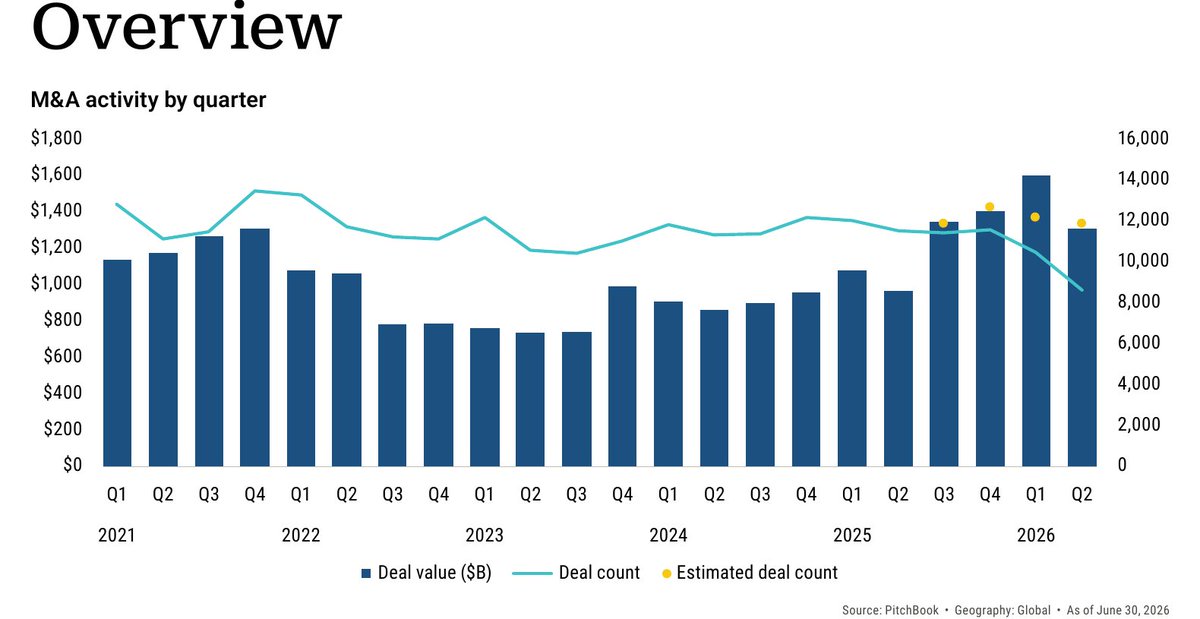
Q2 2026 global M&A: $1.3T headline, up 35% YoY — but strip out 34 megadeals ($5B+) and they're 42% of total value on flat deal count.
Sponsors retreated (buyout value -36% QoQ), strategics filled the gap. Pricing held steady at 10.2x EV/EBITDA. Concentration, not weakness.
Source: PitchBook Q2 2026 Global M&A Report
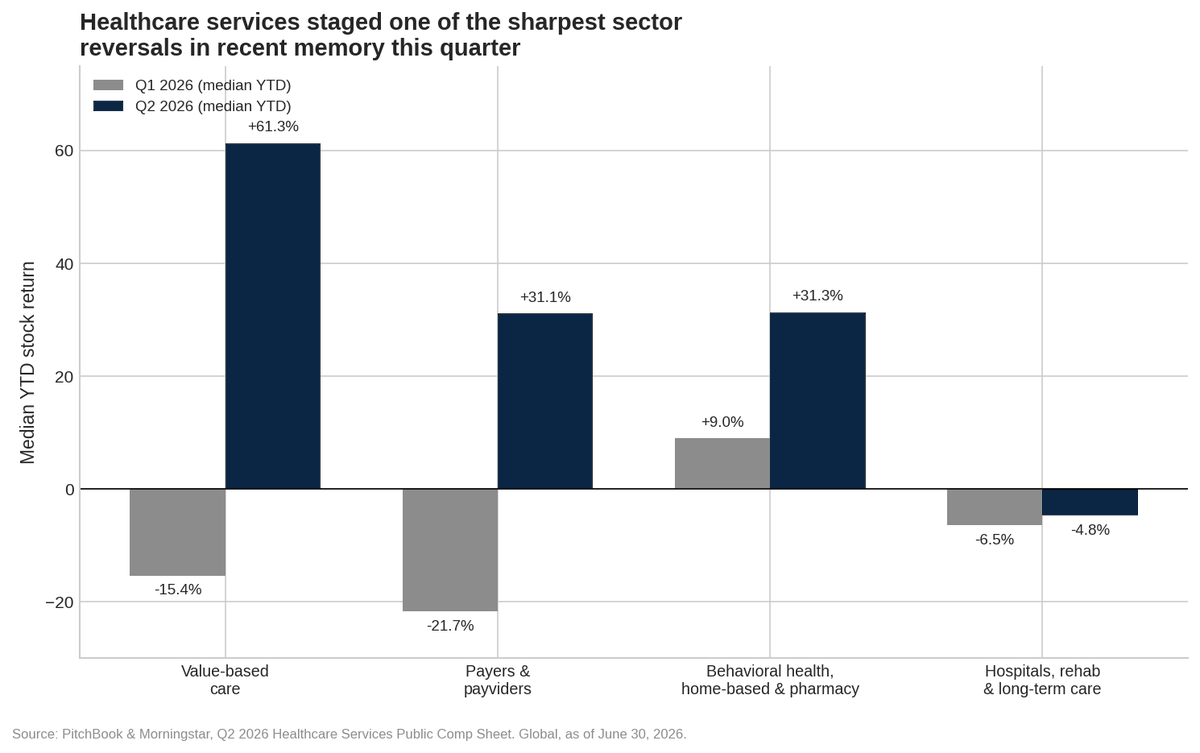
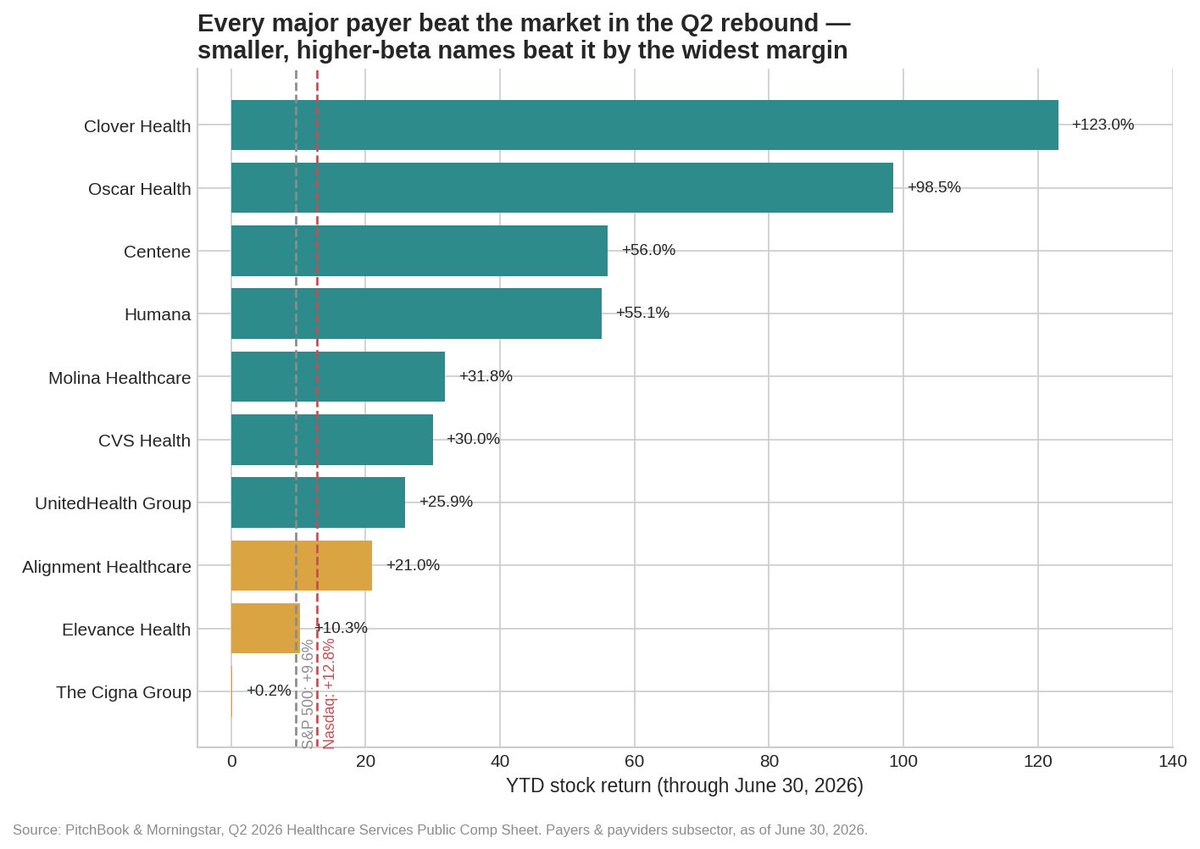
Healthcare services just staged its sharpest sector reversal in years. Payers went from -21.7% median YTD in Q1 to +31.1% in Q2. VBC went from -15.4% to +61.3%.
Two catalysts: CMS's 2027 Medicare Advantage rate came in at ~5% (vs. a near-flat 0.09% proposal), then Q1 earnings confirmed medical cost trend was actually moderating.
But the rally isn't uniform. Hospitals stayed negative (-4.8% median) — their ACA exchange-subsidy headwind is arithmetic, not sentiment. And a chunk of VBC's move (P3 Health, Acadia) looks like distressed-name mean reversion, not a confirmed turnaround.
Source: PitchBook & Morningstar, Q2 2026 Healthcare Services Public Comp Sheet
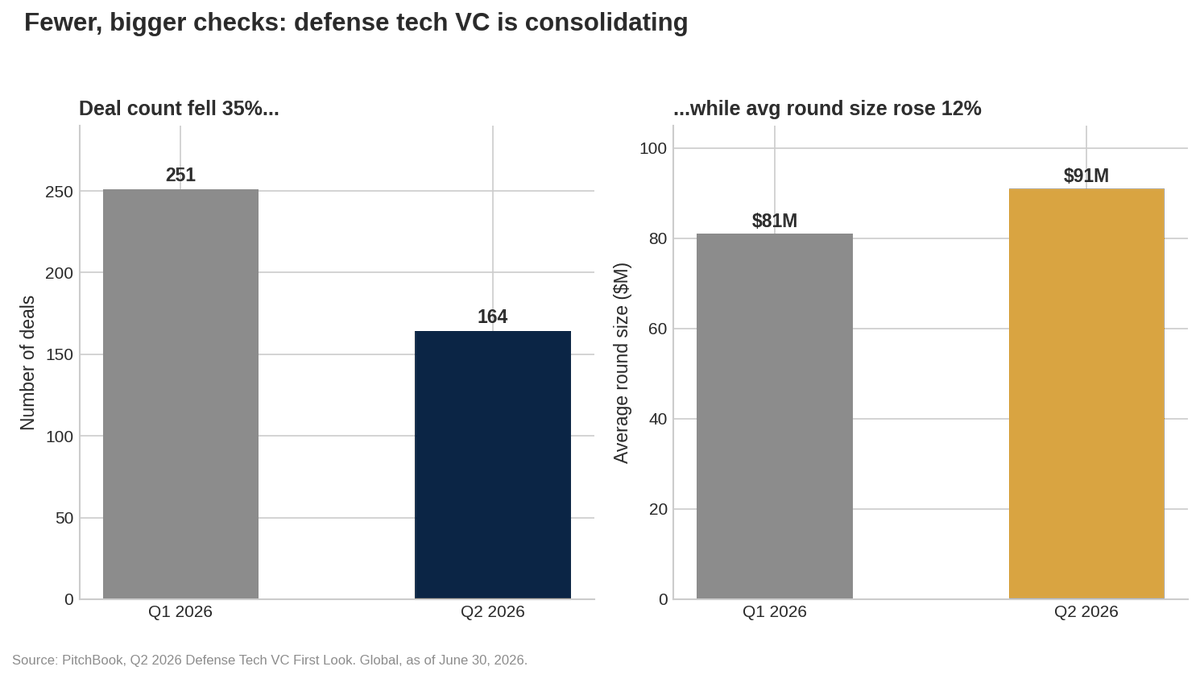
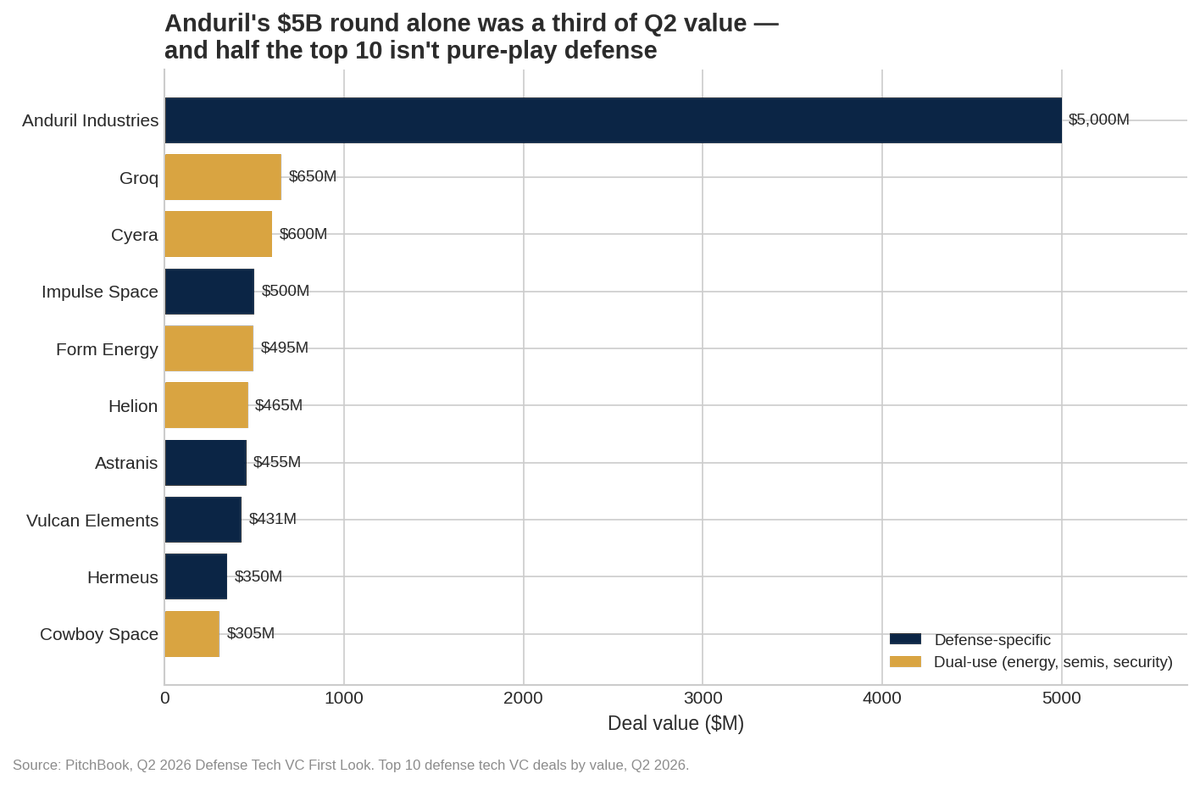
Defense tech VC hit $35.4B YTD, but the composition is the real story. Deal count fell 35% (251→164) while avg round size rose to $91M. Anduril's $5B round alone was a third of Q2 value.
Bigger tell: half the top 10 deals (Groq, Cyera, Form Energy, Helion, Cowboy Space) aren't defense-specific, they're dual-use plays in semis, security, and energy.
Capital is reaching defense through commercial-first companies, not primes.
Source: PitchBook, Q2 2026 Defense Tech VC First Look
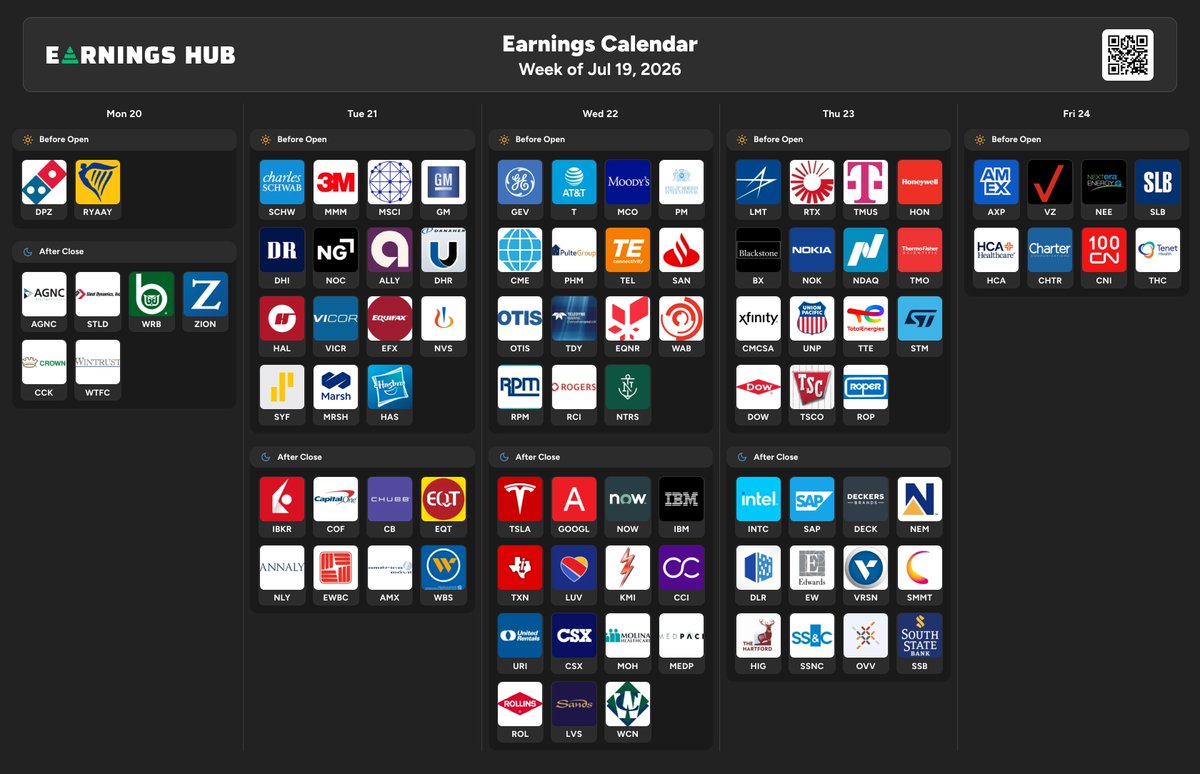
THE FIRST HYPERSCALER REPORTS EARNINGS THIS UPCOMING WEEK
Earnings Season is back in full swing ... the biggest single number of the week
Google's $GOOGL guidance for CAPEX spend
PE is not one asset class anymore.
Middle-market managers ($1B-$3B) have outperformed $6B+ megafunds in 12 of the last 24 years. Megafunds enter at 14-15x EBITDA vs. 8-10x for middle-market — leaving far less room for multiple expansion to work in your favor.
IMO: bigger name ≠ better returns. Scale buys you downside protection (megafunds rarely blow up), not upside. If you actually want alpha, the data says it's sitting in the middle market, you just have to do the manager-selection work megafund investing lets you skip.
Source: PitchBook
BREAKING 🚨: U.S. Housing Market
227,500 properties filed for foreclosure so far this year, a 21% increase from last year and a 30% increase from two years ago 🤯 👀
The "5% cap is working as designed" narrative is doing some work. Listed BDCs already reprice daily — their price declines are flagging stress that appraisal-based NAVs haven't caught up to yet. Redemptions capped ≠ risk contained; it just means the pain shows up later, in the marks.
Also worth flagging: ~100 new credit/multi-strategy funds are in the pre-launch pipeline right now, walking straight into the same software-exposure repricing that's hitting BCRED and Blue Owl. Late-cycle product launches into a cooling narrative rarely age well.
Source: Morningstar & PitchBook, Q2 2026 US Evergreen Fund Landscape
The 5.7% CAGR headline undersells how narrow this growth actually is. Real assets' 11.3% CAGR is basically one bet (datacenter/power buildout) — dressed up as a diversified asset class. And PE's $8.8T forecast assumes distributions recover from a backlog of 13,000+ unrealized portfolio companies that haven't shown up yet.
VC's range ($2.8T–$5.5T) isn't really a forecast — it's a coin flip on whether OpenAI/Anthropic-style AI bets convert paper NAV into actual cash. Notice the asymmetry too: AI is the tailwind in real assets and the tail-risk in private credit (software exposure) and VC (concentration) in the same report.
Source: PitchBook, 2030 Private Market Horizons
Private markets split sharply in Q1 2026:
Natural resources: +9.7%
Mezzanine: +8.7%
VC funds of funds: +6.6%
Meanwhile, direct lending fell 4.1%, growth equity dropped 2.3%, and private equity declined 0.6%.
My take: the broad -0.2% headline is misleading. Strategy selection mattered far more than simply having “private market exposure.”
Source: PitchBook Q1 2026 Private Capital Indexes, global data as of March 31, 2026.
US PE dealmaking just posted one of its steepest single-quarter contractions on record — deal value down 37.5% QoQ in Q2 2026.
Software led the collapse: -65.7% YoY, 90.3% below its Q3 2025 peak. Energy is the counterweight, up 80.5% YTD.
My take: this isn't PE losing conviction, it's PE repricing where the moat actually sits. Software multiples assumed durable competitive advantage — AI is compressing that faster than sponsors can underwrite it.
Energy/infrastructure is picking up the bid because it's the picks-and-shovels layer AI itself depends on. I'd rather own the datacenter than the app built on top of it right now.
Source: PitchBook
Some observations on Kimi:
1. It's a very good model! I don't think its performance can be explained away by distillation or anything like that. In agentic coding sessions, it seems pretty much on par with the best public models of Q1 2026. In my fairly limited use, it also seemed very token hungry. It's not obvious to me that this model is actually that cheap to run.
2. I am personally surprised the Chinese state continues to allow the open sourcing of models this good, given potential risks. To be clear, I *myself* might be fine with models presenting this level of marginal risk being open weight, but I am surprised that China is fine with it. I suspect the reason they are is 75% explained by strategic blindness/lack of AGI-pilledness (the CCP is very Yann Lecun-y in its views of AI). The other 25% or so is their lack of compute for customer inference (making China's open-weight strategy an unintended byproduct of US export controls) and the normal Chinese strategy of aggressive exports. For the companies, as opposed to the government, the decision to open source is partially ideological and partially because they are behind, and they know that very few people would pay for sub-frontier models from China.
3. Open-weight models are inherently decelerationist, and I'm continually surprised to see the so-called "accelerationists" so excited about open-weight models. I suspect the reason they are is that they know open-weight models are effectively ungovernable, and they simply like the overall cloak of ungovernability open-weight models create over the whole of AI. It's not a bad strategy; it reminds me of James Scott's recounting of the hill people in "the art of not being governed." Still, in the end, open-weight models deter further AI capex.
4. One probable outcome of an open-weight-model-dominant world is full AI communism, which is precisely what China proposes: rather than a market product, AI is a "public good" which will ultimately be provided by the state as a kind of "digital public infrastructure." This future strikes me as a dystopian hellscape, but I've never met an open-weight models advocate who doesn't ultimately concede this is where things end. You'd be surprised how many 'accelerationists' lobbied me, while I was in government, to support an eleven or twelve-figure federally funded data center so that startups could train models at a subsidy and then give them away for free. There was no other way for AI to progress, they said. Perhaps this is the logical end state of things. Nonetheless, I find myself surprised to see supposed accelerationists excited about such an outcome. I think many of them just don't know what they're doing. Many accelerationists do not view the creation and serving of frontier models as a legitimate business.
5. I would guess that the Trump Administration will at some point realize that their best strategy here would be to create large amounts of regulatory risk around the use of open-weight Chinese models. You don't need to "ban open source" (one of the dumber motifs of AI policy discussion). You just need to direct every agency to issue soft law that creates FUD. "A Federal Reserve Advisory Bulletin found that there may be backdoors in Chinese AI models." It needn't be that well justified. You just create enough regulatory risk that every regulated enterprise backs off. You probably don't want to create so much regulatory risk that you scare off the hyperscalers from serving Chinese models; this will just drive startups to sketchier providers. There's a happy middle ground here. I'd assume they will do some version of this.
6. It's probably true that open-weight models of this capability make the world a bit more dangerous, but not so much more that you'll really notice. At some point the models will be capable enough that you will notice. "A nonliving, invisible, dangerous, and infinitely self-replicating agent escaped from a Chinese lab," you say? Color me shocked.