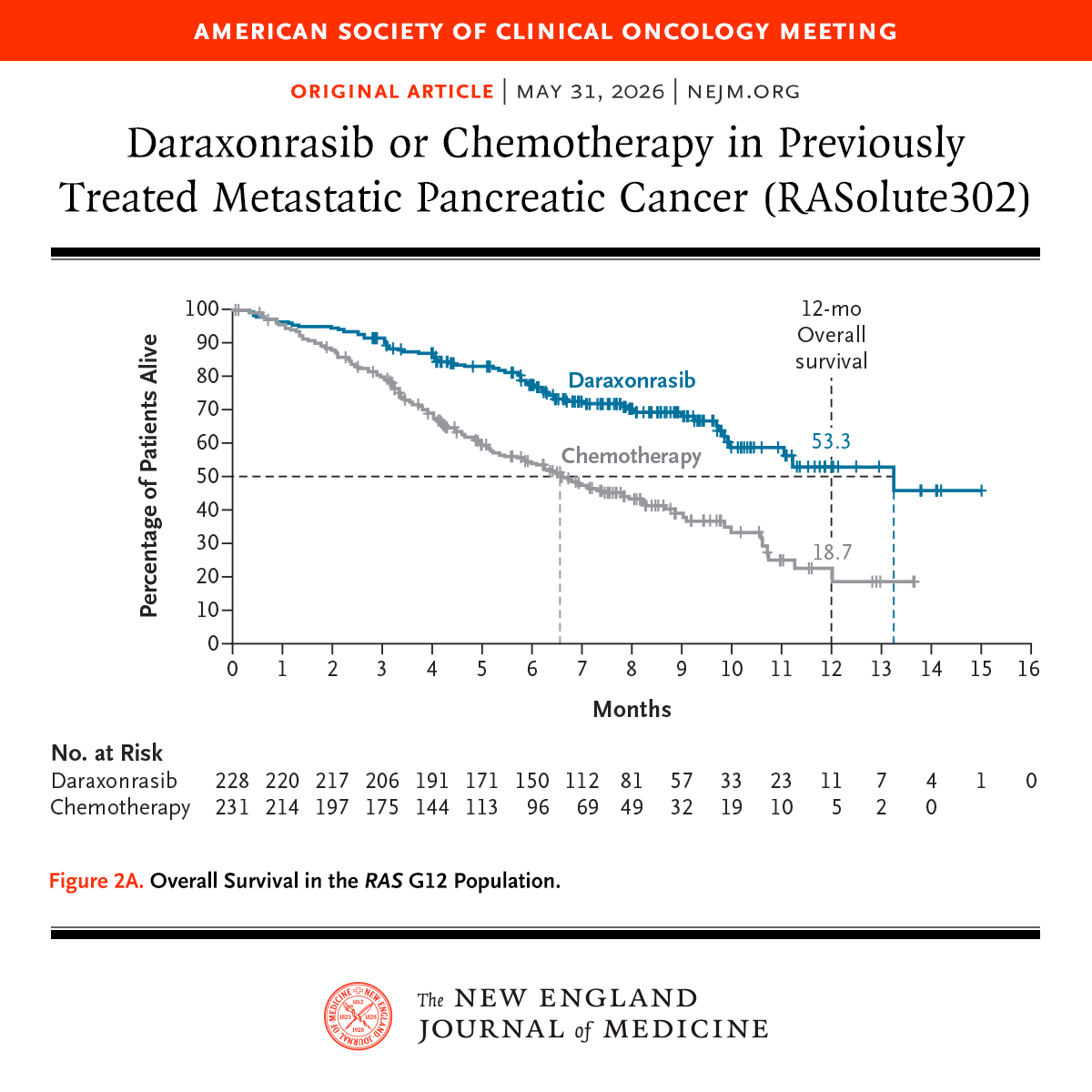
Presented at #ASCO26:
Among patients with previously treated metastatic pancreatic ductal adenocarcinoma, the RAS(ON) inhibitor daraxonrasib led to significantly longer overall survival and progression-free survival than chemotherapy. Full phase 3 RASolute 302 trial results: https://t.co/xwLWBZYRzq
@ASCO
New name for PCOS. The new name makes pathophysiological sense but, like all these name changes, will lead to more confusion than clarity. Some of us will use the old name and some the new. Notes over time will be inconsistent and confusing to providers. Patients will get lost in all the letters. I'm not sure this is a net positive change.
Winston Churchill fought his depression with bricks. He'd lay them for hours at his country home in Kent. He joined the bricklayers' union. And in 1921 he wrote about why it worked. It took psychology another 75 years to catch up.
He called his depression the "Black Dog." It followed him for decades. His method for fighting it back was as basic as it sounds: laying brick after brick, hour after hour.
Churchill spelled out his theory in a long essay for The Strand Magazine. People who think for a living, he wrote, can't fix a tired brain just by resting it. They have to use a different part of themselves. The part that moves the eyes and the hands. Woodworking, chemistry, bookbinding, bricklaying, painting. Anything that drags the body into a problem the mind can't solve by itself.
Modern psychology now calls this behavioral activation. It's one of the most-studied depression treatments out there. Depression sets a behavior trap. You feel bad, so you stop doing things, and doing less means less to feel good about. Feeling worse makes you do even less. The loop tightens until you can't breathe inside it.
Behavioral activation breaks the loop from the action side. You schedule the activity first, even when every part of you doesn't want to. Doing it produces small rewards: a wall gets straighter, a painting fills in, a messy room gets clean. Those small rewards slowly rewire the brain. Action comes first, and the feeling follows.
Researchers at the University of Washington put this to the test in 2006. They studied 241 adults with major depression and compared three treatments: behavioral activation, regular talk therapy, and antidepressants. For the people who were most severely depressed, behavioral activation matched the drugs. It beat the talk therapy. A 2014 review of more than 1,500 patients across 26 trials backed up the result.
Physical work like bricklaying does something extra on top of this. It crowds out rumination, the looping bad thoughts that grind people down during the worst stretches of depression. Bricklaying needs both hands and gives feedback brick by brick: each one is straight or crooked. After an hour you can see exactly how much wall you built. No room left for the mental chewing.
The line George Mack used in his post, "depression hates a moving target," is good poetry. The science behind it is sharper. Depression hates a brain that has somewhere else to be.
🫀Heart failure in 2026: we are no longer treating symptoms. We are redesigning the disease.
The latest evidence update reminds us of something profound:
Heart failure is no longer a single entity.
It is a spectrum, and now, finally, we are treating it as one.
Several paradigm shifts stand out.
1. SGLT2 inhibitors are no longer “add-on” therapy.
They are foundational across the entire EF spectrum.
From HFrEF to HFpEF, the data are now consistent.
Not just symptom improvement, but hard outcomes.
This may be the most important unifying therapy in modern HF.
2. HFpEF is no longer a therapeutic desert.
For the first time, we have real disease-modifying options:
Finerenone → outcome reduction across EF ranges
GLP-1 / dual incretin therapies → targeting the obesity phenotype
Structural and metabolic mechanisms are finally being addressed
We are moving from “HFpEF frustration” → HFpEF phenotyping.
3. Acute heart failure is no longer about stabilization.
It is about early transformation.
The new paradigm:
Start GDMT in-hospital
Optimize rapidly
Treat beyond congestion
Decongestion is still important, but it is no longer the goal.
Disease modification starts on day 1.
4. Decongestion is becoming precision medicine
Urine sodium-guided therapy
Early escalation of loop diuretics
Sequential nephron blockade
Not just “give furosemide”, but measure, adjust, and target response.
5. Devices are no longer rescue therapy, they are integrated care
TEER expanding from mitral → tricuspid
Pulmonary artery pressure monitoring reducing hospitalizations
Remote hemodynamics shaping outpatient management
The boundary between ICU, ward, and home is dissolving.
6. The biggest problem is no longer evidence.
It is implementation.
We already have:
Quadruple therapy
Proven outcome benefits
Yet many patients never reach target doses.
The gap is no longer science.
It is execution.
🤓Final message
Heart failure care has entered a new era:
Mechanism-based therapy
Early aggressive optimization
Phenotype-driven treatment
And perhaps most importantly:
We are no longer chasing symptoms.
We are altering the trajectory of the disease.
📃Reference
Liori S, et al. Heart failure evidence update 2026. Heart Failure Reviews. 2026. https://t.co/T4MVjK0vGd
@GovSherrillNJ Why were all NJ transit outbound from Penn New York cancelled without a prior notice at 7 pm EST? Suspension was supposed to go into affect at 9 pm. It has not even snowed an inch yet and your system has started to give up? Please investigate.
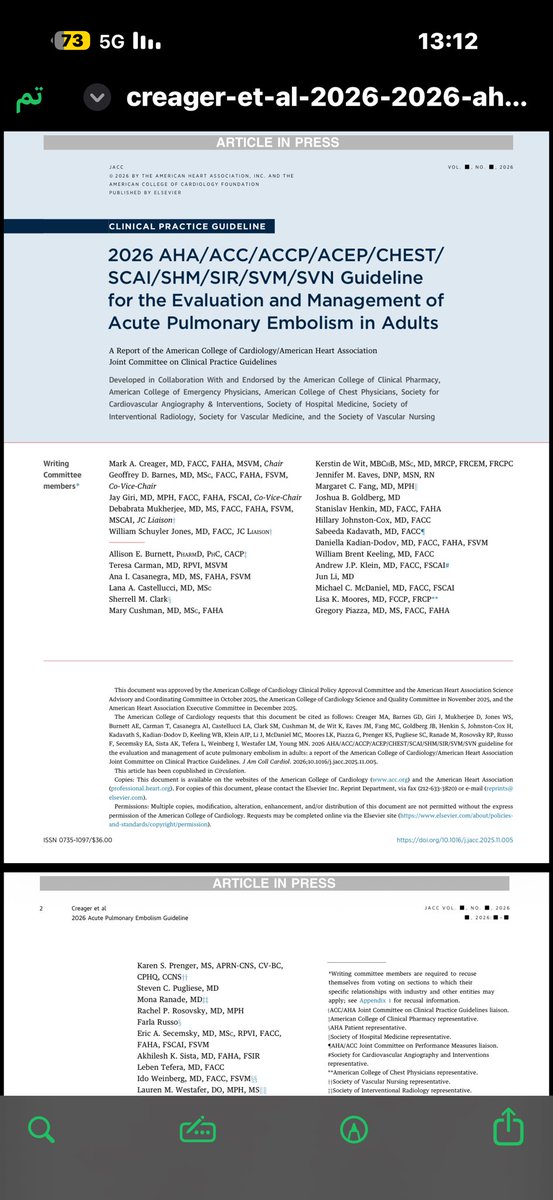
2/ ⭐️ Use d-dimer and CTA in pts with high diagnostic suspicion to rule out PE.
⭐️ CTA is optimal diagnostic test.
⭐️ Quantitatively report RV:LV ratio with all PE CTA
⭐️ Specific reccs for TTE performance & reporting also included.